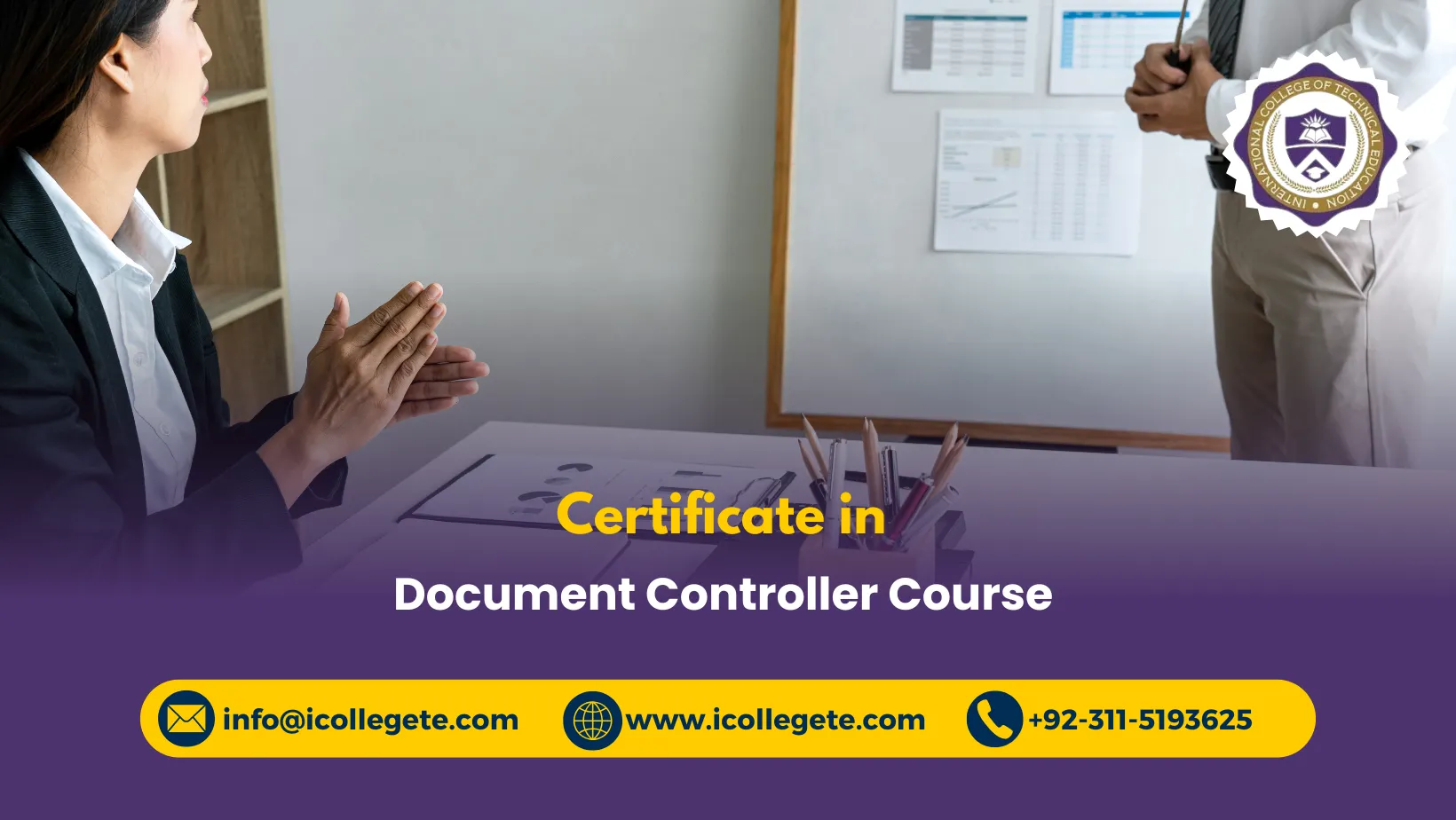
The Document Controller Course in Swat is designed to develop practical knowledge and professional skills required to manage, organise, control, track, store, and retrieve documents effectively within modern workplaces. Document control is an essential business function across construction, engineering, manufacturing, healthcare, oil and gas, infrastructure, education, and corporate environments, where accurate and accessible documentation supports operational efficiency, quality assurance, compliance, and project delivery.
This course provides learners with a structured understanding of document control principles, filing systems, record-keeping techniques, digital archiving, document management software, compliance requirements, quality assurance, document tracking, and version control. Learners also develop practical skills for handling document registers, revisions, approvals, distribution, retention, and secure document storage.
The Document Controller Course in Swat combines theoretical knowledge with practical training and project-based activities to help learners understand how professional document control systems operate in real workplace environments. The course is suitable for individuals beginning a career in document control as well as existing administrative, project, engineering, quality, and office personnel seeking to strengthen their documentation skills.
Course Study Units
Unit 1: Fundamentals of Document Control and Management
- Introduction to document control and document management
- Roles and responsibilities of a document controller
- Types of business, technical, project, and quality documents
- Document control procedures and workflows
- Document identification and numbering systems
- Document creation, review, approval, and distribution
- Document registers and master document lists
- Confidentiality, security, and controlled access
- Document retention and disposal principles
Unit 2: Filing Systems and Record-Keeping Techniques
- Principles of effective filing systems
- Physical and electronic filing structures
- Alphabetical, numerical, chronological, and subject-based filing
- Records classification and indexing
- Document retrieval techniques
- Record retention and disposal procedures
- Maintaining accurate registers and logs
- Storage, protection, and preservation of records
- Preventing document loss, duplication, and misfiling
Unit 3: Digital Archiving and Document Management Software
- Fundamentals of digital document management
- Electronic document storage and archiving
- Folder structures and naming conventions
- Document management platforms and software
- Digital document indexing and metadata
- Search and retrieval techniques
- Access permissions and user controls
- Digital backups and information security
- Scanning and digitisation of physical records
- Managing electronic workflows
Unit 4: Compliance Standards and Quality Assurance
- Importance of document control in quality management
- Understanding organisational policies and procedures
- Compliance documentation and audit requirements
- Document approval and authorisation processes
- Quality checks for controlled documents
- Maintaining accurate and complete records
- Document retention and traceability
- Supporting internal and external audits
- Corrective actions related to documentation
- Confidentiality and information governance principles
Unit 5: Document Tracking and Version Control
- Principles of document tracking
- Version and revision numbering
- Revision histories and change records
- Document status identification
- Tracking document submissions and approvals
- Transmittals and distribution records
- Managing superseded documents
- Preventing the use of obsolete information
- Document control registers
- Monitoring document workflows and deadlines
Unit 6: Practical Training and Project Work
- Developing a practical document control system
- Creating document registers and tracking logs
- Designing structured filing systems
- Applying document numbering conventions
- Managing document revisions
- Preparing document transmittals
- Practising document approval workflows
- Digital archiving exercises
- Conducting document control checks
- Completing a practical document management project
Learning Outcomes
By completing the Document Controller Course in Swat, learners should be able to:
- Explain the fundamental principles, functions, and responsibilities of professional document control.
- Identify different types of organisational, technical, project, and quality documentation.
- Develop structured physical and digital filing systems for efficient document management.
- Apply appropriate record-keeping, indexing, classification, and retrieval techniques.
- Explain the role of digital archiving and document management software in modern organisations.
- Apply appropriate document naming, numbering, metadata, storage, and retrieval practices.
- Maintain document registers, logs, transmittals, and distribution records.
- Apply version control and revision management procedures.
- Identify and manage obsolete, superseded, and uncontrolled documents.
- Support compliance, quality assurance, audit preparation, and document traceability.
- Apply confidentiality, access control, retention, and secure document-handling principles.
- Monitor document workflows, submissions, reviews, approvals, and distribution.
- Identify documentation errors and implement appropriate corrective actions.
- Develop practical document control procedures for workplace environments.
- Demonstrate document control skills through practical exercises and project work.
Course Benefits
The Document Controller Course in Swat provides several practical and professional benefits:
- Develops a strong foundation in professional document control.
- Builds practical filing and record-management skills.
- Improves understanding of document registers and document workflows.
- Develops digital archiving and electronic document management capabilities.
- Strengthens version control and revision management skills.
- Supports accurate document tracking and retrieval.
- Develops awareness of compliance and quality assurance requirements.
- Improves organisational, administrative, and coordination skills.
- Helps learners understand document control within project environments.
- Provides practical exposure through project-based activities.
- Supports career development in construction, engineering, administration, quality, and project management environments.
- Builds transferable skills applicable across multiple industries.
Who is This Course For?
The course is suitable for:
- Aspiring document controllers
- Junior document control personnel
- Administrative assistants
- Project administrators
- Project coordinators
- Engineering support staff
- Construction project support personnel
- Quality assurance and quality control personnel
- Records management staff
- Office administrators
- Information management personnel
- Technical documentation staff
- Professionals seeking document management skills
- Individuals planning a career in project documentation
Why Choose the Document Controller Course in Swat?
The Document Controller Course in Swat focuses on the practical skills required to manage documentation systematically in contemporary organisations. Rather than concentrating only on theoretical concepts, the course introduces learners to practical document workflows, filing structures, document registers, digital archiving, version control, tracking systems, and quality documentation.
The course also provides knowledge applicable to a wide range of industries. Document controllers are commonly required wherever organisations manage large volumes of technical, commercial, operational, project, or compliance documentation.
Another key advantage is the focus on digital document management. Modern workplaces increasingly rely on electronic records, cloud-based platforms, document management systems, controlled access, digital approvals, and electronic archiving. Understanding these processes can help learners adapt to technology-driven documentation environments.
Practical training and project work further allow learners to apply document control principles in realistic workplace scenarios, helping bridge the gap between classroom learning and professional responsibilities.
Future Progression
After completing the Document Controller Course in Swat, learners can explore progression opportunities in document control, records management, project administration, quality documentation, and information management.
Potential career roles include:
- Document Controller
- Junior Document Controller
- Project Document Controller
- Technical Document Controller
- Records Administrator
- Documentation Assistant
- Project Administrator
- Document Management Assistant
- Quality Documentation Assistant
- Information Management Assistant
With additional professional experience and relevant qualifications, learners may progress towards roles such as Senior Document Controller, Document Control Coordinator, Document Control Supervisor, Project Information Coordinator, or Document Control Manager.
Take the Next Step Document Controller Course – Enroll Now