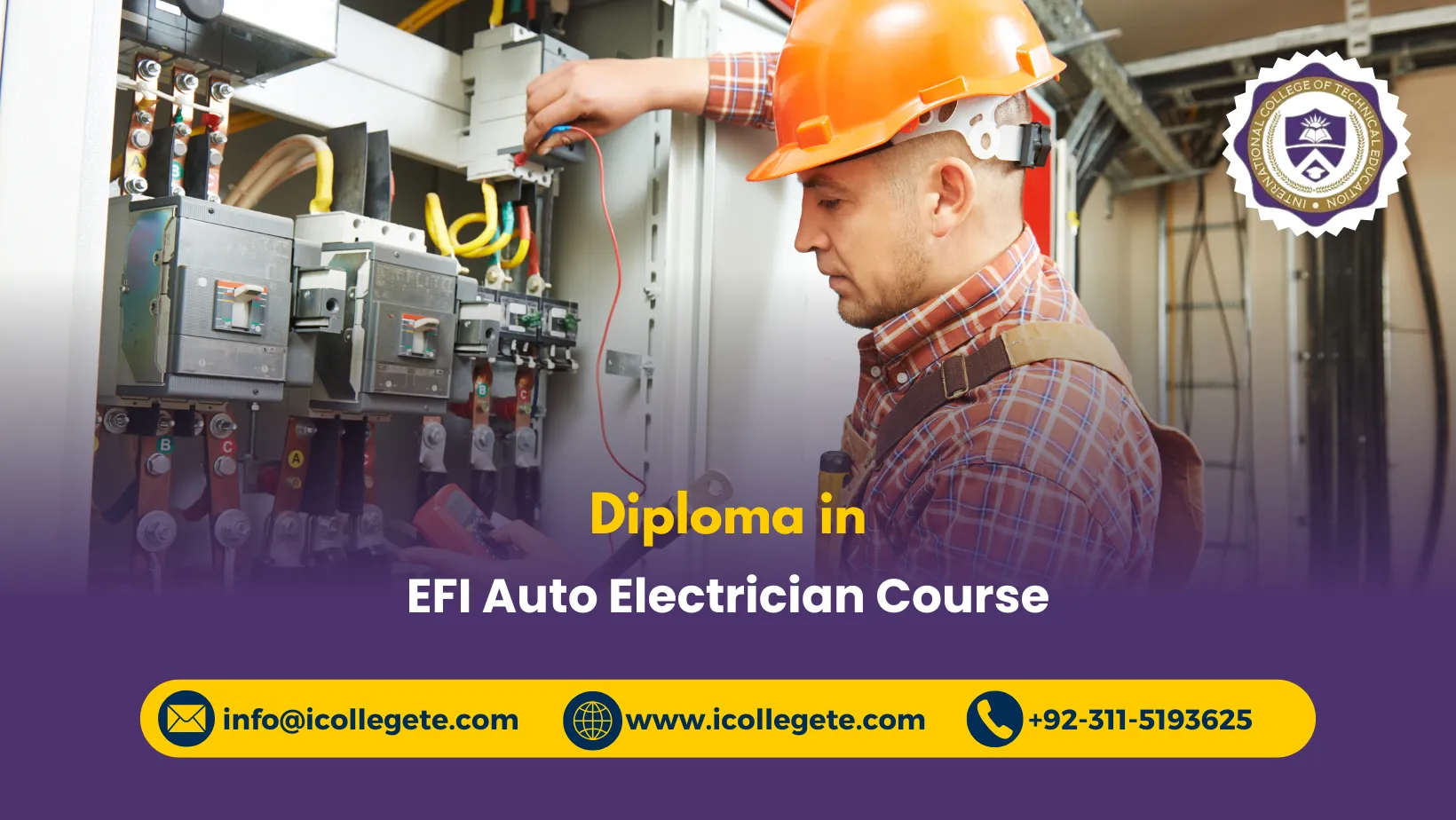
The Diploma in EFI Auto Electrician Course in Swabi is a practical, career-focused technical programme designed to develop the knowledge and hands-on skills required to diagnose, maintain, repair, and service modern automotive electrical and Electronic Fuel Injection (EFI) systems. As vehicles increasingly rely on electronic control units, sensors, actuators, computerised diagnostics, and advanced electrical circuits, skilled auto electricians are in growing demand across automotive workshops, service centres, dealerships, and vehicle maintenance businesses.
This diploma provides structured learning in EFI systems, automotive electrical fundamentals, diagnostic tools, sensors and actuators, ECU programming, vehicle wiring, circuit design, fault diagnosis, maintenance, and practical automotive applications. Learners develop the ability to understand how electrical and electronic components interact with engine management systems and how diagnostic equipment can be used to identify faults accurately.
The course combines theoretical knowledge with practical problem-solving to help learners build workplace-ready automotive skills. Students learn how to inspect electrical circuits, interpret wiring diagrams, test components, identify EFI faults, perform diagnostic procedures, and apply appropriate repair and maintenance techniques.
The Diploma in EFI Auto Electrician Course in Swabi is suitable for aspiring auto electricians, automotive technicians, workshop assistants, mechanics, vehicle enthusiasts, and individuals seeking professional skills for employment or self-employment in the automotive sector.
Course Study Units
Study Unit 1: Introduction to EFI Systems
This unit introduces learners to Electronic Fuel Injection (EFI) technology and its role in modern vehicle engine management. Learners explore the basic operating principles of EFI systems and understand how electronic control improves fuel delivery, engine performance, fuel efficiency, and emission control.
Key Topics
- Introduction to Electronic Fuel Injection
- Development of automotive fuel systems
- EFI system components
- Fuel injection principles
- Electronic engine management
- Fuel delivery and injection control
- Basic EFI operating cycles
- EFI system advantages
- Electronic engine control
- Basic EFI safety practices
- Common EFI system faults
- Introduction to diagnostic procedures
Study Unit 2: Tools and Equipment for Auto Electricians
This unit develops learners’ ability to identify and safely use the tools and equipment required for automotive electrical and EFI work. Emphasis is placed on correct tool selection, electrical testing, diagnostic equipment, workshop safety, and equipment maintenance.
Key Topics
- Automotive electrical hand tools
- Digital multimeters
- Test lamps
- Battery testers
- Circuit testers
- OBD diagnostic scanners
- Oscilloscopes
- Automotive diagnostic equipment
- Wire crimping and stripping tools
- Soldering equipment
- Electrical connectors
- Workshop safety equipment
- Tool inspection and maintenance
- Safe use of electrical testing equipment
Study Unit 3: Fundamentals of Automotive Electrical Systems
Learners develop a strong foundation in automotive electricity and electrical systems. The unit explains how electrical energy is generated, stored, distributed, controlled, and consumed within modern vehicles.
Key Topics
- Basic electrical principles
- Voltage, current and resistance
- Ohm’s Law
- Automotive batteries
- Alternators and charging systems
- Starter motors
- Fuses and relays
- Switches and electrical loads
- Grounding systems
- Electrical connectors
- Automotive wiring
- Series and parallel circuits
- Voltage-drop testing
- Basic circuit testing
- Electrical safety
Study Unit 4: Sensors and Actuators in EFI Systems
This unit focuses on the sensors and actuators that allow an EFI system to monitor engine conditions and control vehicle operation. Learners explore how sensor signals are generated, interpreted, and used by the ECU.
Key Topics
- Role of sensors in EFI
- Engine coolant temperature sensors
- Throttle position sensors
- Mass airflow sensors
- Manifold absolute pressure sensors
- Oxygen sensors
- Crankshaft position sensors
- Camshaft position sensors
- Vehicle speed sensors
- Knock sensors
- Fuel injectors
- Idle control systems
- Electronic throttle systems
- Actuator operation
- Sensor testing and diagnosis
Study Unit 5: ECU Programming and Diagnostics
This unit introduces learners to Electronic Control Units (ECUs) and computer-based vehicle diagnostics. Learners understand how the ECU receives information from sensors, processes data, and controls different vehicle systems.
Key Topics
- Introduction to automotive ECUs
- ECU functions and architecture
- Engine control strategies
- Diagnostic trouble codes
- OBD and OBD-II systems
- Diagnostic scan tools
- Live data interpretation
- ECU communication
- Fault-code analysis
- ECU resetting procedures
- ECU programming fundamentals
- Software and calibration concepts
- Diagnostic data analysis
- Safe ECU diagnostic practices
Study Unit 6: Wiring and Circuit Design in Modern Vehicles
Learners develop the skills needed to understand, inspect, test, and repair automotive wiring and electrical circuits. The unit introduces wiring diagrams and modern vehicle communication systems.
Key Topics
- Automotive wiring systems
- Wiring diagrams
- Circuit symbols
- Wire identification
- Connectors and terminals
- Fuse and relay circuits
- Ground circuits
- Power supply circuits
- Signal circuits
- Voltage and continuity testing
- Circuit protection
- Wiring fault identification
- Harness inspection and repair
- Basic circuit design
- Introduction to CAN communication systems
Study Unit 7: Troubleshooting EFI and Electrical Faults
This unit develops systematic fault-finding and diagnostic skills. Learners learn how to move from customer complaints and symptoms to accurate diagnosis and appropriate corrective action.
Key Topics
- Automotive fault diagnosis
- Diagnostic procedures
- Fault symptoms and causes
- No-start conditions
- Hard-start problems
- Engine misfires
- Poor acceleration
- Excessive fuel consumption
- Sensor-related faults
- Actuator-related faults
- Wiring faults
- Battery and charging faults
- Short circuits and open circuits
- Diagnostic trouble codes
- Testing and confirmation of repairs
- Preventing repeat faults
Study Unit 8: Maintenance and Servicing Techniques
This unit develops practical knowledge of preventive maintenance and servicing for automotive electrical and EFI systems. Learners understand how regular inspection and maintenance can improve vehicle reliability and reduce electrical and electronic failures.
Key Topics
- Automotive electrical inspection
- Battery inspection and maintenance
- Charging-system checks
- Starter-system inspection
- EFI system servicing
- Sensor inspection
- Injector maintenance
- Wiring and connector inspection
- ECU diagnostic checks
- Cleaning electrical connections
- Preventive maintenance procedures
- Workshop documentation
- Service records
- Safe servicing practices
- Quality control during repairs
Study Unit 9: Final Project and Practical Applications
The final unit enables learners to integrate the knowledge and skills developed throughout the diploma into practical automotive tasks. Learners undertake a supervised project involving diagnosis, testing, repair, servicing, or improvement of an EFI and automotive electrical system.
Practical Activities
- Vehicle electrical system inspection
- EFI diagnostic assessment
- Fault-code identification
- Sensor testing
- Actuator testing
- Wiring diagnosis
- Battery and charging-system testing
- ECU diagnostic procedures
- Fault-finding project
- Electrical repair activities
- Preventive maintenance
- Final practical assessment
- Technical project documentation
Learning Outcomes
After successfully completing the Diploma in EFI Auto Electrician Course in Swabi, learners should be able to:
- Explain the operating principles and applications of Electronic Fuel Injection systems.
- Identify major automotive electrical and EFI components.
- Select and safely use tools and diagnostic equipment for automotive electrical work.
- Apply fundamental electrical principles to automotive systems.
- Test voltage, current, resistance, continuity, and voltage drop.
- Explain the functions of automotive sensors and actuators.
- Diagnose common sensor and actuator faults.
- Explain the purpose and operation of automotive ECUs.
- Use diagnostic scanners and interpret diagnostic trouble codes.
- Interpret automotive wiring diagrams and circuit information.
- Identify open circuits, short circuits, poor connections, and grounding faults.
- Diagnose common EFI performance and starting problems.
- Apply systematic automotive fault-finding procedures.
- Carry out basic maintenance and servicing of EFI and electrical systems.
- Apply appropriate workshop safety and electrical safety practices.
- Document diagnostic findings, repairs, and servicing activities.
- Complete practical automotive electrical and EFI diagnostic tasks.
- Demonstrate professional problem-solving skills in an automotive workshop environment.
Course Benefits
The Diploma in EFI Auto Electrician Course in Swabi offers several practical and professional benefits:
1. Develop Modern Automotive Skills
Gain knowledge of EFI, automotive electronics, sensors, actuators, ECUs, and vehicle diagnostics.
2. Practical Diagnostic Training
Develop practical experience with automotive electrical testing and diagnostic procedures.
3. Understand Modern Vehicle Technology
Learn how electronic systems influence engine performance, fuel efficiency, starting, charging, and vehicle operation.
4. Improve Employability
Build technical skills relevant to automotive workshops, service centres, dealerships, and vehicle maintenance businesses.
5. Develop Fault-Finding Skills
Learn systematic methods for identifying electrical, electronic, wiring, EFI, and sensor-related faults.
6. Support Self-Employment
The skills gained can provide a foundation for establishing or expanding an automotive electrical and EFI repair service.
7. Build Professional Confidence
Practical exercises and project-based learning help learners become more confident when working with automotive electrical systems.
8. Work with Diagnostic Technology
Develop familiarity with scan tools, multimeters, electrical testing equipment, and modern automotive diagnostic technology.
Who Is This Course For?
The diploma is suitable for:
- Aspiring auto electricians
- Automotive electrical technicians
- Vehicle mechanics
- Automotive workshop assistants
- EFI technicians
- Automotive engineering learners
- Vehicle diagnostic technicians
- Workshop employees
- Automotive service professionals
- Vehicle maintenance workers
- Individuals interested in automotive electronics
- Entrepreneurs planning an auto electrical workshop
- Students seeking practical automotive technical skills
- Professionals wanting to update their automotive electrical knowledge
The course can be particularly valuable for learners in Swabi and surrounding areas who want practical training related to modern vehicle electrical and EFI technology.
Why Choose the Diploma in EFI Auto Electrician Course in Swabi?
Industry-Relevant Automotive Technology
Modern vehicles increasingly depend on electronic systems. This course focuses on technologies that are directly relevant to contemporary automotive electrical and engine-management work.
Strong EFI and Diagnostic Focus
Rather than concentrating only on traditional mechanical repairs, learners develop knowledge of EFI systems, ECUs, sensors, actuators, diagnostic scanners, wiring, and electronic fault diagnosis.
Practical Learning Approach
The course is designed around practical applications so learners can connect theoretical electrical principles with real automotive diagnostic and servicing situations.
Comprehensive Curriculum
The study units cover the complete learning journey from automotive electrical fundamentals through EFI diagnostics, wiring, troubleshooting, maintenance, and a final practical project.
Career-Oriented Skills
Learners develop technical competencies that can support employment and professional development within automotive workshops, garages, service centres, and vehicle maintenance environments.
Suitable for Different Experience Levels
The structured curriculum can provide a foundation for beginners while also helping existing mechanics and automotive workers develop modern electrical and EFI diagnostic skills.
Local Learning Opportunity
For learners searching for an EFI auto electrician diploma in Swabi, the programme provides a focused pathway for developing specialist automotive electrical knowledge without limiting learning to traditional vehicle repair techniques.
Future Progression of the Course
After completing the Diploma in EFI Auto Electrician Course in Swabi, learners can continue developing their technical and professional capabilities through advanced automotive training and workplace experience.
Automotive Electrical Specialisation
Learners may develop further expertise in advanced automotive electrical systems, electronic control systems, vehicle networking, and computerised diagnostics.
Advanced EFI Diagnostics
Further training can focus on advanced engine-management diagnostics, ECU fault diagnosis, sensor signal analysis, fuel injection systems, and complex vehicle troubleshooting.
Automotive Diagnostic Technician
With additional practical experience and specialist training, learners may work towards roles involving computerised vehicle diagnostics and advanced fault-finding.
Hybrid and Electric Vehicle Technology
Learners can expand their knowledge into hybrid and electric vehicle systems, including high-voltage safety, electric powertrains, battery systems, charging systems, and electronic vehicle controls.
Workshop Career Development
The qualification can support progression from junior workshop roles towards positions such as Auto Electrician, EFI Technician, Automotive Electrical Technician, Diagnostic Technician, or Workshop Technician, depending on experience and additional qualifications.
Self-Employment
Experienced learners may use their technical knowledge as a foundation for establishing an automotive electrical, EFI diagnostics, or vehicle maintenance business, subject to local business, safety, and professional requirements.
Continuous Professional Development
Automotive technology continues to evolve, making ongoing professional development important. Learners can continue updating their skills in automotive electronics, diagnostic software, vehicle communication networks, advanced driver assistance systems, hybrid vehicles, and electric vehicles.
Career Opportunities
Successful learners may explore opportunities such as:
- Auto Electrician
- EFI Technician
- Automotive Electrical Technician
- Automotive Diagnostic Technician
- Vehicle Electrical Technician
- EFI Diagnostic Assistant
- Automotive Workshop Technician
- Vehicle Maintenance Technician
- Automotive Service Technician
- Electrical Workshop Assistant
- Automotive Electronics Technician
Career progression will depend on practical competence, workplace experience, additional training, employer requirements, and relevant local regulations.
Take the Next Step Toward World EFI Auto Electrician Course-Enroll Now