QA/QC Piping: Complete Guide to Piping Inspection, Quality Control, Skills and Career Opportunities
QA/QC Piping is an essential part of industrial construction, oil and gas projects, petrochemical plants, power generation facilities and manufacturing operations. It helps ensure that piping systems are installed, inspected and tested according to approved engineering drawings, project specifications, applicable codes and quality requirements.
A piping system may transport water, steam, fuel, chemicals, compressed air or other process fluids. Poor material selection, defective welding, incorrect installation or inadequate testing can lead to leakage, equipment damage, production interruptions and serious safety risks. Quality assurance and quality control help organisations identify potential problems, verify compliance and maintain reliable piping systems throughout construction and commissioning.
For learners and professionals interested in mechanical inspection, understanding QA/QC Piping can provide a foundation for developing practical knowledge of piping materials, welding inspection, non-destructive testing, pressure testing, technical documentation and quality management.
This complete guide explains what QA/QC Piping means, how piping inspection works, which standards may apply, what skills inspectors need and how individuals can prepare for career opportunities in Pakistan and international industrial markets.
What is QA/QC Piping?
QA/QC Piping refers to the quality assurance and quality control activities used to verify that piping materials, fabrication, welding, installation, inspection and testing meet specified quality requirements.
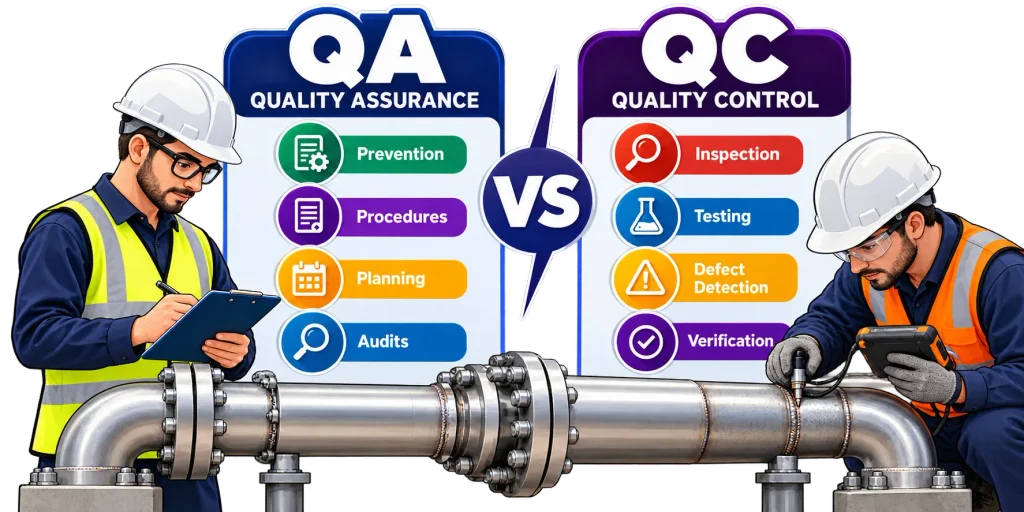
Quality assurance focuses on the processes used to prevent defects, while quality control involves inspecting, measuring, examining and testing work to determine whether it meets the acceptance criteria.
The two functions work together to support safe, reliable and compliant piping systems.
What is Quality Assurance in Piping?
Quality assurance (QA) is a planned and systematic approach to preventing quality problems. It establishes the procedures, responsibilities, documentation and controls required before and during piping construction.
Typical QA activities include:
- Preparing and reviewing quality plans.
- Establishing inspection and test requirements.
- Approving applicable procedures and documentation.
- Verifying personnel qualifications where required.
- Managing document control and traceability.
- Conducting quality audits and monitoring corrective actions.
What is Quality Control in Piping?
Quality control (QC) involves checking actual work against approved requirements. It helps identify non-conformities before they affect subsequent activities or the completed installation.
Typical QC activities include:
- Inspecting incoming pipes, fittings, flanges and valves.
- Checking dimensions and material identification.
- Monitoring piping fit-up and welding.
- Reviewing applicable non-destructive testing results.
- Verifying pressure testing and reinstatement records.
- Recording inspection findings and managing non-conformance reports.
Difference Between QA and QC in Piping
| Quality Assurance (QA) | Quality Control (QC) |
|---|---|
| Focuses on preventing defects | Focuses on detecting non-conformities |
| Establishes procedures and processes | Checks work against requirements |
| Includes audits and quality planning | Includes inspection and testing |
| Reviews the effectiveness of quality systems | Verifies product and installation quality |
| Supports consistent project execution | Confirms compliance at defined inspection stages |
Both functions are necessary. A well-designed quality system cannot guarantee that every installation is defect-free, and inspection alone cannot replace effective planning and process control.
Why is QA/QC Piping Important?
QA/QC Piping helps protect personnel, equipment, facilities and the environment by verifying that piping work meets applicable requirements.
Its importance extends beyond passing an inspection. Reliable piping systems support safe operations, reduce avoidable rework and provide documented evidence that construction activities have been completed correctly.
Key benefits include:
- Safety: Helps identify defects that could contribute to leakage, pressure failure or other hazardous events.
- Regulatory and code compliance: Supports conformity with applicable regulations, engineering codes and project specifications.
- Material verification: Helps prevent the use of incorrect or unsuitable materials.
- Welding quality: Identifies workmanship issues and verifies required examinations.
- Cost control: Reduces avoidable rework, material waste and delays caused by preventable defects.
- Operational reliability: Supports dependable piping performance during service.
- Traceability: Maintains records linking materials, welds, inspections and tests.
- Project acceptance: Provides evidence required for completion, handover and client review.
For example, if a pipe fitting has an incorrect material grade, incoming inspection may identify the discrepancy before installation. Correcting the issue at this stage is generally more practical than discovering it after welding, testing or commissioning.
Where is QA/QC Piping Used?
QA/QC Piping is relevant wherever industrial piping systems must meet defined technical, operational and safety requirements.
| Industry | Typical piping applications | Quality priorities |
|---|---|---|
| Oil and gas | Production facilities, refineries and gas processing | Material suitability, welding, examination and pressure integrity |
| Petrochemical | Chemical processing and transfer systems | Material compatibility, process conditions and leak prevention |
| Power generation | Steam, cooling water and auxiliary piping | Applicable code compliance, installation and testing |
| Pharmaceutical | Process and utility piping | Cleanliness, material traceability and project-specific hygiene requirements |
| Water treatment | Water distribution and treatment plants | Corrosion protection, joints and leakage control |
| Manufacturing | Industrial process and utility systems | Dimensional accuracy, reliability and documentation |
| Marine and offshore | Shipboard and offshore piping | Applicable marine, classification and project requirements |
The inspection scope differs between industries. For example, pharmaceutical process piping may require specific cleanliness and contamination controls, whereas high-pressure industrial piping may place greater emphasis on pressure integrity and applicable examination requirements.
What Does a QA/QC Piping Inspector Do?
A QA/QC Piping Inspector checks whether piping materials, fabrication and installation comply with approved drawings, project specifications, inspection plans and applicable codes.
The exact responsibilities depend on the project stage, contract, inspection authority and the inspector’s qualifications.
Main Responsibilities of a QA/QC Piping Inspector
A QA/QC Piping Inspector is responsible for verifying that piping materials, fabrication, welding, installation and testing comply with approved drawings, project specifications and applicable codes. The role involves coordinating inspections, identifying defects, reviewing technical documents and maintaining quality records throughout the project lifecycle.
1. Review Drawings and Specifications
Reviewing technical documents helps the inspector understand the required piping configuration, material specifications, dimensions and inspection stages before work begins. This ensures that inspection activities follow the latest approved project requirements.
Common documents reviewed include:
- Piping and Instrumentation Diagrams (P&IDs).
- Piping isometric and general arrangement drawings.
- Piping material specifications.
- Inspection and Test Plans (ITPs).
- Welding procedures and relevant qualification records.
- Project specifications and applicable technical codes.
2. Inspect Incoming Materials
Material inspection verifies that delivered pipes, fittings, flanges and valves meet the specified requirements before installation. Inspectors check identification, documentation and physical condition to help prevent incorrect or damaged materials from entering the construction process.
Key inspection activities include:
- Verifying pipe sizes, schedules and material grades.
- Checking heat numbers, markings and traceability.
- Reviewing material test certificates.
- Inspecting materials for visible damage or deterioration.
- Checking storage and handling conditions.
- Verifying positive material identification or additional testing when required.
3. Monitor Piping Fit-Up
Piping fit-up inspection takes place before welding to confirm that components are correctly prepared and positioned. Proper fit-up helps reduce welding defects, dimensional problems and unnecessary rework.
The inspector typically verifies:
- Joint alignment and preparation.
- Root gap and bevel geometry.
- Pipe orientation and dimensions.
- Cleanliness of joint surfaces.
- Correct material identification.
- Compliance with approved drawings and welding documentation.
4. Monitor Welding Activities
Welding inspection helps confirm that piping joints are produced according to approved welding procedures and specified quality requirements. The inspector monitors relevant welding controls and ensures that required inspection records are maintained.
Depending on the project, responsibilities may include:
- Checking welder qualification records.
- Verifying welding consumable identification and handling.
- Monitoring preheat and interpass temperatures where required.
- Checking compliance with the approved Welding Procedure Specification (WPS).
- Verifying weld identification and traceability.
- Confirming completion of required visual and other specified inspections.
5. Verify Non-Destructive Testing
Non-Destructive Testing (NDT) is used to examine welds and materials without causing unacceptable damage to the components. The inspector verifies that required examinations are completed using approved methods and that the results meet the applicable acceptance criteria.
Typical responsibilities include:
- Confirming required NDT coverage and examination methods.
- Checking relevant personnel qualifications.
- Reviewing radiographic, ultrasonic and other applicable examination reports.
- Verifying that reported indications are assessed against specified criteria.
- Ensuring rejected welds are addressed through approved repair and re-examination procedures.
6. Check Installation and Testing
Installation inspection confirms that piping systems are assembled according to approved drawings and project requirements. The inspector also verifies required pressure or leak testing before the system progresses to subsequent stages.
Important checks include:
- Piping routing, alignment and dimensions.
- Pipe supports and equipment connections.
- Flange alignment, gaskets and bolting arrangements.
- Valve orientation and accessibility.
- Pressure or leak test preparation and documentation.
- Verification of test results against approved acceptance criteria.
7. Maintain Quality Documentation
Quality documentation provides evidence that inspection activities have been completed and that identified issues have been addressed. Accurate records support technical reviews, audits, client acceptance and final project handover.
The inspector may be responsible for:
- Preparing and maintaining inspection reports.
- Updating material and weld traceability records.
- Reviewing test packages and NDT reports.
- Recording non-conformance reports (NCRs).
- Tracking corrective actions and re-inspection results.
- Organising quality records for final handover.
By carrying out these responsibilities systematically, a QA/QC Piping Inspector helps maintain piping quality, reduce avoidable construction defects and ensure that completed work meets the applicable project requirements.
What is the QA/QC Piping Inspection Process?
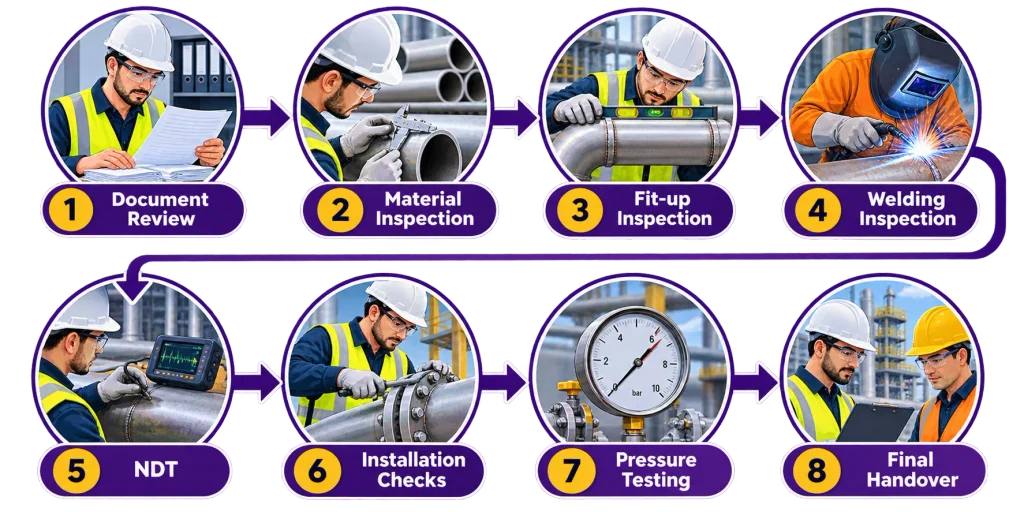
Piping inspection normally follows a planned sequence defined by the project quality system and inspection and test plan. The following stages provide a general overview; actual requirements vary according to the piping service and governing documents.
Step 1: Review Project Documents
Identify the applicable drawings, material specifications, inspection procedures, codes and acceptance criteria before inspection begins.
Step 2: Inspect Materials
Check materials against approved documentation and confirm that required identification and traceability are maintained.
Step 3: Verify Fit-Up
Inspect joint preparation, alignment, dimensions and cleanliness before welding.
Step 4: Monitor Welding
Confirm compliance with the approved welding procedure and applicable controls. Record weld identification and required inspection results.
Step 5: Complete Visual Inspection
Examine accessible weld surfaces and piping components for visible defects, dimensional issues and other non-conformities.
Step 6: Conduct Required NDT
Verify that specified examinations, such as radiographic or ultrasonic testing, have been performed and accepted in accordance with the governing requirements.
Step 7: Inspect Piping Installation
Check routing, supports, orientation, connections and other installation requirements against approved drawings.
Step 8: Verify Pressure or Leak Testing
Review the approved test procedure, test boundaries, instruments, safety precautions, test results and records. Confirm that required acceptance criteria have been satisfied.
Step 9: Review Final Documentation
Check that inspection records, material certificates, weld records, test reports and outstanding corrective actions are complete.
Step 10: Support Handover
Confirm that required quality records and close-out documents are submitted and that outstanding issues are addressed according to the project’s handover procedure.
QA/QC Piping Inspection Checklist
A piping inspection checklist helps organise inspection activities and maintain consistent records. The following is a general reference, not a substitute for an approved project-specific checklist.
| Inspection stage | Key checks |
|---|---|
| Material receiving | Grade, size, markings, certificates and damage |
| Storage and handling | Protection, segregation and preservation |
| Fit-up | Alignment, joint preparation, dimensions and cleanliness |
| Welding | Procedure compliance, welder identification and required controls |
| Visual inspection | Visible weld condition and specified dimensional checks |
| NDT | Required examination, reports and acceptance status |
| Installation | Routing, supports, valves and equipment connections |
| Flanges and bolting | Alignment, gasket requirements and approved tightening method |
| Pressure testing | Approved procedure, test boundaries, instruments and results |
| Final documentation | Traceability, reports, non-conformance close-out and handover records |
Each inspection point should identify the applicable requirement, inspection result, responsible person and required evidence where specified.
What is an Inspection and Test Plan (ITP) in Piping?
An Inspection and Test Plan (ITP) is a controlled document that identifies inspection and testing activities, responsibilities, acceptance criteria, required records and inspection stages for defined work.
It helps the project team coordinate inspections and establish when activities can proceed.
An ITP may include the following information:
- Activity or work stage.
- Applicable procedure, drawing or specification.
- Inspection and test method.
- Acceptance criteria.
- Responsible inspection personnel.
- Required records.
- Hold points, witness points and review points where applicable.
A hold point generally requires a defined approval before the work proceeds. A witness point identifies an opportunity for a designated party to witness an activity under the agreed inspection arrangements.
The precise meaning and release requirements should follow the project’s approved procedures and contract.
What is Welding Inspection in QA/QC Piping?
Welding inspection verifies that piping welds are produced and examined according to approved welding procedures and specified acceptance criteria.
Weld quality is important because piping joints must withstand the service conditions for which the system has been designed.
Common Welding Inspection Activities
- Reviewing the applicable welding procedure specification (WPS).
- Verifying relevant welder qualification records.
- Checking joint preparation and fit-up.
- Confirming required preheat and interpass controls.
- Monitoring consumable identification and handling.
- Performing visual inspection at specified stages.
- Reviewing required NDT results.
- Verifying post-weld heat treatment when required.
- Recording weld identification and inspection status.
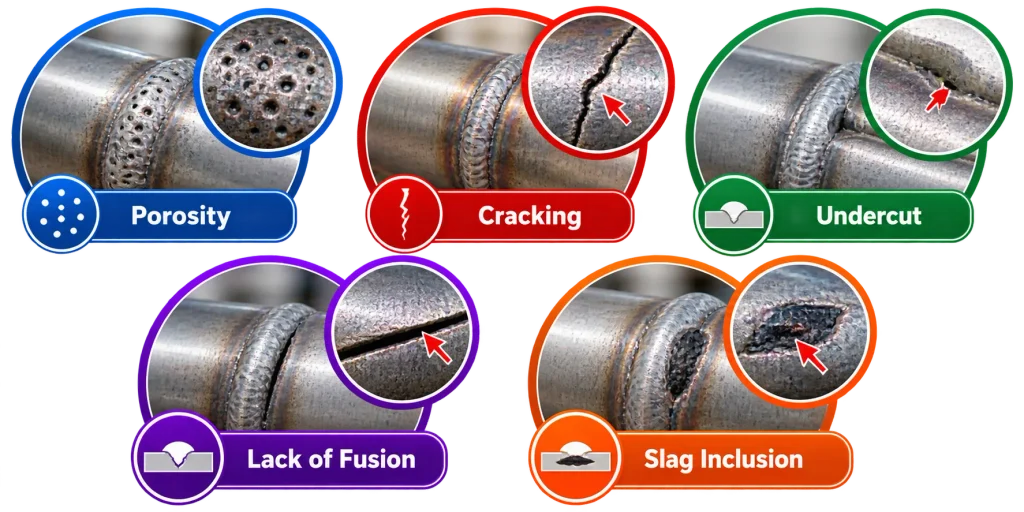
Common Piping Weld Defects
| Defect | General description |
|---|---|
| Porosity | Gas-related cavities within or on the weld |
| Lack of fusion | Incomplete bonding between weld metal and the base material or previous weld pass |
| Lack of penetration | Incomplete penetration where full penetration is required |
| Undercut | A groove formed at the weld toe or adjacent base material |
| Cracking | A fracture in the weld metal or heat-affected region |
| Slag inclusion | Non-metallic slag trapped within the weld |
| Excessive reinforcement | Weld reinforcement exceeding the applicable permitted limits |
Not every indication is automatically rejectable. Disposition depends on the governing code, specified acceptance criteria, defect characteristics and authorised engineering or inspection decisions.
What is Non-Destructive Testing (NDT) in Piping?
Non-destructive testing involves methods used to examine materials or components without causing unacceptable damage to their intended serviceability.
The required method depends on the material, component geometry, expected defect type, inspection purpose and project requirements.
| NDT method | Common abbreviation | General application |
|---|---|---|
| Visual testing | VT | Visible surface condition and workmanship |
| Radiographic testing | RT | Evaluating internal weld features using radiation-based imaging |
| Ultrasonic testing | UT | Detecting and evaluating internal discontinuities using sound waves |
| Magnetic particle testing | MT | Detecting surface and near-surface discontinuities in suitable ferromagnetic materials |
| Liquid penetrant testing | PT | Detecting surface-breaking discontinuities in suitable non-porous materials |
NDT must be carried out by personnel with the qualifications required by the applicable scheme, contract and project procedures. QA/QC personnel should understand the purpose of each method and how to verify the resulting reports.
What is Hydrostatic Testing in Piping?
Hydrostatic testing is a pressure test that uses a liquid, commonly water, to assess the pressure integrity of a piping system or defined test section under specified conditions.
The test procedure must establish the test pressure, boundaries, isolation arrangements, instrumentation, safety controls and acceptance criteria.
Typical QA/QC verification activities include:
- Reviewing the approved test package.
- Checking test boundaries and isolation points.
- Verifying instrument calibration status where required.
- Confirming that the system is prepared for testing.
- Checking applicable filling, venting and safety arrangements.
- Recording the required pressure and duration.
- Inspecting for leakage or other specified signs of failure.
- Reviewing test results and close-out records.
Hydrostatic testing must not be treated as a universal procedure. Test pressure, duration, test medium and acceptance requirements depend on the applicable code, design conditions and approved project documentation.
Pneumatic testing may be permitted in certain circumstances, but it involves different hazards and requires specifically approved controls.
Which Standards Are Used in QA/QC Piping?
Piping inspection requirements depend on the type of system, service conditions, location, contractual obligations and applicable regulations. No single standard covers every piping system or every inspection activity.
Important references may include:
ASME B31.3 — Process Piping
ASME B31.3 addresses process piping found in applications such as petroleum refineries, chemical plants, pharmaceutical facilities and other processing installations. Its scope includes materials, components, fabrication, assembly, erection, examination, inspection and testing.
ASME B31.1 — Power Piping
ASME B31.1 is relevant to specified power piping systems. Its applicability must be confirmed against the installation, project requirements and governing code framework.
ISO 9001 — Quality Management Systems
ISO 9001 provides requirements for establishing and improving a quality management system. It supports consistent processes, documented controls and continual improvement, but it is not a substitute for the technical piping code applicable to a project.
API 570 — Piping Inspection Code
API 570 concerns in-service inspection, rating, repair and alteration of piping systems within its scope. It is particularly relevant to piping integrity activities during operation and maintenance. It should not be confused with a complete construction inspection code.
How Should Inspectors Use Piping Standards?
QA/QC professionals should:
- Identify the code and edition specified by the contract or governing requirements.
- Review the relevant project specifications and approved procedures.
- Understand the applicable inspection and acceptance criteria.
- Confirm any required qualifications and authorisations.
- Record inspection evidence and report deviations through the approved process.
Always verify the applicable edition and project requirements. Standards can be revised, and different piping systems may be governed by different codes.
Essential Skills Required for a QA/QC Piping Inspector
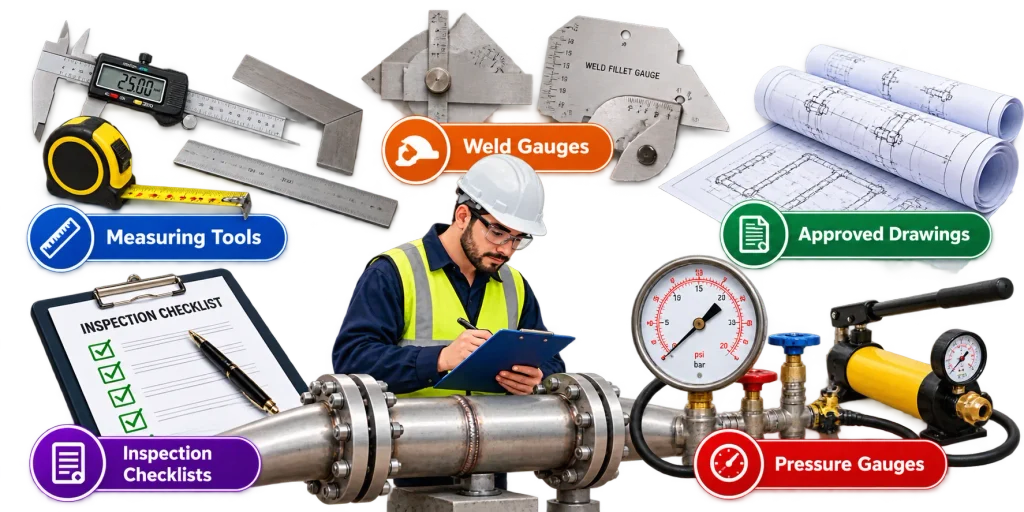
A QA/QC Piping Inspector needs a combination of technical knowledge, practical inspection abilities, documentation skills and professional judgement to verify piping quality. These competencies help inspectors identify defects, confirm compliance with approved drawings and specifications, and maintain accurate quality records throughout industrial projects. Strong communication and problem-solving skills are also important when coordinating with construction teams, engineers and other inspection personnel.
Technical Skills
Technical knowledge enables inspectors to evaluate piping materials, welding activities, installation work and testing results against applicable requirements. Essential technical skills include:
- Understanding piping materials, fittings, flanges and valves.
- Reading piping isometric drawings and Piping and Instrumentation Diagrams (P&IDs).
- Understanding welding terminology and Welding Procedure Specifications (WPS).
- Identifying common welding and installation defects.
- Following Inspection and Test Plans (ITPs).
- Reviewing Non-Destructive Testing (NDT) reports within the inspector’s authorised scope.
- Understanding pressure testing procedures and acceptance criteria.
- Maintaining material identification and weld traceability.
Documentation Skills
Accurate documentation is essential for demonstrating that piping work has been inspected according to project requirements. Inspectors must understand how to review, complete and maintain records that support quality verification, audits and final project handover.
Important documentation skills include:
- Preparing and reviewing inspection reports.
- Verifying material certificates and traceability records.
- Maintaining weld maps and inspection histories.
- Reviewing pressure testing packages and test reports.
- Recording non-conformities and corrective actions.
- Organising quality records for project completion and handover.
Communication and Problem-Solving Skills
QA/QC Piping Inspectors regularly coordinate with engineers, welding personnel, construction supervisors, NDT technicians, quality managers and client representatives. Effective communication helps ensure that inspection findings are understood, technical discrepancies are addressed and required corrective actions are completed before work proceeds.
Key professional skills include:
- Communicating inspection findings clearly and accurately.
- Identifying discrepancies between drawings and actual installations.
- Reporting defects through approved quality procedures.
- Coordinating inspections with relevant project teams.
- Supporting corrective action and verification activities.
- Applying sound judgement when evaluating inspection evidence against specified requirements.
Digital Skills
Digital tools are increasingly used to manage inspection records, track non-conformities and share project documentation. Familiarity with these systems can improve reporting accuracy, information retrieval and coordination across industrial projects.
Useful digital competencies include:
- Using spreadsheets to organise inspection data.
- Managing electronic quality records and reports.
- Accessing approved drawings through document management systems.
- Completing digital inspection forms and checklists.
- Tracking inspection status and outstanding corrective actions.
Developing these technical, documentation, communication and digital skills can help aspiring QA/QC Piping Inspectors prepare for workplace responsibilities and improve their readiness for opportunities in industrial construction, oil and gas, petrochemical and other piping-related sectors.
How to Become a QA/QC Piping Inspector
Individuals interested in piping inspection can follow a structured learning and development pathway. Requirements vary by employer, country, industry and project.
Step 1: Build a Technical Foundation
Develop knowledge of mechanical engineering fundamentals, industrial piping systems, engineering drawings, materials and basic quality management.
Relevant educational backgrounds may include mechanical engineering, mechanical technology, welding technology or related technical disciplines. Some entry-level opportunities may have different requirements.
Step 2: Learn Piping Inspection Principles
Study material verification, fit-up inspection, welding controls, NDT methods, pressure testing, inspection documentation and non-conformance management.
Practical examples help learners understand how these activities are applied on real projects.
Step 3: Understand Relevant Codes and Specifications
Learn how to identify applicable requirements and use approved documents to determine what must be inspected.
For example, ASME B31.3 may be relevant to process piping, while other systems may require different codes or standards.
Step 4: Complete Relevant Training
A QA/QC Piping course or piping inspection training programme may help learners develop structured technical knowledge.
Before enrolling, check the syllabus, practical content, assessment method, entry requirements, certificate status and recognition claims.
Step 5: Develop Practical Experience
Where available, supervised experience, workshop exposure, site visits or relevant mechanical work can help develop inspection skills.
Practical experience is particularly valuable for understanding construction sequences, inspection points, site coordination and quality records.
Step 6: Explore Relevant Qualifications
Some employers or projects require specific inspector certifications, technical qualifications or documented experience.
API 570 certification, for example, is associated with in-service piping inspection and has defined eligibility and examination requirements. It is not a universal entry requirement for every piping inspection role.
Learners should confirm the requirements of their target position before selecting a qualification.
QA/QC Piping Career Opportunities
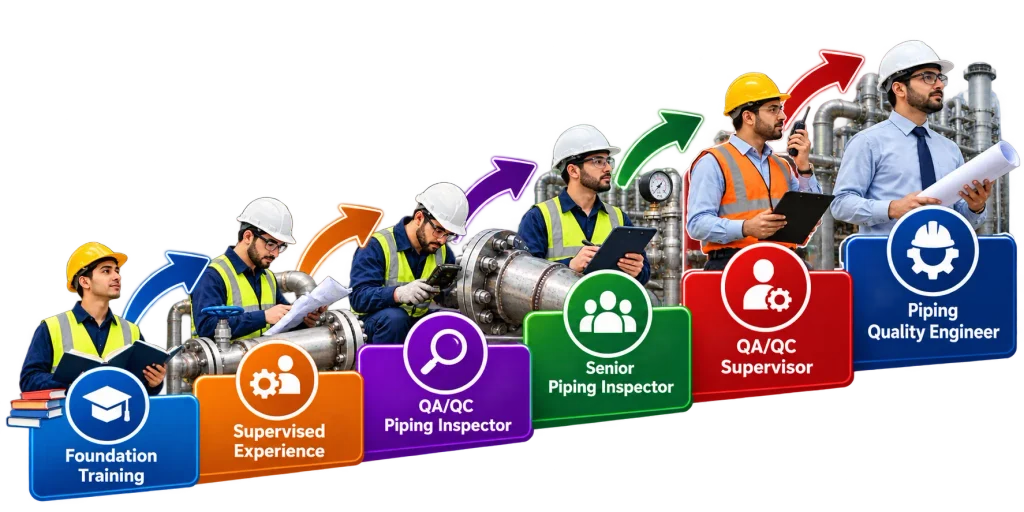
QA/QC Piping knowledge may support progression into several technical and quality-related roles. Job titles and responsibilities vary between employers.
| Career role | Main responsibilities |
|---|---|
| QA/QC Piping Inspector | Inspects piping materials, fabrication and installation |
| Piping QC Inspector | Performs defined quality control checks and maintains inspection records |
| Welding Inspector | Focuses on welding processes, workmanship and specified examinations |
| Mechanical QA/QC Engineer | Coordinates quality planning, inspection activities and technical documentation |
| Piping Quality Engineer | Supports quality systems, non-conformance resolution and improvement |
| NDT Technician | Performs approved non-destructive examinations within the required qualification scope |
| Piping QA/QC Supervisor | Coordinates inspection personnel, schedules and quality activities |
| In-Service Piping Inspector | Supports inspection and integrity activities for operating piping systems, subject to required competence |
These roles are not interchangeable. For example, an NDT Technician performs examinations within the scope of their qualification, while an inspector may review the results against project requirements.
Career progression depends on technical competence, relevant experience, required certifications, communication skills and employer expectations.
QA/QC Piping Jobs and Career Opportunities in Pakistan and International Markets
QA/QC Piping skills may be relevant to industrial projects in Pakistan and overseas, particularly where employers require personnel to verify piping fabrication, installation, testing and quality documentation.
Potential employment sectors include:
- Oil and gas facilities.
- Refineries and petrochemical plants.
- Power generation projects.
- Industrial construction and maintenance.
- Manufacturing and process plants.
- Offshore and marine projects, where relevant requirements are met.
In Pakistan, opportunities may be connected to industrial construction, energy infrastructure, manufacturing and maintenance contractors. International opportunities may arise in the Gulf region and other countries with active industrial and energy sectors.
However, employment availability changes with project activity, economic conditions, experience requirements and recruitment demand. A course certificate alone does not guarantee employment, overseas placement or a particular salary.
How Can Candidates Improve Their Employability?
Candidates can strengthen their professional profile by developing:
- Practical knowledge of piping drawings and inspection documentation.
- Understanding of material identification and traceability.
- Familiarity with welding inspection and NDT reporting.
- Knowledge of relevant codes and project specifications.
- Accurate reporting and professional communication.
- Appropriate technical qualifications and documented experience.
- Awareness of site safety and quality procedures.
When applying for jobs, candidates should match their CV to the advertised role and describe their actual qualifications and experience accurately.
Common QA/QC Piping Mistakes and How to Prevent Them
Many quality problems can be reduced through effective planning, inspection and document control.
| Common mistake | Prevention approach |
|---|---|
| Using incorrect materials | Verify material identification and documentation before installation |
| Skipping fit-up checks | Complete required inspections before welding |
| Using outdated drawings | Confirm the current approved revision |
| Poor weld traceability | Maintain weld identification and associated records |
| Missing required NDT | Follow the approved ITP and examination requirements |
| Incorrect flange alignment | Verify alignment and assembly requirements before final tightening |
| Inadequate test preparation | Review the approved test package and safety arrangements |
| Incomplete quality records | Update inspection reports and close-out documentation promptly |
| Accepting work without evidence | Verify results against specified acceptance criteria |
Quality problems should be addressed through the approved reporting, corrective action and verification process. Informal acceptance should never replace required inspection or authorisation.
Future Trends in QA/QC Piping
QA/QC Piping is evolving as industrial projects adopt digital technologies, advanced inspection methods and integrated quality management systems. These developments help improve inspection accuracy, maintain traceability, reduce documentation errors and support more efficient project delivery. Professionals who develop technical knowledge and adapt to modern inspection practices can prepare for changing industry requirements.
Digital Quality Management
Digital quality management systems are replacing many manual inspection and documentation processes. Electronic records allow inspectors and project teams to access quality information more efficiently and improve coordination across project activities.
Key developments include:
- Electronic inspection forms and quality reports.
- Digital storage and management of inspection records.
- Automated tracking of non-conformance reports.
- Faster access to approved drawings and specifications.
Digital Traceability
Digital traceability helps connect piping materials, weld identification, inspection results and testing records throughout the project lifecycle. This improves accountability and makes it easier to retrieve quality evidence during audits and handover.
Common applications include:
- Digital material identification and tracking.
- Electronic weld maps and inspection histories.
- Linking test reports to specific piping systems.
- Maintaining accessible records for project verification.
Advanced Inspection Technologies
Modern inspection equipment and data analysis tools are improving the way defects are detected and piping integrity is evaluated. Their effectiveness depends on selecting suitable methods, following validated procedures and using appropriately qualified personnel.
Important developments include:
- Advanced ultrasonic and radiographic examination techniques.
- Digital capture and storage of inspection results.
- Improved defect analysis and reporting tools.
- Technology-assisted inspection planning and monitoring.
Risk-Based Inspection
Risk-based inspection helps prioritise inspection activities according to potential damage mechanisms, the likelihood of failure and the consequences of failure. When applied to suitable in-service piping systems, it can help organisations direct resources towards areas requiring greater attention.
Key considerations include:
- Identifying potential degradation mechanisms.
- Evaluating the likelihood and consequences of failure.
- Prioritising inspection activities according to assessed risk.
- Reviewing findings and updating inspection plans using approved methodologies.
Integrated Project Information
Better integration between engineering, construction, quality and commissioning teams can improve information sharing and reduce delays caused by missing records or inconsistent documents. Connected project information also supports more efficient quality reviews and handover activities.
Key improvements include:
- Sharing current approved drawings and specifications.
- Coordinating inspection schedules across departments.
- Identifying documentation discrepancies earlier.
- Tracking outstanding inspections and corrective actions.
As these trends continue, QA/QC Piping professionals can strengthen their career readiness by developing digital documentation skills, understanding modern inspection technologies and maintaining knowledge of relevant codes and quality requirements. Combining these capabilities with practical inspection experience can support effective performance across industrial piping projects.
How Can QA/QC Piping Training Support Learners?
A structured QA/QC Piping training programme can help learners understand the principles behind inspection activities and prepare for relevant technical responsibilities.
A useful programme may cover:
- Introduction to piping systems and components.
- Piping drawings and specifications.
- Quality assurance and quality control principles.
- Material inspection and traceability.
- Welding inspection fundamentals.
- Non-destructive testing methods.
- Inspection and test plans.
- Hydrostatic testing and test documentation.
- Non-conformance reporting and corrective actions.
- Inspection records and project handover.
Before choosing a course, learners should review its syllabus and assessment requirements and verify any claims about accreditation, awarding-body recognition or professional certification.
Training should complement, rather than replace, the practical experience and role-specific qualifications required by employers.
Conclusion
QA/QC Piping plays a vital role in ensuring the quality, safety and reliability of industrial piping systems. Understanding inspection procedures, welding quality, material verification, NDT methods and applicable standards helps professionals identify defects, maintain compliance and support successful project completion.
Developing relevant technical skills, gaining practical experience and completing suitable training can help learners prepare for QA/QC Piping career opportunities in oil and gas, petrochemical, power generation and industrial construction sectors. Continuous learning and familiarity with modern inspection technologies can further support long-term professional development.