How to Become a QA/QC Piping Inspector: Qualifications and Experience
A Quality Assurance and Quality Control (QA/QC) Piping Inspector plays an important role in ensuring that industrial piping systems meet approved drawings, project specifications, applicable codes, and quality requirements. These professionals help verify that piping materials, welding activities, installation work, inspections, and pressure tests comply with the required standards before systems are accepted for operation.
For individuals interested in mechanical engineering, oil and gas, petrochemicals, power generation, construction, and industrial maintenance, becoming a QA/QC Piping Inspector can provide a pathway into specialised technical work. However, employers do not all require the same qualifications or experience. Entry requirements depend on the project, employer, industry, inspection responsibilities, and applicable standards.
To become a QA/QC Piping Inspector, candidates generally need a relevant mechanical or technical education, knowledge of piping drawings and inspection procedures, an understanding of welding and non-destructive testing (NDT), practical industry experience, and the ability to prepare accurate inspection records. Relevant training and certifications can strengthen a candidate’s profile, but they do not automatically replace the experience required for a particular position.
This guide explains how to become a QA/QC Piping Inspector step by step, which qualifications and skills employers may expect, how to gain practical experience, which certifications may be useful, and how to prepare for employment in Pakistan and international markets.
What is a QA/QC Piping Inspector?
A QA/QC Piping Inspector is a technical professional who checks piping materials, fabrication, welding, installation, testing, and associated documentation to verify compliance with approved requirements.
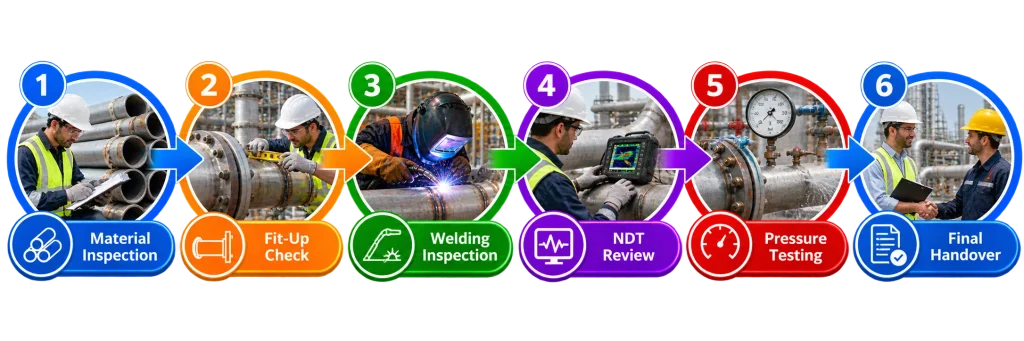
The role involves inspecting work at different stages of an industrial project. These stages may include material receipt, pipe fabrication, weld preparation, welding, dimensional checks, non-destructive examination, pressure testing, and final handover.
Quality assurance focuses on the systems and processes established to prevent quality problems. Quality control focuses on inspection, measurement, testing, and verification of completed or ongoing work. A piping inspector commonly performs quality control activities within a broader project quality management system.
Typical responsibilities include:
- Reviewing approved piping drawings, specifications, and inspection requirements.
- Checking pipes, fittings, flanges, valves, and other materials against purchase and project requirements.
- Verifying material identification and traceability.
- Inspecting weld preparation, fit-up, and completed welds within the inspector’s authorised scope.
- Checking pipe alignment, dimensions, supports, and installation arrangements.
- Reviewing applicable NDT reports and pressure-test documentation.
- Raising inspection reports and recording non-conformities.
- Verifying that corrective actions are completed and documented.
- Supporting final inspection, system handover, and quality dossier preparation.
The exact responsibilities depend on the employer, project specifications, inspection plan, and the inspector’s competence and authorisation.
How to Become a QA/QC Piping Inspector: Step-by-Step Guide
Step 1: Obtain a Relevant Educational Qualification
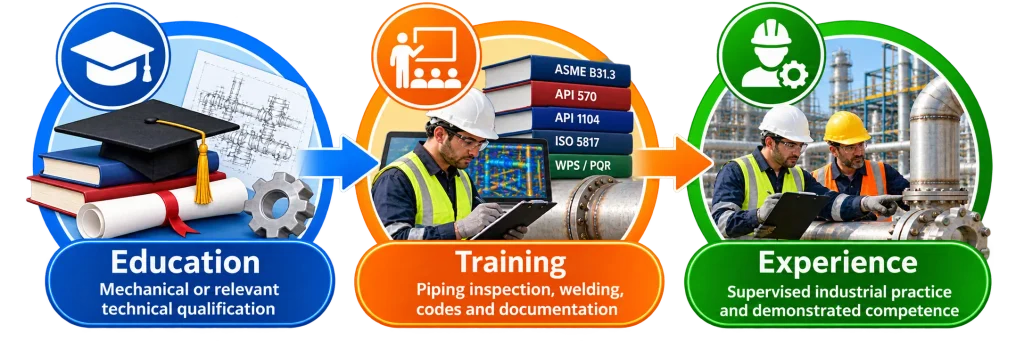
The first step is to develop a suitable technical foundation. Employers commonly consider candidates with education in mechanical engineering or a related engineering discipline. Depending on the position, a diploma in mechanical engineering or another relevant technical qualification may also be accepted.
Common educational routes include:
- Bachelor’s degree in Mechanical Engineering.
- Diploma of Associate Engineering in Mechanical Technology.
- Relevant technical diploma in piping, fabrication, or industrial engineering.
- Other recognised technical qualifications accepted by the employer.
A degree may be beneficial for engineering-level, supervisory, or quality engineering positions, while some inspection roles accept candidates with a relevant diploma and appropriate practical experience.
Candidates should check the specific vacancy requirements before choosing a qualification. Completing a course does not automatically qualify someone for every inspection position.
Step 2: Learn Piping Systems and Engineering Drawings
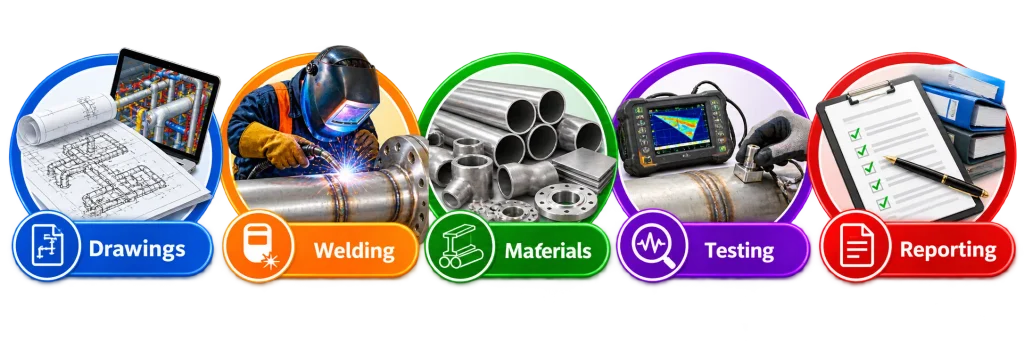
A QA/QC Piping Inspector must understand how piping systems are designed, fabricated, installed, and inspected. Technical drawing interpretation is particularly important because inspection activities must be compared with approved project documents.
Key subjects to study include:
- Piping and Instrumentation Diagrams (P&IDs).
- Piping isometric drawings.
- General arrangement drawings.
- Pipe sizes, schedules, wall thicknesses, and material specifications.
- Flange ratings, fittings, valves, and piping components.
- Pipe supports, routing, elevations, and dimensions.
- Welding symbols and weld identification.
- Piping material specifications and line lists.
For example, an inspector checking a fabricated pipe spool may compare its dimensions, component arrangement, weld locations, and material details against the approved isometric drawing.
Drawing interpretation helps inspectors identify discrepancies before they create installation problems, delays, or costly rework.
Step 3: Understand Piping Codes and Project Standards
Industrial piping work is governed by applicable codes, standards, specifications, and regulatory requirements. A QA/QC Piping Inspector should understand which requirements apply to the particular project rather than assuming that one code covers every piping system.
Important references may include:
- ASME B31.3 for process piping.
- ASME B31.1 for power piping.
- ASME BPVC Section IX for welding procedure and welder qualification requirements within its scope.
- ASME BPVC Section V for non-destructive examination methods within its scope.
- Relevant ASTM material specifications.
- Applicable ISO standards and project-specific quality procedures.
- Approved inspection and test plans, drawings, and contractual specifications.
The applicable code depends on the system, project scope, jurisdiction, and contractual requirements. These standards should be studied through their official editions and the project documents that apply to the work.
An inspector must know how to locate acceptance criteria, verify compliance, and refer technical uncertainties to the responsible engineer or authorised inspection authority.
Step 4: Develop Welding Inspection Knowledge
Welding is a major part of piping fabrication, making welding inspection knowledge valuable for many QA/QC Piping Inspector positions.
Candidates should learn the stages of welding quality control, including:
- Reviewing the approved Welding Procedure Specification (WPS).
- Understanding the purpose of the Procedure Qualification Record (PQR).
- Checking welder qualification records where required.
- Inspecting joint preparation and fit-up.
- Verifying specified welding consumables and storage conditions.
- Checking preheat, interpass temperature, and other specified parameters.
- Inspecting completed welds for visible defects.
- Reviewing applicable NDT results and repair records.
Common weld discontinuities and defects include porosity, cracks, undercut, incomplete fusion, and incomplete penetration. Their significance and acceptability depend on the applicable code, examination method, and project acceptance criteria.
A piping inspector should not approve a weld simply because it looks acceptable. The weld must satisfy the relevant inspection requirements and acceptance criteria.
Step 5: Understand Non-Destructive Testing Methods
Non-destructive testing helps assess the condition of welds and materials without damaging the component during examination. Inspectors should understand the purpose, limitations, and documentation associated with commonly used NDT methods.
| NDT method | Main purpose |
|---|---|
| Visual Testing (VT) | Examines visible surface conditions and workmanship |
| Liquid Penetrant Testing (PT) | Detects surface-breaking discontinuities in suitable non-porous materials |
| Magnetic Particle Testing (MT) | Detects surface and near-surface discontinuities in suitable ferromagnetic materials |
| Radiographic Testing (RT) | Uses radiation-based imaging to examine internal features |
| Ultrasonic Testing (UT) | Uses sound waves to examine material or weld conditions |
A QA/QC Piping Inspector may review NDT reports, verify that the required examinations have been completed, check traceability to the relevant welds, and confirm that reported results meet the specified acceptance criteria.
Performing or interpreting specialised NDT examinations may require separate qualifications and authorisation. A general piping inspection certificate does not automatically qualify an individual to carry out every NDT method.
Step 6: Complete Relevant QA/QC Piping Training
Structured training can help candidates develop the technical knowledge needed for entry-level or more specialised inspection roles. A suitable course should cover practical piping inspection requirements rather than focusing only on general quality terminology.
Useful training subjects include:
- Piping components and material identification.
- Drawing and specification interpretation.
- Inspection and Test Plans (ITPs).
- Material receiving inspection.
- Welding inspection fundamentals.
- Dimensional inspection and fit-up checks.
- NDT methods and report review.
- Hydrostatic and pneumatic testing principles.
- Non-conformity reporting and corrective actions.
- Inspection records and quality documentation.
- Safety requirements during fabrication, testing, and installation.
When selecting a course, check the training provider’s credibility, course syllabus, assessment method, practical content, certificate recognition, and relevance to target job vacancies.
A training certificate can demonstrate learning, but its value depends on the employer’s requirements and the competence it helps the candidate develop.
Step 7: Gain Practical Industrial Experience
Practical experience is one of the most important factors in progressing towards a QA/QC Piping Inspector position. Employers may prefer candidates who have worked in piping fabrication, mechanical construction, welding inspection support, material inspection, or industrial quality control.
Potential entry routes include:
- Mechanical trainee positions.
- Piping fabrication workshops.
- Junior QA/QC roles.
- Material inspection assistance.
- Mechanical construction projects.
- Welding inspection support roles.
- Quality documentation and inspection coordination.
During supervised work, candidates should learn how to inspect actual components, follow approved inspection procedures, use measuring equipment, record inspection results, and communicate discrepancies.
Experience should be documented accurately through employment records, project descriptions, training logs, and evidence of relevant responsibilities where permitted.
Candidates must not claim inspection authority, certifications, or project experience they do not possess.
Step 8: Learn Inspection Documentation and Reporting
Technical inspection is only one part of the job. QA/QC Piping Inspectors must also maintain reliable records that demonstrate whether the work complies with project requirements.
Important documents include:
- Inspection and Test Plans.
- Material Test Certificates (MTCs).
- Material receiving inspection reports.
- Welding Procedure Specifications and qualification records.
- Weld maps and weld traceability records.
- NDT reports.
- Dimensional inspection reports.
- Pressure-test packs and test certificates.
- Non-Conformance Reports (NCRs).
- Corrective action records.
- Final inspection reports and quality dossiers.
For example, if a material certificate does not match the identification marking on a pipe, the inspector should record the discrepancy and follow the project procedure before the material is accepted for use.
Accurate documentation supports traceability, technical accountability, audits, and final project handover.
Step 9: Consider Relevant Certifications
Professional certifications may strengthen an application when they match the target role and are recognised by the employer or project. The most suitable option depends on the candidate’s experience, intended responsibilities, and the requirements stated in job advertisements.
Potentially relevant credentials include:
- QA/QC Piping Inspector training or certification.
- Welding inspection qualifications recognised by target employers.
- NDT qualifications appropriate to the required examination method and applicable scheme.
- Relevant occupational health and safety training.
- Quality management training, including ISO 9001 principles.
Some welding inspection and NDT certifications have specific prerequisites, examinations, experience requirements, or renewal conditions. Candidates should verify these directly with the issuing organisation.
Before paying for a certification, check whether employers in the intended market actually request it. A widely recognised, role-relevant qualification combined with practical experience is generally more useful than collecting unrelated certificates.
Step 10: Prepare a Professional CV and Apply for Jobs
Once candidates have developed the required knowledge and gained relevant experience, they can prepare a targeted CV and apply for suitable roles.
A QA/QC Piping Inspector CV should clearly present:
- Educational qualifications and relevant technical training.
- Inspection-related employment and practical experience.
- Piping drawings, components, and inspection stages understood.
- Relevant welding and NDT knowledge.
- Familiarity with applicable codes and project specifications.
- Experience with inspection reports and quality documentation.
- Relevant certifications and their current status.
- Project experience, responsibilities, and measurable contributions.
Candidates without direct inspection experience should apply for suitable trainee, assistant, junior quality, or supervised technical roles rather than presenting themselves as experienced inspectors.
Interview preparation should focus on practical scenarios, inspection procedures, code awareness, documentation, material traceability, and the handling of non-conforming work.
Qualifications Required to Become a QA/QC Piping Inspector
There is no single educational qualification that applies to every QA/QC Piping Inspector vacancy. Requirements vary according to employer policy, project complexity, industry, and the level of responsibility.
| Qualification route | Potential suitability | Important consideration |
|---|---|---|
| Mechanical engineering degree | Engineering and inspection-related positions | Experience may still be required |
| Mechanical engineering diploma | Technician and some inspection positions | Employer acceptance varies |
| Relevant piping or fabrication training | Entry-level technical development | Training alone may not meet vacancy requirements |
| Welding inspection qualification | Roles involving welding quality control | Check the required certification scheme |
| NDT qualification | Specialised examination activities | Method-specific competence and authorisation may be necessary |
| QA/QC piping course | Developing inspection knowledge | Verify syllabus, assessment, and recognition |
A candidate should select the educational and training route that aligns with the intended position rather than assuming that a particular certificate guarantees employment.
How Much Experience Is Required?
Experience requirements differ considerably between employers and projects. Some entry-level vacancies accept candidates with limited industrial experience, while more demanding inspection roles may require several years of relevant work and specific exposure to piping fabrication, welding, or construction.
The following table provides a general career-planning guide, not a universal industry requirement.
| Career stage | Illustrative experience profile | Typical focus |
|---|---|---|
| Trainee or assistant | Limited direct inspection experience | Learning procedures and supporting inspections |
| Junior inspector | Some relevant industrial exposure | Performing defined checks under appropriate supervision |
| Piping inspector | Demonstrated inspection competence | Conducting assigned inspections and maintaining records |
| Senior piping inspector | Substantial relevant project experience | Handling complex inspections and coordinating quality activities |
| Inspection supervisor or quality engineer | Role-dependent technical and leadership experience | Coordinating inspection teams, quality systems, or project activities |
Experience alone does not establish competence. Inspectors must also understand the applicable requirements, demonstrate sound judgement, and work within their authorised responsibilities.
Essential Skills of a QA/QC Piping Inspector
A successful piping inspector combines technical knowledge with observation, documentation, communication, and problem-solving skills.
Technical Skills
- Reading piping isometric drawings and P&IDs.
- Identifying pipes, fittings, valves, and flange components.
- Understanding welding processes and inspection stages.
- Using measuring instruments appropriately.
- Reviewing material certificates and traceability records.
- Understanding applicable codes and acceptance criteria.
- Reviewing NDT reports and pressure-test documentation.
Professional Skills
- Attention to detail.
- Clear written reporting.
- Effective communication with engineers, supervisors, and contractors.
- Objective judgement when identifying non-conforming work.
- Time management during inspection activities.
- Confidence in escalating safety or quality concerns.
- Commitment to ethical reporting and accurate records.
Safety Awareness
Piping inspection can involve industrial construction sites, hot work, confined spaces, pressurised systems, and hazardous materials. Inspectors must follow site safety procedures, use required personal protective equipment, and avoid entering hazardous areas or performing activities without appropriate authorisation.
Pressure testing requires particular caution because stored energy can create serious hazards. Inspection activities must follow the approved test procedure and site controls.
What Does a QA/QC Piping Inspector Do on a Typical Project?
A piping inspector may follow different inspection stages depending on the project Inspection and Test Plan.
| Project stage | Inspection activity | Example record |
|---|---|---|
| Material receipt | Check material identification and documents | Material receiving report |
| Fabrication preparation | Verify drawings, cutting, and preparation requirements | Inspection checklist |
| Weld fit-up | Check joint preparation and alignment | Fit-up inspection report |
| Welding | Verify specified process and inspection requirements | Weld inspection record |
| NDT | Check required examination coverage and reports | NDT report and weld traceability |
| Installation | Check alignment, supports, and component arrangements | Installation inspection report |
| Pressure testing | Verify test readiness and specified test requirements | Approved test records |
| Final handover | Review outstanding items and quality documents | Final quality dossier |
The inspector should follow the approved ITP and project procedures to identify required inspection stages, hold points, witness points, and documentation requirements. Inspection and acceptance decisions must be made according to the applicable project authority and the inspector’s assigned responsibilities.
Where Can QA/QC Piping Inspectors Work?
QA/QC Piping Inspectors may find opportunities in industries where piping fabrication, installation, testing, and maintenance are important.
Potential employment sectors include:
- Oil and gas facilities.
- Petrochemical and chemical plants.
- Power generation projects.
- Industrial manufacturing.
- Refineries and processing facilities.
- Water treatment and industrial utilities.
- Mechanical construction and fabrication companies.
- Plant maintenance and shutdown projects.
- Engineering, procurement, and construction contractors.
In Pakistan, candidates may explore industrial construction, manufacturing, process facilities, fabrication workshops, and maintenance contractors. International opportunities may be available in Gulf Cooperation Council countries and other markets, subject to employer requirements, work authorisation, relevant experience, and project demand.
Job availability changes over time, so candidates should review current vacancies rather than relying on general claims about demand.
How to Become a QA/QC Piping Inspector in Pakistan
Candidates in Pakistan can follow a practical route based on their current education and experience.
- Complete a relevant mechanical engineering qualification or technical diploma.
- Build knowledge of piping components, drawings, welding, and inspection procedures.
- Enrol in a credible QA/QC Piping course that matches target job requirements.
- Develop familiarity with relevant ASME codes, project specifications, ITPs, and quality records.
- Seek supervised experience with a fabrication workshop, mechanical contractor, or industrial project.
- Pursue additional welding inspection or NDT qualifications when relevant to the intended position.
- Prepare a technical CV and apply for suitable trainee, junior, or experienced roles.
Candidates targeting Saudi Arabia, the United Arab Emirates, Qatar, or other international markets should compare their qualifications and experience against current employer requirements. Some projects impose additional client-specific approval, examination, or experience conditions.
QA/QC Piping Inspector vs QA/QC Piping Engineer
These positions overlap in quality management but may differ in scope, technical responsibility, and employer expectations.
| Area | QA/QC Piping Inspector | QA/QC Piping Engineer |
|---|---|---|
| Main focus | Inspection and verification | Quality planning, engineering coordination, and technical quality control |
| Typical activities | Material, fit-up, weld, dimensional, and test inspections | Reviewing quality procedures, ITPs, technical issues, and quality performance |
| Documentation | Inspection reports and verification records | Quality plans, procedures, technical reviews, and reports |
| Qualification expectations | Vary by inspection role and employer | Often requires an engineering qualification for engineering-designated positions |
| Career progression | Senior inspector or inspection supervisor | Senior quality engineer or quality management roles |
Job titles and responsibilities are not standardised across all companies. A vacancy description should be reviewed carefully to understand its actual requirements.
Career Progression for a QA/QC Piping Inspector
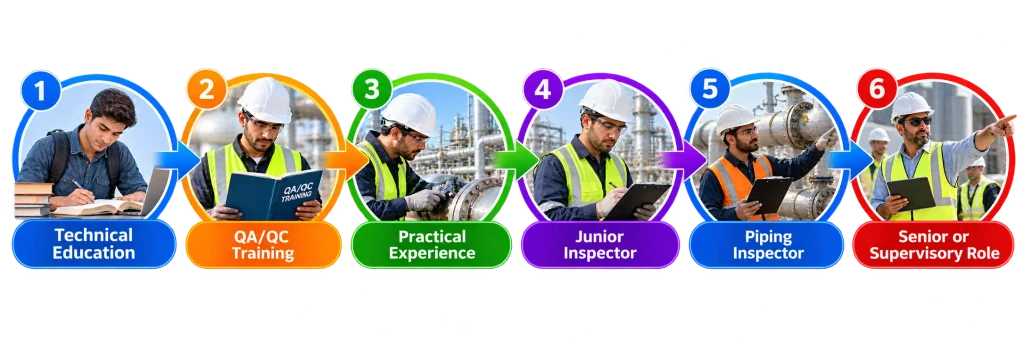
A possible career pathway begins with technical education and supervised industrial exposure. With demonstrated competence, relevant experience, and suitable qualifications, a candidate may progress towards more responsible inspection or quality roles.
A typical pathway may include:
- Mechanical trainee or inspection assistant.
- Junior QA/QC Piping Inspector.
- QA/QC Piping Inspector.
- Senior QA/QC Piping Inspector.
- Inspection supervisor or quality control supervisor.
- QA/QC Engineer or quality management role, where the required qualifications and experience are met.
Progression is not automatic. Promotion depends on competence, performance, employer requirements, project opportunities, and any mandatory educational or professional credentials.
Common Mistakes to Avoid When Starting a QA/QC Piping Career
New candidates can improve their preparation by avoiding these common mistakes:
- Choosing a course without checking its syllabus or relevance to actual job vacancies.
- Assuming that a training certificate guarantees employment.
- Ignoring drawing interpretation and material traceability.
- Memorising code names without learning how to locate applicable requirements.
- Confusing general NDT awareness with qualification to perform NDT examinations.
- Applying only for experienced positions without building practical competence.
- Listing skills on a CV that cannot be demonstrated during an interview.
- Failing to understand inspection documentation and non-conformance procedures.
- Accepting inspection responsibilities beyond their competence or authorisation.
A strong candidate develops technical knowledge, gains supervised practical experience, and builds a record of reliable inspection work.
Conclusion
Becoming a QA/QC Piping Inspector requires relevant technical qualifications, specialised training, practical experience, and a strong understanding of piping inspection procedures, welding quality control, applicable codes, and inspection documentation. Developing these skills helps candidates prepare for inspection roles across oil and gas, petrochemical, construction, and other industrial sectors.
For aspiring inspectors in Pakistan and international markets, the best approach is to choose relevant training, gain supervised industrial experience, and meet the qualification requirements of target employers. Continuous professional development and practical competence can support career progression towards senior inspection, supervision, and quality management positions.