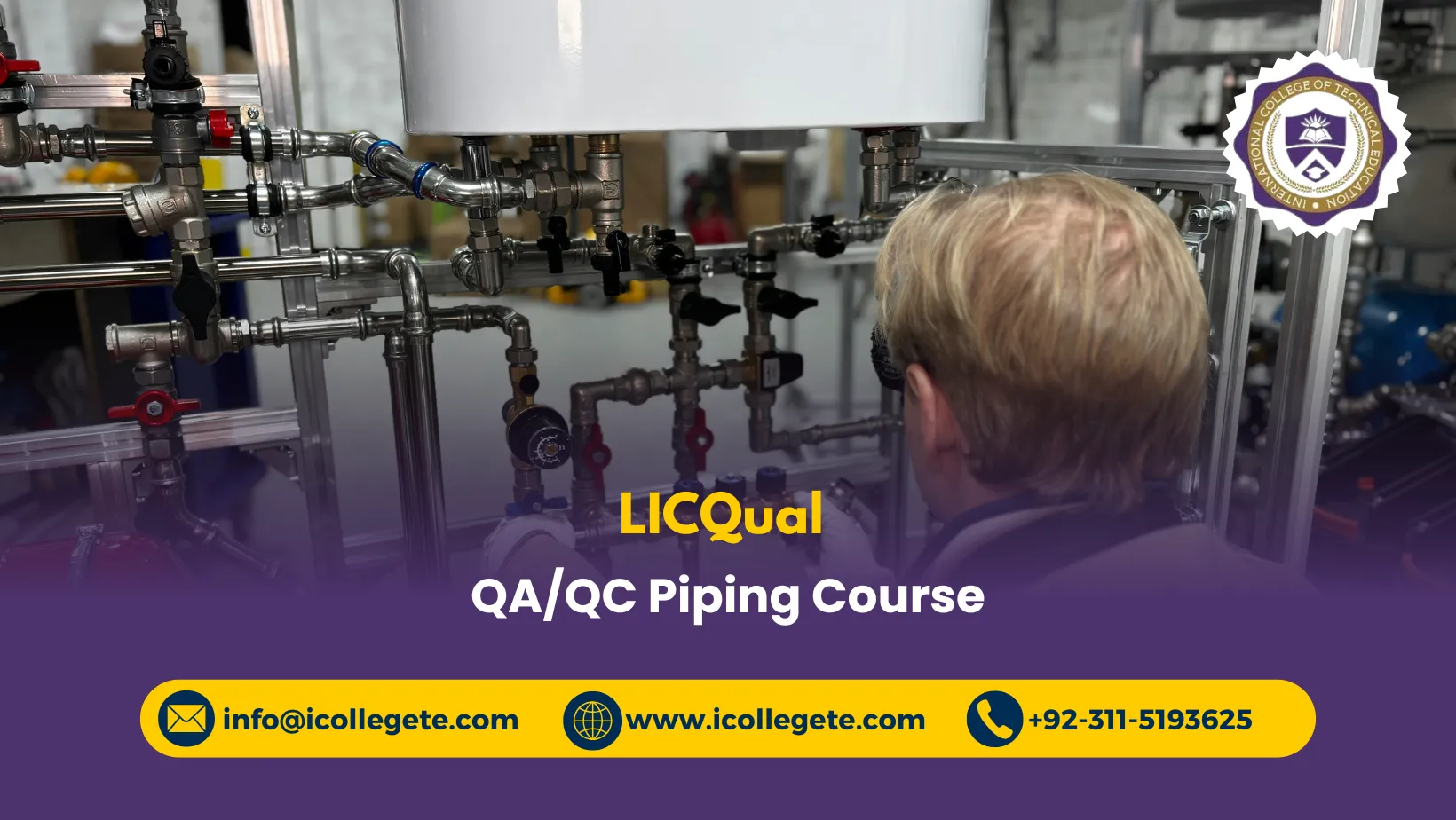
The LICQual QA/QC Piping Course in Pakistan is designed for individuals who want to develop practical and industry-focused knowledge in piping quality assurance, quality control, inspection, welding, NDT, fabrication, installation, and technical documentation. The course focuses on the quality requirements used in industrial and construction projects where piping systems must meet approved drawings, specifications, codes, standards, safety requirements, and client expectations.
Learners develop an understanding of how QA/QC processes are applied throughout the piping project lifecycle, from material receiving and verification to fabrication, welding, inspection, testing, installation, documentation, and final handover. Key areas include piping materials, international standards, welding inspection, non-destructive testing (NDT), inspection and test plans (ITPs), quality management systems, non-conformance reporting, and QA/QC documentation.
The course is particularly relevant to sectors such as oil and gas, petrochemical, power generation, construction, manufacturing, process plants, and industrial maintenance. LICQual’s related QA/QC and piping qualifications similarly emphasize international standards, welding inspection, NDT, piping components, inspection procedures, and quality documentation.
For learners in Pakistan, this course can provide a structured pathway toward careers in QA/QC piping inspection, QC inspection, welding inspection support, piping quality control, fabrication inspection, and project quality documentation while building a foundation for further professional development.
Course Study Units
Unit 1: Introduction to QA/QC in Piping Engineering
This unit introduces the fundamental principles of Quality Assurance (QA) and Quality Control (QC) within piping engineering and industrial projects.
Learners explore:
- Fundamentals of QA and QC
- Difference between Quality Assurance and Quality Control
- Roles and responsibilities of QA/QC personnel
- Quality control processes in piping projects
- Inspection stages and hold/witness points
- Inspection and Test Plans (ITPs)
- Quality objectives and project requirements
- Basic piping engineering concepts
- Piping systems and their industrial applications
- Quality, safety, reliability, and compliance
- Introduction to piping inspection activities
- Quality risks in piping fabrication and installation
Unit outcome: Learners develop a strong foundation in QA/QC principles and understand how quality requirements are implemented throughout piping projects.
Unit 2: Piping Materials and International Standards
This unit develops knowledge of piping materials, components, specifications, and internationally recognized standards used in industrial piping.
Key topics include:
- Carbon steel, stainless steel, alloy steel, and other piping materials
- Pipes, fittings, flanges, valves, gaskets, and bolts
- Material specifications and classifications
- Material identification and traceability
- Material Test Certificates (MTCs)
- Heat numbers and material identification
- Material receiving inspection
- Storage and preservation requirements
- Material segregation
- ASTM and ASME material standards
- API and ISO standards awareness
- Project specifications and material requirements
- Verification of materials against approved documentation
Unit outcome: Learners understand how piping materials are selected, received, identified, inspected, stored, and verified against applicable project requirements and standards.
Unit 3: Welding Inspection and Testing for Piping
Welding is one of the most important quality-control activities in piping fabrication. This unit introduces welding processes, documentation, inspection requirements, and common welding defects.
Learners study:
- Basic welding principles
- SMAW, GTAW, GMAW, and FCAW processes
- Pipe welding positions and joint configurations
- Welding symbols
- Welding Procedure Specification (WPS)
- Procedure Qualification Record (PQR)
- Welder Qualification/Performance Qualification
- Pre-welding inspection
- Welding consumable control
- Preheat and interpass temperature
- Visual inspection of welds
- Common welding defects
- Weld acceptance criteria
- Post-weld inspection
- Repair and re-welding requirements
- Welding inspection reports
Unit outcome: Learners gain the knowledge required to support and conduct systematic welding inspection activities and recognize common defects and documentation requirements. LICQual’s existing piping qualifications also emphasize welding processes, WPS/PQR documentation, visual inspection, and welding defects.
Unit 4: Non-Destructive Testing (NDT) Methods in Piping
This unit introduces the major Non-Destructive Testing (NDT) techniques used to assess piping welds and components without damaging them.
Topics include:
- Purpose and importance of NDT
- Visual Testing (VT)
- Liquid Penetrant Testing (PT)
- Magnetic Particle Testing (MT)
- Ultrasonic Testing (UT)
- Radiographic Testing (RT)
- Applications of different NDT methods
- Selection of NDT techniques
- Identification of surface and internal defects
- NDT procedures and reports
- Basic interpretation of NDT results
- Acceptance and rejection criteria
- NDT personnel responsibilities
- Safety considerations during NDT activities
- NDT documentation and traceability
Unit outcome: Learners understand the principles, applications, advantages, limitations, and reporting requirements of major NDT methods used in piping inspection. LICQual’s related qualifications identify VT, PT, MT, RT, and UT as core NDT methods for piping and welding inspection.
Unit 5: Piping Fabrication and Installation Inspection
This unit focuses on quality inspection activities during piping fabrication, assembly, erection, installation, testing, and completion.
Learners explore:
- Piping fabrication workflow
- Cutting and preparation
- Fit-up inspection
- Alignment and dimensional inspection
- Tack welding inspection
- Weld joint inspection
- Flange alignment
- Pipe support inspection
- Installation of valves and fittings
- Piping isometric drawings
- P&ID awareness
- Spool fabrication and identification
- Erection and installation inspection
- Visual and dimensional checks
- Pressure testing awareness
- Flushing and cleaning requirements
- Punch-list identification
- Mechanical completion requirements
- Final inspection and handover
Unit outcome: Learners develop the ability to understand and support quality inspection activities across piping fabrication and installation stages.
Unit 6: Quality Management Systems (QMS) in Piping Projects
This unit introduces the role of Quality Management Systems (QMS) in controlling and improving quality throughout piping projects.
Key areas include:
- Fundamentals of Quality Management Systems
- Quality policies and objectives
- Quality plans
- Project Quality Plans (PQPs)
- Inspection and Test Plans (ITPs)
- Quality procedures
- Quality control checklists
- Internal quality audits
- Corrective and preventive actions
- Non-Conformance Reports (NCRs)
- Root-cause analysis
- Continuous improvement
- Quality performance monitoring
- Client and contractor quality requirements
- Quality assurance throughout the project lifecycle
Unit outcome: Learners understand how structured quality management systems help control risks, maintain compliance, reduce defects, and improve project performance.
Unit 7: Codes, Standards, and Specifications for Piping
This unit develops learners’ awareness of the codes, standards, specifications, and technical requirements used in piping inspection.
Topics include:
- Purpose of engineering codes and standards
- ASME standards
- API standards
- ASTM standards
- ISO standards
- Project specifications
- Client specifications
- Engineering drawings and approved documents
- Piping material specifications
- Welding requirements
- Inspection requirements
- Testing requirements
- Acceptance criteria
- Code compliance
- Regulatory requirements
- Understanding the hierarchy of project documentation
Unit outcome: Learners can identify applicable codes, standards, and specifications and understand their importance in maintaining piping quality, safety, and compliance. LICQual’s existing piping qualifications specifically highlight ASME, API, ASTM, ISO, and project-specific requirements within QA/QC education.
Unit 8: Documentation and Reporting in QA/QC
Accurate documentation is essential for demonstrating that piping work has been inspected and completed according to approved requirements.
This unit covers:
- QA/QC documentation principles
- Inspection reports
- Inspection checklists
- Inspection and Test Plans
- Material receiving reports
- Material traceability records
- Welding records
- Welder qualification records
- NDT reports
- Non-Conformance Reports
- Corrective action records
- Calibration records
- Pressure-test documentation
- Punch lists
- Quality dossiers
- Final handover documentation
- Document control
- Electronic quality records
- Professional technical reporting
Unit outcome: Learners develop the ability to understand, organize, maintain, and communicate essential QA/QC records for piping projects. Documentation and reporting are also identified as core areas within LICQual’s existing QA/QC and piping qualifications.
Learning Outcomes
After successfully completing the LICQual QA/QC Piping Course in Pakistan, learners should be able to:
- Explain fundamental QA/QC principles used in piping engineering.
- Understand the responsibilities of QA/QC inspectors and quality personnel.
- Identify common piping materials, components, fittings, valves, and flanges.
- Understand material inspection, identification, and traceability requirements.
- Recognize relevant international piping codes and standards.
- Understand welding processes commonly used for piping fabrication.
- Interpret basic welding documentation, including WPS and PQR.
- Identify common welding defects and understand visual inspection requirements.
- Explain the principles and applications of major NDT methods.
- Understand piping fabrication and installation inspection activities.
- Apply quality principles to fit-up, alignment, welding, installation, and testing activities.
- Understand Inspection and Test Plans and quality checklists.
- Recognize the importance of Quality Management Systems in piping projects.
- Understand NCRs, corrective actions, audits, and continuous improvement.
- Maintain awareness of material and weld traceability.
- Understand the importance of accurate inspection records and technical reports.
- Support quality documentation and project handover processes.
- Develop professional knowledge relevant to QA/QC piping inspection environments.
Course Benefits
The LICQual QA/QC Piping Course in Pakistan can provide learners with several professional and technical benefits:
- Industry-focused QA/QC knowledge covering piping, fabrication, welding, inspection, and documentation.
- Piping inspection awareness applicable to industrial and construction environments.
- International standards awareness, including ASME, API, ASTM, and ISO.
- Welding inspection knowledge covering welding processes, defects, WPS/PQR, and visual inspection.
- NDT awareness covering VT, PT, MT, UT, and RT.
- Improved technical documentation skills for inspection reports, checklists, ITPs, and quality records.
- Better understanding of piping fabrication and installation quality requirements.
- Career development opportunities in QA/QC and piping-related roles.
- A foundation for progressing toward higher-level QA/QC, piping inspection, and engineering qualifications.
LICQual’s published progression includes Level 3 and advanced Level 6 qualifications covering piping inspection, QA/QC management, advanced NDT, compliance, and quality systems.
Who Is This Course For?
The course is suitable for:
- Mechanical engineering graduates and diploma holders
- Civil or industrial engineering professionals working with piping projects
- QA/QC professionals seeking piping specialization
- QC inspectors and junior piping inspectors
- Piping technicians and supervisors
- Welding inspectors and welding technicians
- Fabrication personnel
- Piping installation and construction workers
- EPC project personnel
- Oil and gas industry workers
- Petrochemical and process-plant professionals
- Power plant and industrial maintenance personnel
- Fresh technical graduates seeking QA/QC careers
- Professionals planning a career change into piping inspection
- Individuals seeking to strengthen their technical profile for industrial projects
LICQual’s related Level 3 piping qualifications are designed for learners entering or progressing within QA/QC, piping, welding, fabrication, construction, oil and gas, petrochemical, and power-sector environments.
Why Choose LICQual QA/QC Piping Course in Pakistan?
Industry-Relevant Curriculum
The course focuses on practical areas that are important in real piping projects, including materials, welding, NDT, fabrication, installation, quality systems, standards, and documentation.
Strong QA/QC Foundation
Learners build a structured understanding of both Quality Assurance and Quality Control, helping them understand how quality is planned, monitored, inspected, documented, and improved.
International Standards Awareness
Understanding standards such as ASME, API, ASTM, and ISO helps learners become familiar with the technical framework commonly referenced in industrial piping projects.
Piping-Specific Skills
Rather than focusing only on general quality management, the course concentrates on piping-related inspection and quality activities.
Career-Oriented Learning
The knowledge gained can support career development toward roles such as QA/QC Inspector, Piping QC Inspector, QC Technician, Welding Inspection Assistant, QA/QC Documentation Controller, and Piping Quality Technician, depending on the learner’s experience and employer requirements.
Foundation for Advanced Qualifications
The course can provide a foundation for further study in advanced piping inspection, QA/QC engineering, welding inspection, NDT, and quality management.
Future Progression for This Course
The LICQual QA/QC Piping Course can serve as a starting point for continued professional development in piping quality and inspection.
A potential progression pathway is:
LICQual QA/QC Piping Course
↓
Advanced Piping Inspection / QA/QC Qualification
↓
LICQual Level 6 QA/QC Piping Inspector or Piping QA/QC Engineer
↓
Senior QA/QC Inspector / Piping Inspector
↓
QA/QC Engineer / Quality Engineer
↓
QA/QC Lead / Quality Manager / Project Quality Manager
Learners may also specialize in related areas such as:
- Welding Inspection
- NDT Inspection
- Piping Inspection
- Quality Management Systems
- Mechanical Inspection
- Pressure Testing
- Quality Auditing
- Project Quality Management
- Construction Quality Control
For example, LICQual currently lists advanced Level 6 pathways in QA/QC Piping Inspector and Piping QA/QC Engineer, covering advanced inspection strategies, NDT, quality management, compliance, risk assessment, engineering design, and project quality management.
Career Opportunities
Depending on qualifications, practical experience, employer requirements, and any additional professional certifications, learners may progress toward roles such as:
- QA/QC Piping Inspector
- QC Piping Inspector
- QA/QC Technician
- Piping QC Technician
- Junior QA/QC Engineer
- Welding Inspection Assistant
- Fabrication Quality Inspector
- Piping Installation Inspector
- NDT Inspection Coordinator
- QA/QC Documentation Controller
- Quality Engineer
- Senior QA/QC Inspector
- QA/QC Supervisor
The qualification should be viewed as part of a broader professional development pathway: employers may also require relevant industry experience, technical qualifications, competency-based certifications, and project-specific approvals for particular inspection positions.
Take the Next Step Toward World LICQual QA/QC Piping Course-Enroll Now