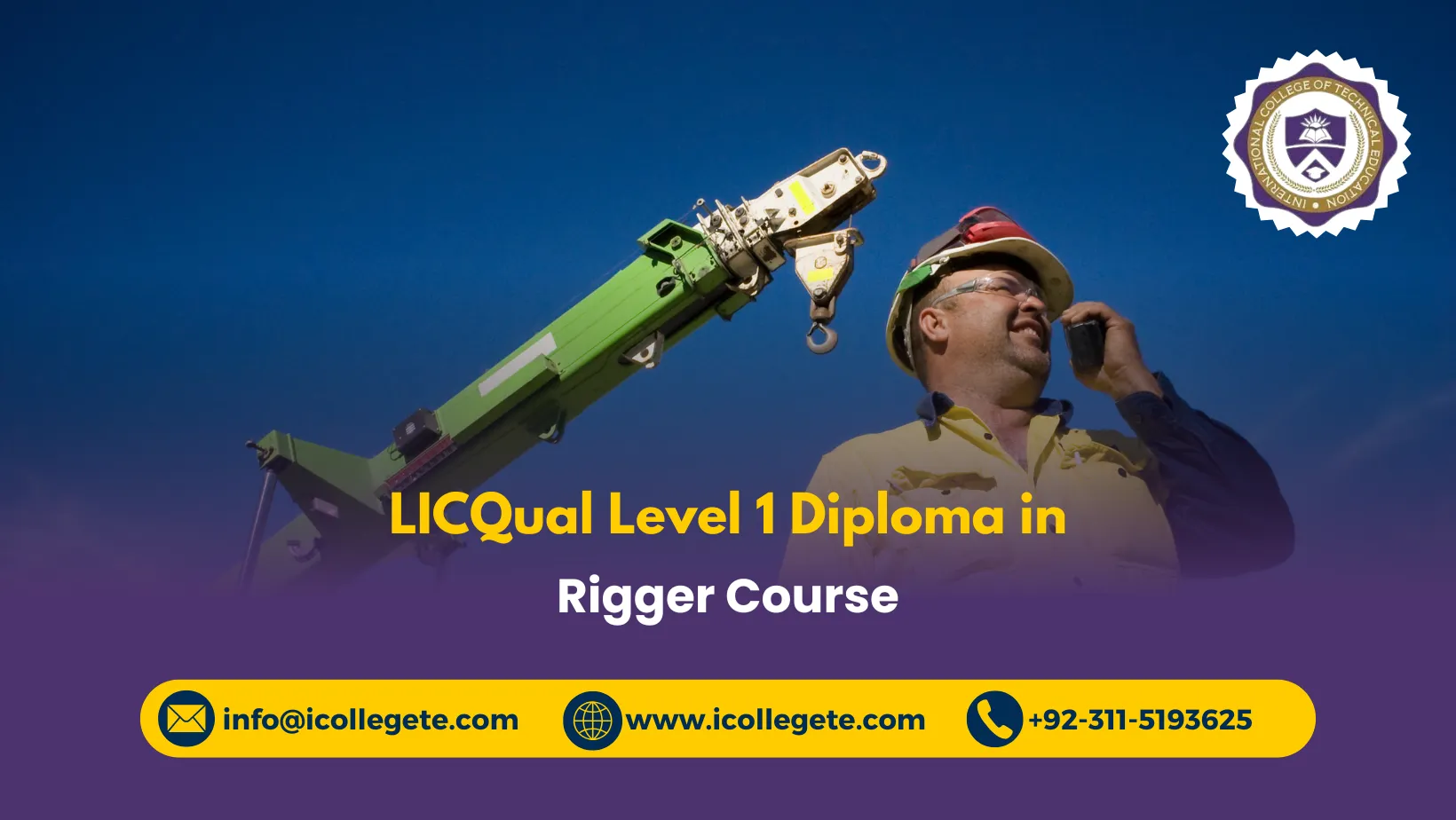
The LICQual Level 1 Diploma in Rigger Course in Peshawar is an entry-level vocational qualification designed to develop the essential knowledge, practical skills, and safety awareness required to support lifting and rigging operations. The course introduces learners to fundamental rigging principles, lifting equipment, load handling, basic calculations, inspection procedures, hazard control, and safe working practices.
Rigging is an important activity across construction, civil engineering, manufacturing, logistics, oil and gas, infrastructure, and industrial maintenance. Safe rigging requires correct equipment selection, appropriate lifting methods, accurate load assessment, effective communication, and careful control of workplace hazards. International safety guidance also emphasizes inspecting lifting equipment before use, following rated capacities, protecting slings from sharp edges, and keeping personnel clear of suspended loads.
This Level 1 diploma provides a structured foundation for learners who want to begin a career as a rigger or develop basic lifting and material-handling competencies. The course combines theoretical understanding with practical rigging exercises, enabling learners to understand how rigging equipment is selected, connected, inspected, and used under appropriate supervision.
For learners in Peshawar, the qualification can provide a useful starting point for employment opportunities in construction projects, industrial operations, logistics, engineering works, and other environments where lifting and material-handling activities are performed.
Course Overview
The LICQual Level 1 Diploma in Rigger Course in Peshawar is an entry-level vocational qualification designed to develop essential rigging, lifting, and workplace safety skills. This course comprises 8 study units covering rigging safety standards, tools and equipment, load calculations, safe lifting practices, rigging techniques, equipment inspection, risk assessment, and practical rigging exercises. Learners gain foundational knowledge of lifting equipment, load handling, hazard identification, and safe working procedures. Suitable for beginners and aspiring riggers, this qualification provides a starting point for career development in construction, engineering, manufacturing, and industrial lifting operations in Peshawar and beyond.
Entry Requirements
To enroll in the LICQual Level 1 Diploma in Rigger Course in Peshawar, applicants must meet the following criteria:
- Age Requirements: Applicants must be at least 18 years old.
- Qualification Requirements: A minimum of matriculation or equivalent qualification is required.
- Professional Experience: Prior industrial or construction experience is preferred but not mandatory.
- Educational Background: Candidates with technical or vocational education will be given preference.
- Language Proficiency: Basic understanding of English or Urdu is required to follow course materials.
Course Study Units
The LICQual Level 1 Diploma in Rigger Course in Peshawar consists of eight study units:
Unit 1:Introduction to Rigging and Safety Standards
This unit introduces the fundamental principles of rigging and lifting operations. Learners explore basic rigging terminology, the role of a rigger, workplace responsibilities, safe systems of work, lifting hazards, and the importance of following established safety procedures.
Learners will develop an understanding of:
- Basic rigging and lifting terminology
- Roles and responsibilities of a rigger
- Fundamental lifting safety principles
- Safe working practices
- Basic rigging safety standards
- Communication during lifting operations
- Common causes of rigging accidents
- Personal protective equipment requirements
Unit 2: Rigging Tools and Equipment
This unit develops knowledge of commonly used rigging tools, lifting accessories, and equipment. Learners become familiar with slings, shackles, hooks, wire ropes, chain slings, web slings, lifting points, and other basic rigging accessories.
Learners will develop skills in:
- Identifying common rigging equipment
- Understanding equipment applications
- Selecting suitable accessories for basic lifting tasks
- Recognising equipment identification markings
- Understanding safe working load information
- Handling and storing rigging equipment
- Recognising unsuitable or damaged equipment
Unit 3: Load Calculations and Weight Estimation
This unit introduces basic load assessment and weight estimation principles. Learners develop an understanding of load weight, dimensions, centre of gravity, safe working loads, sling configurations, and basic factors affecting lifting capacity.
Key learning areas include:
- Estimating load weight
- Identifying the centre of gravity
- Understanding safe working load
- Reading equipment capacity information
- Understanding basic sling angles
- Recognising uneven or unstable loads
- Preventing overloading
- Supporting basic lifting calculations
Unit 4: Safe Lifting Practices
This unit focuses on safe methods for preparing and carrying out lifting activities. Learners explore safe positioning, exclusion zones, load control, communication, pre-lift checks, and precautions for suspended loads.
Learners will learn how to:
- Prepare a lifting area
- Check equipment before use
- Position loads safely
- Maintain safe distances
- Control suspended loads
- Avoid shock loading
- Protect slings from sharp edges
- Follow agreed lifting instructions
- Respond appropriately to unsafe conditions
Safe lifting practice is particularly important because damaged or defective slings should be removed from service, while loads must not exceed the rated capacity of the lifting equipment.
Unit 5: Rigging Procedures and Techniques
This unit introduces basic rigging procedures and techniques used to secure and prepare loads for lifting. Learners explore common sling configurations and methods for attaching lifting equipment correctly.
Topics include:
- Basic sling arrangements
- Vertical lifting
- Basket hitch arrangements
- Choker hitch arrangements
- Shackles and hook connections
- Load securing
- Basic load balancing
- Centre-of-gravity considerations
- Use of tag lines where appropriate
- Basic lifting signals and communication
Learners will understand that lifting arrangements must be appropriate for the load and equipment being used. For example, OSHA guidance emphasizes controlling loads, protecting slings from sharp edges, preventing slippage, and avoiding shock loading.
Unit 7:Inspection and Maintenance of Rigging Equipment
This unit develops learners’ awareness of equipment inspection and basic maintenance requirements. Learners learn how to identify visible defects that could make lifting equipment unsafe.
The unit covers:
- Pre-use inspection
- Identification of damaged slings
- Inspection of hooks and shackles
- Wire rope condition
- Corrosion and wear
- Cuts, burns and deformation
- Missing identification markings
- Equipment cleaning and storage
- Reporting defective equipment
- Removing unsafe equipment from service
Routine inspection is a critical part of rigging safety. OSHA guidance recommends inspection of slings and attachments before use and additional inspections where service conditions require them.
Unit 8: Risk Assessment and Hazard Control
This unit introduces the principles of workplace risk assessment for lifting and rigging activities. Learners identify hazards, consider potential consequences, and understand basic control measures.
Learners will study:
- Hazard identification
- Basic risk assessment
- Falling loads
- Equipment failure
- Uncontrolled movement
- Poor ground conditions
- Overhead hazards
- Pinch and crush points
- Communication failures
- Weather-related risks
- Exclusion zones
- Basic emergency controls
The objective is to help learners recognise hazards before lifting begins and contribute to safer working conditions.
Practical Rigging Exercises
This unit provides practical opportunities for learners to apply the knowledge developed throughout the course. Practical activities can include equipment identification, sling selection, basic load preparation, inspection, attachment methods, communication, and controlled lifting exercises.
Practical activities may include:
- Identifying rigging equipment
- Conducting pre-use inspections
- Selecting suitable slings
- Connecting shackles and hooks
- Preparing basic loads
- Applying basic rigging techniques
- Using standard lifting signals
- Establishing safe working areas
- Practising load control
- Completing basic rigging tasks under supervision
Learning Outcomes
Upon successful completion of the LICQual Level 1 Diploma in Rigger Course in Peshawar, learners will be able to:
- Explain fundamental rigging and lifting principles.
- Identify common rigging tools and lifting accessories.
- Recognise the purpose and application of different sling types.
- Understand basic safe working load requirements.
- Estimate basic load weights using appropriate information.
- Identify the centre of gravity of simple loads.
- Apply basic safe lifting practices.
- Assist with the preparation of loads for lifting.
- Apply basic rigging procedures under appropriate supervision.
- Recognise common rigging hazards.
- Participate in basic risk assessment activities.
- Identify damaged or defective lifting equipment.
- Carry out basic pre-use equipment checks.
- Understand the importance of equipment inspection and maintenance.
- Use basic rigging communication and signals.
- Apply appropriate precautions around suspended loads.
- Maintain safe working practices during practical rigging activities.
- Demonstrate basic rigging competencies through practical exercises.
Course Benefits
The LICQual Level 1 Diploma in Rigger Course in Peshawar can provide several professional and practical benefits:
- Builds a strong foundation in basic rigging operations.
- Develops essential lifting and material-handling knowledge.
- Introduces learners to commonly used rigging equipment.
- Develops awareness of load weight and centre-of-gravity considerations.
- Strengthens workplace health and safety awareness.
- Introduces practical equipment inspection procedures.
- Develops hazard identification and risk-control skills.
- Provides practical exposure to basic rigging techniques.
- Supports entry-level career development in lifting-related industries.
- Helps learners understand professional rigging responsibilities.
- Provides a foundation for progressing to more advanced rigger training.
- Supports skills development for construction and industrial workplaces.
- Develops transferable safety and equipment-handling competencies.
Who is This Course For?
The LICQual Level 1 Diploma in Rigger Course in Peshawar is suitable for:
- Individuals starting a career in rigging.
- Entry-level construction workers.
- New lifting and material-handling workers.
- Construction site assistants.
- Industrial workers seeking rigging skills.
- Warehouse and logistics personnel involved in material handling.
- Workers interested in crane and lifting operations.
- Apprentices and vocational learners.
- Individuals seeking practical safety skills.
- Existing workers who require a structured introduction to rigging.
- Learners planning to progress to higher-level rigging qualifications.
The course is particularly suitable for learners who have little or no previous professional rigging experience and want to establish a basic understanding before undertaking more advanced responsibilities.
Why Choose the LICQual Level 1 Diploma in Rigger Course in Peshawar?
Choosing a Level 1 rigger qualification can provide learners with a structured introduction to an important area of construction and industrial safety. The course focuses on the practical fundamentals that entry-level rigging personnel need to understand before participating in lifting operations.
The course covers equipment identification, load assessment, lifting techniques, inspection, hazard control, and practical exercises rather than focusing only on theoretical concepts. This practical orientation can help learners connect classroom knowledge with workplace situations.
The Peshawar location also makes the course accessible to learners seeking vocational training within the region. Rigging skills can be relevant across construction, infrastructure, engineering, logistics, manufacturing, and industrial projects.
Safety is central to the qualification. Industry guidance stresses that lifting accessories should be inspected, used within their rated capacities, protected against damage, and removed from service when defects are identified.
Future Progression
The LICQual Level 1 Diploma in Rigger Course in Peshawar can serve as a foundation for continued professional development in rigging and lifting operations.
After completing the Level 1 qualification, learners may consider progressing toward:
- Level 2 Rigger qualifications.
- Advanced rigging and lifting training.
- Crane and lifting operations courses.
- Banksman and slinger/signaller training.
- Lifting supervision programmes.
- Construction site safety qualifications.
- Industrial lifting and material-handling training.
- Specialist rigging courses for construction or industrial environments.
With additional training, workplace experience, and appropriate competency development, learners can progress from entry-level rigging support roles toward more responsible positions within lifting and rigging operations. The exact progression route will depend on employer requirements, workplace regulations, practical experience, and the requirements of the next qualification.
Take the Next Step Toward World LICQual Level 1 Diploma in Rigger Course – Enroll Now