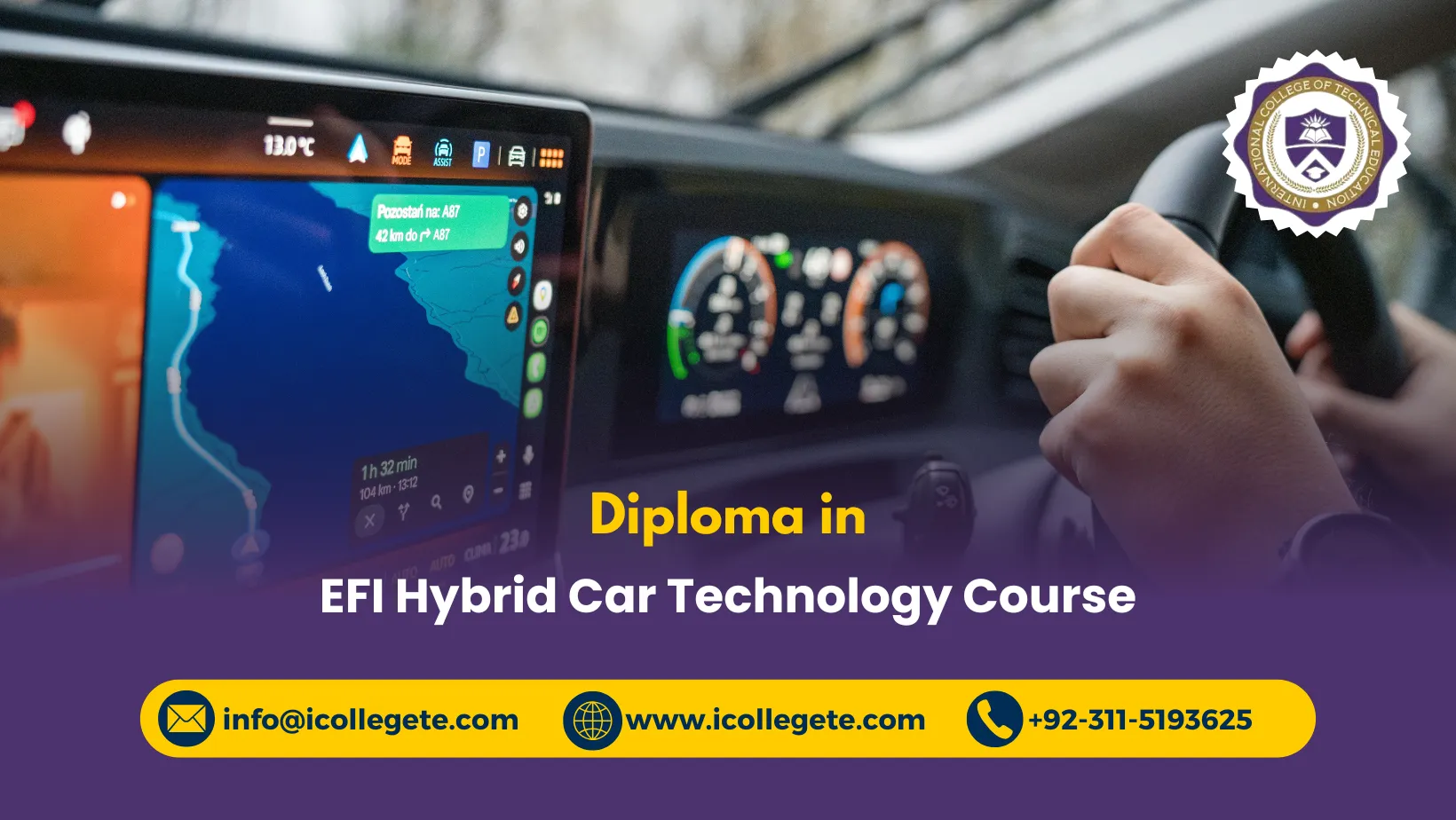
The Diploma in EFI Hybrid Car Technology Course Swat is a career-focused automotive technology programme designed to develop practical knowledge and technical skills in Electronic Fuel Injection (EFI), automotive electrical systems, hybrid powertrains, battery management, sensors, electronic control units (ECUs), and modern vehicle diagnostics. As vehicles increasingly depend on electronic control, computerised fuel management and hybrid power systems, technicians require skills that extend beyond conventional mechanical servicing. This course provides a structured pathway for learners to understand and work with these modern automotive technologies.
The programme combines theoretical learning with practical automotive applications, helping learners understand how EFI systems, electrical circuits, hybrid drivetrains, batteries, sensors and ECUs interact within modern vehicles. Diagnostic tools and systematic fault-finding methods are also covered to support accurate identification of electrical, electronic and hybrid-system faults. Practical training and project work provide opportunities to apply technical knowledge in realistic workshop situations. Similar EFI and hybrid programmes commonly emphasise electrical diagnostics, battery systems, sensors, ECUs, scanning equipment and practical workshop experience.
The Diploma in EFI Hybrid Car Technology Course in Swat is suitable for aspiring automotive technicians, mechanics, auto electricians, workshop personnel, technical learners and existing automotive professionals seeking to upgrade their skills for modern vehicle servicing and diagnostics.
Course Overview
The Diploma in EFI Hybrid Car Technology Course Swat provides a comprehensive foundation in modern automotive electronics, EFI systems and hybrid vehicle technology. Learners progress from fundamental electrical and fuel-injection concepts to hybrid powertrains, battery management, electronic control systems and advanced diagnostic practices.
The course places particular emphasis on understanding system relationships rather than simply replacing components. Learners develop the ability to interpret wiring circuits, understand sensor signals, examine ECU functions, use diagnostic equipment and apply systematic fault-finding methods. Practical training and project work reinforce the theoretical concepts through automotive workshop applications.
Entry Requirements
To enroll in the Diploma in EFI Hybrid Car Technology Course in Swat, applicants must meet the following requirements to ensure they are prepared for training and career success.
- Age Requirements: Applicants should be at least 16 years old.
- Qualification Requirements: A minimum of secondary school education (Matric or equivalent) is preferred.
- Professional Experience: No prior experience is required, but candidates with basic knowledge of automotive or electrical work will benefit.
- Educational Background: Students from science or technical streams are encouraged, though the course is open to all who meet the minimum qualification.
Course Study Units
Unit 1: Fundamentals of EFI and Hybrid Systems
This unit introduces the operating principles and architecture of Electronic Fuel Injection and hybrid vehicle systems.
Key topics include:
- Introduction to modern automotive technology
- Principles of Electronic Fuel Injection
- EFI system components and functions
- Fuel injectors and fuel delivery systems
- Throttle bodies and electronic throttle control
- Air and fuel management
- Introduction to hybrid vehicle technology
- Series, parallel and power-split hybrid configurations
- Internal combustion engine and electric motor integration
- Hybrid system operating modes
- Regenerative braking principles
- Inverters and converters
- Basic hybrid vehicle safety
- High-voltage system awareness
Unit 2: Automotive Electrical Wiring and Circuits
This unit develops knowledge of automotive electrical principles and practical wiring systems used in modern vehicles.
Key topics include:
- Automotive electrical fundamentals
- Voltage, current and resistance
- Ohm’s Law and electrical power
- Series and parallel circuits
- Automotive batteries and charging systems
- Fuses, relays and circuit protection
- Automotive wiring diagrams
- Cable identification and routing
- Connectors and terminals
- Grounding and earth circuits
- Continuity and voltage testing
- Short circuits and open circuits
- Electrical circuit fault diagnosis
- Safe use of electrical testing equipment
Unit 3: Hybrid Powertrains and Battery Management
This unit focuses on the major components responsible for hybrid vehicle propulsion and energy management.
Key topics include:
- Hybrid powertrain architecture
- Electric motors and generators
- Hybrid transmissions
- High-voltage battery systems
- Battery modules and cells
- Battery Management Systems (BMS)
- Battery state of charge and state of health
- Battery temperature monitoring
- Battery cooling systems
- Inverter and converter operation
- Regenerative energy recovery
- High-voltage cables and components
- Hybrid battery inspection and testing
- High-voltage safety procedures
- Preventive maintenance considerations
Unit 4: Sensors and Electronic Control Units (ECUs)
This unit examines how sensors, actuators and ECUs communicate and control vehicle functions.
Key topics include:
- Purpose and operation of automotive sensors
- Throttle Position Sensors
- Mass Air Flow Sensors
- Manifold Absolute Pressure Sensors
- Oxygen and air-fuel ratio sensors
- Crankshaft and camshaft position sensors
- Coolant temperature sensors
- Wheel-speed sensors
- Hybrid-system sensors
- Electronic Control Units
- ECU inputs and outputs
- Actuator control
- Electronic throttle control
- CAN communication fundamentals
- Sensor signal interpretation
- ECU-related fault diagnosis
Unit 5: Diagnostic Tools and Fault-Finding Techniques
This unit develops systematic diagnostic skills for EFI, electrical and hybrid vehicle systems.
Key topics include:
- Automotive diagnostic principles
- OBD-II systems
- Diagnostic scanners
- Reading and interpreting Diagnostic Trouble Codes (DTCs)
- Live-data analysis
- Digital multimeter applications
- Oscilloscope fundamentals
- Sensor waveform analysis
- Electrical testing procedures
- ECU diagnostic procedures
- Hybrid system diagnostics
- Battery diagnostic methods
- Fault-tree analysis
- Root-cause investigation
- Intermittent fault diagnosis
- Verification of repairs
Unit 6: Practical Training and Project Work
This unit provides opportunities to apply knowledge through structured workshop activities and automotive projects.
Practical activities may include:
- EFI component identification
- Automotive wiring exercises
- Circuit testing and troubleshooting
- Sensor testing
- Injector and fuel-system checks
- Diagnostic scanner operation
- Reading and interpreting fault codes
- ECU data analysis
- Hybrid system component identification
- Battery system inspection
- Basic hybrid diagnostic procedures
- Electrical fault-finding exercises
- Preventive maintenance activities
- Workshop safety procedures
- Vehicle diagnostic case studies
- Completion of an applied automotive technology project
Learning Outcomes
By successfully completing the Diploma in EFI Hybrid Car Technology Course Swat, learners should be able to:
EFI and Hybrid Systems
- Explain the fundamental principles of EFI technology.
- Identify major EFI components and describe their functions.
- Explain the architecture and operating principles of hybrid vehicles.
- Distinguish between major hybrid powertrain configurations.
- Explain how combustion engines and electric motors work together.
- Recognise the role of regenerative braking in hybrid systems.
Automotive Electrical Systems
- Explain fundamental automotive electrical principles.
- Interpret basic automotive wiring diagrams and circuit layouts.
- Identify fuses, relays, connectors, wiring and grounding systems.
- Perform basic electrical measurements using appropriate equipment.
- Identify common electrical circuit faults.
- Apply safe working practices when testing automotive electrical systems.
Hybrid Powertrains and Batteries
- Identify major hybrid powertrain components.
- Explain the function of electric motors, inverters and converters.
- Describe the operating principles of hybrid battery systems.
- Explain the purpose of Battery Management Systems.
- Interpret basic battery condition and operating information.
- Apply appropriate precautions when working around high-voltage components.
Sensors and ECUs
- Identify common automotive sensors and their applications.
- Explain how sensor signals influence vehicle control.
- Describe the role of ECUs in EFI and hybrid systems.
- Interpret basic sensor and ECU-related diagnostic information.
- Explain the relationship between sensors, ECUs and actuators.
- Recognise common symptoms associated with sensor and control-system faults.
Diagnostics and Fault Finding
- Operate basic automotive diagnostic equipment.
- Retrieve and interpret Diagnostic Trouble Codes.
- Analyse live vehicle data.
- Apply systematic fault-finding procedures.
- Use electrical measurements to support diagnostic decisions.
- Distinguish between symptoms, fault codes and probable root causes.
- Verify whether corrective action has resolved an identified fault.
Practical Application
- Apply theoretical knowledge in automotive workshop activities.
- Perform structured diagnostic exercises.
- Follow appropriate automotive safety procedures.
- Document diagnostic findings and practical activities.
- Complete an applied EFI or hybrid technology project.
Course Benefits
Develop Modern Automotive Skills
The course develops knowledge relevant to electronically controlled and hybrid vehicles, supporting the transition from conventional mechanical servicing toward modern automotive diagnostics and electronics.
Build EFI Expertise
Learners gain an understanding of electronic fuel injection, sensors, fuel management and ECU-controlled engine systems.
Develop Hybrid Vehicle Knowledge
The programme introduces hybrid powertrains, electric motors, battery systems, regenerative braking and electronic energy management.
Strengthen Diagnostic Skills
Learners develop systematic approaches to fault finding using diagnostic scanners, electrical testing equipment, fault codes and live data.
Gain Practical Workshop Experience
Practical activities allow learners to connect theoretical concepts with realistic automotive maintenance, testing and troubleshooting tasks.
Improve Technical Problem-Solving
The course encourages learners to analyse symptoms, test possible causes and verify faults before selecting appropriate corrective actions.
Support Automotive Career Development
The combination of EFI, electrical, electronic, diagnostic and hybrid vehicle knowledge can support progression into modern automotive service and maintenance environments.
Who is This Course For?
The Diploma in EFI Hybrid Car Technology Course Swat is suitable for:
- Aspiring automotive technicians
- Auto electricians
- Automotive mechanics
- Hybrid vehicle technicians
- Workshop technicians
- Vehicle diagnostic technicians
- Automotive engineering learners
- Technical and vocational learners
- Garage and workshop personnel
- Automotive service professionals
- Individuals seeking to establish an automotive repair business
- Existing mechanics seeking modern EFI and hybrid technology skills
The programme can also be suitable for learners entering the automotive field who want to develop foundational knowledge before progressing toward more specialised automotive technologies.
Why Choose the Diploma in EFI Hybrid Car Technology Course Swat?
Comprehensive EFI and Hybrid Coverage
The curriculum combines Electronic Fuel Injection, automotive electrical systems, hybrid powertrains, battery management, sensors, ECUs and diagnostics within one structured programme.
Practical and Career-Focused Learning
The inclusion of practical training and project work enables learners to apply knowledge to realistic automotive situations rather than relying exclusively on theoretical study.
Focus on Modern Vehicle Technology
Modern vehicles increasingly depend on electronic control systems, sensors, computerised diagnostics and electrified powertrains. This programme addresses these important areas within an integrated learning pathway. Government vocational training material in Pakistan also identifies advanced diagnostics and hybrid/electric vehicle technology as relevant automotive competencies.
Strong Diagnostic Foundation
Understanding diagnostic procedures is essential for modern automotive technicians. Learners develop familiarity with fault codes, scanning equipment, electrical testing, sensor analysis and systematic troubleshooting.
Suitable for Career Development
The course can help existing automotive workers expand their technical capabilities while providing new learners with a structured introduction to modern automotive technology.
Location-Focused Training in Swat
For learners seeking automotive technology training in Swat, the programme provides a focused pathway into EFI, hybrid vehicle systems and automotive diagnostics without requiring the curriculum to remain limited to traditional mechanical skills.
Future Progression
Successful completion of the Diploma in EFI Hybrid Car Technology Course Swat can support progression into several automotive-related professional pathways, depending on experience, practical competence and additional industry requirements.
Potential progression areas include:
- EFI Technician
- Automotive Electrical Technician
- Hybrid Vehicle Technician
- Automotive Diagnostic Technician
- Vehicle Electronics Technician
- Hybrid Battery Technician
- Automotive Service Technician
- ECU Diagnostic Technician
- Workshop Technician
- Automotive Maintenance Specialist
Learners may also progress toward more advanced areas such as:
- Electric Vehicle Technology
- Advanced Automotive Diagnostics
- Hybrid and EV Battery Systems
- Automotive Electronics
- ECU Diagnostics and Programming
- CAN Bus and Vehicle Communication Systems
- Advanced Automotive Electrical Systems
- Automotive Workshop Management
With additional experience and suitable technical development, the knowledge gained can also support work in automotive workshops, vehicle service centres, dealerships, diagnostic facilities and independent repair businesses. Related vocational programmes in Pakistan similarly emphasise advanced diagnostics, electrical systems, hybrid/electric vehicle technology and practical automotive competencies.
Take the Next Step EFI Hybrid Car Technology Course – Enroll Now