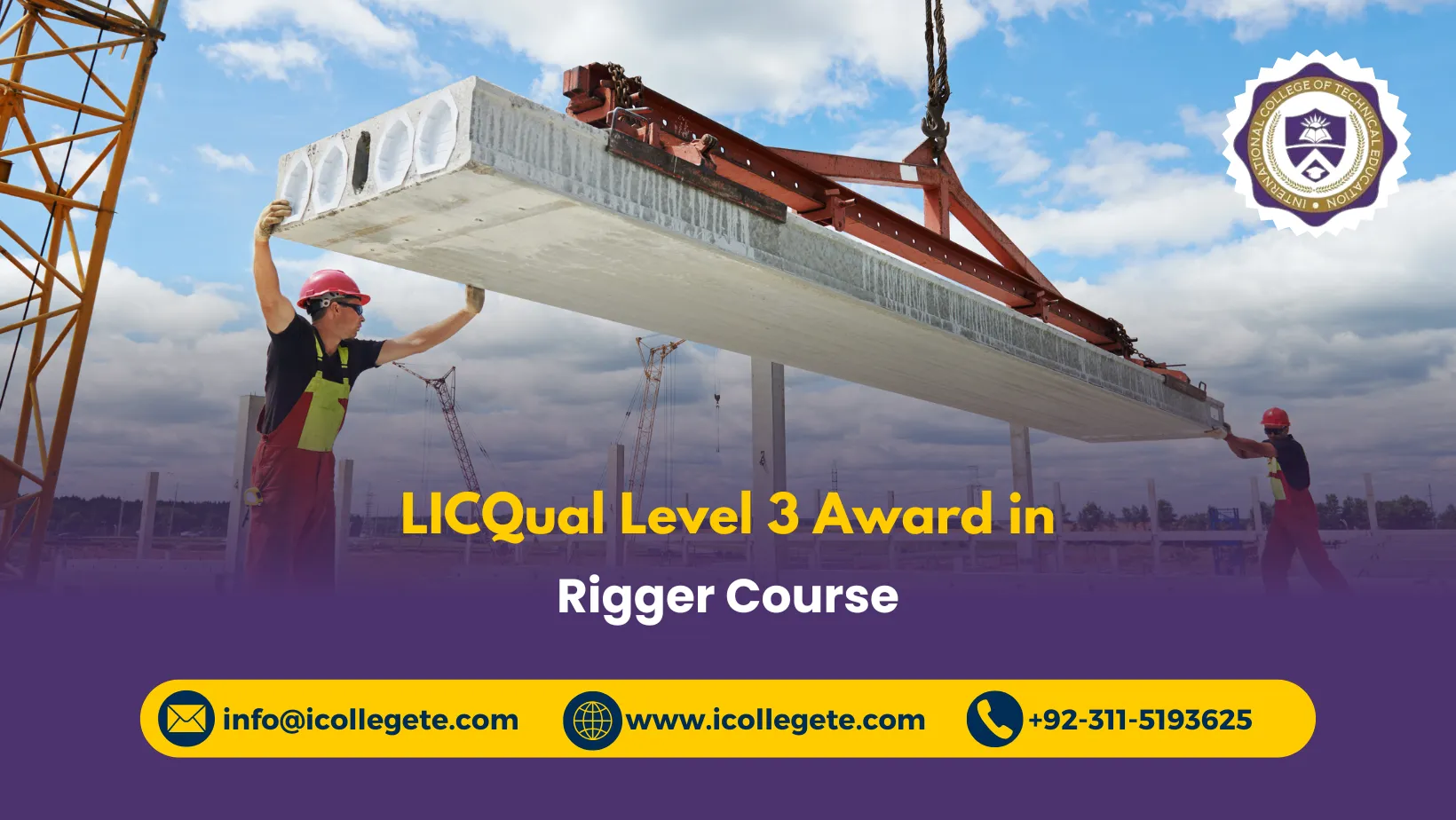
The LICQual Level 3 Award in Rigger Course is designed for learners who want to develop advanced knowledge and practical competence in rigging, lifting operations, load handling and workplace safety. The course provides structured training in advanced rigging methods, lifting equipment, load calculations, risk assessment, equipment inspection and safe lifting practices.
Rigging operations require careful planning, competent equipment selection, accurate weight estimation and effective communication. International lifting guidance emphasises the importance of competent personnel, appropriate equipment, pre-use inspection, lift planning, hazard assessment and maintaining loads within safe capacity limits.
This Level 3 course develops the knowledge and practical skills required to support increasingly complex lifting activities across construction, engineering, manufacturing, industrial, logistics, energy and other sectors where lifting and material-handling operations are undertaken. Learners explore advanced rigging equipment, sling configurations, load distribution, centre of gravity, working load limits, lifting accessories and safe methods of attaching and moving loads.
The course also develops the learner’s ability to identify hazards, apply appropriate control measures, inspect rigging equipment and participate effectively in lifting teams. International rigging practices also emphasise checking equipment before use, removing defective equipment from service and ensuring that rigging arrangements do not exceed equipment capacity.
By completing the LICQual Level 3 Award in Rigger Course in Peshawar, learners can strengthen their professional profile and prepare for roles involving advanced rigging and lifting support while developing a safety-focused approach to lifting operations.
Course Overview
The LICQual Level 3 Award in Rigger Course in Peshawar provides advanced training in rigging operations, lifting equipment, load calculations, heavy-load handling, inspection, maintenance and risk control. The course combines technical knowledge with practical application to help learners understand how complex lifting activities are planned, prepared, controlled and executed safely. Learners develop competence in selecting suitable rigging equipment, estimating loads, applying safe lifting techniques, identifying hazards and responding to changing site conditions. The programme also introduces international safety principles relevant to lifting operations and encourages disciplined communication, teamwork and equipment control. It is suitable for learners seeking to strengthen their professional capabilities in construction, engineering, industrial lifting, logistics, energy and related working environments.
Entry Requirements
To enroll in the LICQual Level 3 Award in Rigger Course in Peshawar, applicants must meet the following criteria:
- Age Requirements: Applicants must be at least 18 years old.
- Qualification Requirements: A minimum of matriculation or equivalent qualification is required.
- Professional Experience: Prior rigging or industrial work experience is strongly preferred.
- Educational Background: Candidates with technical or vocational education will be given preference.
- Language Proficiency: Basic understanding of English or Urdu is required to follow course materials.
Course Study Units
Unit 1: Advanced Rigging and International Safety Standards
This unit develops advanced understanding of rigging principles and internationally recognised approaches to safe lifting operations. Learners explore the responsibilities of riggers, lifting teams, supervisors and other personnel involved in lifting activities.
Key areas include:
- Advanced rigging principles and terminology
- Roles and responsibilities within lifting teams
- International approaches to lifting safety
- Safe working loads and working load limits
- Load stability and lifting integrity
- Communication during lifting operations
- Lift planning and preparation
- Safe exclusion zones
- Personal protective equipment
- Emergency arrangements
- Manufacturer instructions and equipment limitations
- Safe working procedures and site controls
Learners also develop awareness of recognised rigging standards and guidance. For example, ASME B30.26 addresses rigging hardware including shackles, links, rings, swivels, turnbuckles, eyebolts, wire rope clips and related equipment.
Unit 2: Rigging Tools and Equipment Handling
This unit focuses on the identification, selection, handling and correct application of rigging tools and lifting accessories.
Learners develop knowledge of:
- Wire rope slings
- Chain slings
- Web slings
- Shackles
- Hooks
- Eyebolts and lifting points
- Spreader beams
- Lifting beams
- Turnbuckles
- Rigging blocks
- Hoists
- Clamps and lifting accessories
- Tag lines and associated equipment
- Equipment identification and markings
- Working load limits
- Manufacturer specifications
Learners examine how equipment selection should reflect the characteristics, weight, configuration and lifting requirements of the load. Correct equipment selection is essential because rigging equipment must be suitable for its intended purpose and operating conditions.
Unit 3: Complex Load Calculations and Weight Estimation
This unit develops the mathematical and technical knowledge required to assess loads before lifting operations begin.
Learners explore:
- Load weight estimation
- Centre of gravity
- Load distribution
- Load dimensions
- Sling angles
- Sling-leg loading
- Working load limits
- Rated capacity
- Dynamic loading considerations
- Load stability
- Unequal load distribution
- Lifting-point capacity
- Crane and hoist capacity considerations
- Safety factors
- Basic lifting calculations
- Interpretation of load information
Learners develop the ability to assess whether a proposed rigging arrangement is appropriate for the intended lift. Particular attention is given to sling angles and how changes in rigging configuration can affect forces within lifting components. International lifting guidance specifically identifies load weight, load characteristics, equipment capacity and sling-angle factors as important considerations in lifting planning.
Unit 4: Safe Lifting Practices for Heavy Loads
This unit focuses on the safe preparation and execution of heavy-load lifting activities.
Learners study:
- Heavy-load lifting principles
- Lift preparation
- Pre-lift inspections
- Safe positioning
- Exclusion zones
- Communication and signalling
- Controlled load movement
- Suspended-load hazards
- Load stability
- Swinging and uncontrolled movement
- Environmental considerations
- Restricted-access lifting
- Emergency stop procedures
- Team coordination
- Safe positioning of personnel
- Post-lift procedures
Learners develop an understanding that lifting operations must be properly planned, appropriately supervised and undertaken by competent personnel.
The unit also reinforces the principle that personnel should remain clear of suspended loads and potential impact areas and that lifting activities should stop whenever conditions become unsafe or differ materially from the agreed lifting plan.
Unit 5: Rigging Procedures and Advanced Techniques
This unit develops practical understanding of advanced rigging procedures used when preparing and controlling complex loads.
Topics include:
- Advanced sling configurations
- Multi-leg lifting arrangements
- Choker and basket configurations
- Direct lifting arrangements
- Load balancing
- Uneven-load rigging
- Restricted-access lifting
- Controlled load positioning
- Tag-line techniques
- Connecting and disconnecting lifting accessories
- Protecting slings and loads
- Preventing load movement
- Communication between riggers and operators
- Pre-lift briefings
- Step-by-step lifting procedures
- Safe de-rigging procedures
Learners develop the ability to select and apply suitable rigging techniques while considering equipment capacity, load integrity, lifting points, sling angles and the intended movement of the load.
Unit 6: Inspection and Maintenance of Rigging Equipment
This unit develops knowledge of inspection, maintenance and safe equipment-control procedures.
Learners study:
- Pre-use inspection
- Routine inspection
- Thorough examination principles
- Identification of damaged equipment
- Wear and deformation
- Corrosion
- Cuts and abrasions
- Broken wires
- Damaged hooks and shackles
- Defective lifting points
- Identification tags and markings
- Equipment registers
- Inspection records
- Maintenance requirements
- Quarantine procedures
- Removal of defective equipment
- Storage and protection of rigging equipment
Learners understand that rigging equipment must be checked before use and that defective equipment should be removed from service to prevent accidental reuse. International guidance recommends visual examination before lifting activities and appropriate inspection and maintenance systems.
The unit also introduces the importance of maintaining appropriate records. International occupational safety guidance recognises the importance of documented inspection, examination and certification records for lifting appliances and loose gear.
Unit 7: Risk Assessment and Hazard Control
This unit develops the learner’s ability to identify hazards associated with rigging and lifting activities and apply appropriate control measures.
Learners examine:
- Hazard identification
- Risk assessment
- Dynamic risk assessment
- Suspended-load hazards
- Falling-object risks
- Crushing and trapping hazards
- Load instability
- Equipment failure
- Incorrect equipment selection
- Poor communication
- Environmental conditions
- Restricted working areas
- Overhead obstructions
- Ground and surface conditions
- Personnel positioning
- Emergency planning
- Control measures
- Stop-work procedures
Learners develop the ability to assess lifting activities before work begins and identify controls that reduce the likelihood and severity of incidents. Lift planning and risk assessment are recognised as integral elements of safe lifting operations.
Unit 8: Practical Rigging Exercises and Simulations
This unit provides opportunities to apply theoretical knowledge to realistic rigging situations and simulated lifting activities.
Practical activities may include:
- Identifying rigging equipment
- Selecting appropriate lifting accessories
- Inspecting equipment before use
- Determining load characteristics
- Estimating load weight
- Identifying the centre of gravity
- Selecting appropriate sling configurations
- Connecting loads
- Applying tag lines
- Conducting pre-lift checks
- Communicating with lifting teams
- Simulating controlled load movement
- Managing restricted-access scenarios
- Identifying unsafe conditions
- Applying emergency stop procedures
- De-rigging loads safely
- Completing inspection records
Practical exercises help learners connect technical knowledge with workplace decision-making. Industry training approaches for rigging commonly combine knowledge development with practical activities involving equipment selection, load movement, risk assessment and lifting procedures.
Learning Outcomes
On successful completion of the LICQual Level 3 Award in Rigger Course in Peshawar, learners should be able to:
- Explain advanced rigging principles and international lifting safety practices.
- Identify different types of rigging equipment and lifting accessories.
- Select suitable rigging equipment for different lifting applications.
- Interpret equipment markings and working load limits.
- Estimate load weights using available technical information.
- Identify the centre of gravity of loads.
- Assess load distribution and stability.
- Apply basic and advanced load calculations.
- Explain the effect of sling angles on lifting forces.
- Prepare loads for safe lifting operations.
- Apply appropriate techniques for lifting heavy and complex loads.
- Follow established rigging procedures and safe systems of work.
- Apply advanced slinging and load-attachment techniques.
- Conduct pre-use inspections of rigging equipment.
- Identify damaged, worn or defective lifting equipment.
- Explain appropriate maintenance and storage requirements.
- Apply equipment quarantine procedures where defects are identified.
- Identify hazards associated with rigging and lifting activities.
- Participate in risk assessments and hazard-control processes.
- Apply appropriate control measures during lifting activities.
- Communicate effectively with members of a lifting team.
- Respond appropriately to unsafe conditions.
- Apply stop-work principles when lifting conditions become unsafe.
- Demonstrate practical rigging techniques through exercises and simulations.
Course Benefits
The LICQual Level 3 Award in Rigger Course in Peshawar can provide learners with several professional and practical benefits:
- Develops advanced rigging knowledge and practical awareness.
- Strengthens understanding of safe lifting operations.
- Improves knowledge of rigging tools and lifting accessories.
- Develops load calculation and weight-estimation skills.
- Builds awareness of sling angles and load distribution.
- Improves equipment inspection and defect identification skills.
- Develops risk assessment and hazard-control capabilities.
- Supports safer participation in complex lifting operations.
- Strengthens workplace communication and teamwork.
- Develops practical decision-making during lifting activities.
- Supports professional development within rigging and lifting environments.
- Provides knowledge applicable across construction, engineering and industrial sectors.
- Builds awareness of internationally recognised lifting safety principles.
- Helps learners develop a stronger safety-focused professional profile.
Who is This Course For?
The LICQual Level 3 Award in Rigger Course in Peshawar is suitable for:
- Riggers seeking advanced professional development.
- Experienced lifting operatives.
- Construction site workers involved in lifting operations.
- Crane and lifting support personnel.
- Mechanical and engineering workers.
- Industrial rigging personnel.
- Oil and gas support workers.
- Energy-sector lifting personnel.
- Manufacturing and plant workers.
- Logistics and material-handling personnel.
- Warehouse and heavy-load handling workers.
- Maintenance personnel involved in lifting activities.
- Supervisors supporting lifting operations.
- Learners seeking to develop a career in rigging and lifting.
- Workers who want to strengthen their knowledge of lifting safety and equipment control.
Why Choose the LICQual Level 3 Award in Rigger Course in Peshawar?
This course provides a structured pathway for learners who want to move beyond basic rigging knowledge and develop stronger capabilities in complex lifting environments.
Key reasons to choose the course include:
- Advanced focus on rigging and lifting operations.
- Coverage of load calculations and weight estimation.
- Practical focus on lifting equipment and accessories.
- Strong emphasis on inspection and equipment integrity.
- Dedicated risk assessment and hazard-control content.
- Coverage of advanced rigging procedures.
- Practical exercises and simulated lifting activities.
- Focus on safe heavy-load handling.
- Development of workplace communication skills.
- Internationally relevant safety principles.
- Suitable for multiple industrial and construction environments.
- Supports continued professional development in rigging-related occupations.
Safe lifting depends on competent personnel, suitable equipment, effective planning and appropriate supervision. These principles are reflected across recognised lifting guidance and provide an important foundation for advanced rigging training.
Future Progression
After completing the LICQual Level 3 Award in Rigger Course in Peshawar, learners may use the knowledge and skills gained to pursue further occupational development in rigging, lifting operations, crane support, construction and industrial material handling.
Potential progression routes may include:
- Advanced Rigger roles
- Senior Rigger positions
- Rigging Supervisor roles
- Lifting Operations support roles
- Crane and lifting team positions
- Industrial lifting operations
- Construction rigging activities
- Mechanical and engineering lifting work
- Heavy-load handling operations
- Lifting equipment inspection support
- Lifting supervision and coordination
- Appointed-person or lift-planning related training, where entry requirements are met
- Further specialist training in crane operations and lifting management
- Additional occupational health and safety qualifications
- Sector-specific rigging and lifting certifications
Further progression will depend on the learner’s practical experience, employer requirements, local regulations, additional qualifications and the specific requirements of the intended occupation.
Career Opportunities
The qualification can support career development in environments where rigging and lifting activities are part of normal operations.
Potential job roles may include:
- Rigger
- Advanced Rigger
- Rigging Operative
- Lifting Operative
- Rigging Technician
- Rigging Team Member
- Lifting Operations Assistant
- Crane Support Operative
- Industrial Lifting Operative
- Construction Rigger
- Heavy Load Handling Operative
- Rigging Supervisor, subject to experience and additional requirements
Take the Next Step Toward World LICQual Level 3 Award in Rigger Course – Enroll Now