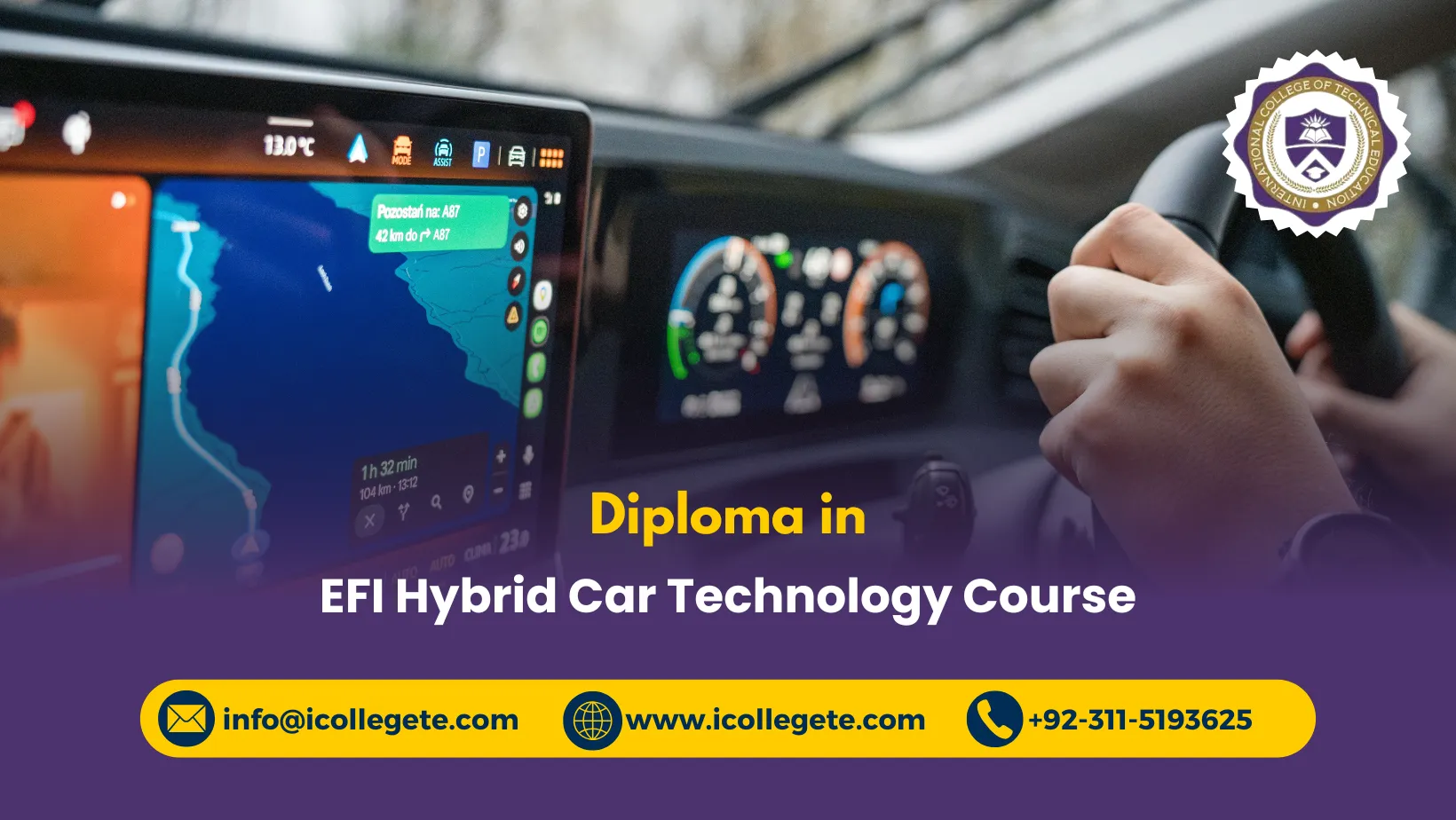
The Diploma in EFI Hybrid Car Technology Course in Islamabad is a career-focused automotive technology programme designed to develop practical knowledge and technical skills in Electronic Fuel Injection (EFI), hybrid vehicle systems, automotive electronics, diagnostics, and high-voltage vehicle technology. As modern vehicles increasingly depend on electronic control systems, sensors, computerised diagnostics, electric motors, and battery management technologies, automotive technicians require skills that extend beyond conventional mechanical repair. The course therefore combines core EFI principles with the architecture, operation, diagnosis, and maintenance of hybrid vehicles. Similar vocational programmes in Pakistan increasingly emphasise hybrid powertrains, battery systems, diagnostic equipment, electrical safety, and practical workshop experience.
Learners develop an understanding of fuel injection, vehicle wiring, electrical circuits, Electronic Control Units (ECUs), sensors, actuators, Battery Management Systems (BMS), diagnostic tools, and systematic fault-finding techniques. Practical workshops and case studies provide opportunities to connect theoretical concepts with realistic automotive problems. Particular attention is given to safe working practices when dealing with hybrid electrical and high-voltage systems.
The Diploma in EFI Hybrid Car Technology in Islamabad is suitable for aspiring automotive technicians, auto electricians, workshop personnel, mechanics, and learners seeking specialist knowledge of modern vehicle technology. It can also support progression into specialist automotive diagnostics, hybrid vehicle servicing, electrical systems, and related technical roles.
Course Overview
The course provides a structured pathway from fundamental EFI and automotive electrical principles to advanced hybrid vehicle diagnostics and practical troubleshooting. Learners study how mechanical, electronic and electrical systems interact within modern vehicles.
The programme combines technical theory, diagnostic methods, safety practices, practical workshop activities and automotive case studies. This approach helps learners develop skills relevant to modern automotive workshops and service environments in Islamabad and wider Pakistan.
Entry Requirements
To enroll in this course, candidates must meet the following requirements:
- Age Requirements: Minimum age of 18 years.
- Qualification Requirements: Completion of secondary education or equivalent.
- Professional Experience: Prior experience in automotive or technical work is preferred but not mandatory.
- Educational Background: Basic knowledge of mathematics and science is recommended.
- Language Proficiency: Ability to understand technical instructions in English or Urdu.
Course Study Units
Unit 1: Fundamentals of EFI Systems
This unit introduces Electronic Fuel Injection and its role in modern vehicle engine management. Learners explore fuel delivery, injectors, throttle systems, air-fuel ratios and electronic control processes.
Key areas include:
- Principles of Electronic Fuel Injection
- EFI system architecture
- Fuel pumps and injectors
- Throttle body systems
- Air and fuel management
- Fuel pressure and delivery
- Electronic engine control
- EFI fault symptoms and basic diagnosis
Unit 2: Introduction to Hybrid Car Technology
Learners develop a foundation in hybrid vehicle architecture and understand how internal combustion engines and electric propulsion systems operate together.
Key areas include:
- Fundamentals of hybrid vehicles
- Hybrid vehicle architecture
- Series, parallel and power-split systems
- Electric motors and generators
- Hybrid powertrain components
- Regenerative braking
- Inverters and converters
- Hybrid energy management
- Differences between conventional and hybrid vehicles
Hybrid and electric vehicle training programmes in Pakistan commonly cover hybrid powertrain components, battery systems, energy management and high-voltage safety.
Unit 3: Automotive Wiring and Electrical Circuits
This unit develops the electrical knowledge required for modern automotive diagnostics and repair.
Key areas include:
- Voltage, current and resistance
- Ohm’s Law
- Series and parallel circuits
- Automotive wiring diagrams
- Fuses, relays and connectors
- Grounding and earthing
- Continuity and voltage testing
- Wiring fault identification
- Electrical circuit diagnosis
- Basic communication networks
Unit 4: Electronic Control Units (ECU) and Programming
Learners examine how ECUs process information from vehicle sensors and control different automotive functions.
Key areas include:
- ECU architecture and functions
- Engine control modules
- Hybrid control modules
- Input and output signals
- ECU communication
- CAN-based vehicle communication
- Diagnostic communication
- ECU programming principles
- Calibration concepts
- ECU-related fault diagnosis
Unit 5: Sensors and Actuators in Hybrid Systems
This unit focuses on the components that allow hybrid vehicles to monitor operating conditions and control system functions.
Key areas include:
- Temperature sensors
- Oxygen sensors
- Airflow and pressure sensors
- Position and speed sensors
- Battery monitoring sensors
- Current and voltage sensors
- Electric motor sensors
- Fuel injectors
- Electronic throttle actuators
- Sensor signal testing and interpretation
Unit 6: Battery Management Systems
Learners explore the function and importance of Battery Management Systems in hybrid vehicles.
Key areas include:
- Hybrid battery architecture
- Battery cells and modules
- Battery state of charge
- Battery state of health
- Cell balancing
- Temperature monitoring
- Voltage monitoring
- Battery cooling systems
- BMS communication
- Battery fault detection
- Safe battery inspection procedures
Battery technology, battery management and safe handling of high-voltage systems are important components of contemporary hybrid vehicle technician training.
Unit 7: Diagnostic Tools and Techniques
This unit develops practical diagnostic competence using modern automotive testing equipment.
Key areas include:
- OBD-II diagnostic systems
- Automotive scan tools
- Digital multimeters
- Oscilloscopes
- Voltage and resistance testing
- Live data analysis
- Diagnostic trouble codes
- Sensor waveform analysis
- ECU communication testing
- Diagnostic software
- Systematic diagnostic procedures
Unit 8: Fault Diagnosis and Troubleshooting
Learners develop a structured approach to identifying, analysing and resolving EFI and hybrid vehicle faults.
Key areas include:
- Diagnostic methodologies
- Fault-code interpretation
- Electrical fault diagnosis
- EFI performance problems
- Sensor and actuator faults
- ECU communication faults
- Hybrid battery faults
- Inverter-related faults
- Wiring and connector faults
- Root-cause analysis
- Verification of repairs
Unit 9: Safety Standards and Compliance in Automotive Work
This unit establishes the safety knowledge required when working with automotive electrical, electronic and high-voltage systems.
Key areas include:
- Automotive workshop safety
- Personal protective equipment
- Electrical hazard awareness
- High-voltage system risks
- Isolation and de-energisation principles
- Safe use of insulated tools
- Battery handling precautions
- Emergency response
- Safe diagnostic procedures
- Workshop risk assessment
- Manufacturer safety instructions
High-voltage safety is specifically highlighted within government-supported hybrid and electric vehicle technician training materials in Pakistan.
Unit 10: Practical Workshops and Case Studies
The final unit connects technical theory with realistic workshop applications.
Practical activities may include:
- EFI system inspection
- Sensor testing
- Wiring and circuit testing
- ECU diagnostic scanning
- Hybrid system inspection
- Battery diagnostic demonstrations
- Fault-code analysis
- Live-data interpretation
- Troubleshooting exercises
- Preventive maintenance
- Realistic automotive case studies
- Practical diagnostic projects
Course Learning Outcomes
On successful completion of the Diploma in EFI Hybrid Car Technology Course in Islamabad, learners should be able to:
- Explain the principles and operation of Electronic Fuel Injection systems.
- Identify major EFI components and explain their functions.
- Explain the architecture and operating principles of hybrid vehicles.
- Distinguish between major hybrid powertrain configurations.
- Interpret basic automotive electrical circuits and wiring diagrams.
- Test electrical circuits using appropriate diagnostic equipment.
- Explain the role and operation of ECUs in modern vehicles.
- Understand ECU communication, programming and calibration concepts.
- Identify and evaluate sensor and actuator functions.
- Interpret relevant sensor and actuator signals.
- Explain the purpose and operation of Battery Management Systems.
- Recognise common hybrid battery performance and monitoring issues.
- Use automotive diagnostic tools for systematic fault investigation.
- Interpret diagnostic trouble codes and relevant live data.
- Apply structured troubleshooting techniques to EFI and hybrid faults.
- Analyse wiring, sensor, actuator and ECU-related problems.
- Apply appropriate safety procedures when working around high-voltage systems.
- Follow manufacturer instructions and workshop safety requirements.
- Apply technical knowledge during practical workshop activities.
- Analyse automotive case studies and propose appropriate diagnostic solutions.
Course Benefits
Develop Modern Automotive Technology Skills
Learners gain knowledge across EFI, automotive electronics, hybrid powertrains, sensors, ECUs, batteries and diagnostics rather than focusing only on conventional mechanical systems.
Build Practical Diagnostic Capability
The programme places emphasis on diagnostic tools, fault codes, electrical testing and systematic troubleshooting, helping learners develop practical problem-solving skills.
Understand Hybrid Vehicle Systems
Learners gain an understanding of how combustion engines, electric motors, batteries, inverters, ECUs and regenerative braking systems interact.
Improve Automotive Electrical Knowledge
The course develops understanding of wiring, circuits, electrical measurements, sensors and electronic control systems.
Develop High-Voltage Safety Awareness
Learners are introduced to appropriate safety principles for hybrid vehicle systems, including electrical hazards, isolation procedures and safe workshop practices.
Support Automotive Career Development
The combination of EFI, hybrid technology, electronics and diagnostics can support progression toward technical roles within automotive workshops, service centres, dealerships and specialist diagnostic environments.
Prepare for Technological Change
Modern automotive training increasingly includes hybrid and electric vehicle technologies, making knowledge of electronic and energy-management systems increasingly relevant to automotive technicians.
Who is This Course For?
The Diploma in EFI Hybrid Car Technology Course in Islamabad can be suitable for:
- Aspiring automotive technicians
- Auto electricians
- Automotive mechanics
- EFI technicians
- Hybrid vehicle technicians
- Workshop technicians
- Automotive diagnostic technicians
- Vehicle maintenance personnel
- Technical and vocational learners
- Automotive workshop owners
- Professionals upgrading conventional automotive skills
- Learners interested in hybrid vehicle technology
- Individuals planning to establish an automotive diagnostic or repair service
Previous automotive experience can be beneficial, but the structured nature of the programme can also support learners developing their knowledge from fundamental concepts.
Why Choose This Course?
Comprehensive EFI and Hybrid Coverage
The curriculum brings together EFI, electrical circuits, ECUs, sensors, battery management, diagnostics, troubleshooting and safety within one structured programme.
Practical and Industry-Oriented Learning
Learners can connect theoretical concepts with workshop activities, diagnostic exercises and case studies. Practical training is also a common feature of hybrid vehicle technician programmes in Pakistan.
Focus on Diagnostics
Modern automotive servicing increasingly depends on electronic diagnostics. The course therefore develops knowledge of scan tools, diagnostic codes, live data, electrical testing and systematic fault diagnosis.
Relevant to Islamabad’s Automotive Sector
The course is designed around technical skills applicable to automotive workshops, service centres and diagnostic environments in Islamabad and surrounding areas.
Suitable for Different Experience Levels
The programme can support beginners developing automotive knowledge as well as existing technicians seeking to expand into EFI and hybrid technologies.
Future-Focused Automotive Skills
Hybrid vehicles combine mechanical engineering, electronics, computerised control and energy-storage technology. Developing skills across these areas can provide a foundation for continued professional development as vehicle technology evolves.
Future Progression
After completing the Diploma in EFI Hybrid Car Technology Course in Islamabad, learners may progress toward specialist areas such as:
Automotive Diagnostic Technician
Focus on advanced scan-tool operation, ECU diagnostics, live-data analysis and electronic fault finding.
Hybrid Vehicle Technician
Develop specialist competence in hybrid powertrains, batteries, electric motors and associated control systems.
Auto Electrician and Electronics Technician
Build further expertise in automotive wiring, sensors, actuators, ECUs and vehicle communication networks.
Hybrid Battery Technician
Progress toward specialist training involving battery testing, BMS operation, cell monitoring and battery safety.
Automotive Workshop Specialist
Apply EFI and hybrid technology knowledge within automotive repair, maintenance and diagnostic workshops.
Advanced Automotive Diagnostics
Continue developing knowledge of oscilloscopes, CAN communication, advanced ECU diagnostics and manufacturer-specific diagnostic systems.
Electric and Hybrid Vehicle Technology
Progress toward broader electric and hybrid vehicle programmes covering electric propulsion, charging, power electronics and energy management.
Automotive Workshop Entrepreneurship
Experienced learners may use their technical knowledge as a foundation for developing specialist automotive diagnostic and repair services, subject to applicable local requirements and competence standards.
Career Opportunities
Depending on experience, practical competence, additional training and employer requirements, the qualification can support pathways toward roles such as:
- EFI Technician
- Hybrid Vehicle Technician
- Automotive Diagnostic Technician
- Auto Electrician
- Automotive Electronics Technician
- Vehicle Maintenance Technician
- Hybrid Battery Service Technician
- Automotive Service Technician
- Workshop Technician
- Automotive Diagnostic Assistant
- Hybrid Vehicle Maintenance Specialist
Take the Next Step Toward World EFI Hybrid Car Technology Course– Enroll Now