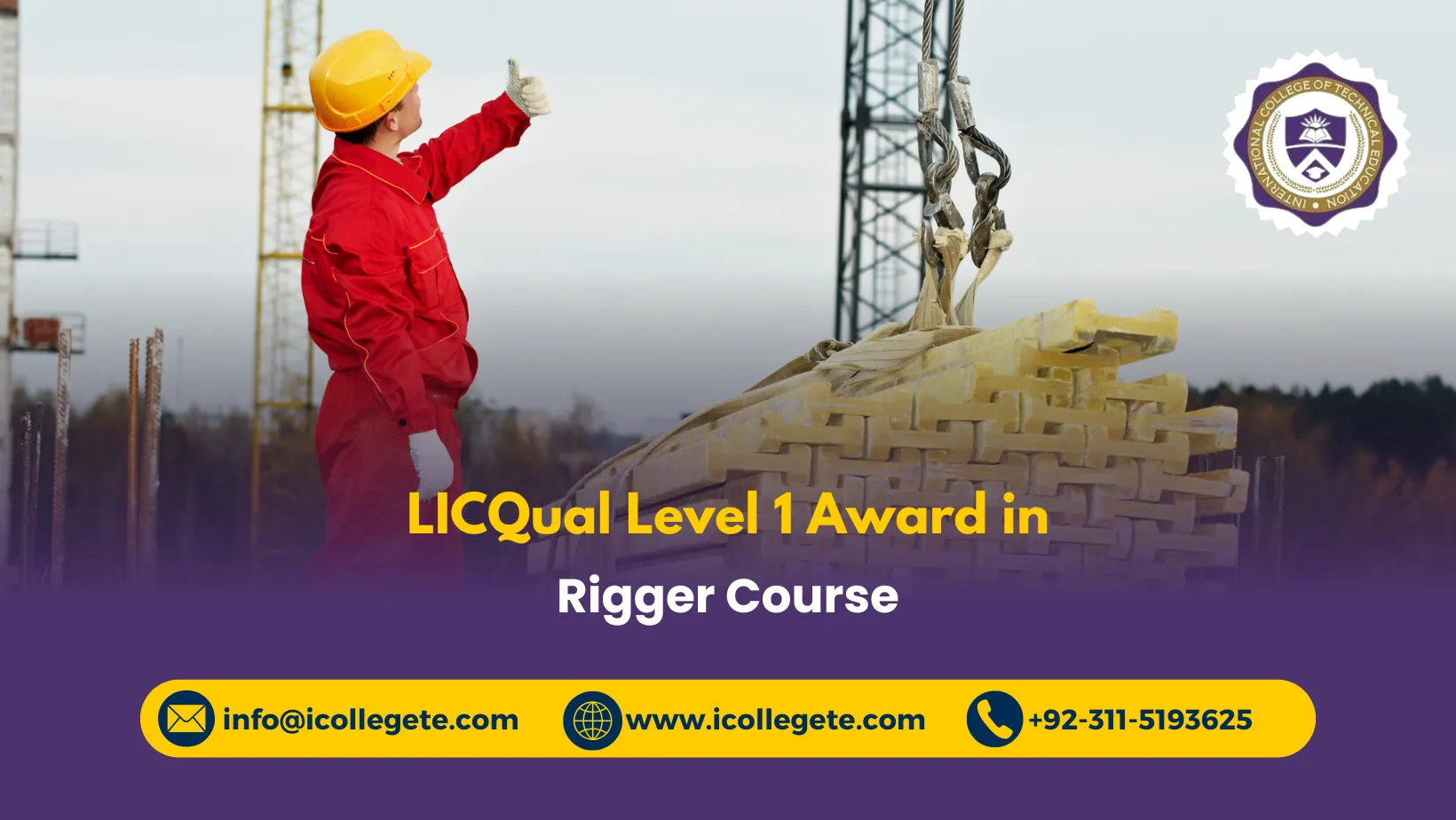
The LICQual Level 1 Award in Rigger Course in Peshawar is an entry-level vocational training programme designed to introduce learners to the essential principles, equipment, safety practices and practical techniques used in rigging and lifting operations. The course provides a structured foundation for learners who want to develop basic rigger skills for construction, engineering, manufacturing, logistics, oil and gas, industrial maintenance, warehousing and other sectors where loads are lifted, moved or positioned.
Rigging is a safety-critical activity. Correct selection and use of slings, shackles, hooks and other lifting accessories, together with proper load assessment, inspection and communication, are essential for controlling risks during lifting operations. International safety guidance emphasises the importance of properly planned lifting, suitable equipment, safe working loads, equipment inspection and competent personnel.
The LICQual Level 1 Award in Rigger Course in Peshawar develops foundational knowledge through the study of rigging tools, load calculations, safe lifting practices, rigging procedures, equipment inspection, risk assessment and practical exercises. Learners gain an understanding of how to prepare for basic lifting activities, recognise common hazards and support safe rigging operations under appropriate supervision.
The course is suitable for beginners with little or no previous rigging experience and provides a foundation for progressing towards more advanced rigger training and occupational responsibilities. The official LICQual Level 1 Award in Rigger qualification is positioned as an introductory qualification covering basic rigging, lifting, health and safety, communication and field operations.
Course Overview
The LICQual Level 1 Award in Rigger Course in Peshawar is an entry-level vocational qualification designed for learners seeking foundational skills in rigging and lifting operations. This course covers eight study units, introducing essential rigging equipment, load weight estimation, safe lifting practices, rigging procedures, equipment inspection, risk assessment, hazard control and practical rigging exercises. Learners develop an understanding of workplace safety, lifting accessories, load stability and effective communication during lifting activities. Suitable for beginners and aspiring riggers, this course provides a foundation for entry-level opportunities in construction, engineering, logistics and industrial sectors, as well as progression to advanced rigging qualifications.
Course Study Units
Unit 1: Introduction to Rigging and Safety Standards
This unit introduces learners to the fundamentals of rigging and the importance of safety during lifting operations. Learners explore basic rigging terminology, roles and responsibilities, lifting hazards, safe working practices and relevant safety principles.
Key areas include:
- Basic principles of rigging
- Types of lifting operations
- Roles of riggers and lifting teams
- Basic rigging terminology
- Safe working practices
- Lifting safety requirements
- Importance of following manufacturer instructions
- Basic international safety principles
Unit 2: Rigging Tools and Equipment
This unit develops knowledge of commonly used rigging tools and lifting accessories. Learners identify equipment and understand its basic purpose, safe use and limitations.
Key areas include:
- Wire rope slings
- Webbing slings
- Chain slings
- Shackles
- Hooks
- Eye bolts
- Lifting clamps
- Spreader beams
- Tag lines
- Basic rigging hand tools
- Equipment identification and selection
Unit 3: Load Calculations and Weight Estimation
This unit introduces learners to basic principles for determining load weight and selecting appropriate lifting equipment. Learners develop an understanding of safe working load, load distribution, centre of gravity and basic lifting calculations.
Key areas include:
- Load weight estimation
- Safe working load
- Working load limits
- Centre of gravity
- Load distribution
- Sling angles
- Basic capacity calculations
- Equipment capacity limitations
- Importance of accurate load information
The ability to understand load weight, centre of gravity, attachment arrangements and equipment limits is an important part of safe lifting planning.
Unit 4: Safe Lifting Practices
This unit focuses on the principles required to support safe lifting operations. Learners examine how lifting activities should be prepared, controlled and carried out while reducing exposure to common hazards.
Key areas include:
- Pre-lift preparation
- Safe positioning
- Exclusion zones
- Suspended-load hazards
- Load stability
- Tag-line use
- Communication during lifting
- Safe lifting routes
- Preventing dropped loads
- Stop-work principles
Safety guidance emphasises that loads should be properly rigged before lifting and that workers should be protected from falling or displaced loads.
Unit 5: Rigging Procedures and Techniques
This unit introduces practical rigging procedures used to connect and secure loads for lifting. Learners develop an understanding of basic rigging configurations and the correct sequence of preparation.
Key areas include:
- Preparing for a lifting operation
- Selecting suitable lifting accessories
- Attaching slings
- Connecting shackles and hooks
- Securing loads
- Basic hitch arrangements
- Load balancing
- Guiding suspended loads
- Communication with lifting teams
- Safe load release
Unit 6: Inspection and Maintenance of Rigging Equipment
This unit develops awareness of the importance of inspecting lifting accessories before use and removing defective equipment from service. Learners explore common signs of damage, deterioration and unsafe conditions.
Key areas include:
- Pre-use inspection
- Visual inspection
- Identifying damaged slings
- Checking hooks and shackles
- Wire rope defects
- Corrosion and wear
- Deformation and cracks
- Equipment identification
- Storage requirements
- Defective equipment control
Regular inspection and maintenance are fundamental to safe lifting. International guidance recommends using suitable lifting equipment that is properly examined, maintained and marked with its safe working load.
Unit 7: Risk Assessment and Hazard Control
This unit introduces learners to basic risk assessment principles for rigging activities. Learners identify hazards associated with lifting operations and consider appropriate controls before work begins.
Key areas include:
- Hazard identification
- Risk assessment
- Falling objects
- Suspended loads
- Crush and pinch points
- Unstable loads
- Damaged equipment
- Poor communication
- Environmental conditions
- Exclusion zones
- Hierarchy of controls
- Emergency response
Unit 8: Practical Rigging Exercises
This unit provides an opportunity for learners to apply foundational rigging knowledge through practical exercises. Activities should be completed using suitable equipment and under appropriate supervision.
Practical areas may include:
- Identifying rigging equipment
- Selecting suitable accessories
- Conducting pre-use checks
- Estimating load weight
- Connecting basic slings
- Using shackles and hooks
- Applying basic rigging techniques
- Guiding loads with tag lines
- Practising safe communication
- Setting up basic lifting arrangements
- Identifying unsafe conditions
Practical exercises help learners connect theoretical knowledge with workplace rigging activities and develop confidence in following safe procedures.
Learning Outcomes
By completing the LICQual Level 1 Award in Rigger Course in Peshawar, learners will be able to:
- Explain the basic principles and purpose of rigging operations.
- Identify common rigging terminology and lifting activities.
- Recognise fundamental rigging safety requirements.
- Identify common rigging tools, accessories and lifting equipment.
- Select basic rigging equipment according to the lifting task.
- Explain safe working load and working load limits.
- Estimate basic load weights using available information.
- Recognise the importance of load distribution and centre of gravity.
- Apply basic safe lifting practices.
- Identify hazards associated with suspended and moving loads.
- Explain basic rigging procedures and techniques.
- Demonstrate awareness of correct sling and shackle use.
- Conduct basic pre-use visual inspections.
- Recognise common defects in rigging equipment.
- Explain basic equipment storage and maintenance requirements.
- Identify common hazards during lifting operations.
- Apply basic risk assessment and hazard-control principles.
- Understand the importance of effective communication during lifting.
- Participate safely in basic practical rigging exercises.
- Support rigging operations under appropriate supervision.
Course Benefits
The LICQual Level 1 Award in Rigger Course in Peshawar offers several benefits for learners seeking an entry point into the rigging and lifting sector:
- Builds foundational rigging knowledge.
- Develops awareness of lifting safety.
- Introduces essential rigging tools and equipment.
- Provides an understanding of basic load assessment.
- Develops practical awareness of lifting procedures.
- Strengthens hazard identification skills.
- Introduces inspection and maintenance principles.
- Supports workplace safety awareness.
- Provides a foundation for entry-level rigging roles.
- Supports progression towards advanced rigging training.
- Develops transferable skills for construction and industrial environments.
- Helps learners understand professional lifting-team practices.
Who is This Course For?
The LICQual Level 1 Award in Rigger Course in Peshawar is suitable for:
- Beginners interested in becoming riggers.
- Individuals seeking entry-level rigging training.
- Construction workers who want basic lifting knowledge.
- Warehouse and logistics workers involved in load handling.
- Industrial workers supporting lifting activities.
- Engineering workers requiring foundational rigging awareness.
- Site workers involved in material movement.
- Apprentices beginning a career in lifting operations.
- Workers preparing for more advanced rigger qualifications.
- Individuals seeking practical vocational skills for local or international employment.
Previous rigging experience is not necessarily required for an introductory qualification. The official LICQual Level 1 qualification information identifies the programme as suitable for candidates without prior rigging experience, subject to its stated entry requirements.
Why Choose the LICQual Level 1 Award in Rigger Course in Peshawar?
Choosing the LICQual Level 1 Award in Rigger Course in Peshawar provides learners with a structured starting point for understanding safe rigging and lifting operations. The programme combines essential technical knowledge with practical awareness, making it appropriate for learners beginning a career in construction, engineering, industrial operations, logistics and related sectors.
The course focuses on skills that are important in real workplace environments, including equipment identification, load assessment, safe lifting, inspection, hazard control and communication. These areas reflect the fundamental principles used to reduce lifting-related risks.
LICQual’s official Level 1 Award in Rigger specification identifies core areas including introduction to rigging, basic rigging equipment, basic lifting techniques, health and safety, communication and signalling, and field rigging operations.
The qualification can therefore provide a useful foundation for learners who want to develop their knowledge before undertaking more advanced rigging responsibilities.
Future Progression
After completing the LICQual Level 1 Award in Rigger Course in Peshawar, learners may consider progressing towards higher-level rigging qualifications and specialised lifting training.
Potential progression routes include:
- Advanced rigger qualifications.
- Intermediate rigging and lifting courses.
- Crane and lifting operations training.
- Banksman and signalling training.
- Lifting supervision programmes.
- Advanced load-handling training.
- Construction lifting and hoisting training.
- Industrial rigging specialisations.
- Oil and gas lifting-related training.
- Mechanical and engineering support roles.
- Construction and industrial site positions.
Learners should understand that completing an introductory qualification does not automatically make a person competent or authorised for every type of lifting operation. Rigging competence depends on the specific work, equipment, load characteristics, training, knowledge and experience required for the task.
For learners progressing professionally, the next stage should therefore focus on developing practical competence, advanced load assessment, lifting-plan awareness, communication, specialised equipment knowledge and industry-specific safety requirements.
Career Opportunities
The qualification can provide a foundation for entry-level opportunities or supervised roles related to:
- Rigger trainee
- Junior rigger
- Rigging assistant
- Lifting operations assistant
- Construction site assistant
- Material handling assistant
- Industrial lifting assistant
- Warehouse lifting support worker
- Engineering site assistant
- Logistics support worker
Actual job titles, responsibilities and employment requirements vary by employer, country, industry and the complexity of lifting operations. OSHA guidance, for example, distinguishes the responsibilities of qualified riggers from those of crane operators and emphasises that qualification must be appropriate to the particular rigging work being undertaken
Take the Next Step Toward World LICQual Level 1 Award in Rigger Course – Enroll Now