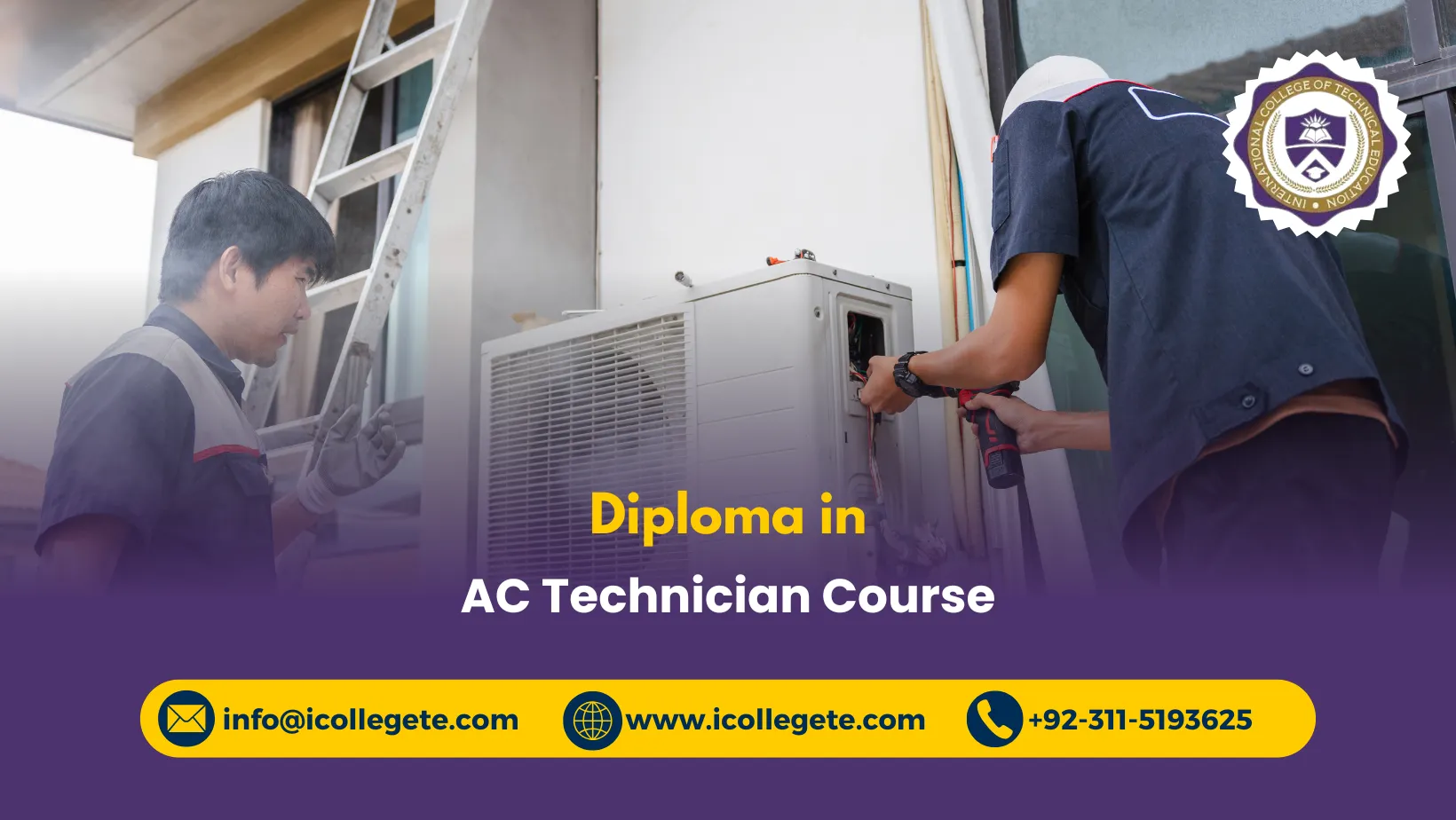
The Diploma in AC Technician Course in Swabi is a practical, career-focused technical programme designed to develop the knowledge and hands-on skills required to install, maintain, service, and troubleshoot modern air conditioning systems. The course provides structured training in air conditioning principles, refrigeration fundamentals, electrical components, installation procedures, preventive maintenance, fault diagnosis, and energy-efficient cooling technologies.
Learners explore different types of residential and commercial AC systems and develop an understanding of how cooling, refrigeration, electrical, and control components work together. The programme also introduces the correct use of professional AC technician tools and equipment, safe working practices, system testing, servicing procedures, and practical fault-finding techniques.
A major focus of the AC Technician Diploma in Swabi is practical application. Students can develop the ability to perform installation and servicing tasks systematically, identify common system faults, assess equipment performance, and apply appropriate corrective measures. The course also introduces modern air conditioning technologies and energy-efficiency practices relevant to changing customer and industry requirements.
This diploma can be suitable for individuals seeking technical skills for employment, self-employment, AC repair services, refrigeration and HVAC-related work, or progression into more advanced technical training. By combining theoretical understanding with practical applications, the course provides a strong foundation for working confidently with contemporary air conditioning systems.
Course Study Units
Unit 1: Introduction to Air Conditioning Systems
This unit introduces learners to the basic principles and applications of air conditioning technology. Students develop an understanding of how AC systems provide cooling, temperature control, humidity management, and indoor comfort.
Key Topics
- Introduction to air conditioning
- Principles of cooling and heat transfer
- Types of air conditioning systems
- Residential air conditioning systems
- Commercial air conditioning systems
- Split and window AC systems
- Inverter and non-inverter AC systems
- Main components of AC systems
- Refrigerant circuits
- Airflow and ventilation fundamentals
- Basic safety requirements
- Introduction to HVAC terminology
Learning Outcomes
Learners will be able to:
- Explain the basic purpose and operation of air conditioning systems.
- Identify common residential and commercial AC systems.
- Describe the function of major AC components.
- Explain basic cooling and heat-transfer principles.
- Recognise essential AC safety requirements.
Unit 2: Tools and Equipment for AC Technicians
This unit develops knowledge of the tools and equipment used by professional AC technicians for installation, maintenance, testing, and repair.
Key Topics
- Hand tools and AC service tools
- Manifold gauge sets
- Vacuum pumps
- Refrigerant charging equipment
- Digital thermometers
- Clamp meters and multimeters
- Leak detection equipment
- Tube cutters and flaring tools
- Brazing and joining equipment
- Pressure testing equipment
- Electrical testing instruments
- Personal protective equipment
- Safe storage and handling of tools
- Tool inspection and maintenance
Learning Outcomes
Learners will be able to:
- Identify tools commonly used by AC technicians.
- Select appropriate tools for specific technical tasks.
- Use basic measuring and testing equipment safely.
- Explain the importance of tool inspection and maintenance.
- Apply safe working practices when using AC service equipment.
Unit 3: Fundamentals of Refrigeration and Cooling
This unit provides learners with the refrigeration knowledge needed to understand how air conditioning systems transfer heat and produce cooling.
Key Topics
- Refrigeration principles
- Heat and temperature
- Pressure and temperature relationships
- Refrigeration cycle
- Evaporation and condensation
- Compression and expansion
- Refrigeration system components
- Compressor operation
- Condenser operation
- Expansion devices
- Evaporator operation
- Refrigerants and their applications
- Superheat and subcooling fundamentals
- Refrigeration system performance
Learning Outcomes
Learners will be able to:
- Explain the basic refrigeration cycle.
- Describe the function of refrigeration components.
- Explain the relationship between pressure and temperature.
- Identify the stages of the cooling process.
- Understand basic refrigerant-system performance indicators.
Unit 4: Electrical Components in AC Systems
This unit introduces the electrical principles and components used in modern air conditioning systems. Learners develop the ability to identify electrical components and understand their role in safe AC operation.
Key Topics
- Basic electrical principles
- Voltage, current, resistance, and power
- AC electrical circuits
- Wiring and electrical connections
- Capacitors
- Relays and contactors
- Compressors and motors
- Fans and fan motors
- Thermostats and temperature sensors
- Circuit protection devices
- Printed circuit boards
- Inverter control systems
- Electrical safety
- Basic electrical testing
Learning Outcomes
Learners will be able to:
- Explain basic electrical concepts relevant to AC systems.
- Identify common electrical components.
- Describe the purpose of capacitors, relays, contactors, and sensors.
- Interpret basic AC electrical circuits.
- Carry out basic electrical checks using suitable instruments.
- Apply appropriate electrical safety procedures.
Unit 5: Installation of Residential and Commercial AC Units
This unit focuses on the practical installation of air conditioning systems in residential and commercial environments. Learners examine installation planning, equipment positioning, pipework, electrical connections, drainage, testing, and commissioning.
Key Topics
- Installation planning
- Site assessment
- Selecting suitable AC locations
- Indoor and outdoor unit positioning
- Mounting procedures
- Refrigerant pipe installation
- Copper pipe preparation
- Flaring and joining
- Drainage installation
- Electrical connections
- Insulation requirements
- Vacuuming procedures
- Leak testing
- Refrigerant charging fundamentals
- System testing and commissioning
- Installation safety
Learning Outcomes
Learners will be able to:
- Assess basic site requirements for AC installation.
- Identify suitable locations for indoor and outdoor units.
- Install basic refrigerant and drainage pipework.
- Make appropriate electrical connections under safe procedures.
- Carry out essential installation checks.
- Test and commission AC systems systematically.
Unit 6: Maintenance and Servicing Techniques
This unit develops practical skills for maintaining AC systems and keeping equipment operating safely and efficiently. Learners examine preventive maintenance, cleaning, inspection, performance testing, and servicing procedures.
Key Topics
- Preventive maintenance
- AC inspection procedures
- Cleaning indoor units
- Cleaning outdoor condenser coils
- Air filter maintenance
- Evaporator and condenser inspection
- Drainage system cleaning
- Electrical component inspection
- Refrigerant-system checks
- Airflow testing
- Temperature measurement
- Performance checks
- Service schedules
- Maintenance documentation
- Safe servicing practices
Learning Outcomes
Learners will be able to:
- Explain the importance of preventive AC maintenance.
- Perform routine inspection and cleaning tasks.
- Check airflow, temperature, and basic system performance.
- Identify signs of wear, contamination, and component problems.
- Maintain appropriate servicing records.
- Apply safe maintenance procedures.
Unit 7: Troubleshooting and Fault Diagnosis
This unit develops systematic fault-finding skills for common air conditioning problems. Students learn how to collect information, inspect equipment, conduct appropriate tests, identify probable causes, and select corrective actions.
Key Topics
- Fault diagnosis principles
- Systematic troubleshooting
- Cooling-performance problems
- Refrigerant-related faults
- Compressor problems
- Condenser and evaporator faults
- Fan and motor problems
- Electrical faults
- Sensor and thermostat problems
- Drainage faults
- Unusual noise and vibration
- Water leakage
- Poor airflow
- High energy consumption
- Error codes and control systems
- Fault reporting and corrective action
Learning Outcomes
Learners will be able to:
- Apply a systematic approach to AC fault diagnosis.
- Identify common operational problems.
- Use appropriate tools to investigate faults.
- Analyse symptoms and identify probable causes.
- Recommend suitable corrective actions.
- Document technical findings and completed repairs.
Unit 8: Energy Efficiency and Modern AC Technologies
This unit introduces energy-efficient air conditioning practices and modern technologies that are transforming the cooling industry. Learners explore how system selection, maintenance, controls, and operating practices can influence energy consumption.
Key Topics
- Energy efficiency fundamentals
- Energy consumption in AC systems
- Inverter technology
- Variable-speed compressors
- Smart thermostats and controls
- Energy-efficient motors
- Modern refrigerant technologies
- Heat pump technology
- Smart AC systems
- Zoning and temperature control
- Efficient installation practices
- Preventive maintenance and efficiency
- Environmental considerations
- Sustainable cooling practices
- Modern AC industry trends
Learning Outcomes
Learners will be able to:
- Explain factors affecting AC energy consumption.
- Describe the benefits of inverter technology.
- Identify modern energy-efficient AC technologies.
- Explain how maintenance influences system efficiency.
- Recommend practical energy-saving measures.
- Understand emerging developments in air conditioning technology.
Unit 9: Final Project and Practical Applications
The final unit allows learners to integrate their theoretical knowledge and practical skills through an AC technician project. Students can demonstrate their ability to plan, inspect, install, service, test, and troubleshoot an air conditioning system.
Key Topics
- Practical project planning
- AC system selection
- Site assessment
- Installation preparation
- Tool and equipment selection
- Refrigeration-system checks
- Electrical-system checks
- Installation and servicing activities
- System testing
- Fault diagnosis
- Performance evaluation
- Energy-efficiency assessment
- Safety checks
- Technical documentation
- Final practical assessment
Learning Outcomes
Learners will be able to:
- Plan an appropriate AC technical project.
- Select suitable tools and equipment.
- Apply installation and servicing techniques.
- Conduct basic system testing and fault diagnosis.
- Evaluate AC system performance.
- Demonstrate safe and professional working practices.
- Produce appropriate technical documentation.
Learning Outcomes
On successful completion of the Diploma in AC Technician Course in Swabi, learners should be able to:
- Explain fundamental air conditioning and refrigeration principles.
- Identify different types of residential and commercial AC systems.
- Identify and use common AC technician tools and testing equipment.
- Understand refrigeration cycles and major cooling components.
- Identify electrical components used in air conditioning systems.
- Apply basic electrical testing and safety procedures.
- Support the installation of residential and commercial AC units.
- Carry out routine maintenance and servicing activities.
- Diagnose common mechanical, refrigeration, and electrical faults.
- Apply systematic troubleshooting techniques.
- Understand inverter and energy-efficient AC technologies.
- Apply practical energy-saving measures.
- Follow safe working practices during AC installation and servicing.
- Document maintenance, testing, and fault-diagnosis activities.
- Integrate technical knowledge through a practical AC project.
Course Benefits
The Diploma in AC Technician Course in Swabi can provide several practical and professional benefits:
- Develop practical air conditioning installation skills.
- Build a foundation in refrigeration and cooling technology.
- Learn how to use professional AC service tools.
- Develop electrical troubleshooting knowledge.
- Gain practical maintenance and servicing skills.
- Understand residential and commercial AC systems.
- Develop systematic fault-diagnosis abilities.
- Learn about inverter and modern AC technologies.
- Improve workplace safety awareness.
- Develop skills applicable to AC service businesses.
- Support opportunities for employment in technical and maintenance environments.
- Provide a foundation for self-employment and AC repair services.
- Build confidence in practical technical work.
- Develop knowledge relevant to the growing cooling and HVAC sector.
Who Is This Course For?
The Diploma in AC Technician Course in Swabi is suitable for:
- Students interested in technical trades.
- Beginners seeking AC technician training.
- Individuals interested in refrigeration and cooling systems.
- Existing AC helpers who want to develop technical skills.
- Maintenance workers seeking air conditioning knowledge.
- Electricians interested in expanding into AC servicing.
- Mechanical and technical workers.
- Individuals planning to establish an AC installation or repair service.
- Professionals seeking practical knowledge of modern AC technology.
- Entrepreneurs interested in residential and commercial cooling services.
The course can be particularly useful for learners who prefer hands-on technical training and want to develop practical skills alongside theoretical knowledge.
Why Choose the Diploma in AC Technician Course in Swabi?
Choosing the Diploma in AC Technician Course in Swabi can provide learners with a structured route into one of the most practical areas of building services and technical maintenance.
Practical Technical Skills
The programme focuses on real-world AC installation, servicing, maintenance, testing, and troubleshooting rather than theory alone.
Comprehensive AC Knowledge
Learners study the complete technical cycle, from basic air conditioning and refrigeration principles to electrical systems, installation, maintenance, fault diagnosis, and modern technologies.
Industry-Relevant Training
The course addresses technologies and practical activities commonly encountered when working with residential and commercial air conditioning systems.
Strong Troubleshooting Foundation
Fault diagnosis is an important part of AC technician work. The course helps learners develop a systematic approach to identifying problems and determining appropriate corrective actions.
Energy-Efficient Technology
Learners gain awareness of inverter systems, smart controls, efficient components, and modern approaches to reducing unnecessary energy consumption.
Employment and Self-Employment Potential
The practical skills developed through the programme can support opportunities in AC installation, maintenance, servicing, technical support, and independent AC repair businesses.
Local Learning Opportunity
For learners in Swabi and surrounding areas, studying an AC technician diploma can provide access to technical training relevant to residential, commercial, and maintenance requirements within the local market.
Future Progression of the Course
After completing the Diploma in AC Technician Course in Swabi, learners can consider developing their technical knowledge through additional training and workplace experience in areas such as:
- Advanced Air Conditioning Technology
- Refrigeration Technology
- HVAC Technology
- Commercial HVAC Systems
- Industrial Refrigeration
- Heat Pump Technology
- Building Services Engineering
- Electrical Installation and Maintenance
- Inverter and Smart AC Systems
- HVAC Maintenance Management
- Energy-Efficient Cooling Systems
- Refrigeration and Air Conditioning Controls
Learners may also progress professionally by gaining supervised workplace experience and developing specialist skills in commercial air conditioning, refrigeration systems, HVAC controls, heat pumps, cold rooms, central cooling systems, and energy-efficient technologies.
For entrepreneurs, the knowledge gained can also provide a foundation for developing an AC installation, maintenance, servicing, or repair business, subject to applicable local requirements, competency expectations, and safety regulations.
Career Opportunities
Depending on additional qualifications, practical experience, and local employment requirements, successful learners may pursue roles such as:
- AC Technician
- Air Conditioning Technician
- AC Installation Technician
- AC Maintenance Technician
- Refrigeration Technician
- HVAC Technician
- AC Service Technician
- HVAC Maintenance Assistant
- Cooling System Technician
- Residential AC Technician
- Commercial AC Technician
- Refrigeration and Air Conditioning Assistant
- AC Repair Technician
- HVAC Service Assistant
The qualification can therefore provide a practical foundation for learners seeking to establish themselves in the air conditioning, refrigeration, cooling, and HVAC technical sector.
Take the Next Step Toward World AC Technician Course-Enroll Now