
QA/QC Electrical: Complete Guide to Quality Assurance, Quality Control
Electrical systems are critical to the safety, reliability and performance of residential, commercial, industrial, infrastructure and energy projects. A small installation error, incorrect cable selection, poor termination or inadequate testing can lead to equipment failure, power interruptions, overheating, fire hazards and costly rework. This is why QA/QC Electrical processes are essential throughout the project lifecycle.
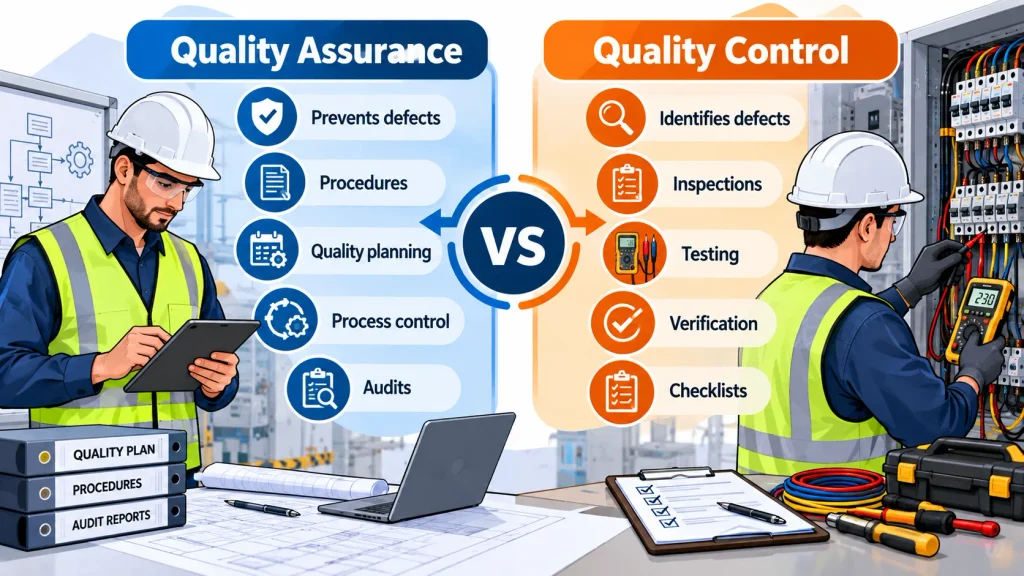
Electrical Quality Assurance (QA) focuses on establishing systems, procedures and controls that prevent quality problems, while Electrical Quality Control (QC) focuses on inspections, measurements, testing and verification to identify whether completed work meets approved requirements.
For electrical engineers, QA/QC engineers, inspectors, contractors, supervisors and project managers, understanding electrical quality management is essential for delivering installations that comply with project specifications, approved drawings, applicable standards and safety requirements.
This complete guide explains QA/QC Electrical, including its meaning, responsibilities, procedures, inspection activities, testing requirements, documentation, checklists, Inspection and Test Plans (ITPs), common defects, required skills and career opportunities.
What is QA/QC Electrical?
QA/QC Electrical refers to the quality assurance and quality control activities used to ensure that electrical equipment, materials, installations and systems meet defined technical, contractual, safety and performance requirements.
Although QA and QC are closely related, they have different purposes.
Electrical Quality Assurance is primarily preventive. It establishes processes that help ensure work is performed correctly from the beginning. QA can include quality plans, procedures, method statements, material approvals, competency requirements, supplier evaluations and document control.
Electrical Quality Control is primarily inspection and verification based. QC checks whether materials and completed work conform to approved drawings, specifications, standards and acceptance criteria.
A typical electrical QA/QC system may cover:
- Electrical materials
- Cables and wiring
- Cable trays and conduits
- Distribution boards
- Switchgear
- Transformers
- Generators
- Motors
- Lighting systems
- Earthing and bonding
- Lightning protection
- Control panels
- Power distribution systems
- Fire alarm systems
- Testing and commissioning
- Inspection documentation
- Non-conformance management
The objective is not simply to find defects. Effective QA/QC aims to prevent defects, verify conformity and provide documented evidence that electrical work has been completed correctly.
Why is Electrical QA/QC Important?
Electrical QA/QC is essential for ensuring that electrical installations, equipment and systems are safe, reliable, functional and compliant with approved project requirements. It provides a structured approach to controlling quality from material selection and installation through inspection, testing and final commissioning.
Effective Electrical QA/QC helps identify defects at an early stage and reduces the likelihood of failures during operation. Without proper quality control, electrical installation problems can affect system performance, increase maintenance requirements and create significant safety and project risks.
Common consequences of poor-quality electrical work include:
- Equipment malfunction or premature failure
- Electrical faults and circuit failures
- Excessive voltage drop
- Cable overheating
- Short circuits
- Insulation deterioration or failure
- Inadequate earthing and bonding
- Incorrect protection-system operation
- Increased electrical fire risk
- Unexpected equipment downtime
- Costly rework and material replacement
- Construction and project delays
- Failed inspections and testing
- Non-compliance with project specifications
- Potential contractual and quality disputes
A well-structured Electrical QA/QC system helps control these risks by establishing clear inspection procedures, testing requirements, acceptance criteria and documentation processes.
Another important benefit is traceability. QA/QC records can demonstrate which material was installed, where it was installed, which approved drawing or specification was followed, what inspection was completed, which tests were conducted, who performed or witnessed the activities and whether the results satisfied the specified acceptance criteria.
This documented approach provides evidence of quality, supports project handover and creates a reliable record for future maintenance, troubleshooting, audits and compliance verification.
Electrical Quality Assurance vs Quality Control
QA and QC are complementary but should not be treated as identical activities.
| Electrical QA | Electrical QC |
|---|---|
| Prevents quality problems | Identifies and verifies quality |
| Process-oriented | Inspection-oriented |
| Establishes procedures | Performs inspections and tests |
| Controls how work is performed | Checks completed work |
| Includes quality planning | Includes inspection records |
| Supports consistency | Verifies conformity |
| Includes audits and process controls | Includes testing and measurements |
For example, an approved cable installation procedure is a QA activity. Inspecting the installed cable for correct routing, identification, termination and physical condition is a QC activity.
Main Responsibilities of an Electrical QA/QC Engineer
An Electrical QA/QC Engineer plays an important role in ensuring that electrical materials, installations, equipment and testing activities comply with approved drawings, technical specifications, project quality requirements and applicable standards.
The exact responsibilities may differ depending on the project type, contract requirements, employer and level of responsibility. However, the following activities are commonly associated with Electrical QA/QC engineering roles.
Reviewing Electrical Drawings
Electrical QA/QC Engineers review approved drawings before and during installation to confirm that electrical works are being executed according to the latest approved design information.
Common documents reviewed may include:
- Single-line diagrams
- Electrical layout drawings
- Cable schedules
- Panel schedules
- Earthing and bonding layouts
- Lighting layouts
- Power distribution layouts
- Control schematics
- Equipment connection drawings
- Detailed installation drawings
- Approved shop drawings
The engineer should also verify that site teams are using the current approved revision and that relevant drawing changes have been incorporated into the installation.
Reviewing Project Specifications
Project specifications establish the technical and quality requirements for electrical materials, installation methods, inspections and testing.
An Electrical QA/QC Engineer reviews these requirements to understand the applicable:
- Material specifications
- Installation requirements
- Inspection criteria
- Testing procedures
- Acceptance criteria
- Documentation requirements
- Applicable codes and standards
Understanding these requirements before inspection helps ensure that electrical work is assessed against the correct criteria.
Inspecting Electrical Materials
Electrical materials should be inspected and verified before installation to confirm that they meet approved project requirements.
Typical material inspection checks may include:
- Manufacturer and supplier
- Model or product type
- Electrical rating
- Size and capacity
- Quantity
- Technical specifications
- Certification and supporting documentation
- Physical condition
- Identification and labelling
- Storage conditions
- Approved material status
Material inspections help prevent incorrect, damaged or non-compliant products from being incorporated into the electrical installation.
Monitoring Electrical Installation Activities
Electrical QA/QC Engineers monitor installation activities at appropriate stages throughout the project rather than relying only on final inspection.
Depending on the project scope, this may include:
- Cable installation
- Cable tray installation
- Conduit installation
- Electrical equipment installation
- Cable termination
- Cable glanding
- Earthing and bonding
- Distribution panel installation
- Equipment connections
- Electrical labelling
- Electrical testing
Progressive inspection helps identify defects early, reducing the potential for costly rework after installation has been completed.
Preparing and Reviewing Inspection Requests
Inspection requests provide a formal process for requesting verification of completed electrical work.
An Electrical QA/QC Engineer may prepare, review or coordinate inspection requests covering specific installation activities. Depending on the project structure, inspections may involve the contractor, consultant, client, engineer or other authorised representatives.
Inspection requests should normally reference the relevant drawings, specifications, inspection criteria and supporting documentation.
Managing Electrical Test Records
Electrical testing provides important evidence that installed systems meet specified requirements.
QA/QC personnel may coordinate, review and maintain records for applicable tests, such as:
- Continuity testing
- Insulation resistance testing
- Earth resistance testing
- Polarity testing
- Phase sequence testing
- Functional testing
- Protection testing
- Equipment testing
Test results should be accurately recorded, reviewed and retained as part of the project’s quality documentation.
Managing Non-Conformances
When electrical work, materials or documentation do not meet specified requirements, the issue may be recorded through a Non-Conformance Report (NCR) or another approved project quality process.
The Electrical QA/QC Engineer may support the process by:
- Identifying the non-conformity
- Documenting the affected work
- Reviewing the applicable requirement
- Supporting root-cause investigation
- Coordinating corrective action
- Verifying completed corrective work
- Arranging re-inspection or re-testing
- Supporting NCR closure
Effective non-conformance management helps prevent recurring quality problems and ensures that deviations are properly controlled and documented.
Electrical QA/QC Inspection Process
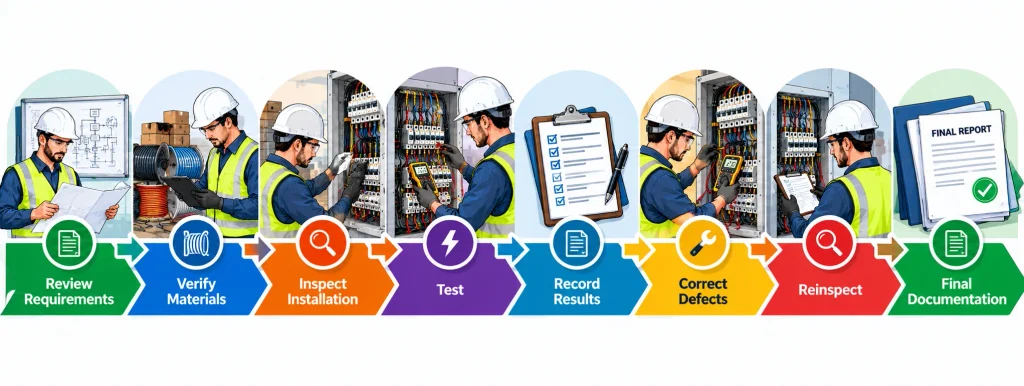
The Electrical QA/QC inspection process is a structured approach used to verify that electrical materials, installation activities and completed systems meet approved project requirements. It normally begins with reviewing technical documents and continues through material verification, installation inspection, testing, defect correction and final documentation.
A well-controlled inspection process helps identify quality issues early, reduce rework and provide documented evidence that electrical works have been inspected and verified.
Review Project Requirements
Before starting an inspection, the QA/QC team reviews the documents and technical requirements applicable to the electrical work.
These may include:
- Approved electrical drawings
- Project specifications
- Approved material submittals
- Method statements
- Inspection and Test Plans (ITPs)
- Applicable codes and standards
- Manufacturer instructions
- Contract requirements
- Approved technical submissions
This review establishes the criteria against which the electrical work will be inspected.
Verify Electrical Materials
Electrical materials should be checked before installation to confirm that they comply with approved requirements.
Verification may cover:
- Material type
- Size and rating
- Manufacturer
- Model or specification
- Quantity
- Certification
- Physical condition
- Identification
- Approved submittal reference
Material verification helps prevent incorrect or non-compliant products from being installed.
Inspect Electrical Installation
The installation is inspected against approved drawings, specifications, method statements and applicable acceptance criteria.
Inspection activities may include checking:
- Cable routing
- Cable support
- Cable trays
- Conduits
- Equipment installation
- Cable termination
- Glanding
- Earthing and bonding
- Panel installation
- Identification and labelling
- Equipment connections
Inspections should be performed at appropriate stages so that defects can be identified before they become difficult or costly to correct.
Perform Required Electrical Testing
Required electrical tests are performed using suitable, calibrated instruments and approved testing procedures.
Depending on the system and project requirements, testing may include:
- Continuity testing
- Insulation resistance testing
- Earth resistance testing
- Polarity testing
- Phase sequence testing
- Functional testing
- Protection testing
- Equipment-specific testing
Test methods and acceptance criteria should be based on the applicable project requirements, standards and manufacturer recommendations.
Record Inspection and Test Results
Inspection findings and test results should be accurately documented using approved project forms and records.
Documentation may include:
- Inspection checklists
- Inspection requests
- Test reports
- Measurement results
- Equipment details
- Instrument identification
- Calibration information
- Inspector details
- Approval or acceptance status
Accurate records provide traceability and demonstrate that required quality checks have been completed.
Correct Identified Defects
If an inspection identifies a defect or non-conformity, the affected work should be addressed through the approved project quality process.
Depending on the nature of the issue, corrective action may involve:
- Repair
- Replacement
- Adjustment
- Re-termination
- Reinstallation
- Additional testing
- Document correction
The corrective action should address the identified requirement and be properly recorded.
Reinspection and Retesting
After identified defects or non-conformities have been corrected, the affected electrical work should be inspected again to confirm that the required corrective action has been properly completed.
Where applicable, additional testing may also be performed to verify that the electrical installation, equipment or system meets the specified performance and acceptance requirements.
The QA/QC team reviews the corrective work, confirms compliance with the relevant drawings and specifications, and ensures that any necessary reinspection or retesting is satisfactorily completed before final acceptance.
Updated inspection checklists, test reports and supporting quality records should be maintained to provide clear evidence of the completed corrective action and final verification.
Complete and Close Quality Documentation
Once inspections, testing and corrective actions are complete, the relevant quality records are compiled and maintained as part of the project’s quality documentation.
Final records may contribute to:
- Project handover documentation
- Testing and commissioning records
- As-built documentation
- Quality dossiers
- Operation and maintenance records
- Compliance evidence
A properly completed Electrical QA/QC inspection process therefore provides both quality control during construction and documented evidence of conformity at project completion.applicable, the handover dossier.
What is an Electrical Inspection and Test Plan?
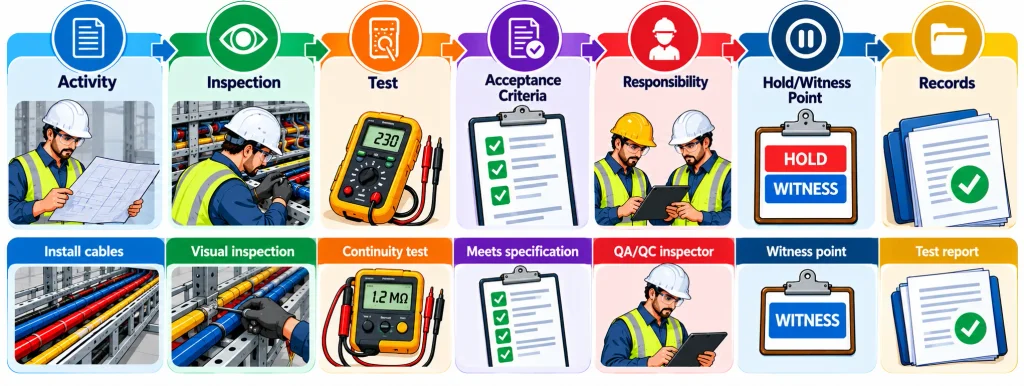
An Electrical Inspection and Test Plan (ITP) is a formal quality control document used to define the inspections, tests and verification activities required during electrical installation and commissioning. It provides a systematic framework for checking that electrical work complies with approved drawings, project specifications, applicable standards and defined acceptance criteria.
An Electrical ITP helps project teams understand what needs to be inspected, when the inspection should take place, what tests are required, who is responsible and what records must be maintained.
A typical Electrical ITP may include:
- Electrical activity or work stage
- Inspection requirements
- Testing requirements
- Applicable specifications and standards
- Acceptance criteria
- Responsible personnel or parties
- Inspection and testing sequence
- Required documentation and records
- Hold points
- Witness points
- Review and approval requirements
For example, an ITP for electrical cable installation may include material verification, cable routing inspection, cable support checks, installation inspection, termination and glanding inspection, insulation resistance testing and final verification.
The specific inspections, tests and acceptance criteria included in an Electrical ITP depend on the project scope, approved specifications, design requirements, applicable standards, manufacturer instructions and contractual requirements. A properly prepared ITP helps maintain consistent quality control, improve traceability and provide documented evidence that electrical work has been inspected and tested as required.
Electrical QA/QC Inspection Checklist
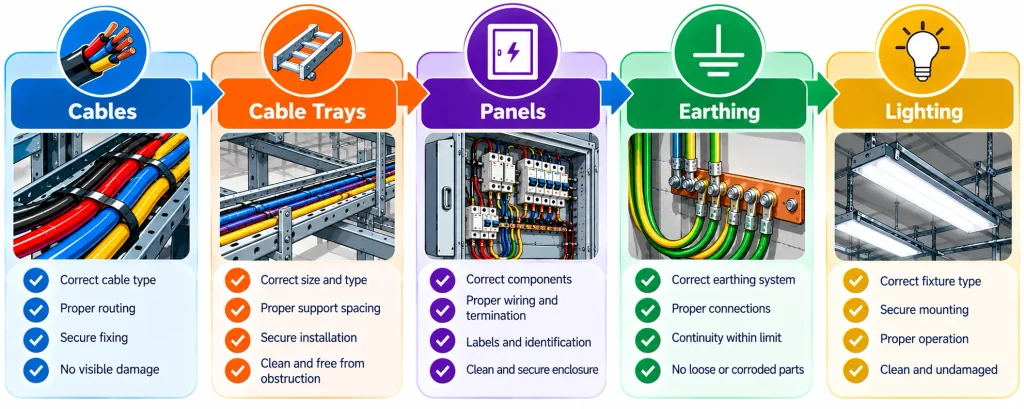
An Electrical QA/QC Inspection Checklist provides a systematic method for verifying that electrical materials, equipment and installation activities meet approved drawings, project specifications, technical requirements and applicable standards. It helps inspectors maintain consistency, identify defects at an early stage and document inspection findings.
The exact checklist should be adapted to the project scope, electrical system, specifications and inspection requirements. A general Electrical QA/QC checklist may include the following areas.
Cable Inspection
Cable inspections help verify that cables have been selected, installed and terminated according to the approved requirements.
Key inspection points may include:
- Correct cable type and construction
- Correct conductor size and rating
- Approved manufacturer and material
- Cable condition and absence of visible damage
- Correct routing and installation path
- Adequate cable support and fixing
- Correct cable identification and labelling
- Appropriate separation from other services
- Compliance with required bending radius
- Correct cable termination
- Suitable cable glands
- Secure and properly completed connections
Cable Tray Inspection
Cable tray inspection confirms that cable support systems are correctly installed and suitable for the intended electrical installation.
Inspection points may include:
- Correct tray type and material
- Required tray dimensions
- Proper support arrangement
- Secure fixing and anchoring
- Correct routing
- Required clearances
- Properly completed joints
- Suitable electrical bonding
- Adequate corrosion protection
- Correct tray identification and labelling
Electrical Panel Inspection
Electrical panel inspections help verify that distribution boards, control panels and related equipment have been installed correctly and are ready for testing or operation.
Typical checks include:
- Correct panel identification
- Approved equipment and components
- Correct voltage and current rating
- Secure and level mounting
- Correct incoming cable connections
- Correct outgoing circuit connections
- Proper cable termination and glanding
- Clear circuit identification
- Proper earthing connection
- Clean and orderly internal arrangement
- Correct protective devices
- Appropriate equipment clearances
Earthing and Bonding Inspection
Earthing inspection is an important part of electrical quality control because the earthing system contributes to electrical safety and fault protection.
Inspection points may include:
- Correct earthing arrangement
- Appropriate conductor size and type
- Secure earthing connections
- Proper bonding between required components
- Correct installation of earth electrodes or related components
- Accessible testing points where required
- Appropriate earthing identification
- Verified continuity
- Completed earth resistance or other required test records
Lighting Installation Inspection
Lighting inspections verify that luminaires and associated electrical connections have been installed according to approved layouts and specifications.
The inspection may cover:
- Correct lighting fixture type
- Correct installation location
- Secure fixture mounting
- Correct electrical connections
- Proper cable termination
- Circuit identification
- Correct switching arrangements
- Suitable installation condition
- Functional testing
- Verification against approved lighting layouts
A comprehensive Electrical QA/QC checklist should be supported by relevant drawings, specifications, Inspection and Test Plans, approved materials, testing procedures and acceptance criteria. This ensures that inspection activities are not only completed systematically but also provide reliable evidence of electrical installation quality and conformity.
Electrical Testing and Verification
Electrical testing and verification are essential components of Electrical Quality Control because visual inspection alone cannot confirm many of the electrical, functional and performance characteristics of an installation. Testing provides measurable evidence that electrical systems, equipment and components have been installed correctly and perform according to approved requirements.
The specific tests required depend on the type of electrical system, project specifications, equipment manufacturer requirements, applicable standards and approved testing procedures.
| Test | Main Purpose |
|---|---|
| Continuity Test | Verifies electrical continuity |
| Insulation Resistance Test | Assesses insulation resistance |
| Earth Resistance Test | Evaluates earthing performance |
| Polarity Test | Verifies correct polarity |
| Phase Sequence Test | Verifies phase rotation |
| Functional Test | Confirms intended operation |
| Protection Test | Verifies protective-device operation |
Electrical QA/QC Documentation
Electrical QA/QC documentation is a fundamental part of an effective quality management system. It provides documented evidence that electrical materials, installation activities, inspections, testing and corrective actions have been completed in accordance with approved project requirements.
Well-organised quality records also improve traceability, accountability and project control. They allow project teams to verify what was installed, which requirements were followed, what inspections were performed and whether the relevant tests achieved the required results.
Common Electrical QA/QC Documents
Depending on the project scope and contractual requirements, Electrical QA/QC documentation may include:
- Approved electrical drawings
- Approved material submittals
- Material inspection reports
- Method statements
- Inspection requests
- Electrical inspection checklists
- Inspection and Test Plans (ITPs)
- Electrical test reports
- Calibration certificates
- Non-Conformance Reports (NCRs)
- Corrective action records
- Equipment certificates
- Manufacturer technical documentation
- Test and commissioning records
- As-built drawings
- Quality inspection records
- Handover documentation
Importance of Electrical QA/QC Records
Accurate documentation demonstrates that required quality activities have been properly planned, performed, inspected and verified. It can also help identify the responsible parties, inspection dates, equipment used, test results and approval status.
Electrical QA/QC records can support:
- Quality verification
- Material and installation traceability
- Regulatory and contractual compliance
- Internal and external audits
- Defect investigation
- Troubleshooting
- Maintenance activities
- Testing and commissioning
- Project handover
- Future system modifications
A complete and properly maintained Electrical QA/QC documentation system therefore provides a reliable quality history of the project and supports the long-term operation, maintenance and management of electrical installations.
Calibration of Electrical Testing Instruments
Electrical test equipment must provide reliable measurements.
Depending on project requirements, instruments may need valid calibration certificates.
Examples include:
- Multimeters
- Insulation resistance testers
- Earth resistance testers
- Clamp meters
- Phase sequence meters
- Primary or secondary injection test equipment
- Power quality analysers
QA/QC personnel should verify that equipment is suitable for the intended test and that calibration status meets project requirements.
Common Electrical QA/QC Defects
Common electrical quality problems can include:
- Incorrect cable size
- Incorrect cable routing
- Poor cable termination
- Missing cable identification
- Damaged cable insulation
- Incorrect gland selection
- Inadequate earthing
- Poor bonding
- Improper cable support
- Incorrect panel labelling
- Incorrect protection settings
- Incomplete testing
- Missing inspection records
- Unapproved materials
- Installation against superseded drawings
Identifying these issues early can reduce rework and project delays.
How to Prevent Electrical Quality Problems
Preventing electrical quality problems is more effective than relying solely on final inspections to identify defects after installation. A proactive Electrical QA/QC system establishes quality controls throughout the project lifecycle, from document review and material procurement to installation, inspection, testing and final handover.
The following practices can help reduce defects, rework, delays and non-conformities.
Use Current Approved Documentation
Electrical installation teams should work only with the latest approved drawings, specifications, method statements and relevant procedures. Using outdated or superseded documents can result in incorrect installation and unnecessary rework.
Verify Materials Before Installation
Electrical materials should be inspected and verified before they are incorporated into the project. Checking type, size, rating, manufacturer, condition and approval status can help prevent non-compliant or unsuitable materials from being installed.
Carry Out Progressive Inspections
Electrical work should be inspected at appropriate stages rather than waiting until the entire installation is complete. Progressive inspections allow defects to be identified and corrected while they are still accessible.
Use Standardised Inspection Checklists
Clear and project-specific QA/QC checklists help inspectors systematically verify installation requirements. Standardised checklists can also improve consistency between different inspection teams and work areas.
Perform Required Testing
Electrical systems should undergo the tests specified by the project requirements and approved testing procedures. Testing helps identify issues that may not be visible during a physical inspection.
Maintain Accurate Test Records
All required electrical test results should be recorded accurately and retained as part of the project quality documentation. Records should provide sufficient information to support traceability and verification.
Manage Non-Conformities Effectively
Identified defects and deviations should be documented through the appropriate quality process. Corrective actions should be completed, verified and, where required, followed by reinspection or retesting before acceptance.
Maintain Complete Traceability
Materials, equipment, inspections, tests and installation locations should be traceable wherever required by the project. Proper traceability makes it easier to investigate defects, verify compliance and maintain reliable project records.
Coordinate Quality Activities
Effective communication between Electrical QA/QC Engineers, site engineers, supervisors, contractors, consultants and other project stakeholders helps ensure that quality requirements are understood and implemented consistently.
A preventive approach to Electrical QA/QC helps identify potential problems early, reduce costly rework and improve the overall reliability and compliance of electrical installations.
Electrical QA/QC Standards and Codes
Electrical QA/QC requirements depend on the project location, electrical system, contract and applicable regulations.
Commonly referenced international standards and codes can include:
- IEC standards
- IEEE standards
- NFPA requirements
- BS standards
- NEC requirements
- Local electrical regulations
- Utility requirements
- Client specifications
- Manufacturer instructions
No single standard applies to every electrical installation. QA/QC personnel should identify the standards specifically referenced by the project’s contract documents, local regulations and engineering design.
QA/QC Electrical in Construction Projects
Electrical QA/QC is particularly important in construction because electrical installation often occurs alongside civil, mechanical, architectural and other works.
Typical construction activities may include:
Design → Material Approval → Procurement → Material Inspection → Installation → Inspection → Testing → Commissioning → Handover
Quality controls should be incorporated throughout this lifecycle.
For example, a cable should not simply be checked after installation. Its specification, procurement, delivery, storage, installation, termination and testing may all require appropriate controls.
Electrical QA/QC for Industrial Projects
Industrial facilities often contain complex electrical systems with significant operational and safety requirements.
QA/QC activities may involve:
- High-voltage equipment
- Transformers
- Switchgear
- Motor control centres
- Motors
- Variable frequency drives
- Generators
- Distribution systems
- Protection systems
- Instrumentation interfaces
- Control systems
- Emergency power systems
The inspection and testing requirements should be determined by the approved design, project specifications, applicable standards and equipment manufacturer requirements.
Skills Required for an Electrical QA/QC Engineer
An Electrical QA/QC Engineer requires a combination of technical knowledge, inspection capability, quality management expertise and effective communication skills. The following table summarises the key skills needed for electrical QA/QC roles:
| Skill | Description |
|---|---|
| Electrical Engineering Fundamentals | Understanding electrical systems, components, circuits, equipment and installation principles. |
| Drawing Interpretation | Ability to read and interpret single-line diagrams, layouts, schematics, cable schedules and other technical drawings. |
| Electrical Inspection | Ability to inspect electrical materials, equipment and installations against approved requirements. |
| Electrical Testing | Knowledge of common electrical testing methods, procedures, instruments and test documentation. |
| Quality Management | Understanding of quality planning, inspection procedures, acceptance criteria and quality control processes. |
| Technical Documentation | Ability to prepare, review and maintain inspection reports, checklists, ITPs, test records and quality documents. |
| Root-Cause Analysis | Ability to investigate defects and identify the underlying causes of electrical quality problems. |
| Problem-Solving | Ability to assess quality issues and support practical corrective and preventive actions. |
| Risk Awareness | Understanding of potential electrical, installation and quality risks and appropriate control measures. |
| Report Writing | Ability to produce clear, accurate and professional inspection, testing and quality reports. |
| Communication | Ability to communicate technical requirements and quality findings with engineers, contractors, inspectors and project stakeholders. |
| Non-Conformance Management | Knowledge of identifying, documenting, correcting and closing electrical non-conformities. |
| Knowledge of Electrical Standards | Familiarity with relevant electrical codes, standards, project specifications and technical requirements. |
| Construction Knowledge | Understanding of electrical construction methods, installation sequences and site activities. |
| Attention to Detail | Ability to identify installation defects, documentation errors and deviations from approved requirements. |
| Digital Documentation | Ability to use digital quality management systems, electronic inspection forms and document-control platforms. |
| Project Management Skills | Understanding of project schedules, coordination, reporting and quality activities within construction projects. |
Strong digital documentation and project coordination skills are becoming increasingly valuable as electrical construction projects adopt cloud-based quality systems, mobile inspection tools and digital project management platforms.
How to Become an Electrical QA/QC Engineer
A typical career pathway may involve:
Electrical Education → Site Experience → Electrical Inspection Skills → QA/QC Knowledge → Specialist Training → QA/QC Engineer Role
Relevant qualifications may include electrical engineering, electrical technology, construction-related qualifications or technical education combined with practical experience.
Additional training in quality management, electrical inspection, testing, health and safety and relevant standards can strengthen professional capability.
Employers may also look for experience with construction documentation, inspection requests, ITPs, testing records and non-conformance processes.
Career Opportunities in Electrical QA/QC
Electrical QA/QC professionals can work across a range of sectors, including:
- Building construction
- Industrial construction
- Manufacturing
- Energy
- Power generation
- Transmission and distribution
- Infrastructure
- Oil and gas
- Renewable energy
- Data centres
- Commercial facilities
- Facilities management
- Engineering and contracting companies
Potential job titles include:
- Electrical QA/QC Engineer
- Electrical QC Inspector
- Electrical QA/QC Inspector
- Electrical Quality Engineer
- Electrical Site Engineer
- Electrical Testing Engineer
- Electrical Commissioning Engineer
- Quality Control Engineer
- Electrical Inspection Engineer
Actual job requirements vary by employer, project and jurisdiction.
QA/QC Electrical Course and Professional Development
A specialised QA/QC Electrical course can help learners develop knowledge of electrical inspection, quality control procedures, testing, documentation and project quality requirements.
A well-structured course may cover:
- Fundamentals of electrical QA/QC
- Electrical drawings and specifications
- Material inspection
- Cable and tray inspection
- Electrical equipment inspection
- Earthing and bonding
- Electrical testing
- Inspection and Test Plans
- Quality checklists
- Non-conformance management
- Corrective actions
- Documentation and reporting
- Testing and commissioning
For learners seeking to enter or progress within electrical construction quality roles, practical understanding should be combined with relevant technical knowledge and workplace experience.
QA/QC Electrical Career Progression
Career progression can develop through increasing technical responsibility and project experience.
A possible pathway is:
Electrical Technician → Electrical Inspector → Electrical QA/QC Inspector → Electrical QA/QC Engineer → Senior QA/QC Engineer → QA/QC Manager
Progression depends on qualifications, technical competence, project experience, employer requirements and professional development.
Conclusion
Electrical QA/QC is essential for ensuring that electrical materials, installations, equipment and systems meet approved drawings, specifications, testing requirements and applicable standards. From material inspection and installation checks to electrical testing, documentation and non-conformance management, each activity contributes to improving quality, reliability and project performance.
For Electrical QA/QC Engineers, developing strong technical, inspection, testing, documentation and communication skills can support effective quality management across construction, industrial, infrastructure and energy projects. A proactive QA/QC approach helps reduce defects, minimise rework and provide reliable evidence that electrical works have been properly inspected and verified.