
OSHA 10-Hour vs 30-Hour Course: Differences, Topics and Who Should Choose
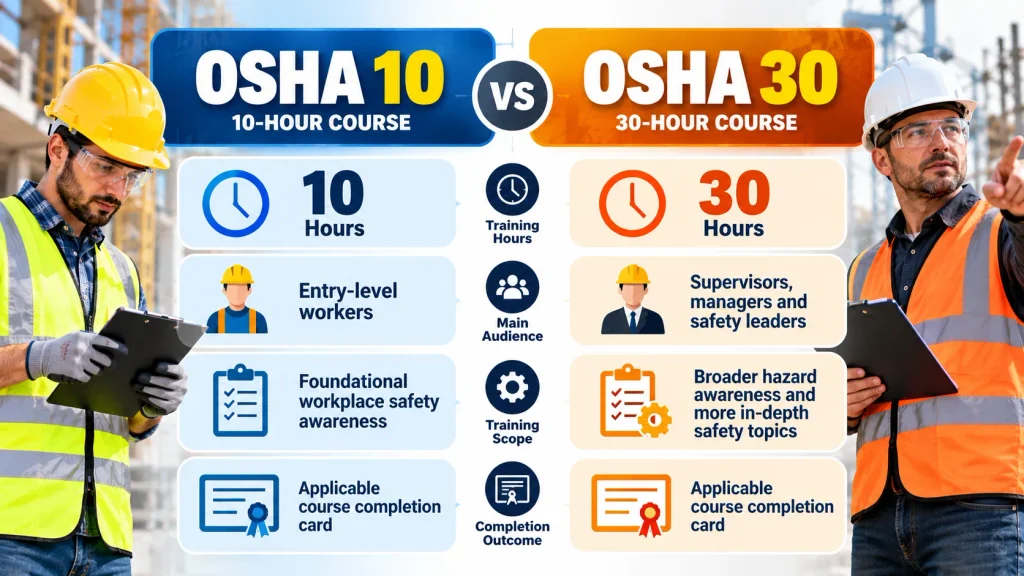
The main difference between the OSHA 10-Hour vs 30-Hour course is the depth of training and the intended audience. The 10-hour course is designed primarily for entry-level workers who need basic workplace hazard awareness, while the 30-hour course provides broader training for supervisors and workers with safety responsibilities. Both belong to the US Occupational Safety and Health Administration’s (OSHA) Outreach Training Program, and the appropriate option depends on the learner’s job duties, industry and employer requirements.
Choosing between OSHA 10-hour and OSHA 30-hour training involves more than comparing the number of hours. Learners should consider the hazards associated with their work, whether they supervise others, which industry-specific course applies, and whether a particular employer or project requires a specified completion card.
This guide compares the two options, explains their topics and intended audiences, and discusses what learners in Pakistan, the United Kingdom and other countries should verify before enrolling.
What is OSHA and What Does It Do?
OSHA stands for the Occupational Safety and Health Administration, a federal agency within the United States Department of Labor. Its responsibilities include administering workplace safety and health requirements within its jurisdiction, enforcing applicable standards, supporting compliance and providing occupational safety and health education.
The OSHA Outreach Training Program helps workers and employers recognise, avoid, prevent and control workplace hazards. It also introduces workers’ rights, employer responsibilities and the process for filing a complaint.
The program includes separate 10-hour and 30-hour training options for Construction and General Industry, among other industry-specific offerings. The course duration indicates the required instructional time; it does not, by itself, determine whether a learner is qualified to perform a specialist safety role.
An important distinction is that OSHA Outreach training is not a professional certification or licence. Completing a course results in a course completion card when the learner meets the applicable program requirements. It does not automatically satisfy every training obligation under individual OSHA standards.
What is the OSHA 10-Hour Course?
The OSHA 10-hour course is introductory occupational safety and health training intended primarily for entry-level workers. It helps learners recognise common hazards, understand basic prevention measures and become familiar with essential workplace safety responsibilities.
The course is available in different industry tracks, including Construction and General Industry. Learners should select the version relevant to their workplace rather than assuming that all OSHA 10-hour courses have identical content.
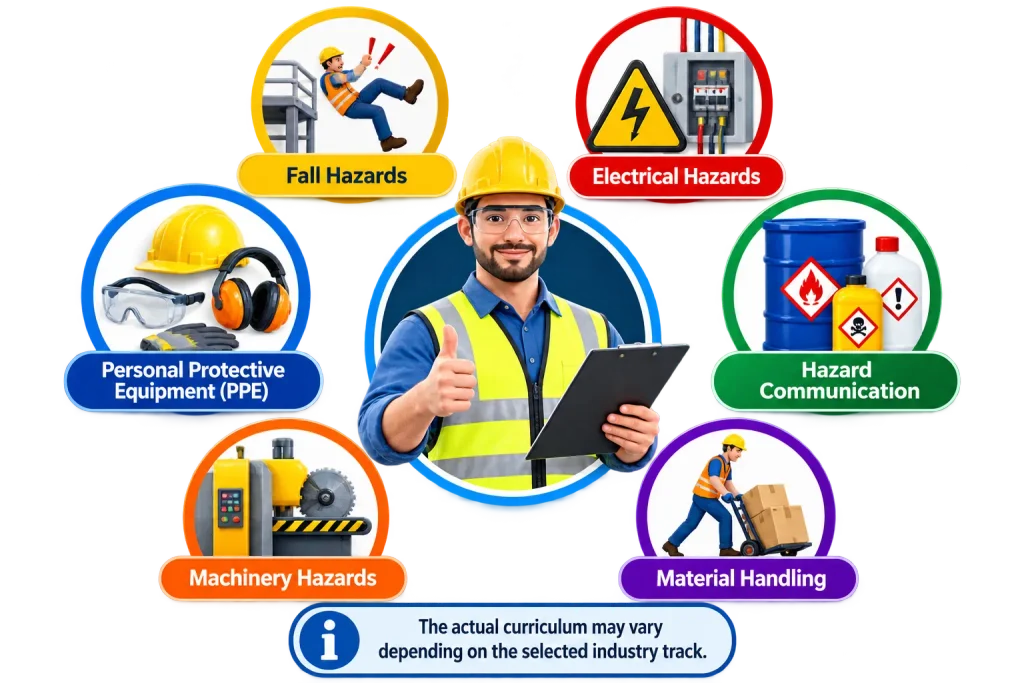
Depending on the selected track and approved curriculum, topics may include:
- Introduction to OSHA and workplace safety responsibilities
- Hazard recognition and prevention
- Fall hazards and safe access
- Electrical safety
- Personal protective equipment (PPE)
- Hazard communication
- Safe material handling
- Worker rights and employer responsibilities
The precise curriculum varies by industry and course requirements. Learners should check the relevant official topic outline before enrolling.
Who is the OSHA 10-hour course suitable for?
The 10-hour option is generally appropriate for construction labourers, warehouse operatives, production workers, maintenance assistants and other employees who need foundational safety awareness.
For example, a new construction worker may need to recognise unprotected edges, unsafe ladder use and electrical hazards. Introductory training can help the worker understand these risks and the importance of following established safe working procedures.
The course is also useful for learners who want a structured introduction to occupational safety before taking on additional workplace responsibilities.
However, the 10-hour course does not replace task-specific instruction, practical competency assessment or any additional training required for hazardous activities.
What is the OSHA 30-Hour Course?
The OSHA 30-hour course provides more extensive occupational safety and health training for supervisors and workers who have safety-related responsibilities. It covers a broader range of workplace hazards and allows more instructional time for relevant topics.
Like the 10-hour option, the 30-hour course is available in different industry tracks. The Construction version addresses hazards associated with construction activities, while General Industry training focuses on relevant hazards in workplaces such as manufacturing facilities and warehouses.
Depending on the track and curriculum, the training may cover:
- Hazard recognition, avoidance and control
- Workplace safety management
- Inspection and prevention practices
- Fall protection and electrical hazards
- Personal protective equipment
- Hazard communication
- Emergency planning and safe work procedures
- Worker rights and employer responsibilities
- Additional industry-specific hazards
The course is intended to provide broader awareness and knowledge, not to establish that a participant is automatically competent to manage every workplace risk.
Who is the OSHA 30-hour course suitable for?
The 30-hour option is particularly relevant to forepersons, team leaders, construction supervisors, maintenance supervisors and other workers with safety responsibilities.
For example, a site supervisor may need to coordinate several subcontractors working near lifting equipment, temporary electrical installations and elevated work areas. Broader safety training can help the supervisor recognise hazards, communicate concerns and understand the importance of suitable preventive controls.
A learner does not necessarily need to supervise employees to benefit from 30-hour training. Some employers or projects may specify the course for particular roles, so the applicable requirement should always be checked.
OSHA 10-Hour vs 30-Hour Course: Key Differences
The comparison below summarises the principal differences between the two OSHA Outreach options.
| Comparison factor | OSHA 10-hour | OSHA 30-hour |
|---|---|---|
| Instructional duration | 10 hours | 30 hours |
| Main audience | Entry-level workers | Supervisors and workers with safety responsibilities |
| Training scope | Foundational hazard awareness | Broader and more detailed hazard coverage |
| Safety management | Introductory concepts | Greater emphasis on safety responsibilities and management topics |
| Industry tracks | Includes Construction and General Industry | Includes Construction and General Industry |
| Completion outcome | Eligible course completion card | Eligible course completion card |
| Prerequisite | Check the relevant program requirements | OSHA 10 is not generally a prerequisite |
| Professional licence | No | No |
| Best selection factor | Worker’s duties and required training | Safety responsibilities and required training |
Which course provides more detailed training?
The 30-hour course offers more instructional time and a wider range of topics. It is generally the more suitable option when a worker needs broader hazard awareness or has supervisory responsibilities.
Nevertheless, more training hours do not automatically make someone a qualified safety officer, competent person or occupational safety professional. Such positions may require additional qualifications, practical experience, role-specific competence and employer-approved training.
Is OSHA 30 three times more useful than OSHA 10?
No. The number of instructional hours does not translate directly into three times the practical value.
A worker who needs introductory hazard awareness may find the 10-hour option more appropriate. A supervisor responsible for coordinating work and addressing multiple hazards may benefit more from the broader 30-hour curriculum.
The correct choice depends on job responsibilities, the applicable industry track and any verified employer or project requirements.
What Topics Are Covered in Each Course?
The subjects covered depend on whether the learner selects Construction or General Industry training. OSHA provides program-specific requirements and topic outlines, so learners should not assume that every provider or industry version follows an identical subject list.
Construction safety topics
Construction-related hazards can include falls, electrical risks, struck-by incidents, caught-in or caught-between hazards, excavation risks and unsafe material handling.
A Construction course helps learners recognise relevant hazards and understand preventive practices. The 30-hour version provides additional instructional time and includes broader training appropriate to workers with safety responsibilities.
For example, a construction worker may need to recognise an unsafe access ladder, while a supervisor may also need to consider access arrangements, work coordination, hazard reporting and the adequacy of preventive controls.
General Industry safety topics
General Industry training is relevant to settings such as factories, warehouses, production facilities and maintenance operations.
Depending on the curriculum, relevant hazards may include:
- Machinery and equipment hazards
- Electrical risks
- Hazardous substances and hazard communication
- Slips, trips and falls
- Material handling and ergonomics
- Personal protective equipment
- Emergency procedures
- Workplace inspection and hazard prevention
A warehouse operative may need to recognise unsafe pedestrian routes near moving equipment. A warehouse supervisor may also need to consider how traffic routes are managed, how hazards are reported and whether corrective actions are followed up.
Does OSHA 30 cover everything in OSHA 10?
The two courses share foundational safety concepts, but they are distinct Outreach programs with separate completion requirements. A learner should not assume that taking one automatically provides the completion card for the other.
OSHA 30 is not simply an automatic upgrade in which an existing OSHA 10 card is exchanged for a 30-hour card. The learner must complete the applicable 30-hour program requirements.
Construction vs General Industry: Which Track Should You Choose?
Selecting the correct industry track is as important as choosing the training duration.
| Workplace or activity | Track to investigate | Example of relevant hazards |
|---|---|---|
| Building construction | Construction | Falls, electrical hazards, excavation |
| Civil engineering site | Construction | Plant movement, falls, struck-by hazards |
| Manufacturing facility | General Industry | Machinery, chemicals, electrical risks |
| Warehouse operations | General Industry | Material handling, traffic routes, falls |
| Industrial maintenance | General Industry, subject to duties | Equipment, energy sources, hazardous substances |
| Mixed industrial or construction project | Confirm the employer’s requirement | Hazards across multiple work activities |
This table is a practical guide, not a definitive classification for every workplace. A project’s legal classification, job duties and employer requirements may affect the appropriate selection.
Before enrolling, learners should confirm the industry track with the employer or project manager and check the applicable OSHA topic requirements.
Who Should Take OSHA 10-Hour Training?
OSHA 10-hour training is generally intended for workers who need introductory workplace hazard awareness rather than extensive training in safety management.
It may be suitable for:
- Construction labourers and general site workers
- Warehouse and logistics operatives
- Manufacturing and production workers
- Maintenance assistants
- Entry-level employees entering safety-conscious workplaces
- Job seekers whose prospective employers request this training
For instance, a new warehouse employee may need to understand pedestrian safety, material handling and hazard reporting before starting work. The OSHA 10-hour course can provide a useful foundation, alongside the employer’s required site induction and task-specific instruction.
The course is not restricted to people who are already employed. OSHA states that participants do not have to be employed to take part in Outreach Training.
Who Should Take OSHA 30-Hour Training?
OSHA 30-hour training is generally intended for workers who have safety responsibilities or need broader occupational hazard awareness.
Potential audiences include:
- Construction forepersons
- Site supervisors
- Manufacturing supervisors
- Warehouse team leaders
- Maintenance supervisors
- Workers with assigned workplace safety responsibilities
- Professionals whose employers or projects specify 30-hour Outreach training
Consider a construction supervisor coordinating work at height, lifting activities and electrical installations. The supervisor may need to understand several overlapping hazards and communicate preventive requirements to different work teams. The broader 30-hour curriculum may be more suitable than introductory training alone.
However, OSHA 30 does not automatically qualify a learner to carry out specialist risk assessments, authorise hazardous work, conduct every type of inspection or fulfil a designated competent-person role. Additional qualifications and practical competence may be necessary.
Is OSHA 10 Required Before OSHA 30?
No. OSHA 10 is not generally a prerequisite for OSHA 30. Learners can enrol directly in the appropriate 30-hour Outreach course without first completing the 10-hour option.
The two programs have different completion requirements. Completing the 10-hour course does not automatically award the 30-hour card, and completing 30-hour training does not mean a learner has separately completed the 10-hour program.
A learner considering both courses should first establish whether both are genuinely required. Taking additional training may be useful in certain circumstances, but it should be based on job responsibilities, employer requirements and learning objectives rather than an assumption that everyone must complete the courses in sequence.
OSHA Training in Pakistan, the UK and International Workplaces
OSHA is a US federal agency. Its Outreach Training Program should not be confused with the workplace safety laws and regulatory authorities of other countries.
Learners outside the United States may still find OSHA training useful, especially when employers, contractors or international projects value familiarity with US workplace safety concepts. However, the relevance of a particular course depends on the job, project and applicable legal requirements.
OSHA training in Pakistan
Learners in Pakistan may consider OSHA-related training when seeking to strengthen their understanding of occupational hazards in construction, manufacturing, logistics or industrial workplaces.
Before enrolling, learners should confirm:
- Whether the employer or project requires the 10-hour or 30-hour option.
- Whether Construction or General Industry training is appropriate.
- Whether the provider is authorised to deliver the specific OSHA Outreach program and arrange its official completion card.
- Whether the advertised course is an official Outreach course or a separate provider-issued safety certificate.
- Which Pakistani workplace safety laws, employer procedures and task-specific training requirements apply.
An OSHA course should not be represented as automatically satisfying every Pakistani legal requirement. The relevant provincial or federal framework and the employer’s obligations must be assessed separately.
OSHA training in the United Kingdom
The United Kingdom has its own workplace health and safety framework, with the Health and Safety Executive (HSE) serving as the regulator for most workplaces in Great Britain. Different arrangements apply in Northern Ireland.
The HSE explains that employers must provide adequate health and safety training when employees start work and when changes in risks, equipment or job responsibilities create additional training needs.
An OSHA 10-hour or 30-hour course may provide useful supplementary knowledge, but it does not automatically demonstrate compliance with UK legal duties or replace training appropriate to a particular role and workplace.
UK learners should check whether the course is relevant to the employer’s requirements and whether additional UK-specific training is needed.
OSHA training for international learners
International learners should distinguish between three separate considerations:
- Learning value: Whether the training improves understanding of workplace hazards and preventive practices.
- Employer acceptance: Whether a prospective employer or project recognises the specific course and completion card.
- Legal compliance: Whether the training meets the applicable requirements in the country and workplace concerned.
These are not interchangeable. A course may be educationally useful without being a legally required qualification or a substitute for locally mandated training.
Benefits and Limitations of OSHA Outreach Training
Potential benefits
OSHA 10-hour and 30-hour training can help learners develop a structured understanding of workplace hazards and prevention.
Potential benefits include:
- Improved awareness of common occupational hazards.
- Better understanding of worker rights and employer responsibilities.
- Greater familiarity with hazard reporting and preventive practices.
- Training relevant to construction or General Industry environments.
- A completion card that may meet a specific employer or project requirement.
- A foundation for further role-specific workplace safety learning.
The usefulness of the training depends on the course content, learner engagement and application of the knowledge in the workplace.
Important limitations
Learners should also understand what the courses do not provide.
- Neither course is a professional licence or safety qualification in itself.
- Neither course automatically fulfils every legal training requirement.
- Completing a course does not prove practical competence in every hazardous activity.
- A completion card does not guarantee employment, promotion or salary increases.
- Recognition by employers, contractors and projects can vary.
- Additional local, industry-specific or task-specific training may be required.
OSHA explicitly describes Outreach training as voluntary at the federal level and explains that the program does not satisfy the training requirements of individual OSHA standards. Some jurisdictions, employers or other organisations may nevertheless require it.
Which Course Should You Choose?
The most appropriate course is the one that matches the learner’s responsibilities and verified requirements.
| Situation | Recommended starting point |
|---|---|
| A new worker needs foundational hazard awareness | OSHA 10-hour |
| A construction worker’s employer specifies a 10-hour card | OSHA 10-hour Construction, subject to verification |
| A warehouse employee needs introductory safety awareness | OSHA 10-hour General Industry, if appropriate |
| A foreperson needs broader safety training | OSHA 30-hour in the relevant industry |
| A supervisor’s project specifies a 30-hour card | OSHA 30-hour in the required industry |
| A UK employer requires local compliance training | Confirm UK-specific requirements first |
| A Pakistani employer specifies a particular safety course | Verify the required course and applicable local obligations |
| The learner is unsure which course is accepted | Ask the employer or project manager before enrolling |
These recommendations are a starting point, not a substitute for checking a specific employer’s rules or applicable law.
Conclusion
The main difference between the OSHA 10-hour and 30-hour courses is their intended audience and the breadth of instruction. The 10-hour course focuses on foundational workplace hazard awareness, while the 30-hour course provides broader training for supervisors and workers with safety responsibilities.
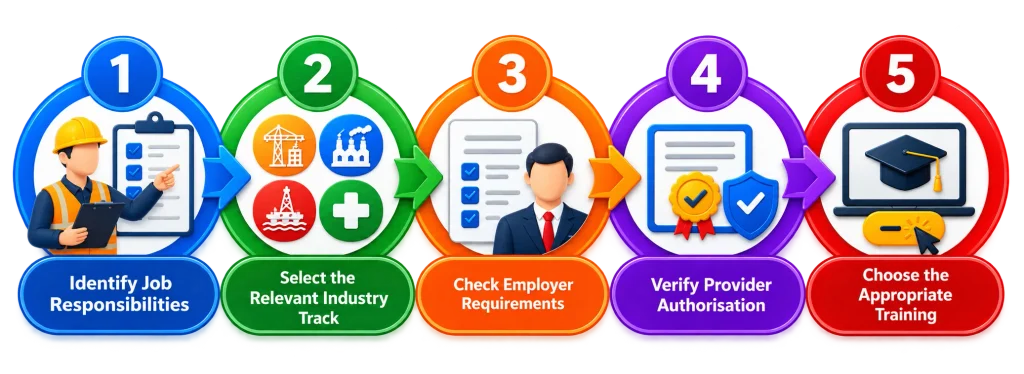
Neither option is universally better. Learners should select the appropriate industry track, check employer or project requirements, verify the provider and understand the limitations of the completion card. International learners should also confirm which local workplace safety requirements apply.