
What is OSHA? Meaning, Role and Workplace Safety Responsibilities
What is OSHA?
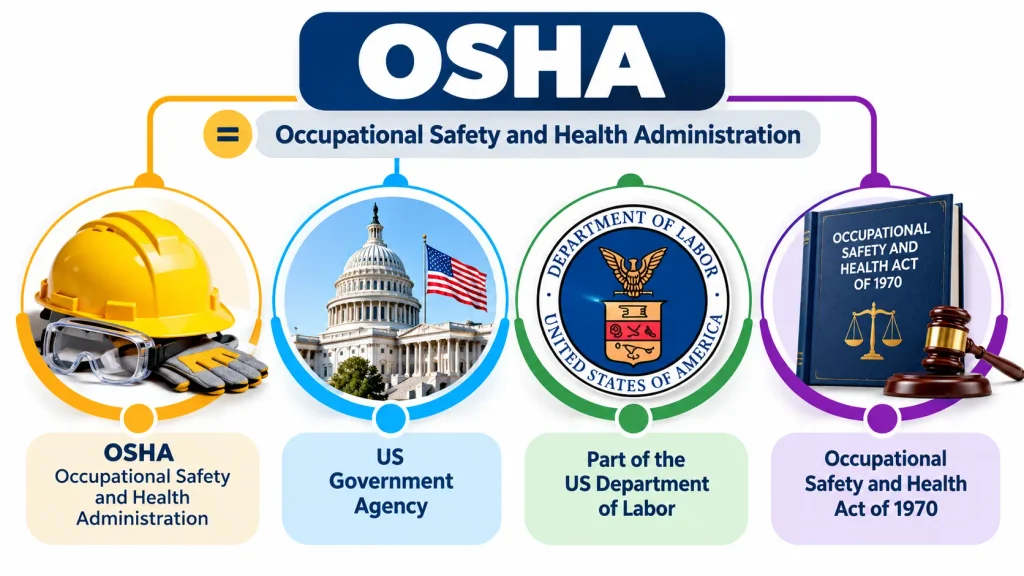
OSHA stands for the Occupational Safety and Health Administration, a United States government agency responsible for helping ensure safe and healthful working conditions for covered workers. It establishes and enforces applicable workplace safety and health standards, provides education and assistance, and protects workers from unlawful retaliation when exercising certain legal rights.
Understanding the OSHA meaning in workplace safety helps workers and employers recognise the importance of hazard prevention, safety training, workplace inspections and compliance with applicable requirements. OSHA is particularly relevant to industries such as construction, manufacturing, warehousing, maintenance and other workplaces where employees may face physical, chemical or environmental hazards.
For learners in Pakistan, the United Kingdom and other countries, it is important to understand that OSHA is a US agency. OSHA training can provide useful occupational safety knowledge, but local laws and employer requirements differ between countries.
This guide explains what OSHA stands for, what OSHA is responsible for, how it supports workplace safety and what learners should understand before choosing an OSHA-related course.
What Does OSHA Stand For?
OSHA stands for the Occupational Safety and Health Administration. It operates within the US Department of Labor and administers workplace safety and health responsibilities under relevant federal legislation, particularly the Occupational Safety and Health Act of 1970.
The agency’s main purpose is to help prevent workplace injuries, illnesses and fatalities by establishing and enforcing applicable standards and supporting workplace safety education.
For example, a construction site may expose workers to falls, moving equipment, electrical hazards and unsafe access routes. OSHA standards may establish requirements relevant to controlling these hazards in workplaces within its jurisdiction. Employers must identify the applicable requirements and implement appropriate safety measures.
The acronym is frequently used in discussions about workplace safety courses, safety procedures, inspections and occupational health requirements. However, OSHA itself is a government agency, not the name of a single training course.
What is OSHA Responsible For?
OSHA has several important responsibilities related to workplace safety and health. Its activities combine regulatory enforcement, worker protection, education and assistance.
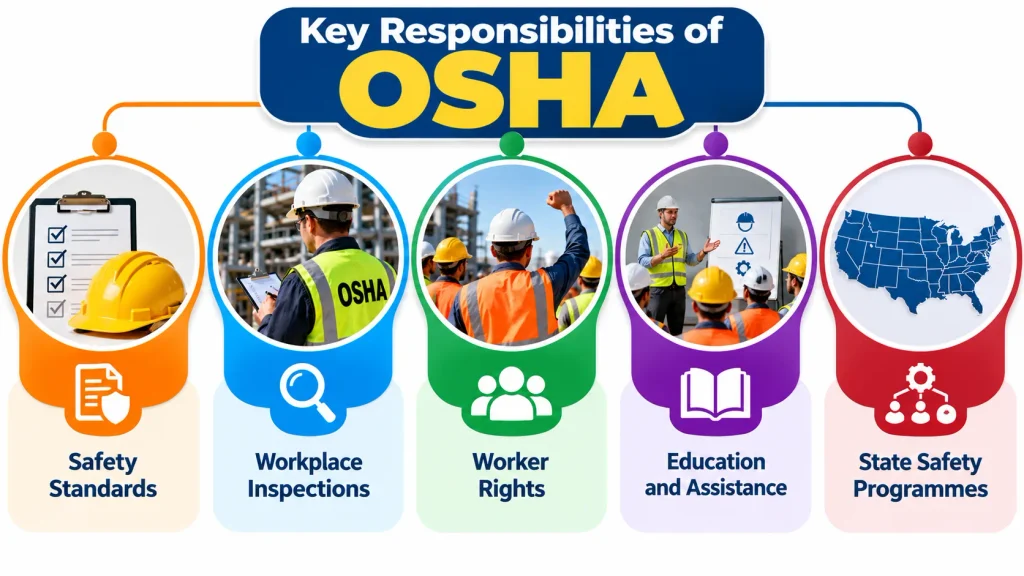
Establishing and enforcing workplace safety standards
One of OSHA’s principal responsibilities is to establish and enforce applicable occupational safety and health standards. These standards address recognised workplace hazards and set requirements for employers within the agency’s jurisdiction.
Depending on the industry and task, relevant requirements may concern:
- Fall protection and working at height.
- Machine guarding and hazardous energy.
- Electrical safety.
- Hazardous chemicals and communication.
- Personal protective equipment.
- Respiratory protection.
- Emergency procedures and workplace training.
The precise requirements depend on the applicable standard, industry, workplace and activity. Employers should consult the relevant official requirements rather than assuming that one general safety checklist covers every situation.
Conducting workplace inspections
OSHA conducts workplace inspections to assess compliance with applicable safety and health requirements. Inspections may follow reports of hazards, serious incidents, complaints or other enforcement priorities.
During an inspection, relevant issues may include unsafe working conditions, exposure to hazardous substances, inadequate protective measures and potential violations of applicable standards.
Employers should maintain appropriate safety documentation, address reported hazards, cooperate with lawful inspection procedures and correct identified deficiencies according to applicable requirements.
Inspections are one part of a broader approach to workplace safety. Effective prevention also requires everyday hazard identification, risk controls, supervision and worker participation.
Protecting workers’ rights
OSHA helps protect workers’ rights under applicable US workplace safety laws. These rights may include raising safety concerns, receiving relevant hazard information, accessing certain exposure and injury records, and reporting suspected violations.
OSHA also enforces applicable provisions against unlawful retaliation for exercising protected rights. Workers who believe they have experienced retaliation may have specific complaint procedures and deadlines to consider.
Workers should understand the relevant procedures and use official channels when reporting workplace safety concerns.
Providing education and safety assistance
OSHA supports workplace safety education through guidance, training resources, outreach programmes and assistance initiatives. These activities help workers and employers understand hazards and ways to prevent workplace injuries and illnesses.
The OSHA Outreach Training Program, for example, offers 10-hour and 30-hour training options for construction and general industry, among other programme tracks. The courses introduce workplace hazards, workers’ rights, employer responsibilities and hazard prevention.
This training can help learners develop hazard-awareness knowledge, although it does not replace every task-specific training obligation imposed by applicable standards.
Supporting state workplace safety programmes
Some US states operate their own occupational safety and health programmes under federal approval. These state programmes must be at least as effective as the federal programme in protecting workers within their approved scope. OSHA works with these programmes as part of the wider US workplace safety system.
This means that workplace safety administration in the United States can involve federal OSHA or an applicable state programme, depending on the workplace and jurisdiction.
What Does OSHA Mean in Workplace Safety?
The OSHA meaning in workplace safety relates to the prevention of work-related injuries, illnesses and fatalities through applicable standards, hazard awareness, employer responsibilities and worker protection.
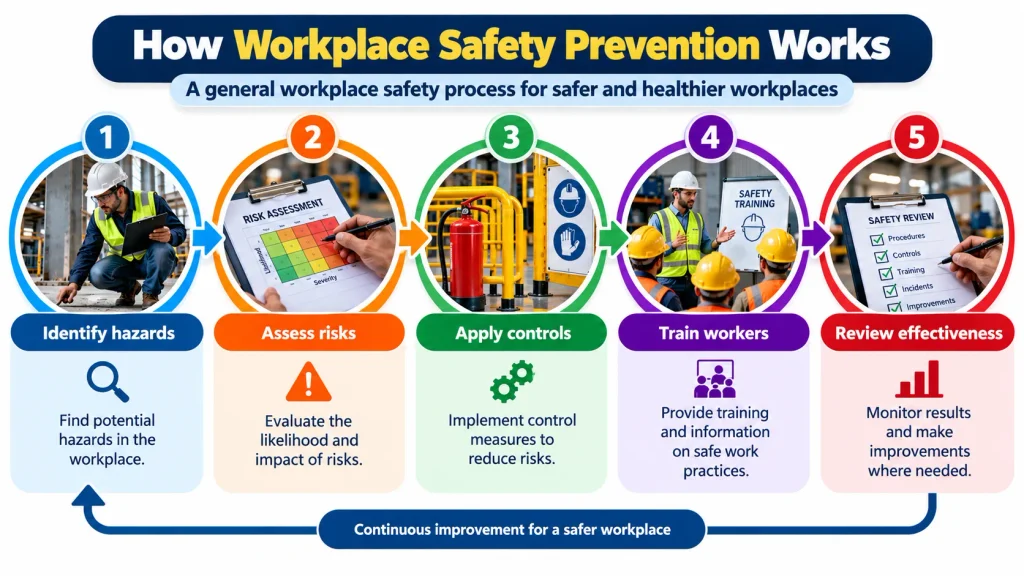
Workplace safety involves more than providing personal protective equipment or displaying warning signs. Employers need to identify hazards, assess risks, implement appropriate controls, provide relevant training and review whether safety measures are effective.
For example, consider a manufacturing facility where employees operate machinery. A practical safety approach may include machine guarding, hazardous energy control, safe operating procedures, worker training and regular equipment inspections. Applicable OSHA standards may establish specific requirements for these activities.
OSHA-related safety principles can help organisations understand the importance of prevention. However, workplaces must follow the laws and requirements applicable to their location and activities.
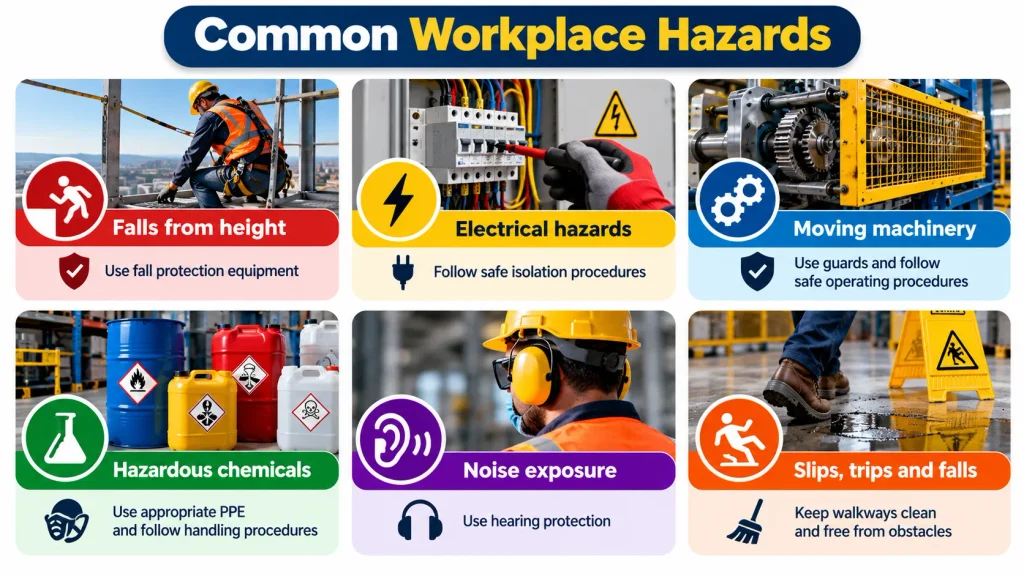
Common workplace hazards addressed by OSHA standards
| Workplace hazard | Example of a preventive measure |
|---|---|
| Falls from height | Appropriate fall protection and safe access arrangements |
| Electrical hazards | Suitable electrical safeguards and authorised work procedures |
| Hazardous chemicals | Chemical labelling, safety information and appropriate controls |
| Moving machinery | Machine guarding and hazardous energy control |
| Excessive noise | Exposure assessment and suitable noise-control measures |
| Slips and trips | Good housekeeping, clear walkways and prompt spill management |
| Respiratory hazards | Suitable exposure controls and respiratory protection where required |
These are general examples rather than a complete statement of OSHA requirements. The applicable standard and appropriate control measures depend on the actual hazard and working conditions.
How Does OSHA Help Protect Workers?
OSHA contributes to worker protection through a combination of standards, enforcement, information, education and complaint procedures.
Hazard prevention
Applicable standards help employers understand the measures required to control particular workplace hazards. Effective hazard prevention can reduce exposure to dangerous conditions and support safer working practices.
Worker awareness
Workers who understand common workplace hazards are better equipped to recognise unsafe conditions, follow established procedures and raise concerns.
Employer accountability
OSHA enforcement helps hold covered employers accountable for applicable legal requirements. Employers remain responsible for meeting their obligations, including providing required training and controlling workplace risks.
Safety education
Training and guidance help workers and supervisors understand hazards, preventive measures and relevant workplace safety responsibilities. The appropriate training depends on the work being performed and the hazards involved.
Who Needs to Understand OSHA?
OSHA information is particularly relevant to people working in or learning about occupational health and safety.
- Construction workers who may encounter falls, excavation hazards and moving equipment.
- Manufacturing employees exposed to machinery, chemicals or hazardous energy.
- Supervisors responsible for coordinating work and communicating safety procedures.
- Safety officers who support hazard identification, risk control and workplace compliance.
- Employers who need to understand their applicable workplace safety responsibilities.
- Students and job seekers who want to develop knowledge of occupational safety practices.
The relevance of OSHA training depends on the intended workplace, employer expectations and applicable requirements. Not every role requires the same course, and completing a course does not automatically qualify someone for a particular job.
What is the Difference Between OSHA and OSHA Training?
OSHA is the government agency. OSHA training refers to educational programmes that explain workplace safety principles, hazards and related responsibilities.
One commonly discussed programme is the OSHA Outreach Training Program, which offers 10-hour and 30-hour courses in areas including construction and general industry.
| Feature | OSHA agency | OSHA Outreach Training |
|---|---|---|
| Main purpose | Regulate applicable workplace safety and health requirements | Educate participants about workplace hazards |
| Main activity | Standards, enforcement, guidance and assistance | Hazard-awareness training |
| Participants | Employers, workers and other relevant parties | Workers, supervisors and other eligible participants |
| Outcome | Applicable legal requirements and enforcement activities | Course completion card when programme requirements are met |
| Professional licence? | Not applicable | The Outreach completion card is not a professional licence or certification |
The distinction matters because completing an Outreach course does not automatically satisfy all employer-specific training obligations. OSHA states that the programme is voluntary at the federal level, although some employers, states or other jurisdictions may require it in particular circumstances.
What is the Difference Between OSHA and HSE in the UK?
OSHA and the Health and Safety Executive (HSE) are associated with workplace safety, but they operate within different regulatory systems.
OSHA is a US agency. The HSE is Britain’s national regulator for workplace health and safety, with responsibilities defined by the applicable legislation and regulatory arrangements. Some workplace activities in Great Britain are regulated by local authorities or other bodies instead.
| Comparison | OSHA | HSE |
|---|---|---|
| Main jurisdiction | United States, within its applicable federal scope | Great Britain, within its regulatory scope |
| Primary role | Workplace safety and health standards, enforcement and assistance | Workplace health and safety regulation, guidance and enforcement |
| Legal framework | Occupational Safety and Health Act and applicable standards | Health and Safety at Work etc. Act 1974 and associated legislation |
| Training context | Includes the OSHA Outreach Training Program | Provides guidance and a range of health and safety training resources |
| International relevance | Knowledge may be useful internationally | Relevant to applicable workplace requirements in Great Britain |
An OSHA course should not be assumed to replace UK-specific training or meet every UK legal requirement. Learners planning to work in the UK should check the requirements of the employer, project, industry and relevant regulator.
Does OSHA Apply in Pakistan?
OSHA is a US government agency and is not Pakistan’s national workplace safety regulator. Pakistani workplaces must comply with the applicable Pakistani laws, regulations and requirements relevant to their location, industry and activities.
Nevertheless, OSHA-related training may help learners in Pakistan develop an understanding of workplace hazards, hazard prevention and international safety terminology. Its practical relevance depends on the course, the learner’s intended role and the expectations of employers or overseas projects.
Before enrolling, learners should check:
- The exact course and training programme being offered.
- Whether the provider’s claims about authorisation and completion documentation can be verified.
- Whether the course suits the learner’s industry and career objectives.
- Whether a prospective employer requires additional local or job-specific training.
These checks help distinguish the educational value of a course from its formal acceptance for a particular job or legal requirement.
How Can Learners Develop OSHA-Related Safety Knowledge?
Learners interested in workplace safety can begin by studying basic hazard recognition, risk prevention, employer responsibilities and worker rights.
A structured learning approach may include the following steps:
- Identify the industry and workplace hazards relevant to the intended role.
- Learn the safety principles and requirements applicable to that workplace.
- Select training that matches the required industry and level of responsibility.
- Confirm the provider’s credentials and the exact documentation issued on completion.
- Apply the knowledge alongside employer-specific procedures and any required practical training.
For workers who need an OSHA Outreach course, the official programme distinguishes between 10-hour training intended primarily for entry-level workers and 30-hour training intended for supervisors or workers with greater safety responsibilities. These courses are delivered by OSHA-authorised Outreach trainers.
Conclusion
OSHA stands for the Occupational Safety and Health Administration, the US agency responsible for establishing and enforcing applicable workplace safety and health standards and supporting worker protection through education, assistance and enforcement.
Understanding the OSHA meaning in workplace safety helps workers, supervisors and employers recognise the importance of hazard prevention, safety awareness and compliance with relevant requirements.
For learners in Pakistan, the UK and other countries, OSHA-related training may provide useful knowledge, but the applicable local regulations and employer requirements must always be considered. Understanding this distinction is essential when selecting a course or planning a career in occupational health and safety.