QA/QC in Oil and Gas Mechanical Engineering: Roles and Responsibilities
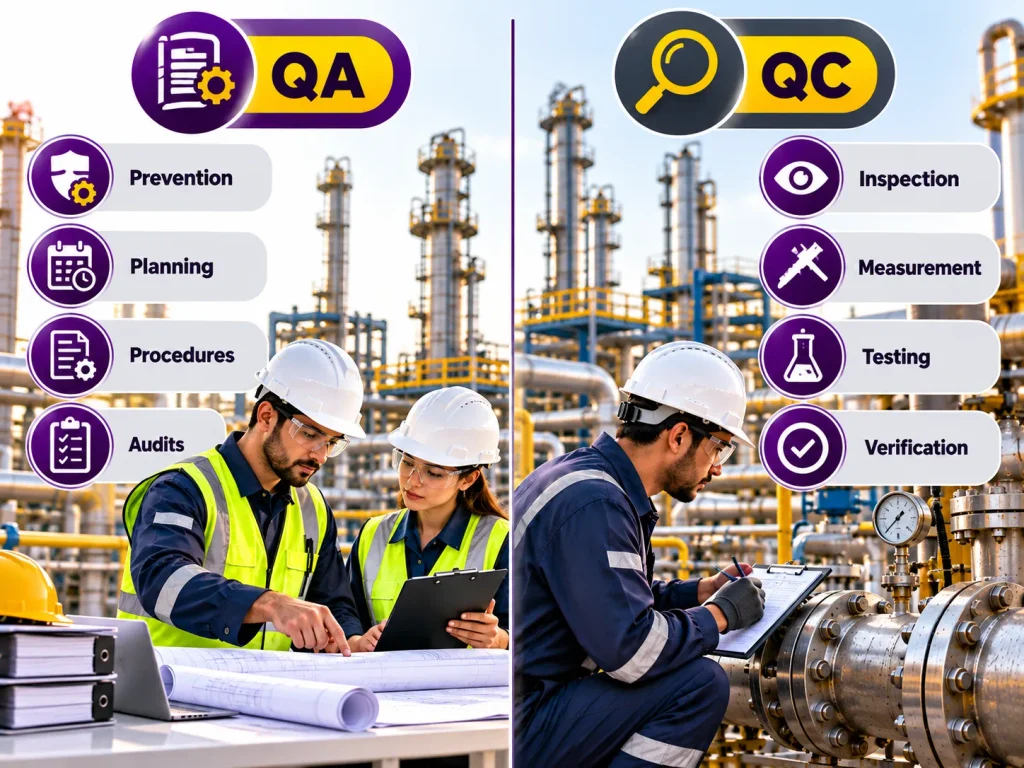
Quality Assurance and Quality Control (QA/QC) in oil and gas mechanical engineering ensure that mechanical equipment, piping systems, pipelines, and pressure vessels meet approved engineering specifications, industry standards, and project quality requirements. Quality Assurance focuses on preventing defects through planned procedures, while Quality Control involves inspections, testing, and verification.
QA/QC is essential across upstream, midstream, and downstream operations, including drilling facilities, pipelines, gas processing plants, refineries, and storage terminals. Effective quality practices help maintain equipment reliability, protect pressure containment, reduce rework, and support compliance with applicable codes and regulations.
QA/QC mechanical engineers inspect materials, monitor welding and fabrication, verify installation activities, review testing results, and maintain quality documentation. These responsibilities help identify defects early, improve operational safety, and ensure that mechanical systems meet specified acceptance criteria before commissioning and project handover.
What is QA/QC in Oil and Gas Mechanical Engineering?
Quality Assurance and Quality Control (QA/QC) in oil and gas mechanical engineering are processes that ensure mechanical equipment, piping systems, pipelines, and pressure vessels comply with approved specifications, applicable industry standards, and project requirements. These processes help prevent defects, verify work quality, and maintain the reliability of mechanical systems throughout a project.
What Quality Assurance Means in Oil and Gas Projects
Quality Assurance (QA) focuses on preventing defects before they occur. It involves developing quality management plans, establishing inspection procedures, reviewing technical documents, conducting audits, and ensuring that personnel follow approved processes. For example, a QA team may review a welding procedure before fabrication begins to confirm that it meets project requirements.
What Quality Control Means in Mechanical Engineering
Quality Control (QC) focuses on checking whether materials, components, and completed work meet specified acceptance criteria. Activities include material verification, dimensional inspections, welding examinations, non-destructive testing (NDT), and pressure testing. QC personnel document inspection results and report any non-conformities requiring corrective action.
Difference Between QA and QC in Oil and Gas
| Comparison | Quality Assurance (QA) | Quality Control (QC) |
|---|---|---|
| Purpose | Prevent defects | Identify defects |
| Timing | Throughout planning and execution | During inspections and testing |
| Activities | Audits, procedures, quality planning | Measurements, inspections, testing |
| Records | Quality plans and audit reports | Inspection and test reports |
| Example | Approving a welding procedure | Inspecting a completed weld |
QA and QC work together to ensure that oil and gas mechanical systems meet quality requirements, support safe operations, and achieve reliable project completion.
Why QA/QC is Important in the Oil and Gas Industry
Quality Assurance and Quality Control (QA/QC) are essential in the oil and gas industry because they help ensure that mechanical equipment, piping systems, pipelines, and pressure vessels meet defined quality and safety requirements. Effective QA/QC practices reduce the risk of equipment failure, leaks, operational disruption, and costly repairs.
Prevention of Mechanical Failures and Leaks
QA/QC inspections help identify defects in welds, materials, joints, and mechanical components before equipment enters service. For example, detecting a weld defect during inspection allows corrective action before a pipeline is commissioned.
Protection of Workers, Assets, and the Environment
Proper inspection and testing help reduce risks associated with hydrocarbon leaks, equipment damage, and pressure containment failures. These controls support safer working conditions and help prevent environmental contamination.
Compliance with Project Specifications and Industry Standards
QA/QC ensures that materials, fabrication, installation, and testing activities follow approved project specifications and applicable codes. This helps demonstrate that mechanical systems meet their required acceptance criteria.
Reduction of Rework, Delays, and Costs
Identifying quality issues during fabrication or installation can prevent expensive repairs and schedule delays. For example, checking pipe alignment before welding can reduce the need for joint rework.
Equipment Reliability and Long-Term Performance
Quality inspections and verification help ensure that equipment is correctly manufactured, installed, and tested, supporting reliable operation throughout its intended service life.
Traceable Inspection Records
Material certificates, welding records, inspection reports, and test results provide evidence that required quality checks have been completed. These records support technical reviews, audits, maintenance planning, and project handover.
Overall, effective QA/QC practices improve mechanical integrity, support safe project delivery, and help oil and gas facilities achieve consistent quality and operational reliability.
Roles and Responsibilities of a QA/QC Mechanical Engineer in Oil and Gas
A QA/QC Mechanical Engineer plays an important role in ensuring that mechanical equipment, piping systems, pipelines, and pressure vessels meet approved engineering specifications, applicable industry standards, and project quality requirements. The role involves reviewing technical documents, inspecting materials, monitoring fabrication and installation, coordinating testing activities, and maintaining accurate quality records. Effective QA/QC management helps prevent defects, reduce rework, and support the safe and reliable delivery of oil and gas projects.
Reviewing Engineering Drawings and Project Specifications
QA/QC Mechanical Engineers review engineering drawings, technical specifications, equipment datasheets, and approved procedures before inspection activities begin. This helps ensure that construction and fabrication work follows the correct technical requirements.
Key responsibilities include:
- Reviewing mechanical drawings, piping isometric drawings, and equipment specifications.
- Checking applicable codes, standards, and project requirements.
- Verifying inspection criteria and required acceptance limits.
- Identifying discrepancies between drawings and site conditions.
- Confirming that the latest approved documents are available for inspection.
Preparing and Implementing Quality Documents
Quality documentation establishes how inspection and testing activities will be performed, recorded, and verified. QA/QC Mechanical Engineers help prepare and implement documents that support consistent quality control throughout the project.
Key responsibilities include:
- Preparing or reviewing Inspection and Test Plans (ITPs).
- Developing inspection checklists and quality control plans.
- Reviewing inspection procedures and method statements.
- Identifying inspection stages, hold points, and witness points.
- Ensuring documents follow contractual and project requirements.
Inspecting Materials and Mechanical Equipment
Material and equipment inspections help confirm that delivered items meet purchase specifications and approved engineering requirements. Proper identification and traceability are particularly important for pressure-containing components and critical mechanical equipment.
Key responsibilities include:
- Verifying material certificates and inspection documentation.
- Checking material grades, dimensions, markings, and identification numbers.
- Inspecting incoming pipes, valves, flanges, fittings, and equipment.
- Confirming material traceability throughout fabrication and installation.
- Recording damage, missing documentation, or discrepancies.
Monitoring Fabrication, Welding, and Installation
QA/QC Mechanical Engineers monitor fabrication and installation activities to verify compliance with approved drawings, procedures, and acceptance criteria. Their involvement helps identify defects before they affect subsequent work or equipment operation.
Key responsibilities include:
- Checking weld preparation, joint fit-up, and dimensional accuracy.
- Verifying compliance with approved welding procedures.
- Reviewing welder qualification records where required.
- Monitoring inspection hold points and witness points.
- Inspecting mechanical equipment alignment and installation.
- Confirming that required non-destructive testing (NDT) is completed and accepted.
Coordinating Testing and Inspection Activities
Mechanical QA/QC engineers coordinate inspection and testing activities with construction teams, client representatives, third-party inspectors, and specialist personnel. Effective coordination ensures that inspections take place at the appropriate stages and that results are properly documented.
Key responsibilities include:
- Scheduling inspections according to the approved ITP.
- Coordinating visual inspection, NDT, and pressure testing.
- Confirming inspection readiness before requesting formal inspections.
- Reviewing test results against approved acceptance criteria.
- Communicating inspection findings and outstanding quality issues.
Managing Non-Conformities and Corrective Actions
When materials, workmanship, or completed activities fail to meet specified requirements, the QA/QC Mechanical Engineer helps document and manage the non-conformity. Corrective action must follow the approved process and receive the necessary authorization.
Key responsibilities include:
- Raising or documenting Non-Conformance Reports (NCRs).
- Identifying the nature and extent of quality deviations.
- Coordinating investigation and corrective action with responsible teams.
- Verifying repairs or corrective work against approved requirements.
- Confirming that non-conformities are properly closed and recorded.
Verifying Records and Supporting Project Handover
Accurate quality records demonstrate that required inspections and tests have been completed. Before project handover, QA/QC Mechanical Engineers help ensure that documentation is complete, traceable, and consistent with contractual requirements.
Key responsibilities include:
- Reviewing inspection reports, material certificates, and test records.
- Checking welding documentation and NDT reports.
- Maintaining material traceability and equipment inspection records.
- Tracking outstanding punch-list items and quality issues.
- Compiling or reviewing the final quality dossier.
- Supporting client acceptance, pre-commissioning, and project handover activities.
Overall, a QA/QC Mechanical Engineer helps maintain quality throughout the oil and gas project lifecycle, from material procurement and fabrication to installation, testing, and final handover. The role requires technical knowledge, attention to detail, effective communication, and a thorough understanding of applicable project requirements.
Mechanical QA/QC Inspection Activities in Oil and Gas Projects
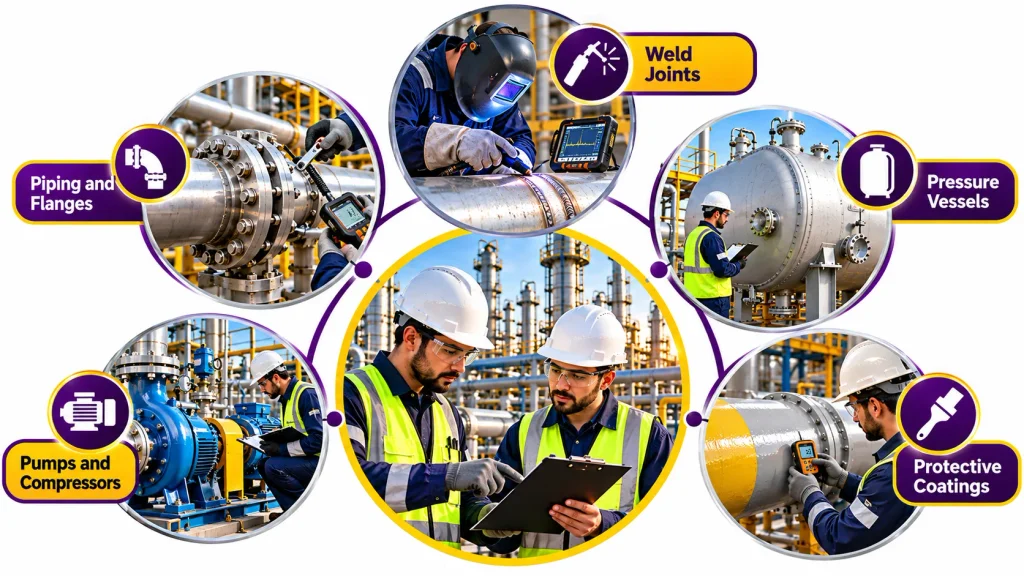
Mechanical QA/QC inspection activities ensure that piping systems, pipelines, pressure vessels, storage tanks, and other mechanical equipment comply with approved drawings, project specifications, and applicable industry standards. These inspections take place during material receiving, fabrication, installation, testing, and project handover. Proper inspection helps identify defects, verify workmanship, maintain equipment integrity, and reduce the risk of failures during operation.
Piping and Pipeline Inspection
Piping and pipeline inspection verifies that materials, components, fabrication, and installation activities meet the required engineering specifications. QA/QC personnel check material identification, dimensions, joint preparation, alignment, and installation quality before approving subsequent work stages.
Key inspection activities include:
- Verifying pipe materials, fittings, flanges, valves, and material certificates.
- Checking pipe dimensions, wall thickness, material grades, and identification markings.
- Inspecting pipe alignment, joint fit-up, supports, and flange connections.
- Reviewing welding records and required non-destructive testing (NDT) results.
- Verifying pressure testing against approved procedures and acceptance criteria.
- Maintaining inspection reports and material traceability records.
Welding Inspection
Welding inspection ensures that welded joints are produced according to approved welding procedures and project requirements. It helps identify defects that could affect the strength, integrity, or service performance of mechanical components.
Key inspection activities include:
- Checking joint preparation, bevel angles, cleanliness, and fit-up.
- Verifying approved Welding Procedure Specifications (WPSs).
- Reviewing welder qualification records where required.
- Monitoring welding parameters and preheating requirements, where applicable.
- Conducting visual inspection of completed welds.
- Reviewing required NDT results, such as radiographic or ultrasonic testing.
- Confirming that repairs and re-inspections meet approved acceptance criteria.
Pressure Vessel and Storage Tank Inspection
Pressure vessels and storage tanks require inspections to verify fabrication quality, dimensional accuracy, weld integrity, and compliance with the applicable construction code. Inspection requirements depend on the equipment design, service conditions, project specifications, and governing standards.
Key inspection activities include:
- Verifying material certificates and component identification.
- Checking plate dimensions, shell alignment, and nozzle locations.
- Inspecting weld preparation, welding activities, and completed joints.
- Reviewing required NDT reports and dimensional inspection records.
- Witnessing or reviewing pressure or leak testing where specified.
- Checking protective coatings and required final documentation.
Rotating and Static Equipment Inspection
Rotating and static equipment inspection helps ensure that mechanical equipment is manufactured, installed, and tested according to approved requirements. Rotating equipment includes pumps and compressors, while static equipment includes heat exchangers, vessels, and other stationary components.
Key inspection activities include:
- Checking equipment identification, condition, and documentation.
- Verifying foundation dimensions, alignment, and installation clearances.
- Inspecting coupling alignment and vibration-related test results where applicable.
- Reviewing pressure, performance, or functional test reports as required.
- Checking valves, connections, gaskets, and bolted joints.
- Recording inspection findings and confirming compliance with acceptance criteria.
Surface Preparation and Protective Coating Inspection
Surface preparation and protective coating inspection help protect mechanical equipment, pipelines, and structural components against corrosion and environmental deterioration. Proper preparation and coating application are important for achieving the required coating performance and service life.
Key inspection activities include:
- Checking surface cleanliness and preparation against the specified standard.
- Verifying environmental conditions, including temperature, humidity, and dew point, where required.
- Inspecting coating materials, mixing, and application procedures.
- Measuring dry film thickness according to project requirements.
- Checking curing conditions, coating defects, and coverage.
- Recording inspection results and verifying compliance with specified acceptance criteria.
QA/QC Procedures Throughout an Oil and Gas Project Lifecycle
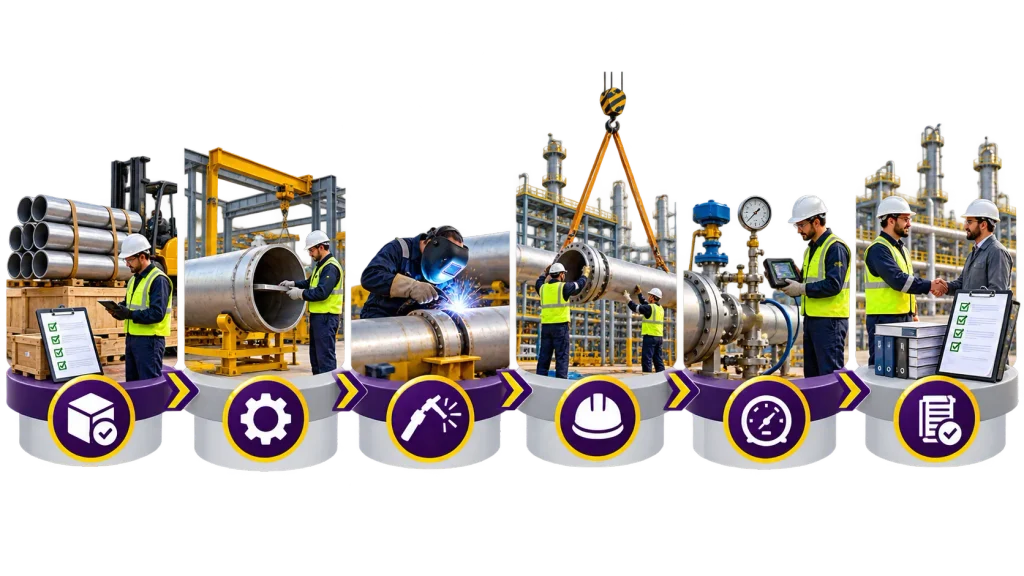
QA/QC procedures in oil and gas projects ensure that mechanical equipment, piping systems, pipelines, and related components meet approved engineering specifications and quality requirements at every project stage. These procedures begin during engineering and planning and continue through procurement, fabrication, installation, testing, and final handover. Effective quality management helps identify defects early, maintain material traceability, reduce rework, and support safe and reliable project delivery.
Engineering and Quality Planning
During the planning stage, QA/QC personnel review technical documents and establish inspection requirements. This preparation ensures that quality activities are clearly defined before construction begins.
Key activities include:
- Reviewing engineering drawings and project specifications.
- Preparing or reviewing Inspection and Test Plans (ITPs).
- Identifying inspection stages, hold points, and witness points.
- Establishing acceptance criteria and documentation requirements.
Procurement and Supplier Quality Checks
Quality control begins during procurement by verifying that suppliers can provide materials and equipment that meet project requirements. Supplier documentation and inspection arrangements help prevent unsuitable items from entering the project.
Key activities include:
- Reviewing purchase specifications and supplier documents.
- Checking material certificates and equipment datasheets.
- Conducting supplier inspections or audits where required.
- Verifying compliance with applicable technical requirements.
Material Receiving and Storage
When materials arrive at the project site or workshop, QA/QC personnel verify their condition, identification, and documentation. Proper storage and handling help prevent damage, contamination, and loss of traceability.
Key activities include:
- Inspecting material grades, dimensions, and markings.
- Checking certificates against purchase requirements.
- Recording damaged or non-conforming materials.
- Ensuring suitable storage and preservation conditions.
Fabrication and Workshop Inspection
During fabrication, QA/QC personnel monitor manufacturing activities to verify compliance with approved drawings and procedures. Inspections help detect defects before components are transported to the installation site.
Key activities include:
- Checking dimensions, fit-up, and alignment.
- Monitoring welding and required NDT activities.
- Inspecting surface preparation and coating application.
- Recording results and managing non-conformities.
Site Installation and Construction Inspection
At the construction site, QA/QC inspections verify that mechanical components are installed correctly and according to approved requirements.
Key activities include:
- Checking equipment positioning, alignment, and supports.
- Inspecting piping joints, flange connections, and bolting.
- Verifying installation records and inspection approvals.
- Monitoring required construction hold points.
Testing, Pre-Commissioning, and Commissioning Support
Before operational handover, QA/QC personnel verify that required testing and inspections have been completed and documented. Testing activities must follow approved procedures and applicable acceptance criteria.
Key activities include:
- Reviewing pressure and leak test documentation.
- Verifying equipment test results where required.
- Checking outstanding defects and punch-list items.
- Confirming that required inspection records are complete.
Final Documentation and Handover
The final stage involves compiling quality records to demonstrate that project requirements have been met. Complete documentation supports client acceptance, future maintenance, and equipment traceability.
Key activities include:
- Reviewing inspection reports and material certificates.
- Compiling welding, NDT, and testing records.
- Verifying the closure of non-conformities.
- Preparing the final quality dossier for handover.
The exact QA/QC procedures vary according to the project contract, facility type, equipment, applicable codes, and approved specifications. Following the defined quality process at each stage helps ensure that mechanical systems are inspected, tested, documented, and accepted before entering service.
Essential QA/QC Documents Used in Oil and Gas Mechanical Engineering
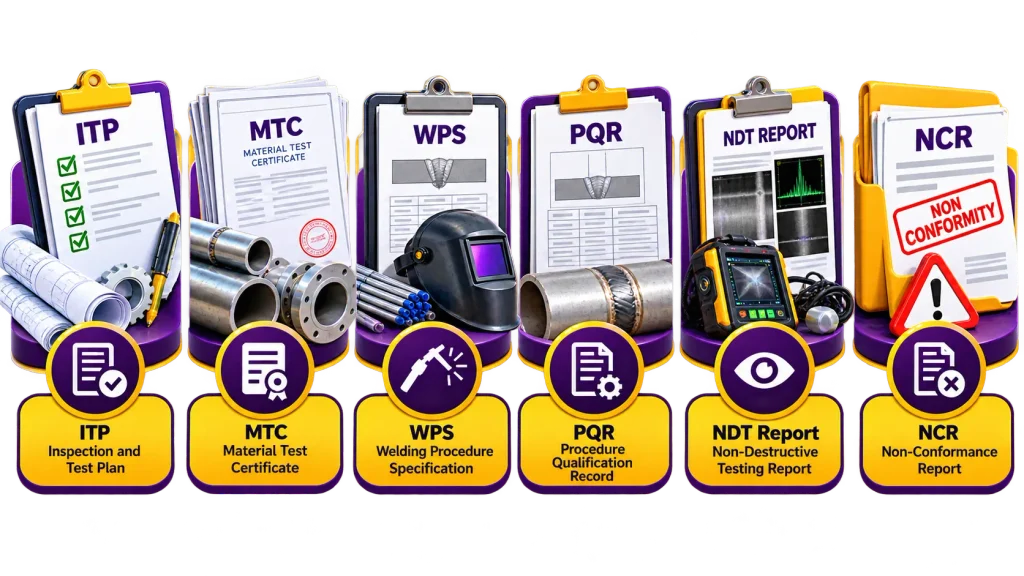
QA/QC documents provide evidence that materials, equipment, fabrication, welding, installation, and testing activities meet approved project requirements. These records support inspection planning, quality verification, traceability, non-conformity management, and final project handover.
| Document | Purpose and Importance |
|---|---|
| Inspection and Test Plan (ITP) | Defines inspection stages, required checks, responsible parties, hold points, witness points, and acceptance criteria. It helps ensure that inspections occur at the correct stages of the project. |
| Material Test Certificate (MTC) | Provides information about material grades, chemical composition, mechanical properties, and test results, as applicable. It helps verify that supplied materials meet specified requirements. |
| Welding Procedure Specification (WPS) | Specifies the approved welding variables and instructions, such as welding process, filler material, and applicable parameters. It guides welders in producing welds that meet project requirements. |
| Procedure Qualification Record (PQR) | Records the welding variables used during procedure qualification and the results of required tests. It provides supporting evidence that a welding procedure meets the applicable qualification requirements. |
| Non-Destructive Testing (NDT) Reports | Record examination methods, findings, and results from techniques such as radiographic testing, ultrasonic testing, and magnetic particle testing. They help assess component or weld integrity without damaging the item. |
| Non-Conformance Report (NCR) | Documents a failure to meet specified requirements. It records the issue and supports investigation, approved disposition, corrective action, and verification of closure. |
| Pressure Test Report | Records pressure-testing details, including the test procedure, test conditions, results, and acceptance status. It provides evidence that the tested system met the applicable test requirements. |
| Final Quality Dossier | Compiles required quality records, including inspection reports, material certificates, welding documentation, NDT results, and test records. It supports client acceptance, project handover, and future maintenance. |
Codes and Standards Relevant to Oil and Gas Mechanical QA/QC
Codes and standards provide technical requirements and quality guidelines for inspecting, fabricating, installing, testing, and maintaining mechanical equipment in oil and gas projects. QA/QC Mechanical Engineers use these references to verify that piping systems, pressure vessels, storage tanks, and welded components meet applicable engineering and quality requirements. The standards selected for a project depend on the equipment, contractual specifications, jurisdiction, and whether the work involves new construction or in-service inspection.
The following standards are commonly relevant to mechanical QA/QC activities in the oil and gas industry:
- ISO 9001 — Quality Management Systems: Establishes requirements for a quality management system, including process control, documented information, performance evaluation, and continual improvement. It supports consistent quality management across project activities.
- ASME B31.3 — Process Piping: Covers requirements for process piping design, materials, fabrication, assembly, examination, inspection, and testing within its scope. It is relevant to piping systems in refineries and chemical processing facilities.
- ASME Boiler and Pressure Vessel Code (BPVC): Provides construction and related requirements for specified pressure equipment, including applicable rules for materials, fabrication, examination, and testing.
- API 650 — Welded Tanks for Oil Storage: Specifies requirements for welded storage tanks operating under the conditions defined by the standard. It supports tank fabrication, inspection, and construction quality verification.
- API 570 — Piping Inspection Code: Addresses in-service inspection, rating, repair, and alteration of piping systems within its scope. It is particularly relevant to maintaining the integrity of operating process piping.
- API 510 — Pressure Vessel Inspection Code: Covers in-service inspection, rating, repair, and alteration of pressure vessels within its scope.
- ISO 3834 — Quality Requirements for Fusion Welding of Metallic Materials: Defines quality requirements for welding processes, helping organisations control welding activities and demonstrate appropriate quality management.
QA/QC professionals should always verify the applicable edition, project specifications, and contractual requirements before applying a standard. These references have different scopes and should not be treated as interchangeable or automatically applicable to every oil and gas project.
Common QA/QC Challenges in Oil and Gas Mechanical Projects
Material Traceability Problems
Material traceability ensures that mechanical components meet approved specifications and can be tracked throughout a project. Missing identification or incomplete records can delay inspection and material acceptance.
- Missing material test certificates or incomplete documentation.
- Incorrect or unreadable identification markings on pipes, fittings, and flanges.
- Mismatches between material grades and approved specifications.
- Loss of traceability during cutting, fabrication, or installation.
- Delays caused by material verification, segregation, or replacement.
Welding Defects and Inspection Delays
Welding defects can affect the integrity and reliability of mechanical components. Proper procedure compliance and inspection planning help identify problems before they cause further delays.
- Incomplete joint preparation or incorrect weld fit-up.
- Failure to follow approved Welding Procedure Specifications (WPSs).
- Defects such as porosity, cracks, and incomplete fusion.
- Delayed non-destructive testing (NDT) due to poor scheduling.
- Additional repair, inspection, and re-testing requirements.
Incomplete Documentation and Failed Inspections
Accurate documentation provides evidence that work meets project requirements. Missing records or inadequate preparation can result in rejected inspections and delayed approvals.
- Incomplete inspection reports or missing material certificates.
- Unavailable welding and NDT records.
- Incorrect or outdated engineering drawings.
- Failure to verify acceptance criteria before inspection.
- Inadequate inspection readiness checks before requesting client approval.
Managing Rework and Project Schedule Pressure
Oil and gas projects often operate under tight deadlines, but schedule pressure must not compromise quality requirements. Uncontrolled shortcuts can increase costs, create safety risks, and cause further delays.
- Repeated fabrication or installation errors requiring correction.
- Pressure to proceed before mandatory inspections are completed.
- Insufficient coordination between construction and QA/QC teams.
- Delays caused by unresolved non-conformities.
- Inadequate planning for inspections, testing, and corrective actions.
Effective communication, proper documentation, early inspection planning, and timely corrective action help QA/QC Mechanical Engineers address these challenges while maintaining compliance with approved project specifications and applicable industry standards.
Practical Example: QA/QC of a Piping Installation
The following illustrative scenario demonstrates how a QA/QC Mechanical Engineer may monitor the installation of a process piping system in an oil and gas facility. The objective is to verify that materials, welding, installation, and testing activities meet approved project specifications and applicable codes before the system is handed over.
During material receiving, the engineer checks pipe and fitting identification against approved drawings, material certificates, and purchase specifications. Before welding, the engineer verifies joint preparation, pipe alignment, and compliance with the applicable approved Welding Procedure Specification (WPS). Required visual inspections and non-destructive testing (NDT) are then coordinated according to the approved Inspection and Test Plan (ITP).
After installation, the engineer reviews the approved pressure-test package, confirms the applicable test requirements, and verifies that the necessary inspections are complete before testing proceeds. Any defects or deviations are documented and resolved through the approved non-conformity process. Finally, inspection reports, material records, welding documents, and pressure-test results are checked before the piping system is submitted for handover.
Piping Installation Inspection Stages
| Inspection Stage | Verification Activity | Evidence Recorded |
|---|---|---|
| Material receiving | Check pipe grades, fittings, identification, and certificates | Material inspection report and certificates |
| Joint preparation | Verify alignment, fit-up, and welding requirements | Fit-up inspection report |
| Welding | Confirm compliance with the approved WPS | Welding inspection records |
| NDT | Review required examinations and results | NDT reports |
| Pressure testing | Verify approved test requirements and results | Pressure-test report |
| Final handover | Confirm records are complete and outstanding issues are resolved | Final inspection records and quality dossier |
This example shows how systematic QA/QC inspections help identify defects early, maintain material traceability, and demonstrate compliance with project requirements. Actual inspection stages, test conditions, acceptance criteria, and documentation depend on the approved project procedures and applicable codes.
How QA/QC Supports Safety, Reliability, and Project Handover
Quality Assurance and Quality Control (QA/QC) support safety and reliability in oil and gas projects by ensuring that mechanical equipment, piping systems, and pressure vessels meet approved engineering specifications and applicable quality requirements. Inspections, material verification, welding examinations, and pressure testing help identify defects that could compromise pressure integrity or equipment performance. Maintaining accurate inspection records also provides evidence that required quality checks have been completed.
Effective QA/QC practices improve equipment reliability by identifying non-conformities during fabrication, installation, and testing. Timely corrective actions help reduce rework, prevent avoidable failures, and support readiness for commissioning. However, QA/QC does not replace engineering approvals, statutory inspections, risk assessments, or operational safety procedures.
Key contributions of QA/QC include:
- Verifying materials, welding, installation, and testing against approved requirements.
- Identifying defects that could affect mechanical integrity and operational reliability.
- Ensuring inspection findings and non-conformities are properly documented and resolved.
- Maintaining traceable records of material certificates, inspection reports, and test results.
- Supporting commissioning readiness and final project acceptance.
- Compiling the quality dossier required for project handover and future maintenance.
Through systematic inspections and reliable documentation, QA/QC Mechanical Engineers help ensure that oil and gas facilities are delivered in accordance with defined quality requirements and are supported by the records needed for safe operation and long-term maintenance.
Conclusion
QA/QC in oil and gas mechanical engineering ensures that materials, equipment, fabrication, welding, installation, and testing meet approved project specifications and applicable industry standards. Effective inspections, accurate documentation, and timely corrective actions help prevent defects, reduce rework, improve equipment reliability, and support safe project handover.
QA/QC Mechanical Engineers play an important role in maintaining quality and mechanical integrity throughout the project lifecycle. Learners interested in this career can explore How to Become a QA/QC Mechanical Engineer: Skills and Career Guide to understand the essential skills, qualifications, and career opportunities in this field.