
How to Become a QA/QC Mechanical Engineer: Skills and Career Guide
A QA/QC Mechanical Engineer ensures that mechanical materials, fabrication, welding, installation, and testing meet required quality standards, approved drawings, and project specifications. These professionals play an essential role in construction, manufacturing, oil and gas, and power generation.
Becoming a QA/QC Mechanical Engineer requires relevant technical education, inspection skills, knowledge of quality standards, and practical experience. Understanding engineering codes, quality documentation, and inspection procedures can help professionals develop the competence required for this career.
This guide explores the qualifications, essential skills, job responsibilities, relevant certifications, and career opportunities available to aspiring QA/QC Mechanical Engineers. It also provides practical guidance for beginners and experienced mechanical professionals seeking to advance in quality assurance and quality control.
What is a QA/QC Mechanical Engineer?
A QA/QC Mechanical Engineer is a mechanical engineering professional responsible for supporting and verifying compliance with established quality requirements throughout manufacturing, fabrication, installation, inspection, testing, and commissioning activities.
The terms Quality Assurance (QA) and Quality Control (QC) are related but serve different purposes.
Quality Assurance focuses on the systems and processes used to prevent quality problems. It includes reviewing procedures, implementing quality management systems, checking documentation requirements, conducting audits, and ensuring that work is planned and controlled appropriately.
Quality Control focuses on examining the actual work, materials, components, and test results to identify whether they meet specified acceptance criteria. It includes inspections, measurements, witnessing tests, reviewing reports, and recording nonconformities.
A mechanical QA/QC professional may work with piping systems, structural steel interfaces, rotating equipment, static equipment, welding activities, pressure testing, and mechanical installations, depending on the project and job description.
The exact responsibilities vary according to the employer, industry, project specifications, and level of seniority. Some positions focus primarily on inspection and testing, while others involve quality planning, auditing, supplier evaluation, document control, and coordination with clients or third-party inspection agencies.
What Does a QA/QC Mechanical Engineer Do?
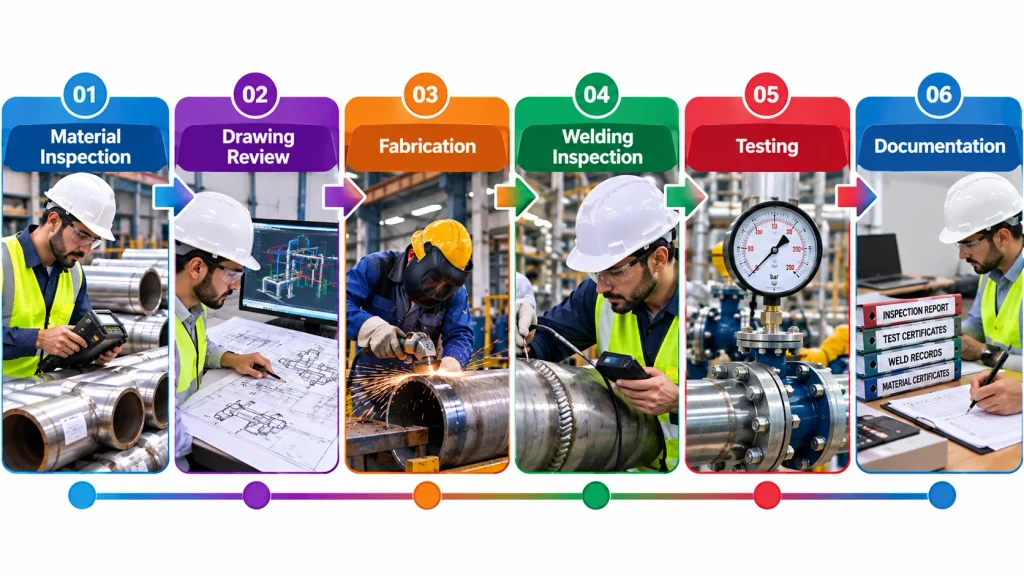
The primary responsibility of a QA/QC Mechanical Engineer is to help ensure that mechanical work complies with approved technical and quality requirements. The role may cover the entire project lifecycle, from material procurement to final handover.
Review Engineering Drawings and Specifications
A QA/QC Mechanical Engineer reviews engineering drawings, technical specifications, inspection requirements, and approved procedures before inspection or fabrication activities begin.
Typical documents include:
- Mechanical general arrangement drawings.
- Piping and instrumentation diagrams (P&IDs).
- Isometric piping drawings.
- Fabrication and assembly drawings.
- Material specifications and purchase orders.
- Welding procedures and inspection requirements.
- Inspection and Test Plans (ITPs).
- Applicable engineering codes and project standards.
The purpose of this review is to understand the required materials, dimensions, tolerances, testing methods, inspection stages, and acceptance criteria.
Inspect Materials and Equipment
Material inspection helps confirm that delivered items correspond to the approved specifications and procurement requirements.
Depending on the project, inspection activities may include checking material identification, dimensions, certificates, quantities, physical condition, markings, and traceability records.
For example, a piping project may require verification of pipe grade, diameter, wall thickness, heat numbers, and material test certificates before the materials are released for fabrication.
A QA/QC professional must also understand when additional verification or specialist inspection is necessary.
Monitor Welding and Fabrication
Welding and fabrication quality can affect the strength, reliability, and service life of mechanical components.
Typical responsibilities may include verifying welder qualifications, reviewing approved Welding Procedure Specifications (WPSs), checking fit-up, monitoring required inspection stages, reviewing weld maps, and coordinating non-destructive testing.
The professional must understand the applicable acceptance criteria and recognize when work requires correction or further evaluation by an authorized specialist.
Perform Mechanical Inspection and Testing
Mechanical inspection confirms whether components and installations meet the required dimensions, workmanship, functional, and testing criteria.
Activities may include:
- Dimensional inspection.
- Visual inspection of welds and fabricated components.
- Piping installation checks.
- Alignment and installation verification.
- Pressure and leak testing.
- Review of non-destructive testing reports.
- Verification of equipment installation against approved drawings.
Not every QA/QC Mechanical Engineer performs every inspection personally. Some activities require certified inspectors, qualified NDT personnel, specialist technicians, or authorized testing organizations.
Manage Quality Documentation
Quality documentation provides evidence that inspection and testing activities have been completed and that the applicable requirements have been addressed.
Common records include Inspection and Test Plans, material inspection reports, welding records, inspection checklists, non-destructive testing reports, pressure test records, calibration certificates, nonconformance reports, and final quality dossiers.
Accurate documentation is essential for traceability, client acceptance, audits, regulatory compliance, and project handover.
Identify and Resolve Nonconformities
A nonconformity occurs when a product, process, material, or activity does not meet a specified requirement.
A QA/QC Mechanical Engineer may raise a Nonconformance Report (NCR), document the issue, identify affected items, coordinate technical evaluation, and verify that approved corrective actions have been implemented.
The professional should not approve deviations without the required authorization. Technical dispositions and concessions must follow the applicable contractual, engineering, and quality procedures.
How to Become a QA/QC Mechanical Engineer
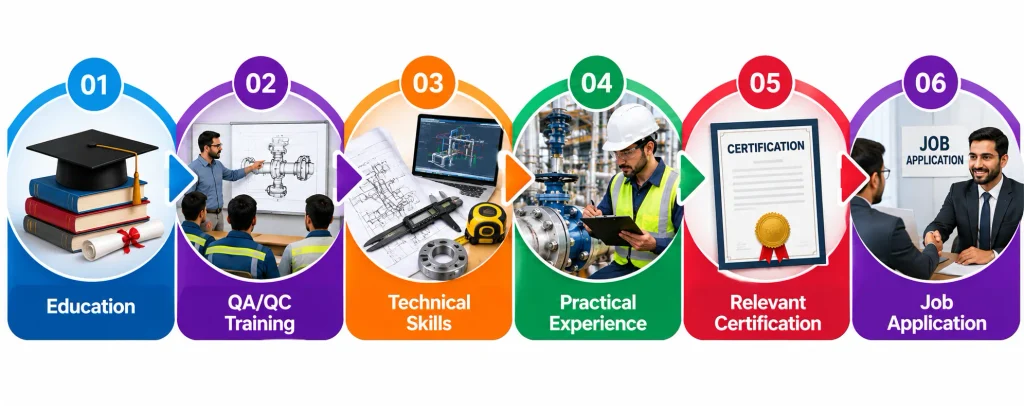
There is no single career route that applies to every employer or country. However, the following steps provide a practical pathway for people entering mechanical quality assurance and quality control.
Step 1: Obtain Relevant Mechanical Engineering Education
Start by developing a sound understanding of mechanical engineering principles. Common educational routes include a diploma in mechanical engineering, a bachelor’s degree in mechanical engineering, or another relevant technical qualification accepted by the employer.
A bachelor’s degree may be preferred for engineering-design, quality-engineering, supervisory, or management positions. Technician-level inspection roles may accept a diploma or vocational qualification combined with relevant experience.
Useful technical subjects include:
- Engineering drawing and interpretation.
- Engineering materials and metallurgy.
- Welding and fabrication technology.
- Manufacturing processes.
- Fluid mechanics and thermodynamics.
- Mechanical measurement and tolerances.
- Piping systems and pressure equipment.
- Engineering mathematics and technical reporting.
The appropriate entry requirement depends on the position. A person should check the actual vacancy requirements before selecting a qualification or training programme.
Step 2: Learn the Fundamentals of Quality Assurance and Quality Control
Mechanical knowledge alone is not enough to perform effectively in a QA/QC role. Learners also need to understand how quality requirements are planned, implemented, inspected, documented, and verified.
Important topics include quality management principles, inspection procedures, quality objectives, risk-based thinking, document control, traceability, nonconformity management, corrective action, and continuous improvement.
An introductory course in mechanical QA/QC can help learners understand industry terminology and inspection workflows. Practical exercises involving drawings, inspection reports, material certificates, and sample ITPs can make the learning process more relevant to employment.
Training should complement technical education and workplace experience rather than being treated as a guaranteed route to employment.
Step 3: Understand Engineering Codes and Quality Standards
QA/QC Mechanical Engineers work with technical codes, project specifications, and quality management standards. The applicable requirements depend on the industry, equipment, jurisdiction, and contract.
Examples include:
- ISO 9001: Quality management systems and process control.
- ASME Boiler and Pressure Vessel Code: Requirements relevant to specified pressure equipment and related activities.
- ASME B31.3: Process piping requirements within its scope.
- API 570: Inspection, rating, repair, and alteration of in-service piping systems within its scope.
- API 510: Inspection, repair, alteration, and rerating of in-service pressure vessels within its scope.
- AWS D1.1/D1.1M: Structural welding requirements for steel within its scope.
- ISO 3834: Quality requirements for fusion welding of metallic materials.
These references serve different purposes and are not interchangeable. For example, ISO 9001 addresses a quality management system, while a technical construction code specifies requirements for particular types of equipment or work.
A candidate should first learn how to locate applicable clauses, identify acceptance criteria, and interpret project requirements. Memorizing standard numbers without understanding their application is unlikely to be sufficient for effective inspection work.
Step 4: Develop Practical Inspection Skills
Practical skills are essential for understanding how quality requirements are applied on site and in manufacturing environments.
Useful areas to practise include:
- Reading mechanical drawings and isometric drawings.
- Measuring dimensions with appropriate calibrated instruments.
- Checking material identification and traceability.
- Reviewing welding documentation.
- Completing inspection checklists.
- Interpreting material test certificates.
- Understanding pressure test procedures.
- Reviewing NDT reports and associated limitations.
- Recording inspection findings accurately.
Training exercises should use realistic examples, including identifying a mismatch between a drawing and an installed component, checking whether a material certificate meets a specified grade, or determining whether an inspection can proceed under an approved ITP.
Where possible, practical learning should take place under the supervision of competent professionals and in accordance with workplace safety requirements.
Step 5: Gain Relevant Industry Experience
Practical experience helps candidates understand inspection sequences, site coordination, documentation requirements, and the consequences of nonconforming work.
Entry-level opportunities may include mechanical technician, fabrication inspector trainee, QA/QC assistant, quality documentation assistant, mechanical site trainee, or inspection support roles. The availability and eligibility requirements for these positions vary by employer.
Candidates should seek supervised exposure to material receiving inspection, fabrication, welding, piping installation, equipment installation, testing, and handover documentation.
A useful way to develop experience is to maintain a record of training activities, inspection exercises, completed courses, and responsibilities performed under supervision. Any portfolio must respect employer confidentiality and should not contain unauthorized project documents.
Do not claim inspection experience, professional registration, or certification that has not actually been obtained.
Step 6: Consider Relevant Professional Certifications
Professional certifications may support career development when they match the intended job and the employer’s requirements. They do not automatically replace engineering education, practical experience, or mandatory role-specific authorization.
Potential options include:
- ISO 9001 quality management system auditor training.
- Welding inspection qualifications appropriate to the target role.
- NDT certification through a recognized certification scheme.
- API inspection certifications for eligible candidates pursuing relevant in-service inspection roles.
- Specialist training in pressure testing, piping inspection, dimensional inspection, or mechanical completion.
Before enrolling, verify the issuing organization’s recognition, eligibility rules, examination requirements, practical experience requirements, renewal conditions, and relevance to the target industry.
For example, an in-service piping inspection certification may be useful for an experienced professional working in plant maintenance, but it may not be the best first qualification for a beginner seeking an entry-level fabrication QA/QC role.
Step 7: Prepare a Professional QA/QC Mechanical CV
A CV should clearly demonstrate technical knowledge, relevant experience, training, and the ability to carry out the responsibilities stated in the vacancy.
Include the following information where applicable:
- Mechanical engineering education and vocational qualifications.
- QA/QC and inspection training.
- Knowledge of relevant codes and standards.
- Experience with drawings, ITPs, and inspection records.
- Welding, piping, fabrication, or equipment inspection exposure.
- Familiarity with NCRs, corrective actions, and traceability.
- Software skills relevant to the role.
- Genuine certifications and professional registrations.
Candidates without direct industry experience should emphasize relevant academic projects, supervised practical training, technical exercises, and transferable skills. They should distinguish training activities from actual employment experience.
Step 8: Apply for Suitable Entry-Level and Junior Roles
Search for vacancies that match the current level of knowledge and experience. Relevant job titles may include QA/QC Mechanical Engineer, Junior QA/QC Engineer, Mechanical Quality Inspector, Piping Inspector, Welding Inspector, Mechanical QC Inspector, or Quality Assurance Assistant.
Read each job description carefully. Some employers require an engineering degree, while others prioritize an accepted technical qualification and specific inspection experience.
Prepare for interviews by practising drawing interpretation, quality terminology, inspection sequencing, material traceability, welding documentation, NCR handling, and the purpose of an ITP.
A realistic career plan focuses on building competence progressively rather than relying on a single course or certificate to secure a particular job title.
Essential Skills for a QA/QC Mechanical Engineer
A QA/QC Mechanical Engineer requires technical knowledge, inspection expertise, analytical thinking, and communication skills to ensure mechanical work meets approved quality standards. These skills help professionals identify defects, verify compliance with engineering drawings, maintain accurate records, and resolve quality issues. Understanding mechanical systems, welding, fabrication, testing procedures, and relevant standards is essential for effective performance across construction, manufacturing, oil and gas, and power generation projects.
Key skills include:
- Technical Knowledge: Understanding mechanical equipment, materials, welding, and fabrication processes.
- Drawing Interpretation: Reading engineering drawings, specifications, dimensions, and tolerances.
- Inspection and Testing: Checking materials, components, installations, and test results.
- Quality Documentation: Preparing inspection reports, reviewing certificates, and maintaining traceability.
- Problem-Solving: Identifying defects, investigating causes, and supporting corrective actions.
- Communication: Coordinating with engineers, contractors, suppliers, and inspection teams.
- Professional Integrity: Reporting nonconformities accurately and following approved procedures.
Important Documents Used in Mechanical QA/QC
Understanding quality documents is a major part of preparing for a mechanical QA/QC career.
| Document | Purpose |
|---|---|
| Quality Management Plan | Defines the project’s quality arrangements. |
| Inspection and Test Plan (ITP) | Identifies inspection stages, checks, and acceptance requirements. |
| Material Test Certificate (MTC) | Provides material information and test results, as applicable. |
| Welding Procedure Specification (WPS) | Specifies essential welding parameters and requirements. |
| Procedure Qualification Record (PQR) | Records qualification test results for a welding procedure, where applicable. |
| Welder Qualification Record | Provides evidence of welder qualification within its stated scope. |
| Nonconformance Report (NCR) | Records a failure to meet a specified requirement. |
| Corrective Action Report | Documents actions to address identified causes and prevent recurrence. |
| Non-Destructive Testing (NDT) Report | Records examination details and results. |
| Pressure Test Report | Records test conditions, results, and relevant approvals. |
| Final Quality Dossier | Compiles required quality evidence for project handover. |
The exact documents depend on the project, contract, applicable codes, and quality procedures. Not every project requires every document listed above.
Understanding an Inspection and Test Plan (ITP)
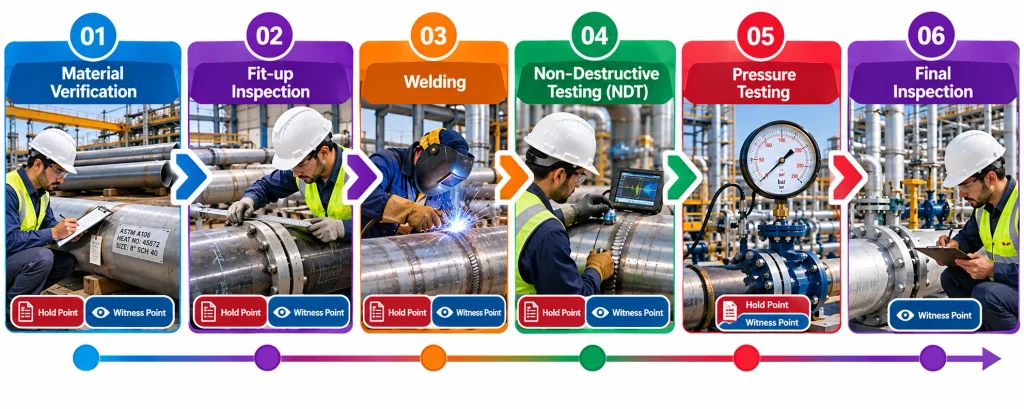
An Inspection and Test Plan (ITP) defines the inspections, tests, and verification activities required at different stages of a mechanical engineering project. It helps ensure that materials, fabrication, welding, installation, and testing comply with approved drawings, project specifications, and applicable quality standards. A QA/QC Mechanical Engineer uses the ITP to coordinate inspections, verify acceptance criteria, maintain records, and confirm that quality requirements are satisfied before work is approved or released.
Key elements of an ITP include:
- Inspection Activities: Checks required during fabrication, installation, and testing.
- Acceptance Criteria: Requirements used to determine whether work meets specifications.
- Hold Points: Stages requiring formal release before work can proceed.
- Witness Points: Activities where designated parties are invited to attend inspections.
- Inspection Records: Reports and documents providing evidence of compliance.
- Inspection Responsibilities: Identification of parties responsible for inspection, review, and approval.
For example, a piping fabrication ITP may cover material verification, fit-up inspection, welding checks, non-destructive testing, pressure testing, and final documentation review.
Career Opportunities for QA/QC Mechanical Engineers
QA/QC Mechanical Engineers can work across industries where mechanical products, equipment, installations, and processes must meet defined requirements.
Oil and Gas
Typical activities include piping fabrication, pressure equipment inspection, welding quality control, material verification, and inspection support during plant construction or maintenance.
Construction and Infrastructure
Mechanical quality professionals may work on building services, industrial facilities, HVAC systems, mechanical plant installations, fire protection piping, and other specified mechanical systems.
Manufacturing and Fabrication
Manufacturing environments may involve machining, welding, assembly, dimensional inspection, supplier quality, product testing, and production process control.
Power Generation
Quality activities may cover mechanical equipment, piping systems, turbines, pumps, pressure components, installation checks, and documentation for commissioning and handover.
Petrochemical and Process Industries
Professionals may support fabrication, equipment installation, piping inspection, shutdown work, and quality documentation for process facilities.
Industrial Maintenance
Experienced personnel may progress into roles involving inspection planning, equipment integrity support, maintenance quality, repair verification, and coordination with specialist inspection teams.
Job responsibilities differ considerably between new construction and in-service inspection. Candidates should select training and certifications based on their intended industry and the actual requirements of the target position.
QA vs QC in Mechanical Engineering
Quality Assurance and Quality Control work together, but their emphasis is different.
| Comparison | Quality Assurance (QA) | Quality Control (QC) |
|---|---|---|
| Main focus | Preventing quality failures | Detecting nonconformities |
| Typical approach | Process-oriented | Inspection-oriented |
| Common activities | Audits, procedures, planning | Inspections, measurements, tests |
| Key documents | Quality plans, procedures, audit reports | Inspection reports, test records, NCRs |
| Main objective | Establish reliable quality processes | Verify that outputs meet requirements |
For example, QA may ensure that an approved welding procedure and qualification process are in place, while QC verifies that the relevant welding activity and completed welds meet the applicable requirements.
In practice, the responsibilities may overlap, particularly in smaller organizations or projects where one professional supports both functions.
QA/QC Mechanical Engineer Salary and Career Growth
Salary depends on the country, industry, employer, project type, education, experience, certifications, and level of responsibility. Site-based positions, specialist inspection work, and international assignments may have different compensation structures from office-based quality roles.
For an accurate salary assessment, compare current vacancies in the target location rather than relying on a single global average. Review the required years of experience, certification requirements, working hours, accommodation arrangements, rotation schedules, and other employment benefits.
A typical career progression may look like this:
| Career stage | Main development focus |
|---|---|
| Trainee or QA/QC Assistant | Learn procedures, documentation, and inspection basics. |
| Junior QA/QC Professional | Support routine inspections under appropriate supervision. |
| QA/QC Mechanical Engineer or Inspector | Manage assigned inspections and quality records. |
| Senior QA/QC Engineer or Lead Inspector | Coordinate inspection activities and resolve complex quality issues. |
| QA/QC Manager | Lead quality planning, audits, teams, and performance improvement. |
| Quality Manager or Specialist Consultant | Oversee quality systems, strategic improvement, or specialist technical services. |
These are illustrative pathways, not guaranteed promotions. Progression depends on demonstrated competence, relevant experience, qualifications, employer structure, and the requirements of the role.
Common Challenges Faced by New QA/QC Mechanical Engineers
New QA/QC Mechanical Engineers often face challenges when applying theoretical knowledge to real project requirements. Understanding technical specifications, interpreting engineering drawings, managing quality documents, and identifying nonconformities requires practice and technical understanding. Mistakes in these areas can cause inspection delays, documentation errors, and quality issues. Beginners should follow approved procedures, seek guidance from experienced professionals, and use established acceptance criteria rather than relying on personal assumptions.
Common challenges include:
- Technical Specifications: Understanding applicable codes, tolerances, and acceptance criteria.
- Drawing Interpretation: Identifying dimensions, revisions, and inspection requirements.
- Documentation Control: Maintaining accurate records and using approved document revisions.
- Nonconformity Identification: Recognising defects and reporting deviations correctly.
- Practical Experience: Applying classroom knowledge to actual inspection activities.
- Problem-Solving: Investigating quality issues and supporting corrective actions.
Regular practice, technical training, and supervised workplace experience help new professionals build confidence and improve their mechanical QA/QC skills.
Conclusion
Becoming a QA/QC Mechanical Engineer requires relevant technical knowledge, practical inspection skills, an understanding of quality standards, and accurate documentation. By developing expertise in mechanical inspection, welding, fabrication, testing, and quality management procedures, aspiring professionals can prepare for opportunities across construction, manufacturing, oil and gas, and power generation.
Continuous learning, relevant training, and practical experience are essential for career progression. With a strong commitment to quality, safety, and professional integrity, learners can build the competence needed to pursue entry-level positions and advance towards senior QA/QC responsibilities.