
QA/QC Civil Engineering:Complete Guide to Quality Assurance, Quality Control, Skills and Careers
Quality is one of the most important aspects of civil engineering and construction. Every building, road, bridge, drainage system, foundation and infrastructure project must meet defined requirements for safety, durability, performance and compliance. This is where QA/QC Civil Engineering plays a critical role.
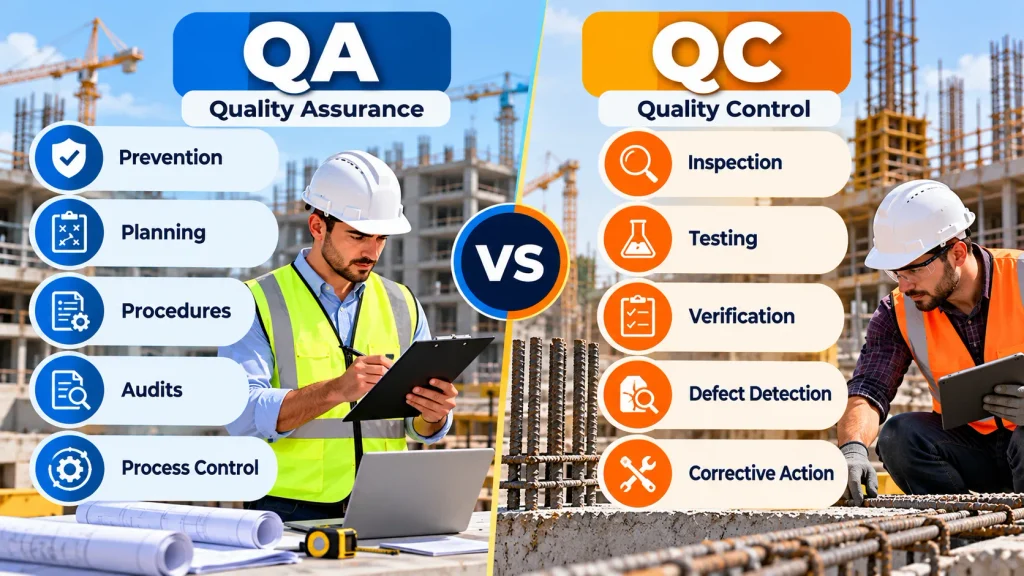
QA/QC Civil Engineering refers to the systematic processes used to ensure that construction activities, materials, workmanship, documentation and completed works meet specified quality requirements. Quality Assurance (QA) focuses primarily on planned systems, procedures and processes, while Quality Control (QC) focuses on inspection, testing, verification and identification of defects.
For construction companies, contractors, consultants and project owners, an effective QA/QC system can help reduce defects, minimise rework, improve project reliability and support compliance with contractual and technical requirements.
This complete guide explains what QA/QC Civil Engineering means, the difference between quality assurance and quality control, the responsibilities of civil QA/QC professionals, essential skills, inspection procedures, documentation, standards, career opportunities and professional development.
What is QA/QC Civil Engineering?
QA/QC Civil Engineering is the application of quality assurance and quality control principles to civil engineering and construction projects.
The objective is to ensure that construction work is completed according to approved drawings, specifications, project requirements, applicable standards and agreed quality criteria.
A civil QA/QC system may cover:
- Construction materials
- Earthworks
- Excavation
- Foundations
- Reinforced concrete
- Structural works
- Masonry
- Waterproofing
- Roads and pavements
- Drainage systems
- Finishing works
- Infrastructure works
- Testing and inspection
- Construction documentation
- Non-conformance management
- Final inspection and handover
QA/QC is not limited to identifying defective work after construction. A well-designed quality system attempts to prevent problems by establishing appropriate procedures before work begins and then verifying performance throughout the project.
What Does QA Mean in Civil Engineering?
Quality Assurance is the planned and systematic approach used to establish confidence that construction processes can consistently achieve the required quality.
In civil engineering, QA commonly involves:
- Developing quality plans
- Establishing procedures
- Defining inspection requirements
- Reviewing construction methods
- Controlling documentation
- Establishing responsibilities
- Managing approved suppliers
- Reviewing testing requirements
- Conducting audits
- Monitoring processes
- Managing corrective actions
- Preventing recurring quality problems
QA is therefore strongly associated with process management and prevention.
For example, before concrete is poured, a QA system may require an approved concrete mix design, qualified suppliers, appropriate inspection procedures, calibrated testing equipment and documented approval processes.
What Does QC Mean in Civil Engineering?
Quality Control is the operational process of checking and verifying whether materials, workmanship and completed activities meet specified requirements.
QC commonly includes:
- Site inspections
- Material inspections
- Sampling
- Laboratory testing
- Field testing
- Dimensional checks
- Concrete inspections
- Reinforcement inspections
- Workmanship verification
- Reviewing test results
- Recording defects
- Issuing inspection reports
- Raising non-conformance reports where required
QC is therefore strongly associated with inspection, measurement, testing and verification.
For example, a QC inspector may inspect reinforcement before a concrete pour to verify bar diameter, spacing, lap lengths, cover, cleanliness and compliance with approved drawings.
QA vs QC in Civil Engineering
Although QA and QC are closely related, they have different primary purposes.
| Aspect | Quality Assurance | Quality Control |
|---|---|---|
| Main focus | Processes and systems | Products and workmanship |
| Primary objective | Prevent quality problems | Detect and control defects |
| Approach | Preventive | Inspection and corrective |
| Typical activities | Procedures, audits, quality planning | Testing, inspection, measurement |
| Timing | Throughout planning and execution | During and after construction activities |
| Documentation | Quality plans and procedures | Inspection and test records |
| Example | Approving a construction procedure | Inspecting completed reinforcement |
In practice, effective civil construction projects require both QA and QC. A strong inspection programme cannot compensate for poorly designed processes, while a sophisticated quality management system is ineffective if actual construction work is not properly inspected and tested.
Why is QA/QC Important in Civil Engineering?
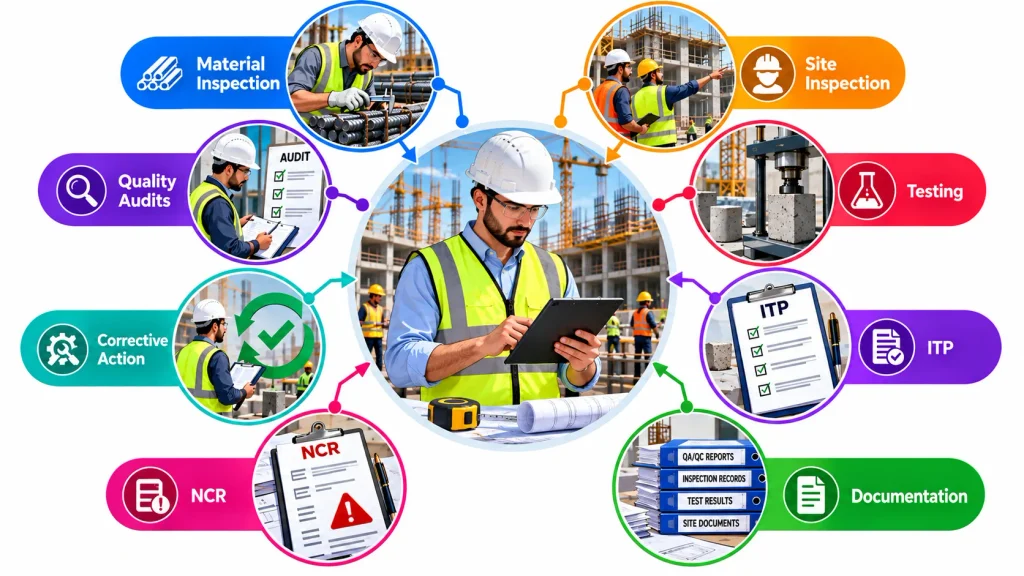
Quality Assurance and Quality Control (QA/QC) are fundamental components of successful civil engineering and construction projects. Civil works must meet defined requirements for safety, strength, durability, functionality and workmanship. Without effective quality management, construction projects may experience defects, rework, material waste, delays, increased costs and compliance issues.
A structured QA/QC system helps construction organisations control quality from the planning stage through construction, inspection, testing and final handover. It provides a systematic approach for identifying potential problems early, verifying completed work and maintaining reliable quality records.
Ensures Construction Quality
QA/QC processes help verify that construction activities, materials and workmanship comply with approved drawings, specifications, standards and project requirements. Regular inspections and testing provide evidence that work is being completed according to the required criteria.
Minimises Defects and Rework
Early identification of construction defects allows corrective action to be taken before problems become more difficult or expensive to resolve. Effective quality control can reduce repeated work, material wastage and disruption to construction activities.
Helps Control Project Costs
Poor construction quality can increase labour, material, equipment and project management costs. Delayed activities and extensive rework can also affect project schedules. A proactive QA/QC approach helps identify quality issues early and supports more efficient use of project resources.
Supports Construction Safety
Quality and safety are closely connected in civil engineering. Correct materials, approved construction methods and compliant workmanship can contribute to the structural integrity and safe performance of buildings, roads, bridges and other infrastructure.
Improves Durability and Performance
Proper inspection and control of materials and construction processes can contribute to the long-term durability of civil engineering works. Effective QA/QC helps ensure that critical activities such as concrete placement, reinforcement installation, compaction and waterproofing are completed according to specified requirements.
Supports Contract and Specification Compliance
Civil construction projects are normally governed by contracts, technical specifications, approved drawings and applicable standards. QA/QC processes help demonstrate that these requirements have been considered and verified through inspections, tests, approvals and documented records.
Provides Reliable Quality Documentation
Quality documentation creates a traceable record of construction activities and decisions. Inspection requests, checklists, test reports, material certificates, approvals and non-conformance records can provide important evidence of how quality requirements were managed throughout the project.
Builds Client and Stakeholder Confidence
A consistent QA/QC system demonstrates that quality is being actively managed rather than checked only after construction is completed. Reliable inspection processes, accurate documentation and transparent corrective actions can strengthen confidence among clients, consultants, contractors and other project stakeholders.
Overall, QA/QC in civil engineering provides a structured framework for controlling construction quality, reducing avoidable defects, supporting compliance and improving project performance. It is therefore an essential function across building, infrastructure and civil construction projects.
Main Responsibilities of a Civil QA/QC Engineer
A Civil QA/QC Engineer may perform different responsibilities depending on the organisation, project type and level of seniority.
Common responsibilities include:
- Developing and implementing quality procedures
- Preparing project quality plans
- Reviewing drawings and specifications
- Preparing inspection and test plans
- Coordinating inspections
- Inspecting construction activities
- Checking materials and workmanship
- Reviewing laboratory and field test results
- Monitoring compliance with approved procedures
- Identifying non-conforming work
- Supporting corrective actions
- Maintaining quality records
- Coordinating with consultants and clients
- Participating in quality meetings
- Conducting internal inspections and audits
- Supporting final inspection and project handover
The exact responsibilities may vary between a QA/QC Engineer, QC Inspector, QA Engineer, Quality Manager and Civil Site Engineer.
Civil QA/QC Engineer vs Civil QA/QC Inspector
| Aspect | Civil QA/QC Inspector | Civil QA/QC Engineer | Quality Manager |
|---|---|---|---|
| Primary Focus | Field inspection and verification | Quality planning, engineering and control | Overall quality management |
| Main Responsibilities | Inspections, testing, measurements and reporting | Quality procedures, ITPs, technical reviews, inspections and documentation | Quality strategy, systems, audits and performance |
| Site Involvement | Usually high | High, depending on project requirements | Moderate to high, depending on project |
| Quality Planning | Limited involvement | Significant involvement | Strategic responsibility |
| Inspection & Testing | Performs and records inspections and tests | Coordinates and reviews inspection and testing activities | Oversees quality inspection systems |
| Technical Reviews | Limited | Reviews drawings, specifications and technical requirements | Provides management-level oversight |
| Documentation | Maintains inspection and test records | Manages and reviews quality documentation | Oversees quality records and reporting |
| Non-Conformance | Identifies and reports issues | Investigates, coordinates corrective actions and follows up closure | Oversees recurring or significant quality issues |
| Coordination | Works with site teams and QA/QC personnel | Coordinates with engineers, contractors, consultants and clients | Coordinates with senior project stakeholders |
| Level of Responsibility | Operational | Technical and operational | Management and strategic |
| Typical Career Level | Entry to experienced inspection role | Experienced technical role | Senior management role |
| Main Objective | Verify that work meets requirements | Establish and maintain effective quality controls | Ensure the overall quality system performs effectively |
Key Areas of Civil QA/QC Inspection
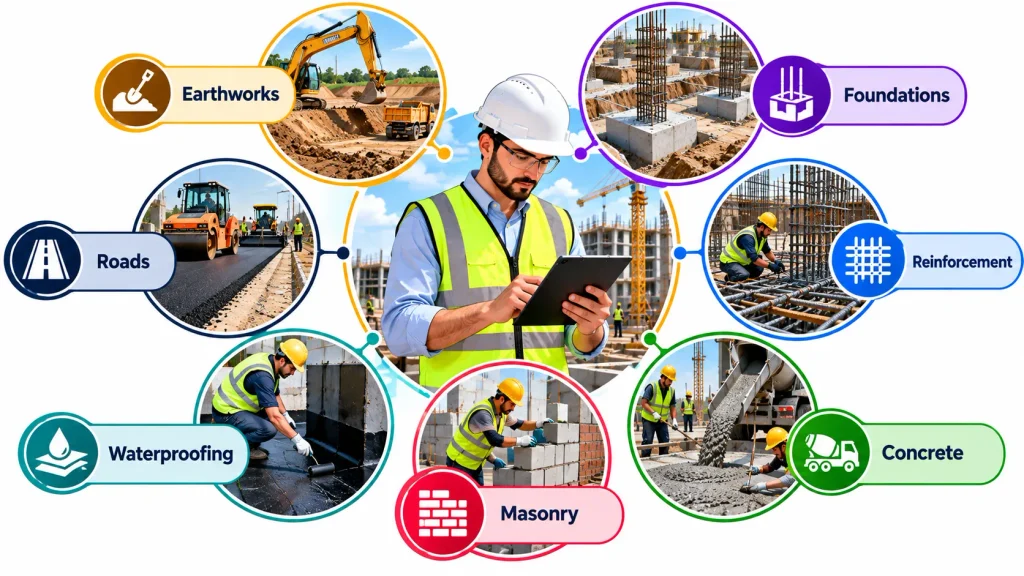
Civil QA/QC inspection covers a wide range of construction activities, from site preparation and foundations to concrete, masonry, waterproofing and road works. The purpose is to verify that materials, workmanship, dimensions and construction processes comply with approved drawings, specifications and applicable quality requirements.
Earthwork and Excavation
Earthwork inspection focuses on ensuring that excavation, filling and ground preparation are completed to the required dimensions and levels. QA/QC checks may include:
- Excavation dimensions and depth
- Formation and finished levels
- Soil and ground conditions
- Approved fill material
- Moisture content
- Compaction requirements
- Field density testing
- Ground preparation before subsequent work
Foundations
Foundation inspections help verify that the substructure is prepared correctly before construction progresses. Typical checks include:
- Excavation depth and dimensions
- Ground conditions
- Blinding concrete
- Reinforcement size, spacing and cover
- Formwork dimensions and stability
- Embedded items
- Foundation levels
- Concrete placement and workmanship
Reinforcement
Reinforcement inspection is important for confirming that steel reinforcement has been installed according to approved structural drawings and specifications. Checks commonly include:
- Bar diameter and type
- Bar spacing and arrangement
- Bar lengths
- Lap lengths and anchorage
- Concrete cover
- Reinforcement cleanliness
- Supports, chairs and spacers
- Positioning before concrete placement
Concrete Works
Concrete QA/QC involves controlling both the materials and the construction process to support the required strength and performance. Inspection may cover:
- Approved concrete mix design
- Material and batch compliance
- Concrete delivery information
- Slump testing
- Concrete temperature
- Sampling for strength testing
- Concrete placement
- Compaction and vibration
- Curing
- Finished surface condition
- Cube or cylinder testing, where applicable
Masonry Works
Masonry inspection focuses on materials, alignment and workmanship to ensure that walls and other masonry elements meet the specified requirements. Typical checks include:
- Brick or block quality
- Mortar composition
- Wall alignment and level
- Joint thickness
- Verticality
- Openings and dimensions
- Bonding and workmanship
- Curing requirements
Waterproofing
Waterproofing inspections help ensure that surfaces and waterproofing systems are correctly prepared and installed. QA/QC checks may include:
- Surface preparation
- Approved waterproofing products
- Application method
- Coating or membrane thickness
- Joints and overlaps
- Corners and penetrations
- Detailing around openings
- Protection layers
- Required waterproofing tests
Road Construction
Road construction QA/QC covers several layers and materials to ensure that the finished pavement meets the required technical and performance criteria. Inspection may include:
- Subgrade preparation
- Sub-base material and thickness
- Base course quality
- Aggregate properties
- Compaction
- Asphalt material
- Layer thickness
- Levels and gradients
- Alignment
- Density testing
- Finished surface quality
Overall, civil QA/QC inspection provides a systematic way to verify construction quality at each stage of a project. Regular inspection and testing can help identify deviations early, reduce rework and provide documented evidence that construction activities meet the required specifications.
What is an Inspection and Test Plan?
An Inspection and Test Plan (ITP) is an important QA/QC document used in civil engineering and construction projects to define how specific construction activities will be inspected, tested and verified. It provides a planned approach for checking whether materials, workmanship and completed activities meet approved drawings, project specifications, standards and acceptance requirements.
An ITP helps the project team understand what needs to be inspected, when inspection should take place, what tests are required, who is responsible and what evidence must be recorded.
What Does an ITP Include?
Depending on the project and organisation, an Inspection and Test Plan may include:
- Construction activity or work stage
- Inspection and testing requirements
- Applicable specifications and standards
- Acceptance criteria
- Inspection and testing frequency
- Responsible personnel or parties
- Required inspection records
- Test reports and certificates
- Hold points
- Witness points
- Reference drawings and documents
- Required approvals
The content and format of an ITP can vary depending on the type, size and requirements of the construction project.
What is a Hold Point?
A hold point is a defined stage in construction where work must normally stop until the required inspection, verification or approval has been completed by the designated party.
For example, reinforcement may need to be inspected and approved before concrete placement begins. This helps prevent important construction stages from progressing before the required quality checks are completed.
What is a Witness Point?
A witness point is a stage where a designated party is given the opportunity to observe an inspection, test or construction activity. The applicable project requirements determine whether the activity can proceed if the designated party does not attend.
Why is an ITP Important?
An ITP provides a clear and systematic framework for managing construction quality. It helps QA/QC teams plan inspections, coordinate testing, verify compliance and maintain appropriate records.
Rather than relying on informal or inconsistent inspections, an ITP establishes defined quality checkpoints throughout the construction process. This can help identify problems at an early stage, improve traceability and provide documented evidence that required inspections and tests have been completed.
Important QA/QC Civil Engineering Documents
Documentation is a fundamental part of QA/QC in civil engineering. Properly maintained quality documents provide evidence that construction activities, materials, inspections and testing have been managed according to approved project requirements. They also support traceability, communication, corrective action and final project handover.
Project Quality Plan
A Project Quality Plan (PQP) explains how quality requirements will be managed and controlled throughout a specific construction project. It may define quality responsibilities, procedures, inspection arrangements, documentation requirements and applicable standards.
Method Statement
A Method Statement describes the planned method for carrying out a particular construction activity. It generally explains the sequence of work, required resources, quality controls, safety considerations and inspection requirements.
Inspection and Test Plan
An Inspection and Test Plan (ITP) identifies the inspections and tests required for specific construction activities. It may include acceptance criteria, responsibilities, inspection stages, hold points, witness points and required records.
Material Approval Request
A Material Approval Request is used to submit construction materials for review and approval before they are incorporated into the project. It may include product information, technical data, certificates, samples and relevant compliance documentation.
Inspection Request
An Inspection Request is used to formally request inspection of a completed or ongoing construction activity. It provides a record that the relevant work has been presented for inspection and verification.
Material Test Certificate
A Material Test Certificate (MTC) provides information about the properties, specifications and test results of a particular material. It can help demonstrate that the supplied material meets the specified requirements.
Non-Conformance Report
A Non-Conformance Report (NCR) records an identified deviation from approved drawings, specifications, standards or other defined requirements. It helps document the issue, required corrective action and subsequent verification.
Corrective Action Report
A Corrective Action Report records the actions taken to address an identified quality problem. Depending on the issue, it may also document the investigation of the underlying cause and measures intended to prevent recurrence.
Test Reports
Test Reports provide documented evidence of laboratory or field testing. They may contain information such as the test performed, sample identification, test date, results, acceptance criteria and relevant references.
Quality Checklists
Quality Checklists provide a structured way for inspectors and site teams to verify specific quality requirements. They help ensure that important inspection points are checked consistently and that completed checks are properly recorded.
Together, these documents create a traceable QA/QC record for the project. They help demonstrate how construction quality was planned, inspected, tested, controlled and documented from the beginning of the work through final completion and handover.
What is an NCR in Civil Construction?
An NCR (Non-Conformance Report) is a formal QA/QC document used in civil construction when a material, product, process, workmanship or completed activity does not meet the requirements defined in approved drawings, specifications, standards, procedures or contract documents.
An NCR provides a structured way to record the quality issue, determine the appropriate corrective action and verify that the issue has been properly addressed. It also creates a traceable record that can be reviewed by the contractor, consultant, client or other authorised project stakeholders.
What Information Does an NCR Include?
Depending on the project requirements, an NCR may contain:
- Description of the non-conformance
- Location and affected work area
- Relevant drawing or specification
- Supporting evidence, such as photographs or test results
- Date and identification of the issue
- Immediate containment or action taken
- Proposed corrective action
- Root cause analysis, where required
- Responsible person or organisation
- Corrective action completion date
- Verification of corrective action
- Final closure and approval
Why is an NCR Important?
An NCR is more than a record of defective or non-compliant work. It helps QA/QC teams understand what went wrong, establish appropriate corrective measures and verify that the problem has been resolved.
When NCRs are reviewed collectively, they can also reveal recurring quality issues, weaknesses in construction procedures, material problems or training and supervision needs. This information can support continuous improvement and help prevent similar non-conformances from occurring elsewhere in the project.
The specific NCR process and approval requirements vary according to the organisation, contract and project quality management system.
Common Causes of Civil Construction Quality Problems
Quality problems in civil construction can arise from a combination of technical, operational, human and management-related factors. Identifying the underlying causes is important because simply correcting a visible defect may not prevent the same issue from occurring again.
Common causes of construction quality problems include:
- Unclear or Misunderstood Drawings: Incorrect interpretation of drawings, details or specifications can result in construction errors.
- Incorrect or Non-Compliant Materials: Using materials that do not meet approved specifications or project requirements can affect the quality and performance of completed work.
- Inadequate Supervision: Insufficient site supervision may allow incorrect construction practices or workmanship issues to continue unnoticed.
- Unapproved Construction Methods: Deviating from approved method statements or procedures can introduce quality risks.
- Poor Workmanship: Inadequate skills, improper installation techniques or lack of attention to detail can lead to defects.
- Insufficient Inspection: Delayed or incomplete inspections can allow quality issues to progress to subsequent construction stages.
- Inadequate Testing: Failure to carry out required material or performance tests can make it difficult to verify compliance.
- Poor Communication: Gaps between designers, engineers, contractors, subcontractors and QA/QC teams can result in misunderstandings and errors.
- Weak Subcontractor Control: Inadequate monitoring of subcontractor activities can create inconsistencies in materials, methods and workmanship.
- Incorrect Measurements: Errors in dimensions, levels, alignment or quantities can affect subsequent construction activities.
- Inadequate Environmental Control: Conditions such as temperature, moisture, dust or unsuitable site conditions can influence certain construction processes and materials.
- Time Pressure: Excessive schedule pressure may result in rushed work, incomplete inspections or deviations from established procedures.
- Poor Documentation: Missing or inaccurate quality records can make it difficult to verify whether requirements were properly followed.
- Failure to Follow Approved Procedures: Ignoring established quality procedures, inspection requirements or acceptance criteria can increase the likelihood of non-conformance.
Effective QA/QC should therefore go beyond identifying and correcting defects. It should also investigate the underlying causes of quality problems, allowing project teams to implement appropriate corrective and preventive actions and reduce the likelihood of recurring issues.
Root Cause Analysis in Civil QA/QC
Root Cause Analysis (RCA) is an important QA/QC practice used to determine the underlying reason behind a construction quality problem. When a defect or non-conformance occurs repeatedly, simply repairing the visible issue may not be enough to prevent it from happening again.
The purpose of root cause analysis is to investigate the problem systematically, identify the factors contributing to it and establish appropriate corrective and preventive actions.
Example of Root Cause Analysis
Problem: Concrete repeatedly fails to achieve the specified strength requirements.
Instead of only replacing or repairing the affected concrete, the QA/QC team may investigate several potential causes, including:
- Mix Design: Whether the approved mix design is suitable and correctly followed
- Material Quality: Whether cement, aggregates, water or admixtures meet the specified requirements
- Batching Accuracy: Whether materials are measured and proportioned correctly
- Water Addition: Whether additional water is being introduced during batching or placement
- Transportation: Whether concrete is transported within the required time and under suitable conditions
- Placement: Whether concrete is placed using the approved method
- Compaction: Whether adequate vibration and compaction are achieved
- Curing: Whether appropriate curing procedures are followed
- Sampling: Whether samples are collected correctly and represent the supplied concrete
- Testing Procedures: Whether testing equipment, procedures and laboratory practices are appropriate
Importance of Root Cause Analysis
Effective RCA helps QA/QC teams move beyond treating individual defects and focus on preventing recurrence. Once the actual cause has been established through evidence, the project team can implement suitable corrective and preventive actions, monitor their effectiveness and improve the relevant construction or quality control process.
Essential Skills for a Civil QA/QC Professional
A successful Civil QA/QC professional needs more than knowledge of inspection procedures. The role requires a combination of technical knowledge, analytical ability, documentation skills, communication and professional judgement. These skills help quality professionals assess construction work, identify non-conformities and support compliance with project requirements.
Technical Knowledge
A strong understanding of civil construction materials, methods, processes and workmanship is essential. QA/QC professionals should be familiar with areas such as concrete, reinforcement, foundations, earthworks, masonry, waterproofing and other relevant civil works.
Engineering Drawing Interpretation
Civil QA/QC professionals regularly use engineering drawings to verify dimensions, levels, reinforcement details, locations and construction requirements. The ability to accurately interpret drawings helps identify deviations before they become larger quality problems.
Specification Reading
Project specifications define important technical and quality requirements. QA/QC personnel should be able to locate relevant requirements, understand acceptance criteria and verify whether construction activities comply with the applicable specifications.
Inspection Skills
Effective inspection requires careful observation and systematic verification. QA/QC professionals should be able to examine materials, workmanship, dimensions, installation methods and completed activities against approved requirements.
Documentation Skills
Accurate documentation is essential for maintaining traceability. Professionals should be able to prepare and review inspection requests, checklists, test reports, NCRs, material records and other quality documents.
Communication Skills
QA/QC professionals work with engineers, site supervisors, contractors, subcontractors, consultants, laboratories and clients. Clear communication helps ensure that quality requirements, inspection findings and corrective actions are properly understood.
Problem-Solving Skills
Construction quality issues often require investigation rather than simple correction. QA/QC professionals should be able to identify problems, evaluate possible causes and support appropriate corrective actions.
Analytical Thinking
Quality professionals may need to analyse test results, inspection records, non-conformance trends and other project information. Analytical thinking helps identify patterns and potential recurring quality issues.
Attention to Detail
Small deviations in dimensions, reinforcement, materials, levels or workmanship can affect construction quality. Strong attention to detail helps professionals identify issues that may otherwise be overlooked.
Professional Judgement
QA/QC personnel often need to evaluate inspection findings and available evidence to determine whether specified requirements have been met. Good professional judgement also helps identify when a quality issue requires further investigation, corrective action or escalation.
Together, these skills enable Civil QA/QC professionals to contribute effectively to quality control, compliance, defect prevention and continuous improvement throughout the construction process.
Qualifications for a Civil QA/QC Career
Requirements vary between employers, countries and project types.
Employers may seek qualifications or experience in:
- Civil engineering
- Construction engineering
- Construction management
- Quality management
- Civil inspection
- Materials testing
- Construction technology
Professional development may also include training in quality management systems, construction inspection, material testing, project documentation and relevant technical standards.
For some positions, employers may require a degree or diploma in civil engineering or a related discipline, while technician and inspector roles may have different entry requirements.
QA/QC Civil Courses and Professional Training
A specialised QA/QC Civil Engineering course can help learners develop structured knowledge of construction quality systems and inspection practices.
Depending on the programme, training may cover:
- Quality assurance principles
- Quality control principles
- Construction inspection
- Civil engineering materials
- Concrete quality control
- Reinforcement inspection
- Earthwork inspection
- Road construction quality
- Inspection and test plans
- Method statements
- Quality documentation
- Non-conformance management
- Corrective actions
- Quality audits
- Construction standards
Learners should evaluate course content, assessment methods, practical relevance, qualification status and progression opportunities before selecting a programme.
Career Opportunities in QA/QC Civil Engineering
QA/QC knowledge can support different roles within construction and civil engineering.
Potential job titles include:
- Civil QA/QC Engineer
- QA/QC Engineer
- Civil QC Inspector
- Civil Quality Inspector
- QA Engineer
- QC Engineer
- Quality Control Inspector
- Construction Quality Engineer
- Quality Assurance Engineer
- Quality Manager
- Site Quality Engineer
- Materials Inspector
- Civil Works Inspector
Career opportunities can vary according to experience, qualifications, technical specialisation, location and employer requirements.
Industries That Employ Civil QA/QC Professionals
Civil QA/QC professionals are needed across a wide range of construction, engineering and infrastructure projects. Their expertise is used to inspect materials, verify workmanship, monitor construction processes and ensure that completed work meets defined quality requirements.
Common sectors and project areas include:
- Building Construction: Residential, commercial, institutional and mixed-use buildings.
- Residential Construction: Houses, apartments, housing developments and residential communities.
- Commercial Construction: Offices, shopping centres, hotels, business facilities and other commercial developments.
- Roads and Highways: Road construction, pavement works, highways, interchanges and related infrastructure.
- Bridges: Construction and rehabilitation of bridges, overpasses and associated structural works.
- Rail Infrastructure: Railway tracks, stations, platforms, bridges and supporting civil works.
- Airports: Runways, terminals, taxiways, aprons and associated infrastructure.
- Water Infrastructure: Water treatment facilities, reservoirs, pipelines and distribution systems.
- Wastewater Projects: Sewage treatment plants, drainage systems, pumping stations and wastewater networks.
- Dams and Hydraulic Structures: Dams, spillways, canals and other major water-related structures.
- Industrial Facilities: Manufacturing plants, warehouses, processing facilities and industrial developments.
- Oil and Gas Construction: Civil works associated with processing facilities, terminals, pipelines and supporting infrastructure.
- Energy Infrastructure: Power plants, substations, renewable energy facilities and related civil construction.
- Utilities: Infrastructure for electricity, water, drainage, telecommunications and other essential services.
- Government Infrastructure: Public buildings, transport systems, municipal facilities and large-scale infrastructure projects.
The specific QA/QC responsibilities can vary according to the type of project, construction stage, technical requirements, contract conditions and professional position. This broad range of applications makes Civil QA/QC a relevant function across many areas of the construction and infrastructure industry.
Career Progression in Civil QA/QC
A typical career pathway may develop from field-based inspection towards engineering, specialist and management responsibilities.
For example:
Trainee / Junior Inspector → QC Inspector → QA/QC Engineer → Senior QA/QC Engineer → Quality Manager
However, career progression is not necessarily linear. Professionals may move into construction management, project management, auditing, quality systems or specialised inspection roles.
Experience with complex projects, strong technical knowledge, effective documentation and recognised professional development can contribute to career development.
QA/QC Civil Engineering Standards and Specifications
Civil QA/QC professionals may work with a combination of international standards, national regulations, project specifications and client requirements.
Depending on the project, relevant references may include:
- ISO 9001
- ASTM standards
- BS standards
- EN standards
- ACI standards
- AASHTO standards
- National building regulations
- Local construction codes
- Project specifications
- Employer requirements
- Approved drawings
- Contract documents
The applicable standard depends on the project, contract and jurisdiction. QA/QC professionals should always use the current and contractually applicable requirements rather than assuming that one standard applies to every project.
ISO 9001 and Civil Construction Quality
ISO 9001 provides a framework for a quality management system based on principles such as customer focus, leadership, process management, improvement and evidence-based decision-making.
In construction, an ISO 9001-based quality management system can provide an organisational framework for controlling processes, responsibilities, documentation and improvement.
However, ISO 9001 does not replace project-specific engineering requirements, construction codes, technical specifications or inspection criteria.
QA/QC Checklist for Civil Construction
A basic civil QA/QC checklist may include:
- Approved drawings available
- Current specifications available
- Approved method statement
- Approved materials
- Required material certificates available
- Inspection and test plan established
- Inspection requirements identified
- Testing equipment suitable
- Equipment calibration verified where applicable
- Construction activity inspected
- Dimensions verified
- Levels checked
- Workmanship assessed
- Test results reviewed
- Defects documented
- NCRs raised where necessary
- Corrective actions verified
- Quality records maintained
Actual checklists should always be adapted to the project and applicable requirements.
Difference Between QA/QC Civil and Site Engineering
QA/QC civil engineering and site engineering are closely connected functions within construction projects, but their responsibilities and primary areas of focus are different.
| Aspect | QA/QC Civil Engineer | Site Engineer |
|---|---|---|
| Primary Focus | Ensures materials, processes and completed works meet specified quality requirements. | Plans, coordinates and supervises construction activities on site. |
| Main Responsibility | Quality assurance, inspection, testing, compliance and quality documentation. | Construction execution, site coordination, progress and technical supervision. |
| Construction Activities | Verifies that work is completed according to approved drawings, specifications and quality requirements. | Directs and supervises construction activities according to approved drawings and project plans. |
| Material Control | Checks material approvals, certificates, testing and compliance with specifications. | Coordinates material use, availability and application during construction. |
| Inspection | Conducts or coordinates inspections and verifies workmanship and completed activities. | Prepares and manages work for inspection and addresses site requirements identified during inspections. |
| Testing | Coordinates or reviews required material and construction tests. | Supports testing activities and ensures construction work is ready for required tests. |
| Documentation | Maintains quality records such as inspection requests, test reports, checklists and NCRs. | Maintains site records related to progress, measurements, resources and construction activities. |
| Non-Conformance | Identifies, documents and follows up quality non-conformances and corrective actions. | Supports investigation and correction of non-conforming construction work. |
| Technical Coordination | Coordinates quality requirements with engineering, construction, consultants and subcontractors. | Coordinates daily construction activities with engineers, subcontractors, supervisors and other site teams. |
| Project Objective | Achieves consistent compliance with quality standards, specifications and acceptance criteria. | Achieves safe, efficient and technically correct construction in line with project requirements. |
| Typical Site Role | Quality-focused and verification-oriented. | Construction-focused and execution-oriented. |
How QA/QC and Site Engineering Work Together
QA/QC and site engineering should operate collaboratively rather than as separate functions. The site engineering team is responsible for executing construction activities correctly, while the QA/QC function provides systematic inspection, verification and quality control.
Quality is therefore a shared project responsibility. Effective coordination between site engineers, QA/QC professionals, subcontractors and other project teams helps reduce defects, prevent rework, maintain compliance and achieve the required construction quality.
Difference Between QA/QC and Quality Management
QA/QC is an important part of the broader quality management system within an organisation. While QA/QC focuses mainly on controlling and verifying the quality of work, quality management provides a wider framework for planning, leading, monitoring and continuously improving organisational quality performance.
| Aspect | QA/QC | Quality Management |
|---|---|---|
| Primary Focus | Ensures products, processes and completed work meet defined quality requirements. | Provides an organisation-wide framework for managing and improving quality performance. |
| Quality Planning | Supports planning through inspections, testing and defined quality requirements. | Establishes overall quality objectives, policies, processes and plans. |
| Quality Assurance | Develops and follows procedures that help prevent quality problems. | Establishes systems and processes to provide confidence that quality requirements will be achieved. |
| Quality Control | Inspects, tests and verifies materials, processes and completed work. | Oversees quality control as part of the wider quality management framework. |
| Quality Improvement | Identifies defects, non-conformances and opportunities for improvement. | Promotes continuous improvement across processes, teams and organisational activities. |
| Leadership | Implements quality requirements within assigned activities and projects. | Provides leadership, direction and organisational commitment to quality. |
| Risk Management | Identifies and addresses quality-related risks during project activities. | Applies risk-based thinking across organisational processes and quality objectives. |
| Performance Monitoring | Monitors inspection results, testing outcomes and non-conformances. | Evaluates broader quality performance using objectives, indicators, audits and management review. |
| Corrective Action | Investigates quality issues and verifies corrective actions. | Ensures corrective action and improvement processes are integrated into the overall quality system. |
| Scope | Often focused on specific projects, processes, products or construction activities. | Covers the wider organisation, including people, processes, systems and strategic quality objectives. |
How QA/QC Fits Within Quality Management
QA/QC should be viewed as an operational component of a broader quality management framework. Effective quality management connects planning, assurance, control, leadership, risk-based thinking, performance monitoring and continuous improvement.
In civil engineering and construction, QA/QC activities provide practical evidence that work meets specified requirements, while quality management establishes the organisational system that supports consistent and sustainable quality performance.erational components within a wider organisational quality framework.
Common Challenges in Civil QA/QC
Civil QA/QC professionals can face a range of challenges during construction projects. These challenges may affect quality, compliance, documentation, productivity and project delivery if they are not identified and managed effectively. Strong communication, controlled processes and proactive quality planning are essential for maintaining consistent construction standards.
Changing Drawings
Frequent design changes, revised drawings and updated specifications can create uncertainty during construction. If revisions are not properly reviewed, approved, distributed and communicated, construction teams may continue working from outdated information, potentially resulting in non-conforming work and rework.
Multiple Contractors and Subcontractors
Large construction projects often involve several contractors and subcontractors with different working methods, levels of experience and quality practices. Maintaining consistent workmanship and ensuring that all parties follow approved procedures can therefore be challenging.
Schedule Pressure
Tight project schedules and construction deadlines can place pressure on site teams to complete activities quickly. If inspections, testing, approvals or quality checks are rushed or bypassed, defects may remain undetected and create additional rework or delays.
Documentation Gaps
Incomplete, inaccurate or missing quality records can make it difficult to demonstrate that construction activities complied with project requirements. Proper control of inspection reports, test results, material certificates, checklists and other QA/QC records is essential for maintaining traceability.
Material Variability
Construction materials may vary due to differences in suppliers, production processes, storage conditions, transportation and environmental factors. QA/QC teams must verify material compliance through appropriate approvals, inspections and testing before and during use.
Communication Problems
Poor communication between designers, site engineers, contractors, subcontractors and QA/QC teams can lead to misunderstandings about drawings, specifications, inspection requirements and construction methods. Clear communication and controlled information flow help reduce these risks.
Recurring Defects
Repeated quality problems may indicate that corrective actions have addressed only the visible defect rather than its underlying cause. Root cause analysis, effective corrective action and follow-up verification are important for preventing recurring non-conformances.
Managing Civil QA/QC Challenges
Effective civil QA/QC requires proactive planning, clear responsibilities, controlled documentation, timely inspections, reliable testing and cooperation across project teams. Addressing quality issues early can help reduce rework, improve compliance and support successful project delivery.subcontractors and quality teams helps identify problems early, reduce rework and maintain compliance with project requirements.
How Technology is Changing Civil QA/QC
Digital technology is transforming the way quality assurance and quality control are managed across modern construction projects. Traditional paper-based inspections and manual record keeping are increasingly being supported or replaced by digital systems that improve the collection, organisation, sharing and traceability of quality information.
Modern civil QA/QC processes may incorporate:
- Digital inspection and quality checklists
- Mobile inspection applications
- Cloud-based document management
- Digital drawings and specifications
- Automated inspection and quality reports
- Building Information Modelling (BIM)
- Geotagged and time-stamped photographs
- QR-based material and asset tracking
- Electronic approvals and workflows
- Quality data analytics
- Digital dashboards and performance monitoring
- Remote collaboration and communication tools
When properly implemented, these technologies can provide faster access to project information, improve communication between teams and strengthen the traceability of inspections, tests, approvals and corrective actions.
Technology can also help QA/QC professionals identify trends in quality performance, monitor outstanding issues and maintain more organised project records. However, digital tools should support established quality processes rather than replace professional inspection, engineering judgement and effective site supervision.

Role of BIM in Civil QA/QC
Building Information Modelling (BIM) can support civil QA/QC by providing a structured digital environment for managing project information and connecting relevant data with physical project elements.
Depending on the project requirements and BIM implementation, it can help QA/QC and construction teams:
- Coordinate design and construction information
- Identify potential design clashes and conflicts
- Track building and infrastructure components
- Link quality information with specific project elements
- Improve communication between project disciplines
- Support inspection and verification activities
- Maintain organised digital quality records
- Improve information traceability throughout the project lifecycle
BIM can therefore contribute to more coordinated and data-driven quality management. However, BIM itself does not guarantee construction quality. Its effectiveness depends on accurate project information, clearly defined workflows, appropriate data management, competent users and effective project management.
The combination of BIM, digital inspection systems, mobile technology and structured quality processes can provide a stronger foundation for modern civil QA/QC management.
How to Become a Civil QA/QC Engineer
A person interested in a Civil QA/QC career can develop through several stages.
Build Civil Engineering Knowledge
Understand construction materials, methods, drawings, structural principles and site practices.
Learn QA/QC Principles
Study quality assurance, quality control, inspection and testing processes.
Develop Inspection Skills
Learn how to inspect earthworks, concrete, reinforcement, masonry and other civil activities.
Understand Documentation
Become familiar with ITPs, checklists, inspection requests, test reports and NCRs.
Gain Practical Experience
Site exposure is particularly valuable because QA/QC involves applying technical requirements to real construction activities.
Develop Communication Skills
Quality professionals need to communicate findings clearly and professionally.
Continue Professional Development
Construction standards, digital tools and quality practices evolve, so ongoing learning is important.
Conclusion
Technology is making civil QA/QC faster, more organised and easier to track. Tools such as digital inspections, cloud systems and BIM can improve communication, documentation and quality monitoring. However, effective QA/QC still depends on skilled professionals, accurate information, proper procedures and regular inspections.