
Civil QA/QC Inspection: Complete Guide to Construction Quality Inspections
Civil QA/QC inspection is the systematic process of checking construction materials, workmanship, processes and completed work to ensure they meet approved drawings, specifications, standards and project requirements. It combines quality assurance and quality control activities to identify defects, verify compliance and support corrective actions.
A construction quality inspection helps confirm that work is completed correctly at each stage, while civil engineering inspection focuses on verifying the technical quality, dimensions, materials and workmanship of civil construction activities. Regular civil QA/QC inspection helps reduce defects, rework and quality-related project risks.
What is Civil QA/QC Inspection?
Civil QA/QC inspection is a structured process used in construction projects to check whether materials, workmanship, construction activities and completed works meet approved drawings, specifications, standards and project requirements. It helps identify defects, confirm compliance and ensure that construction work achieves the required level of quality.
The process combines several related activities, each serving a specific purpose.
Quality Assurance
Quality Assurance (QA) focuses on the processes and systems established to prevent quality problems before they occur. It includes procedures, quality plans, approved methods, inspection and test plans, document control and defined responsibilities.
In simple terms: QA = planning and controlling processes to prevent quality problems.
Quality Control
Quality Control (QC) focuses on checking the actual construction work to determine whether it meets specified requirements. It involves inspections, measurements, testing and recording results.
In simple terms: QC = inspecting and testing work to identify whether requirements have been achieved.
Inspection
Inspection involves physically or visually examining construction activities, materials and completed work. A civil QA/QC inspector may check dimensions, levels, alignment, reinforcement, formwork, workmanship and other project requirements.
Testing
Testing provides measurable evidence about the quality or performance of materials and construction work. Examples include concrete strength testing, soil compaction testing, aggregate testing and other project-specific tests.
Verification
Verification is the process of confirming that an inspection, measurement, test result or completed activity satisfies the specified requirement. It provides documented evidence that the work complies with approved criteria.
Corrective Action
Corrective action is taken when an inspection or test identifies a defect or non-conformance. The issue is investigated, appropriate corrective measures are implemented, and the work is normally reinspected to confirm that the problem has been resolved.
How these Activities Work Together
A typical civil QA/QC process follows this sequence:
QA planning → Construction activity → Inspection and testing → Verification → Identification of non-conformance → Corrective action → Reinspection and closure
Together, these activities create a systematic civil QA/QC inspection process that supports consistent construction quality, reduces rework and maintains reliable quality records throughout a project.
Why is QA/QC Inspection Important in Civil Construction?
QA/QC inspection is important in civil construction because it provides a systematic way to verify that construction activities, materials and completed works meet approved requirements. Regular inspections help detect problems early and support better quality, documentation and project control.
- Verifying construction quality: Confirms that completed work meets required specifications, drawings and quality criteria.
- Identifying defects early: Detects workmanship issues and construction defects before they become more difficult or expensive to correct.
- Checking compliance with drawings: Ensures construction activities follow approved drawings, designs, dimensions and technical requirements.
- Confirming material specifications: Verifies that materials used on site meet approved specifications, standards and project requirements.
- Reducing rework: Early identification of non-conforming work helps prevent repeated construction activities and unnecessary corrections.
- Improving safety and durability: Proper inspection helps ensure that construction elements are installed correctly and can perform as intended.
- Maintaining project records: Inspection reports, test results, checklists and photographs provide documented evidence of completed quality checks.
- Supporting client approval: Clear inspection records and verified results help clients, consultants and other stakeholders review and approve completed work.
- Controlling construction costs: Effective quality control reduces defects, material wastage, delays and costly corrective work.
Main Types of Civil QA/QC Inspections
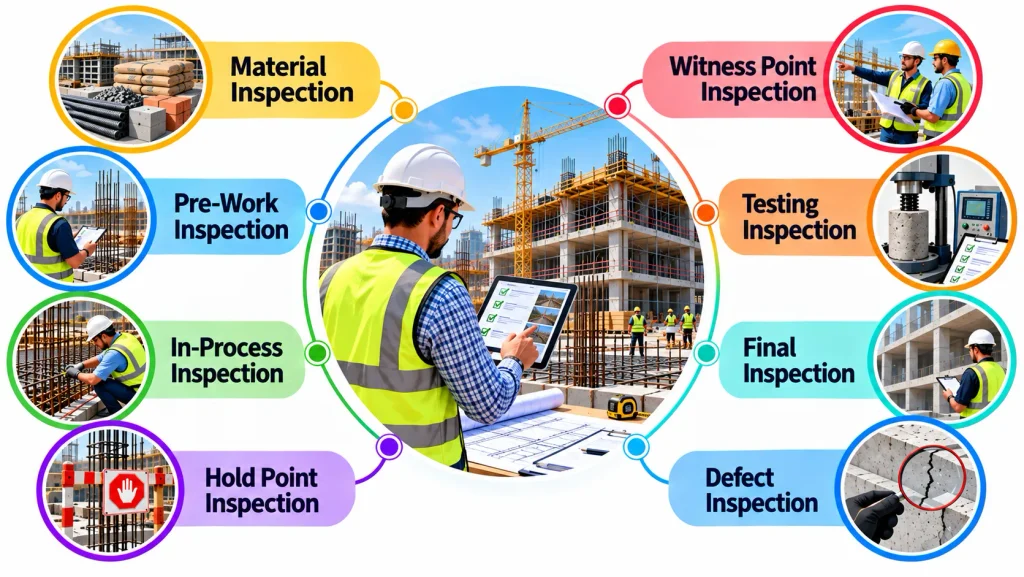
Civil QA/QC inspections are performed at different stages of a construction project to verify materials, workmanship, processes and completed work. Each inspection type has a specific purpose and helps maintain consistent construction quality.
| Inspection Type | Main Purpose |
|---|---|
| Material Inspection | Checks incoming materials to confirm they meet approved specifications, quality requirements and documentation. |
| Pre-Work Inspection | Confirms that drawings, materials, equipment, site conditions and other requirements are ready before construction begins. |
| In-Process Inspection | Monitors ongoing construction activities to identify quality issues while work is still in progress. |
| Hold Point Inspection | Requires inspection and formal approval before a specific activity can proceed to the next stage. |
| Witness Point Inspection | Provides an opportunity for the designated client, consultant or inspector to witness a specified activity or test. |
| Final Inspection | Checks completed work to confirm that it meets drawings, specifications and applicable acceptance requirements. |
| Testing Inspection | Verifies technical requirements through relevant material or construction tests and recorded results. |
| Defect Inspection | Identifies defective or non-conforming work so that appropriate corrective action can be taken. |
Together, these inspection types provide quality control throughout the construction lifecycle, from material delivery and pre-work preparation to final completion and defect correction.
Civil QA/QC Inspection Process
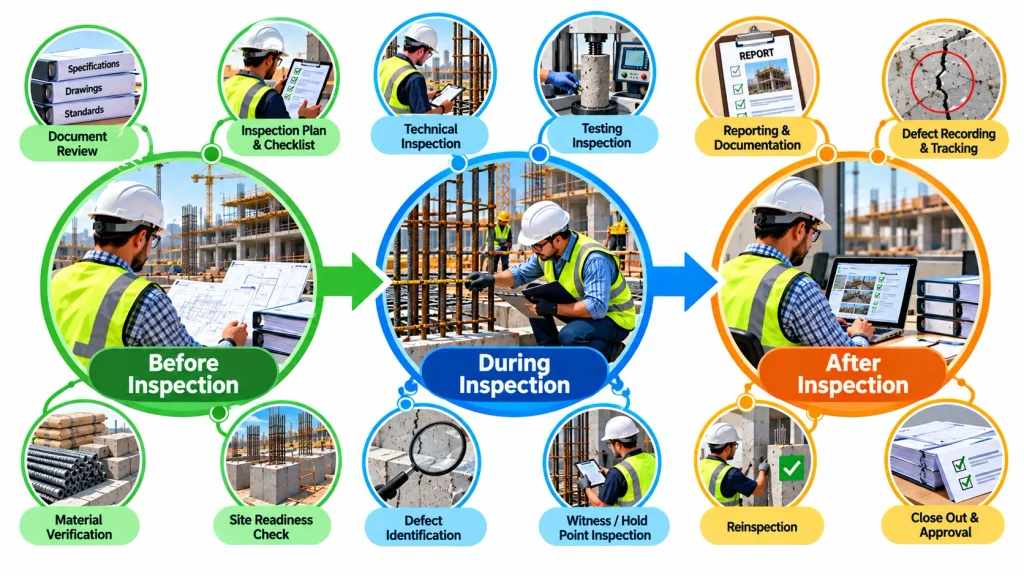
The civil QA/QC inspection process provides a structured approach for checking construction activities, materials and completed work. It helps ensure that quality requirements are identified, inspected, documented and addressed throughout the project.
Review Requirements → Prepare Inspection → Inspect Work → Perform Tests → Record Results → Identify Defects → Corrective Action → Reinspection → Approval
Review Requirements
Before inspection, the QA/QC team reviews approved drawings, specifications, method statements, inspection and test plans, standards and acceptance criteria. This establishes what needs to be checked.
Prepare Inspection
The inspection is planned according to the construction activity and project requirements. Required documents, checklists, equipment, personnel and inspection timing are confirmed.
Inspect Work
The actual construction work is examined to verify dimensions, levels, alignment, materials, workmanship and other specified requirements.
Perform Tests
Where testing is required, appropriate tests are conducted to confirm the quality and performance of materials or completed work. Examples may include concrete strength and soil compaction tests.
Record Results
Inspection findings, measurements, test results, photographs and relevant observations are recorded in appropriate quality documents. Accurate records provide evidence of inspection and compliance.
Identify Defects
Any defect, deviation or non-conforming work identified during inspection is documented and communicated to the responsible team for correction.
Corrective Action
The identified issue is corrected according to approved procedures. The corrective action should address the specific non-conformance and restore compliance with project requirements.
Reinspection
After corrective work is completed, the affected area is inspected again to confirm that the issue has been properly resolved.
Approval
Once inspection results meet the required acceptance criteria, the work can be formally accepted or approved for the next construction stage. This completes the inspection cycle and provides a quality record for the project.
What Does a Civil QA/QC Inspector Check?
A civil QA/QC inspector checks construction activities, materials and completed work against approved project requirements. The inspection focuses on whether the work has been carried out correctly, documented properly and meets the required quality criteria.
- Approved drawings: Checks that construction follows the latest approved drawings and design details.
- Specifications: Verifies that work complies with project specifications and applicable requirements.
- Materials: Confirms that materials are approved, correctly identified and suitable for their intended use.
- Dimensions: Checks measurements such as length, width, thickness and other required dimensions.
- Levels: Verifies elevations, depths and finished levels against approved requirements.
- Alignment: Checks that structural and civil elements are correctly positioned, straight and aligned.
- Workmanship: Reviews the quality of construction methods, installation and finishing.
- Reinforcement: Checks bar size, spacing, positioning, laps, anchorage and required concrete cover.
- Concrete: Reviews formwork, reinforcement readiness, concrete placement, compaction, curing and relevant quality tests.
- Compaction: Verifies that soil or fill materials are properly placed and compacted according to specified requirements.
- Finishes: Checks completed surfaces for appearance, dimensions, smoothness, defects and specified tolerances.
- Testing results: Reviews test results to confirm that materials and construction work meet acceptance criteria.
- Documentation: Ensures inspection requests, checklists, test reports, photographs, material records and other quality documents are complete and traceable.
Civil QA/QC Inspection Checklist
A civil QA/QC inspection checklist provides a structured way to verify important quality requirements during construction. It helps inspectors systematically review documents, materials, workmanship, testing and quality records instead of relying on informal checks.
Documentation
- Approved drawings: Confirm that construction is based on the latest approved drawings.
- Specifications: Check that applicable project specifications are available and understood.
- Method statements: Verify that approved construction methods are available for relevant activities.
- Inspection and Test Plan: Confirm that required inspection stages, tests and acceptance criteria are identified.
- Material approvals: Ensure materials have been reviewed and approved before use.
Materials
- Material certificates: Check certificates and supporting documentation where required.
- Delivery condition: Inspect materials when delivered for damage, deterioration or visible defects.
- Storage: Confirm materials are stored under suitable conditions to prevent damage or contamination.
- Identification: Ensure materials can be clearly identified and matched with approved requirements.
- Traceability: Maintain records that allow materials to be traced to relevant deliveries, certificates or locations.
Workmanship
- Dimensions: Verify that constructed elements meet specified measurements.
- Alignment: Check that elements are correctly positioned and aligned.
- Levels: Confirm elevations, depths and finished levels against approved requirements.
- Installation: Check that construction activities are completed according to approved procedures.
- Finishing: Inspect completed surfaces and finishes for defects and required quality.
- Tolerances: Verify that dimensional and installation tolerances remain within specified limits.
Testing
- Required tests completed: Confirm that all applicable inspections and tests have been carried out.
- Test results recorded: Ensure results are properly documented and available for review.
- Equipment calibrated: Verify that testing and measuring equipment is appropriately calibrated where required.
- Acceptance criteria verified: Compare test results with the applicable project specifications and acceptance criteria.
Records
- Inspection requests: Maintain records of submitted and completed inspection requests.
- Test reports: Keep relevant laboratory, site and material test reports.
- Photographs: Use photographs to provide visual evidence of important inspection stages where appropriate.
- NCRs: Record non-conforming work through the appropriate Non-Conformance Report process.
- Corrective actions: Document corrective measures and verify their completion before closing the issue.
A properly maintained civil QA/QC inspection checklist improves consistency, supports traceability and provides documented evidence that construction activities have been inspected against project requirements.
Inspection and Test Plan in Civil Construction
An Inspection and Test Plan (ITP) is a structured quality document that identifies the inspections, tests, responsibilities and acceptance requirements for specific construction activities. It helps the project team determine what needs to be inspected, when it should be inspected and what evidence must be recorded.
What is an ITP?
An ITP outlines the quality-control activities required for construction work. It normally connects each construction activity with its inspection requirements, testing requirements, acceptance criteria and required records.
Why is an ITP Used?
An ITP helps ensure that important quality checks are completed at the correct stage of construction. It also provides a common reference for contractors, QA/QC personnel, consultants and clients.
Key purposes include:
- Planning inspections and tests
- Defining quality requirements
- Identifying approval stages
- Preventing work from progressing before required checks
- Establishing responsibilities
- Maintaining inspection evidence
- Supporting consistent quality control
Inspection Stages
An ITP can identify inspections at different stages, such as:
- Pre-work inspection: Checks readiness before an activity begins.
- In-process inspection: Monitors work while construction is taking place.
- Post-work inspection: Checks completed work before the next activity.
- Final inspection: Confirms that completed work meets specified requirements.
Acceptance Criteria
Acceptance criteria define the requirements that work must satisfy before it can be accepted. These may come from approved drawings, project specifications, applicable standards, approved method statements or other contractual requirements.
Responsibility
The ITP identifies who is responsible for carrying out, witnessing, reviewing or approving each inspection and test. Responsibilities may involve the contractor’s QA/QC team, site engineers, consultant, client or other designated parties.
Hold Points
A Hold Point is a mandatory inspection or approval stage where work must stop until the designated party completes the required inspection or gives approval to proceed.
For example, reinforcement may need to be inspected and approved before concrete placement begins.
Witness Points
A Witness Point provides a designated party with the opportunity to witness a specific activity or test. The work may proceed according to the agreed procedure if the responsible party does not attend within the applicable arrangements.
Required Records
ITPs identify the documents needed as evidence of completed quality activities. These may include:
- Inspection requests
- Checklists
- Test reports
- Material certificates
- Photographs
- Approval records
- Non-Conformance Reports
- Corrective action records
Example ITP for Civil Construction
| Activity | Inspection | Test | Acceptance Criteria | Record |
|---|---|---|---|---|
| Earthwork | Level and compaction | Density test | Approved specification | Test report |
| Reinforcement | Size and spacing | Visual/check | Approved drawing | Inspection request |
| Concrete | Formwork and reinforcement | Slump/compressive strength | Project requirements | Concrete report |
An effective Inspection and Test Plan in civil construction therefore provides a clear quality roadmap, linking construction activities with inspections, tests, acceptance requirements, responsibilities and documented evidence.
Material Inspection in Civil Construction
Material inspection is an important part of civil QA/QC because construction quality depends heavily on the suitability, condition and compliance of materials used on site. Materials should be checked before installation or use to confirm that they meet approved project requirements.
Cement
Cement is checked for type, manufacturer information, batch details, packaging condition, storage conditions and relevant test certificates. Expired, damaged or improperly stored cement should not be accepted without appropriate evaluation.
Aggregates
Aggregates are inspected for size, cleanliness, grading, contamination and other specified properties. Required test reports are reviewed to confirm compliance with project specifications.
Concrete
Ready-mix or site-produced concrete is checked against the approved mix requirements. Delivery information, batch details, workability and required strength testing are typically recorded as part of quality control.
Reinforcement Steel
Reinforcement is checked for bar diameter, grade, quantity, condition and identification. Mill certificates or other relevant documentation are reviewed to establish compliance and traceability.
Bricks
Bricks are inspected for dimensions, appearance, damage and specified quality characteristics. Testing or certification may be required according to the project requirements.
Blocks
Concrete or masonry blocks are checked for size, type, condition, strength requirements and consistency. Approved documentation and test results should be available where required.
Structural Materials
Structural materials such as steel sections, plates and related components are checked for dimensions, grade, condition, identification and supporting certificates before use.
Waterproofing Materials
Waterproofing products are checked for product type, manufacturer, batch information, condition and compatibility with the specified application. Technical data and approval documentation should be verified.
Finishing Materials
Finishing materials such as tiles, plaster products, paints and flooring materials are checked for type, dimensions, colour, specification, condition and approved samples where applicable.
Certificates and Specifications
Material certificates provide evidence about the material’s origin, grade, properties or testing. QA/QC personnel compare these details with the approved specifications and project requirements before acceptance.
Storage
Proper storage protects materials from moisture, contamination, damage, deterioration and incorrect handling. Different materials require different storage conditions based on their characteristics and manufacturer requirements.
Traceability
Traceability allows a material to be connected to its supplier, batch, certificate, delivery and location of use. Proper identification and records make it easier to investigate quality issues and verify which materials were incorporated into specific parts of the project.
Overall, material inspection in civil construction helps ensure that only approved and properly documented materials are incorporated into the completed works.
Concrete QA/QC Inspection
Concrete QA/QC inspection covers the quality checks carried out before, during and after concrete placement. The purpose is to confirm that the concrete work follows approved drawings, specifications, mix requirements and construction procedures.
Before Concrete
Before concrete placement, the QA/QC team checks the readiness of the work area.
- Formwork: Verify dimensions, alignment, stability, cleanliness and required levels.
- Reinforcement: Check bar size, spacing, quantity, position, laps and anchorage against approved drawings.
- Concrete cover: Confirm that reinforcement has the required cover using suitable spacers or supports.
- Embedded items: Check sleeves, inserts, conduits, bolts and other embedded components for correct location.
- Concrete mix: Confirm that the concrete mix and required grade are approved for the intended application.
During Concrete
During placement, inspections focus on the concrete delivery, handling and placement process.
- Slump: Check concrete workability where required by the project specifications.
- Placement: Ensure concrete is placed correctly and avoids excessive segregation or displacement of reinforcement.
- Vibration: Verify suitable compaction to reduce voids and honeycombing.
- Temperature: Monitor concrete temperature where specified or necessary for project conditions.
After Concrete
After placement, quality checks continue to confirm proper curing and final condition.
- Curing: Ensure appropriate curing methods are applied to support concrete development and durability.
- Compressive-strength testing: Review required strength test results against the specified acceptance requirements.
- Surface defects: Inspect for cracks, honeycombing, voids, poor finishing and other visible defects.
Reinforcement Inspection
Reinforcement inspection ensures that steel reinforcement is installed according to approved structural drawings and specifications.
- Bar diameter: Verify that reinforcement bars have the specified diameter and grade.
- Bar spacing: Check spacing between bars against approved drawings.
- Bar quantity: Confirm that the required number of bars has been installed.
- Lap length: Verify that reinforcement laps meet specified requirements.
- Anchorage: Check that bars have the required anchorage and development arrangements.
- Concrete cover: Confirm the specified cover using appropriate spacers or supports.
- Bar position: Ensure reinforcement is correctly positioned within the structural element.
- Chairs and supports: Check that reinforcement is adequately supported and remains in position during concrete placement.
- Cleanliness: Ensure reinforcement is reasonably free from materials or contamination that could affect concrete bonding.
- Approved drawings: Compare the reinforcement installation with the latest approved drawings and details.
Foundation QA/QC Inspection
Foundation inspection verifies that the foundation is prepared and constructed according to the approved design and project requirements.
- Excavation dimensions: Check the required length, width and depth.
- Formation level: Verify that the excavation reaches the specified formation or founding level.
- Soil condition: Check the exposed formation for suitability and report unexpected conditions.
- Blinding: Inspect blinding concrete for required thickness, level and condition where applicable.
- Reinforcement: Verify reinforcement size, spacing, cover, laps and positioning.
- Formwork: Check dimensions, alignment, stability and cleanliness where formwork is used.
- Concrete: Inspect concrete grade, placement, compaction and curing requirements.
- Waterproofing: Check waterproofing systems where they form part of the foundation design.
- Backfilling: Confirm that approved fill material is placed and compacted appropriately after the relevant foundation work is accepted.
Earthwork and Compaction Inspection
Earthwork QA/QC inspection ensures that excavation, filling and compaction activities meet the specified requirements.
- Excavation: Verify excavation dimensions, levels, boundaries and required slopes.
- Fill material: Check that the selected fill material meets project requirements.
- Layer thickness: Confirm that fill is placed in appropriate layer thicknesses.
- Moisture condition: Check moisture conditions where they affect the required compaction.
- Compaction: Verify that each layer is compacted using the specified method and equipment.
- Field density testing: Review field density or other required test results against the specified criteria.
- Finished levels: Confirm that completed earthwork reaches the required elevations.
- Slopes: Check finished slopes, gradients and profiles against approved drawings.
Masonry and Blockwork Inspection
Masonry and blockwork inspection focuses on material quality, installation accuracy and finished workmanship.
- Material quality: Check bricks or blocks for type, dimensions, condition and approved requirements.
- Mortar: Verify the specified mortar type, mixing and application.
- Line and level: Ensure masonry courses and walls follow the required lines and levels.
- Joint thickness: Check that mortar joints are consistent and within specified requirements.
- Verticality: Verify that walls remain plumb and correctly aligned.
- Openings: Check doors, windows, service openings and other openings for correct location and dimensions.
- Bonding: Confirm that bricks or blocks are properly bonded according to the specified construction method.
- Curing: Ensure appropriate curing is carried out where required.
- Finishing: Inspect completed masonry for joint quality, surface condition, alignment and visible defects.
These activity-specific inspections help ensure that concrete, reinforcement, foundations, earthwork and masonry are checked systematically at the appropriate construction stages, reducing defects and supporting reliable quality documentation.
Common Defects Found During Civil QA/QC Inspection
Common Defects Found During Civil QA/QC Inspection
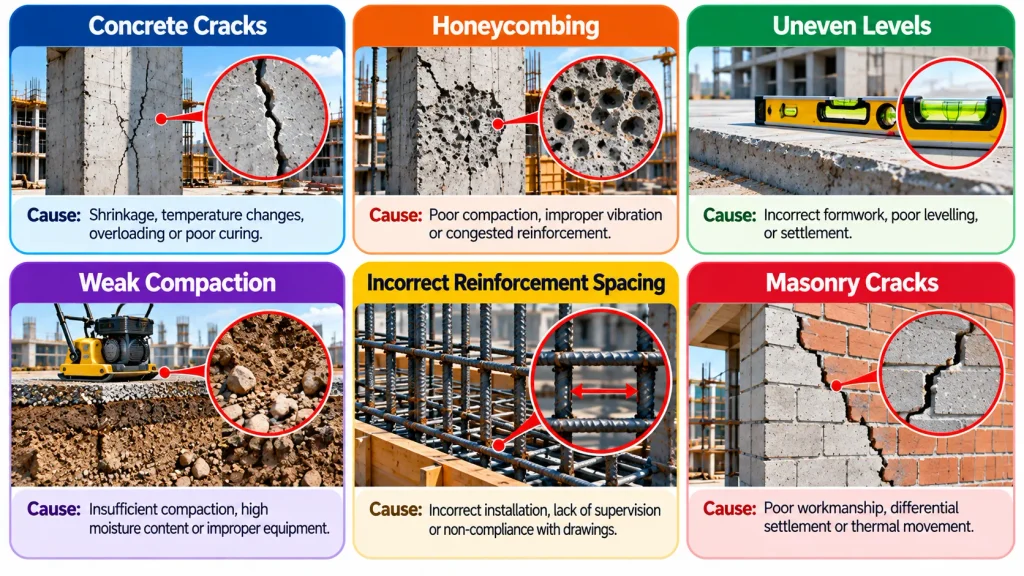
Civil QA/QC inspections help identify construction defects before they affect structural performance, durability, safety or project completion. Common defects are assessed by identifying their likely cause, checking the extent of the problem and applying appropriate corrective action.
| Defect | Possible Cause | QA/QC Response |
|---|---|---|
| Concrete cracks | Poor curing, shrinkage, thermal movement or structural movement | Inspect the crack, determine the cause and carry out suitable repair |
| Honeycombing | Poor vibration, inadequate compaction or congested reinforcement | Assess the affected area and rectify using an approved repair method |
| Uneven levels | Poor setting out, incorrect measurements or construction errors | Recheck survey data, verify benchmark levels and correct the work where required |
| Weak compaction | Incorrect compaction equipment, insufficient passes or unsuitable moisture content | Conduct field density testing, identify the cause and recompact or replace the material |
| Incorrect reinforcement spacing | Installation error, poor supervision or deviation from approved drawings | Recheck reinforcement against drawings and correct spacing before concreting |
| Masonry cracks | Building movement, inadequate bonding, poor workmanship or unsuitable materials | Investigate the cause, assess the severity and complete appropriate corrective work |
Concrete Cracks
Concrete cracks can develop because of inadequate curing, drying shrinkage, temperature changes, settlement or movement. During QA/QC inspection, the location, width, pattern and extent of cracking should be assessed. The cause should be investigated before selecting a repair method.
Honeycombing
Honeycombing occurs when concrete contains voids or exposed aggregate because concrete has not been adequately compacted. It may result from insufficient vibration, difficult access or congested reinforcement. QA/QC inspection should assess the depth and extent of the defect before an approved repair is carried out.
Uneven Levels
Uneven levels can result from inaccurate setting out, incorrect survey measurements or poor control during construction. QA/QC personnel should compare actual levels with approved drawings and survey requirements. Survey data should be rechecked before corrective work is undertaken.
Weak Compaction
Weak compaction occurs when fill or soil does not achieve the required density. Common causes include unsuitable moisture content, excessive layer thickness or inadequate compaction equipment and passes. Field density testing helps verify whether the required compaction has been achieved. Failed areas should be reworked and retested.
Incorrect Reinforcement Spacing
Incorrect reinforcement spacing occurs when bars are installed differently from the approved structural drawings. This can result from installation mistakes, inadequate supervision or movement of reinforcement during preparation. QA/QC inspection should verify bar diameter, spacing and position before concrete placement. Any discrepancy should be corrected before concreting.
Masonry Cracks
Masonry cracks may result from building movement, settlement, inadequate bonding, poor workmanship or unsuitable materials. QA/QC inspection should examine the crack location, pattern and severity and investigate the underlying cause. Repairs should address the cause rather than simply covering the visible crack.
How QA/QC Handles Construction Defects
A typical defect-control process is:
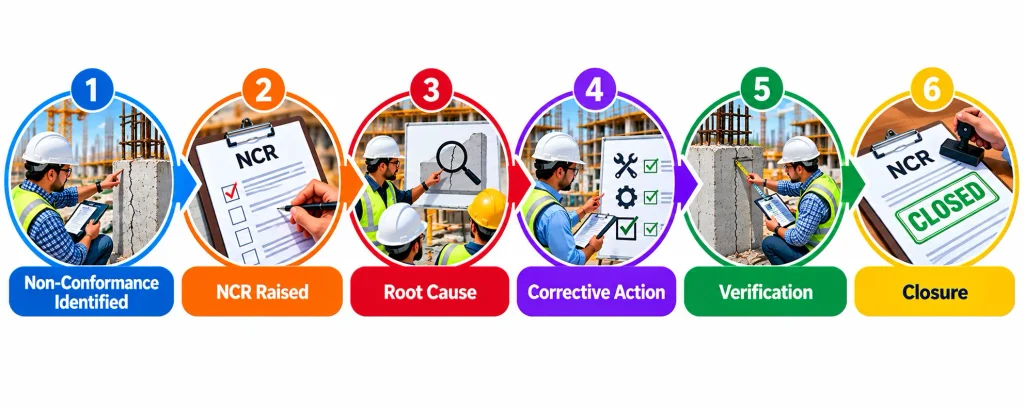
Identify defect → Record finding → Investigate cause → Assess severity → Apply corrective action → Reinspect → Close the defect
This approach helps ensure that construction defects are not only repaired but also investigated to reduce the likelihood of recurrence. Proper inspection records, photographs, test results and corrective-action documentation should be maintained as evidence of quality control.
What is an NCR?
NCR stands for Non-Conformance Report. It is a formal quality record used to document a deviation from specified requirements. An NCR normally identifies the affected work, describes the non-conformance, records supporting evidence and defines the required corrective action.
When is an NCR Raised?
An NCR is raised when a significant or confirmed deviation is identified and cannot be treated through routine correction or minor site adjustment. Examples include:
- Work completed outside approved drawings
- Materials that do not meet specified requirements
- Failed inspection or testing results
- Incorrect reinforcement installation
- Concrete that does not meet required criteria
- Poor workmanship that requires formal corrective action
- Use of unapproved materials or procedures
Who investigates an NCR?
The investigation is normally led by the contractor’s QA/QC team with relevant site personnel, engineers, supervisors or technical specialists. The client or consultant may review the investigation and proposed corrective action depending on the project’s quality procedures.
Root Cause
Root cause analysis identifies why the non-conformance occurred rather than focusing only on the visible defect. Possible causes may include incorrect information, inadequate supervision, unsuitable materials, ineffective procedures, equipment problems or insufficient worker competency.
Corrective Action
Corrective action addresses the identified non-conformance and its underlying cause. Depending on the issue, this may involve repairing or replacing defective work, changing a construction method, improving supervision, retraining personnel or revising a procedure.
Verification
After corrective action is completed, QA/QC personnel verify that the defect has been properly corrected and that the specified acceptance requirements have been achieved. This may involve reinspection, measurement, testing, document review or photographic evidence.
Closure
An NCR is closed when the corrective action has been completed and verified as satisfactory. The final record should contain the original finding, investigation, root cause, corrective action, verification evidence and required approvals.
NCR Process in Civil Construction
A typical NCR process is:
Identify non-conformance → Raise NCR → Investigate cause → Determine corrective action → Implement correction → Verify result → Close NCR
Effective NCR management helps prevent recurring quality problems and provides traceable evidence that identified construction deficiencies have been properly addressed.
Below is a concise, SEO-friendly and blog-ready version covering all the requested sections without unnecessary detail.
QA/QC Inspection Documentation
Proper documentation provides evidence that construction work has been inspected, tested and completed according to project requirements. Common civil QA/QC inspection documents include:
| Document | Purpose |
|---|---|
| Inspection Request | Requests formal inspection of completed or prepared work before the next activity |
| Inspection Checklist | Provides a structured list of quality points to verify during inspection |
| Inspection and Test Plan | Defines inspection stages, testing requirements, responsibilities and acceptance criteria |
| Material Inspection Report | Records inspection and approval of delivered construction materials |
| Test Report | Documents testing procedures, results and compliance with specified requirements |
| Site Inspection Report | Records site observations, inspection findings, defects and required actions |
| NCR | Documents significant non-conformance and the required corrective action |
| Corrective Action Report | Records actions taken to correct a quality problem and prevent recurrence |
| Calibration Certificate | Provides evidence that measuring or testing equipment has been calibrated |
| Photographic Records | Provides visual evidence of construction conditions, inspections and completed work |
| As-built Records | Records the actual completed installation, including approved changes from the original design |
Accurate documentation improves traceability and provides evidence for quality verification, approvals, audits and project handover.
Role of a Civil QA/QC Inspector
A Civil QA/QC Inspector is responsible for checking construction activities, materials and workmanship to verify that they meet approved drawings, project specifications, inspection requirements and applicable quality standards. The inspector works closely with site engineers, contractors, supervisors and other project stakeholders to identify quality issues and maintain reliable inspection records.
Responsibilities Before Inspection
Before an inspection, the Civil QA/QC Inspector prepares by:
- Reviewing the latest approved construction drawings
- Checking relevant project specifications and acceptance criteria
- Reviewing the approved method statement
- Checking the Inspection and Test Plan requirements
- Confirming that required materials have been approved
- Preparing the appropriate inspection checklist
- Confirming that measuring and testing equipment is suitable and calibrated where required
- Understanding the work activity and inspection stage
Proper preparation helps ensure that the inspection is based on current and approved project requirements.
Responsibilities During Inspection
During inspection, the Civil QA/QC Inspector verifies the actual construction work against the specified requirements. Responsibilities may include:
- Checking dimensions, levels and alignment
- Inspecting materials and workmanship
- Verifying reinforcement size, spacing, position and cover
- Checking formwork before concrete placement
- Inspecting earthwork, foundations, masonry and other civil activities
- Witnessing or reviewing required testing
- Recording measurements and observations
- Taking photographs where appropriate
- Identifying defects or non-conforming work
- Communicating quality issues to the responsible site team
The inspector should record objective findings based on drawings, specifications, measurements and inspection criteria.
Responsibilities After Inspection
After inspection, the inspector completes the required documentation and follows up on identified issues. This may include:
- Completing inspection reports and checklists
- Recording test results
- Documenting defects and non-conformances
- Recommending or recording corrective actions
- Following up on outstanding quality issues
- Conducting reinspection after corrective work
- Verifying that acceptance requirements have been achieved
- Supporting NCR closure where applicable
- Maintaining inspection and quality records
Key Skills of a Civil QA/QC Inspector
Drawing Interpretation
The inspector must be able to read and understand structural, architectural and civil drawings, including dimensions, levels, details, sections and construction requirements.
Specification Review
The inspector needs to understand project specifications and identify the required materials, workmanship standards, testing requirements and acceptance criteria.
Technical Inspection
Technical inspection skills are required to assess construction activities, dimensions, installation methods, workmanship and compliance with approved requirements.
Testing Knowledge
A Civil QA/QC Inspector should understand relevant construction tests and how to review or witness test results, such as concrete strength testing, slump testing and soil compaction testing.
Documentation
Accurate documentation is essential. The inspector should be able to complete inspection requests, checklists, reports, test records, photographs and non-conformance documentation.
Communication
The inspector must communicate inspection findings clearly with engineers, supervisors, contractors, consultants and other project personnel.
Problem Identification
The ability to recognise defects, deviations and potential quality problems helps prevent non-conforming work from progressing to the next construction stage.
Digital Reporting
Modern projects increasingly use mobile inspection applications, digital checklists, cloud-based document systems, digital drawings and photographic records. Digital reporting skills help inspectors create accurate and traceable quality records.g defects, delayed corrective actions and areas requiring additional quality control.
Civil QA/QC Inspection vs Site Supervision
Civil QA/QC inspection and site supervision support construction quality but have different primary functions.
| Civil QA/QC Inspection | Site Supervision |
|---|---|
| Focuses on quality requirements | Focuses on construction activities |
| Verifies compliance | Coordinates site execution |
| Reviews inspection records | Monitors daily progress |
| Checks testing requirements | Coordinates site resources |
| Identifies non-conformance | Helps manage corrective work |
| Verifies completed work | Monitors construction operations |
In practice, QA/QC inspectors and site supervisors work together. Site supervision focuses more on managing and coordinating construction activities, while QA/QC focuses on verifying that the resulting work meets defined quality requirements.
Best Practices for Effective Civil QA/QC Inspection
Effective inspection should be systematic, evidence-based and aligned with approved project requirements.
- Inspect according to approved documents
- Use activity-specific checklists
- Inspect work before it is covered
- Verify materials before installation
- Maintain accurate inspection records
- Use calibrated equipment where required
- Photograph important construction stages
- Record defects clearly and objectively
- Track corrective actions to completion
- Conduct reinspection before closing quality issues
These practices help improve consistency, reduce rework and maintain reliable evidence of construction quality.
Civil QA/QC Inspection Checklist: Quick Reference
This quick-reference checklist can be used as a basic starting point for construction quality inspections.
Before Work
- Approved drawings available
- Method statement approved
- Materials approved
- ITP available
- Required resources ready
- Inspection criteria confirmed
During Work
- Dimensions verified
- Materials checked
- Workmanship inspected
- Required testing completed
- Photographs recorded
- Inspection findings documented
After Work
- Test results reviewed
- Defects recorded
- Corrective action completed
- Reinspection conducted
- Inspection documentation completed
- Quality records closed
The exact inspection requirements should always be adapted to the project specifications, approved drawings, ITP, method statements and applicable acceptance criteria.
Conclusion
Civil QA/QC inspection helps ensure that construction work, materials and workmanship meet approved drawings, specifications and quality requirements. Regular inspections, testing, proper documentation and corrective actions help identify defects early, reduce rework and improve project quality. Effective QA/QC inspection supports safe, durable and compliant civil construction.