
Building Management System (BMS): Complete Guide to How It Works, Components, Benefits, Types and Applications
A Building Management System (BMS) is a computer-based system used to monitor, control and optimise building services such as heating, ventilation and air conditioning (HVAC), lighting, electrical systems, energy consumption and, where integrated, security and other building services.
Modern buildings contain thousands of devices, sensors, controllers and mechanical systems. Managing these systems independently can make it difficult to maintain comfort, control energy consumption, identify faults and respond quickly to operational problems. A BMS brings relevant building information together through a centralised digital platform, allowing building operators to monitor conditions, automate processes, analyse performance and respond to alarms.
Modern BMS technology has developed considerably from traditional building controls. Contemporary systems can use open communication protocols, cloud connectivity, Internet of Things (IoT) devices, advanced analytics, fault detection and artificial intelligence to support more data-driven building operations.
This complete guide explains what a Building Management System is, how BMS works, its main components, different types, communication protocols, applications, benefits, limitations, implementation considerations and future developments.
What is a Building Management System?
A Building Management System is an integrated hardware and software platform designed to monitor and control building services from a centralised interface.
In simple terms, a BMS acts as a digital control layer between building equipment and the people responsible for operating the facility. Sensors collect information about conditions such as temperature, humidity, pressure, occupancy and energy use. Controllers process this information according to programmed rules, while actuators and connected equipment carry out the required control actions.
For example, a temperature sensor may detect that a room is warmer than its configured setpoint. The BMS can process this information through a controller and adjust a valve, damper, fan or other HVAC component to bring the room back toward the required condition.
A typical BMS can monitor or control:
- Heating systems
- Ventilation systems
- Air conditioning
- Chillers and boilers
- Air handling units
- Pumps and valves
- Lighting systems
- Electrical consumption
- Energy meters
- Indoor air quality
- Temperature and humidity
- Occupancy
- Water systems
- Security and access systems
- Fire-related interfaces
- Alarms
- Equipment operating status
- Maintenance information
The exact scope depends on the building, system architecture, equipment and integration requirements.
What Does BMS Stand For?
BMS stands for Building Management System.
The term is commonly used for integrated building monitoring and control systems. In different markets, related terminology may include Building Automation System (BAS), Building Automation and Control System (BACS), Building Control System or Building Management and Control System.
Although these terms are sometimes used interchangeably, their scope can differ depending on the project, manufacturer and region.
A BAS may focus primarily on automation and control of systems such as HVAC and lighting, while a broader BMS may provide centralised monitoring, management, analytics and integration across multiple building services.
How Does a BMS Work?
A BMS generally works through a continuous cycle of:
Sense → Communicate → Process → Decide → Control → Monitor
1. Sensors collect data
Sensors installed throughout a building measure physical conditions.
Examples include:
- Temperature sensors
- Humidity sensors
- CO₂ sensors
- Pressure sensors
- Occupancy sensors
- Light sensors
- Flow meters
- Energy meters
- Water meters
- Air quality sensors
The accuracy and positioning of these sensors are important because control decisions depend on the quality of the information collected.
2. Data is transmitted
Sensor information travels through a communication network to controllers or other BMS devices.
Depending on the installation, communication may use wired Ethernet, dedicated control networks or wireless technologies.
Common communication technologies and protocols include:
- BACnet
- Modbus
- MQTT
- LonWorks
- KNX
- Ethernet/IP
- LoRaWAN in certain IoT applications
BACnet and Modbus are particularly common in building and industrial control environments.
3. Controllers process the information
Controllers receive data from sensors and compare current conditions against programmed parameters.
For example:
Room temperature: 25°C
Required setpoint: 22°C
The controller may determine that cooling is required and issue a command to the relevant HVAC equipment.
4. Actuators perform the action
Actuators convert control commands into physical actions.
Examples include:
- Opening or closing valves
- Adjusting dampers
- Changing fan speed
- Switching equipment
- Adjusting lighting levels
- Controlling pumps
5. The BMS monitors the result
The system continues monitoring the building after a control action has taken place.
If the desired condition has not been achieved, the control sequence can continue adjusting the equipment according to its programmed logic.
This feedback loop is one of the fundamental principles behind automated building control.
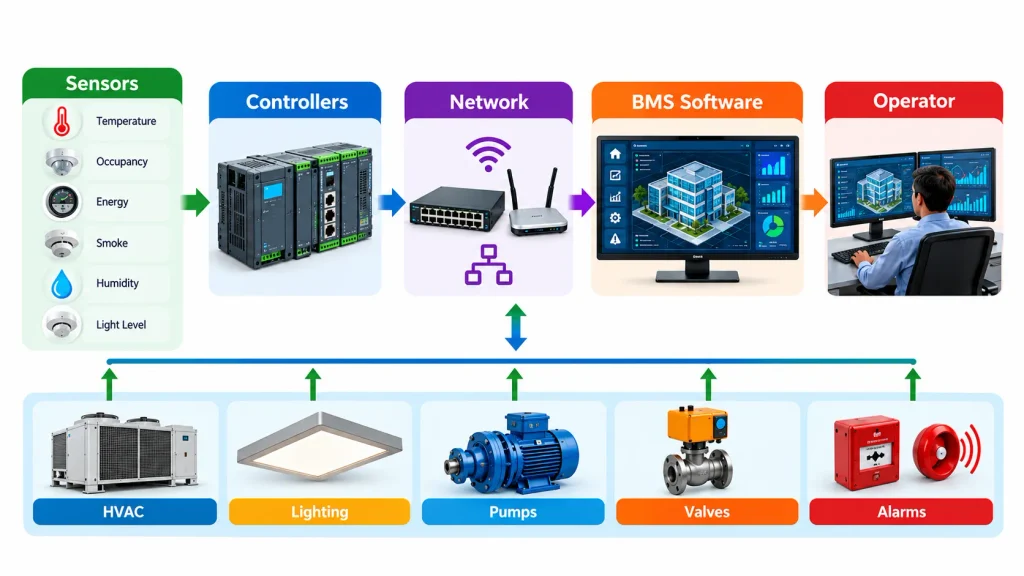
BMS Architecture: The Three Main Levels
A conventional BMS architecture can be understood through three primary levels.
Field Level
The field level contains devices that interact directly with the physical environment.
Typical field devices include:
- Sensors
- Meters
- Thermostats
- Valves
- Dampers
- Actuators
- Switches
- Variable speed drives
- Input/output modules
This is where information about the physical condition of the building is collected.
Automation or Control Level
The automation level contains controllers responsible for processing information and executing control logic.
Controllers receive sensor data, apply programmed sequences and send commands to field equipment.
For example, a controller may receive temperature and occupancy information and use both variables to determine whether an HVAC zone requires heating, cooling or reduced operation.
Management Level
The management level provides the operator interface.
This may include:
- Graphical dashboards
- Floor plans
- Alarm displays
- Trend charts
- Energy dashboards
- Reports
- Scheduling tools
- Equipment status screens
- Historical data
- Remote access
Modern BMS platforms may provide browser-based or mobile interfaces, allowing authorised personnel to monitor systems remotely.
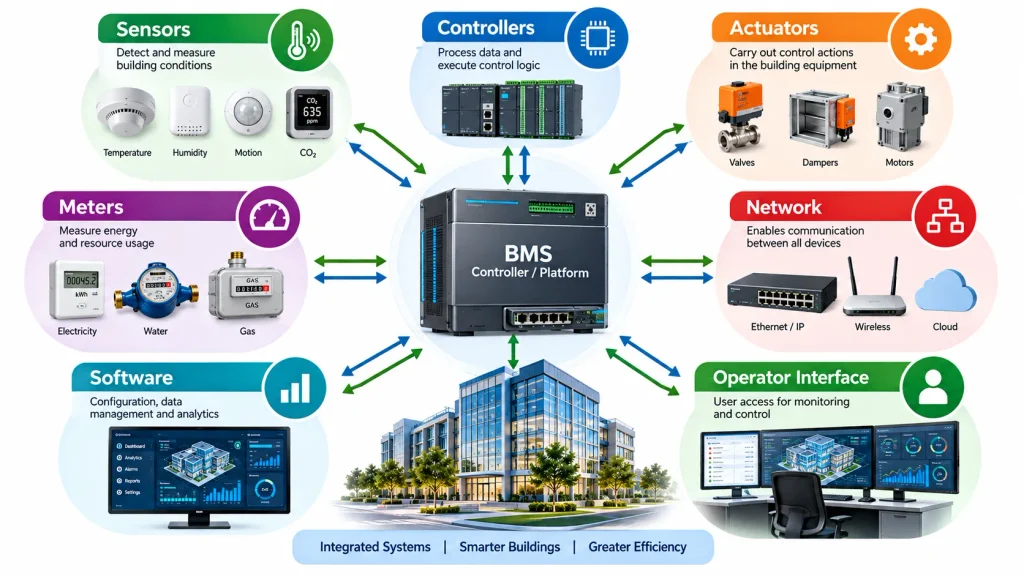
Main Components of a Building Management System
A Building Management System (BMS) consists of several interconnected components that collect information, process data and control building services. These components work together to provide centralised monitoring and automated control.
- Sensors: Measure conditions such as temperature, humidity, pressure, occupancy and air quality.
- Controllers: Process sensor information and apply programmed control logic to connected equipment.
- Actuators: Carry out physical control actions, such as opening valves, adjusting dampers or changing fan speeds.
- Meters: Monitor electricity, water, gas and other resource consumption.
- Communication Network: Connects sensors, controllers, meters and other BMS devices so they can exchange information.
- BMS Software: Provides monitoring, scheduling, alarms, trends, reports and system management functions.
- Operator Interface: Allows authorised personnel to view building conditions, control equipment and respond to alarms through dashboards or graphical displays.
Together, these components create a continuous monitoring, decision-making and control cycle, allowing building systems to operate more efficiently and reliably.
What Systems Can a BMS Control?
The exact scope of a BMS varies by project, but common applications include the following.
HVAC
HVAC is one of the most important BMS applications.
A BMS can monitor and control:
- Chillers
- Boilers
- Air handling units
- Fan coil units
- Pumps
- Fans
- Dampers
- Valves
- Temperature setpoints
- Ventilation rates
HVAC automation can help align equipment operation with occupancy and building requirements.
Lighting
A BMS can integrate lighting controls to support automated operation.
Examples include:
- Time schedules
- Occupancy-based lighting
- Daylight-responsive control
- Zone control
- Lighting status monitoring
Energy Management
Energy meters and equipment data can be integrated into BMS dashboards.
Operators can use this information to identify:
- Unusual consumption
- Equipment running outside schedules
- Peak demand
- Energy waste
- Changes in consumption patterns
Electrical Systems
Depending on the project, a BMS may monitor electrical infrastructure such as:
- Main electrical consumption
- Distribution boards
- Generators
- UPS systems
- Power quality information
- Electrical alarms
Water Systems
BMS integration may include:
- Water consumption
- Pump operation
- Tank levels
- Flow
- Leak-related information
- Water temperature
Security and Access Control
Some integrated systems connect BMS platforms with:
- Access control
- CCTV
- Intrusion detection
- Door status
- Security alarms
However, critical security functions should not automatically be assumed to be controlled directly by a BMS. The integration architecture must reflect the requirements and safety responsibilities of the individual systems.
Fire and Life Safety Interfaces
BMS platforms can receive or exchange information with fire and life-safety systems where properly designed and permitted.
Examples may include:
- Fire alarm status
- Smoke control interfaces
- HVAC shutdown signals
- Emergency operating modes
A BMS should not be treated as a replacement for dedicated life-safety systems. Fire protection and emergency systems require their own appropriate design, testing and compliance arrangements.
Types of Building Management Systems
BMS technology can be classified in several ways depending on architecture, connectivity and level of integration.
Traditional BMS
Traditional BMS installations generally rely on dedicated controllers, sensors, networks and supervisory software.
They can provide reliable control but may be more difficult to integrate with modern digital platforms when older proprietary technologies are involved.
Digital BMS
Digital BMS platforms use digital controllers, communication networks and software-based supervision.
They provide greater monitoring, data collection and automation capabilities than older analogue control arrangements.
IP-Based BMS
IP-based systems use standard network infrastructure to communicate between devices and supervisory platforms.
Potential advantages include:
- Easier network integration
- Remote access
- Scalability
- Improved data accessibility
- Integration with IT infrastructure
However, cybersecurity and network segmentation become increasingly important.
Cloud-Connected BMS
Cloud-connected BMS platforms can transfer selected building data to cloud services for:
- Remote monitoring
- Portfolio management
- Data analytics
- Reporting
- Centralised dashboards
- Multi-site comparison
Cloud connectivity can improve accessibility but introduces additional cybersecurity, connectivity and data-governance considerations.
Integrated BMS
An integrated BMS connects multiple building systems through a common management environment.
The objective is to provide a more unified view of building performance.
Smart Building Platforms
Smart building platforms go beyond conventional monitoring and control by incorporating analytics, IoT devices, automation and potentially artificial intelligence.
IoT-Enabled BMS
IoT-enabled BMS architectures use connected sensors and devices to increase data collection and integration.
This approach can be particularly useful in retrofit projects where replacing an entire legacy system may not be practical.
BMS vs BAS vs Building Automation and Control Systems
The terms BMS and BAS are frequently used interchangeably, but they can represent different scopes.
| System | Typical Focus |
|---|---|
| BMS | Monitoring, management, integration and control of building services |
| BAS | Automated control of building systems, particularly HVAC and lighting |
| BACS | Building automation and control functions, often focused on automated technical building services |
| Smart Building Platform | Broader integration of automation, IoT, analytics and digital services |
The exact definition depends on the project and terminology used by the manufacturer, consultant or organisation.
A useful way to understand the distinction is:
BAS focuses heavily on automation.
BMS adds broader management, monitoring and integration.
Smart building platforms add wider connectivity, analytics and data-driven optimisation.
Some modern systems blur these boundaries considerably.
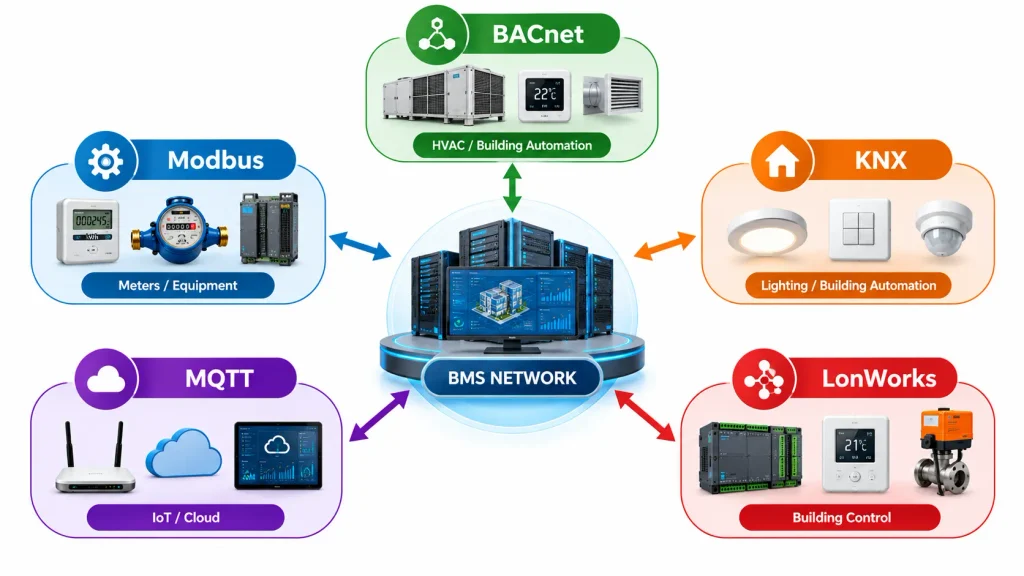
BMS Communication Protocols
BMS communication protocols are the rules that allow sensors, controllers, meters, HVAC equipment and software to exchange information. They are essential for integrating equipment from different manufacturers and ensuring that building systems can communicate reliably.
Common protocols used in BMS include:
- BACnet: Widely used for building automation and HVAC control, with strong support for interoperability.
- Modbus: Commonly used for meters, drives, boilers and other industrial or building equipment.
- KNX: Frequently used for lighting, HVAC, blinds and other building automation applications.
- LonWorks: Used in various building control and automation systems.
- MQTT: A lightweight messaging protocol increasingly used for IoT-connected building devices and cloud applications.
The choice of protocol depends on the equipment, project requirements, network architecture and integration needs. Open and widely supported protocols can make future expansion and integration easier, while proprietary protocols may create greater dependence on a particular manufacturer.
Benefits of a Building Management System
A Building Management System (BMS) provides centralised monitoring and control of important building services such as HVAC, lighting, ventilation and energy systems. By bringing operational information into one platform, a BMS can help building operators improve efficiency, comfort and day-to-day management.
Key Benefits of BMS
- Improved energy efficiency: Optimises equipment operation and reduces unnecessary energy consumption.
- Lower operating costs: Helps identify energy waste and inefficient equipment operation.
- Better occupant comfort: Maintains suitable temperature, ventilation, humidity and lighting conditions.
- Centralised monitoring: Allows operators to monitor multiple building systems from one interface.
- Faster fault detection: Provides alarms and operational data to help identify problems quickly.
- Predictive maintenance: Trend data can help identify unusual equipment behaviour before major failures.
- Remote monitoring: Enables authorised personnel to monitor connected systems remotely.
- Better reporting: Provides useful information about energy use, equipment performance and building conditions.
A BMS can also support sustainability and long-term asset management by providing reliable operational data. When properly designed, commissioned and maintained, it helps building teams make informed decisions and optimise building performance over time.
Limitations and Challenges of BMS
Although a Building Management System (BMS) can improve building efficiency and control, its effectiveness depends on proper design, installation, commissioning and ongoing management. A poorly configured system may provide large amounts of data without delivering meaningful operational improvements.
Key Limitations and Challenges
- High initial cost: Installation can require significant investment in sensors, controllers, software, networking and integration.
- Complex installation: Integrating different equipment, protocols and legacy systems can make implementation challenging.
- Maintenance requirements: Sensors, controllers, software and communication networks require regular maintenance.
- Cybersecurity risks: Internet connectivity and remote access can expose BMS infrastructure to cybersecurity threats.
- Staff training: Operators need appropriate technical knowledge to interpret alarms, trends and system data.
- Poor commissioning: Incorrect settings, sensor calibration or control sequences can reduce system performance.
- Legacy equipment: Older buildings may contain incompatible systems that are difficult or expensive to integrate.
Another challenge is data quality and alarm management. Incorrect sensor readings or excessive alarms can lead to poor decisions and operator fatigue. BMS performance can also decline when systems are not regularly reviewed and optimised. Therefore, achieving the full value of a BMS requires appropriate technology, competent personnel, cybersecurity controls and continuous performance management.
How Much Does a BMS Cost?
There is no universal BMS price.
The cost depends on factors such as:
- Building size
- Building type
- Number of systems
- Number of sensors
- Number of control points
- HVAC complexity
- Existing infrastructure
- Required integrations
- Communication protocols
- Network requirements
- New-build or retrofit installation
- Software features
- Analytics requirements
- Cybersecurity requirements
- Commissioning requirements
- Training and support
A small commercial property may require a relatively simple control solution, while a hospital, airport, university, data centre or large commercial campus may require a highly complex architecture.
The most useful approach is therefore to assess BMS cost through the complete lifecycle rather than focusing only on the initial purchase price.
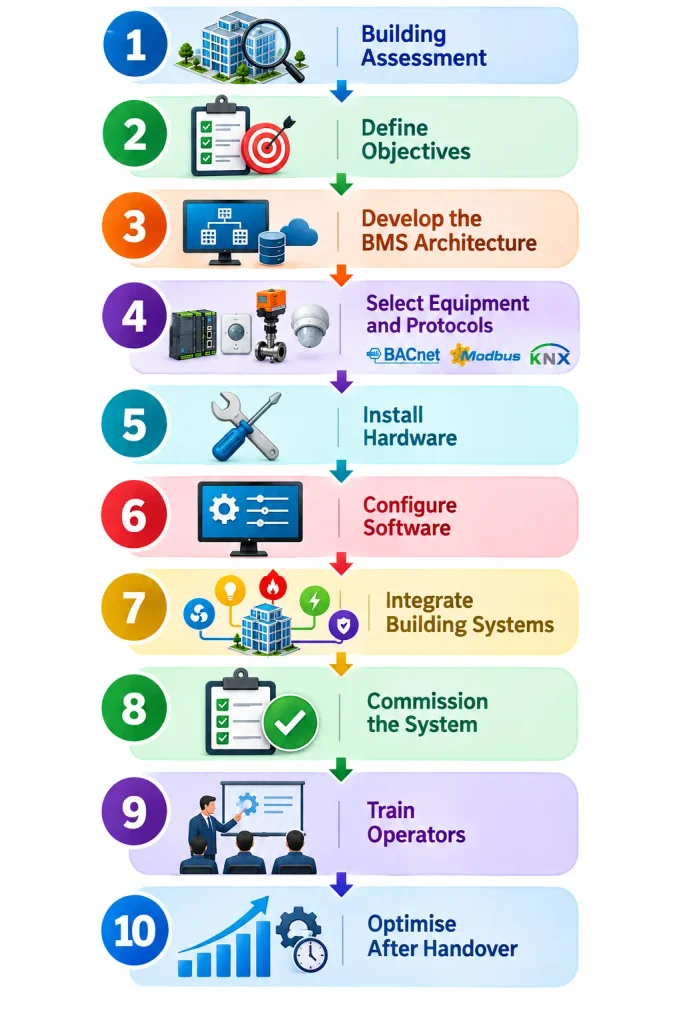
BMS Installation and Implementation Process
A successful BMS project generally requires more than simply installing controllers and software.
Step 1: Building Assessment
The first stage is understanding the existing building.
The assessment should identify:
- Existing HVAC systems
- Electrical systems
- Lighting
- Meters
- Sensors
- Controllers
- Communication protocols
- Existing automation
- Equipment condition
- Operational requirements
Step 2: Define Objectives
Clear objectives should be established.
These might include:
- Energy reduction
- Improved comfort
- Better monitoring
- Remote operation
- Improved maintenance
- Improved reporting
- Integration of legacy equipment
Step 3: Develop the BMS Architecture
The architecture should define:
- Field devices
- Controllers
- Networks
- Servers
- Software
- User interfaces
- Integration points
- Security controls
Step 4: Select Equipment and Protocols
Equipment should be selected according to technical compatibility, reliability, lifecycle requirements and integration needs.
Step 5: Install Hardware
Installation may include:
- Sensors
- Controllers
- Control panels
- Actuators
- Meters
- Network equipment
- Cabling
Step 6: Configure Software
The software is configured with:
- Setpoints
- Schedules
- Control sequences
- Alarms
- User permissions
- Dashboards
- Trend logs
Step 7: Integrate Building Systems
Relevant systems are connected to the BMS.
Integration should be tested carefully to ensure data is correctly interpreted and control commands operate as intended.
Step 8: Commission the System
Commissioning verifies that the BMS performs according to the design.
Testing may include:
- Sensor verification
- Control sequence testing
- Alarm testing
- Communication testing
- Equipment response
- Trend verification
- Fail-safe operation
- User interface testing
Step 9: Train Operators
Operators should understand how to use the system and respond appropriately to alarms and abnormal conditions.
Step 10: Optimise After Handover
The first configuration should not necessarily be treated as the final configuration.
Operational data can reveal opportunities to improve:
- Schedules
- Setpoints
- Control sequences
- Energy performance
- Alarm thresholds
BMS Applications
A Building Management System (BMS) is used across different types of buildings to monitor, control and optimise building services. Its applications vary according to the size, purpose and operational requirements of the facility.
Commercial Buildings
BMS technology is commonly used in offices and commercial properties to control HVAC, lighting, ventilation and energy consumption. It helps maintain comfortable indoor conditions while reducing unnecessary equipment operation.
Hospitals
Hospitals use BMS technology to monitor critical environmental conditions, HVAC systems, air quality, temperature and pressure. It can also provide centralised monitoring of selected building services.
Hotels
In hotels, BMS can manage guest-room HVAC, lighting, ventilation and energy use. Occupancy information can help adjust building services according to room usage.
Educational Buildings
Schools, colleges and universities can use BMS to manage HVAC, lighting and ventilation across classrooms, laboratories, offices and common areas. Scheduling helps ensure systems operate according to building occupancy.
Industrial Facilities
Industrial facilities can use BMS to monitor HVAC, ventilation, utilities, energy consumption and environmental conditions. It can also integrate selected equipment monitoring systems.
Retail Buildings
Shopping centres and retail properties use BMS for HVAC, lighting, energy monitoring and equipment scheduling. Centralised control can help operators manage large areas more efficiently.
Data Centres
BMS technology can monitor cooling, environmental conditions, electrical infrastructure and supporting facility equipment. Reliable monitoring is particularly important because environmental changes can affect critical equipment.
Airports and Large Facilities
Large facilities such as airports, campuses and transport hubs can use BMS to centrally monitor and coordinate HVAC, lighting, energy systems and other building services across multiple areas.
Residential and Smart Buildings
Modern residential developments can use BMS and building automation technologies for HVAC, lighting, energy monitoring, access systems and other connected services, particularly where smart-building functionality is required.
BMS for Smart Buildings
A Building Management System (BMS) provides an important foundation for smart buildings by connecting and managing different building services through a centralised platform. It can monitor HVAC, lighting, energy consumption, occupancy and other systems, allowing building operators to make faster and more informed decisions.
Modern smart buildings can combine BMS, IoT sensors, cloud platforms, data analytics and artificial intelligence to create more responsive building environments. For example, occupancy data can help adjust HVAC and lighting automatically, while energy analytics can identify inefficient equipment or unusual consumption patterns.
The combination of BMS and smart-building technologies can improve energy efficiency, occupant comfort, operational visibility, predictive maintenance and overall building performance.
BMS and IoT
Traditional BMS installations often rely on dedicated field devices and control networks.
IoT-enabled systems can introduce additional connected devices, including:
- Wireless sensors
- Smart meters
- Occupancy sensors
- Environmental sensors
- Connected equipment
- Edge devices
IoT can be particularly useful for retrofit projects because wireless devices can reduce the need for extensive new cabling in certain applications.
However, IoT deployments introduce additional considerations around cybersecurity, device management, battery life, connectivity and data quality.
BMS and Artificial Intelligence
Artificial Intelligence (AI) is making Building Management Systems more intelligent by enabling them to analyse large amounts of building data and identify patterns that may not be obvious through conventional monitoring. AI can work with information from HVAC systems, occupancy sensors, energy meters, weather data and other connected equipment to support more efficient building operation.
AI-enabled BMS platforms can move beyond simple programmed rules by helping systems respond to changing conditions and predict potential problems.
Key Applications of AI in BMS
- Predictive maintenance: Identifies unusual equipment behaviour that may indicate an upcoming fault.
- Energy optimisation: Analyses energy consumption and recommends or supports adjustments to reduce unnecessary use.
- Occupancy prediction: Uses occupancy patterns to improve HVAC and lighting schedules.
- Fault detection: Identifies abnormal temperature, pressure, energy or equipment-performance patterns.
- Demand forecasting: Helps predict future building energy requirements.
- Automated optimisation: Can continuously adjust selected operating parameters within predefined limits.
AI does not replace engineering controls or human oversight. Its effectiveness depends on accurate sensor data, suitable system design and properly configured control strategies. When appropriately implemented, AI can help transform a conventional BMS into a more predictive, adaptive and data-driven building management platform.
BMS and Predictive Maintenance
A Building Management System (BMS) can support predictive maintenance by continuously collecting data from building equipment such as HVAC systems, pumps, fans, chillers and boilers. This information can reveal changes in equipment performance before a major failure occurs.
For example, unusual temperature, pressure, vibration, energy consumption or operating-time patterns may indicate that equipment is developing a fault. BMS trend data and advanced analytics can help maintenance teams identify these changes early and schedule maintenance before equipment failure disrupts building operations.
Predictive maintenance can therefore help reduce unexpected breakdowns, maintenance costs, equipment downtime and energy waste, while improving asset reliability and extending equipment service life.
BMS Cybersecurity
As BMS platforms become more connected, cybersecurity becomes an important part of system design.
Good practices may include:
- Network segmentation
- Strong authentication
- Role-based access
- Secure remote access
- Regular software updates
- Asset inventories
- Monitoring of network activity
- Backup and recovery procedures
- Controlled administrative access
- Secure configuration management
BMS networks should not automatically be treated as isolated systems.
Where BMS infrastructure connects to corporate IT networks or cloud services, responsibilities between facilities, engineering and IT teams should be clearly defined.
BMS Best Practices
The following practices can improve the effectiveness of a BMS project:
- Define clear operational objectives.
- Assess existing building systems before design.
- Avoid unnecessary complexity.
- Select appropriate sensors.
- Verify sensor positioning and calibration.
- Use suitable communication protocols.
- Plan cybersecurity from the beginning.
- Use clear naming conventions.
- Configure meaningful alarms.
- Commission all control sequences.
- Train operators.
- Maintain accurate documentation.
- Review trend data after implementation.
- Optimise schedules and setpoints.
- Plan for future expansion.
- Maintain software and hardware.
- Regularly review system performance.
What is the Difference Between BMS and Energy Management Systems?
| Feature | BMS | EMS |
|---|---|---|
| Main Purpose | Controls and manages building systems. | Monitors and optimises energy use. |
| Main Focus | Building automation and operation. | Energy efficiency and cost reduction. |
| HVAC | Controls HVAC equipment. | Analyses HVAC energy performance. |
| Lighting | Controls lighting schedules and operation. | Analyses lighting energy use. |
| Energy Monitoring | Collects energy data. | Provides detailed energy analysis and reporting. |
| Equipment Control | Controls various building equipment. | Controls selected energy-related equipment. |
| Energy Analytics | Provides basic energy trends. | Provides detailed energy and demand analysis. |
| Renewable Energy | Can monitor renewable systems. | Can optimise solar, batteries and other energy resources. |
| Carbon Management | Provides data for carbon reduction. | Analyses energy-related emissions. |
| Typical Users | Facility managers and building operators. | Energy managers and sustainability teams. |
| Scope | Broad building management. | Energy-focused management and optimisation. |
| Relationship | Provides building data and control. | Uses data to improve energy performance. |
What is the Difference Between BMS and a Smart Building?
| Feature | BMS | Smart Building |
|---|
| Definition | Monitors and controls building services. | Uses connected technologies to optimise the whole building. |
| Main Purpose | Controls HVAC, lighting and other systems. | Improves efficiency, comfort and overall building performance. |
| Main Focus | Equipment and building-system control. | Building-wide intelligence and automation. |
| HVAC | Monitors and controls HVAC equipment. | Optimises HVAC using occupancy, weather and other data. |
| Lighting | Controls lighting through schedules and sensors. | Uses smart lighting with occupancy and daylight data. |
| IoT | Can integrate IoT devices. | Makes extensive use of connected IoT devices. |
| AI | May use AI for analytics and optimisation. | Can apply AI across multiple building functions. |
| Data Analytics | Analyses equipment and operational data. | Combines data from multiple building systems. |
| Cloud | May support cloud-based monitoring. | Commonly uses cloud platforms for wider management and analytics. |
| Occupancy | Uses occupancy data to control systems. | Uses occupancy data across multiple building functions. |
| Security | Can integrate with security systems. | Connects security with other smart-building technologies. |
| Energy Management | Monitors and controls energy-consuming equipment. | Combines energy data with renewables, storage and demand management. |
| Digital Twin | Can provide data for digital twins. | Can use digital twins for simulation and optimisation. |
| Automation | Uses programmed control rules. | Can use adaptive automation and intelligent optimisation. |
| Human Role | Operators monitor and control systems. | Operators increasingly supervise automated systems. |
| Scope | Focuses mainly on building services. | Covers systems, data, energy, occupants and digital technologies. |
| Example | Adjusts room temperature to a setpoint. | Predicts occupancy and weather to optimise HVAC and lighting together. |
| Relationship | Can form the foundation of a smart building. | Can combine BMS with IoT, AI, cloud and analytics. |
What are the Weaknesses of Traditional BMS?
Traditional BMS platforms can have several limitations depending on their age and architecture.
These may include:
- Proprietary communication protocols
- Vendor dependence
- Limited interoperability
- High retrofit costs
- Difficult upgrades
- Limited analytics
- Separate data silos
- Complex maintenance
- Limited cloud connectivity
Modern open and IoT-enabled architectures are increasingly being developed to address some of these limitations.
What are the Strengths of Modern BMS?
Modern BMS platforms can provide:
- Centralised monitoring
- Automated control
- Real-time data
- Energy optimisation
- Remote access
- Trend analysis
- Alarm management
- Equipment monitoring
- Integration capabilities
- Predictive maintenance support
- IoT connectivity
- Cloud connectivity
- Advanced analytics
The actual benefits depend on system design, commissioning, equipment quality and how effectively the building team uses the available information.
Future Trends in Building Management Systems
Building Management Systems are evolving from conventional monitoring and control platforms into intelligent, connected and data-driven building ecosystems. Future BMS technology is expected to focus not only on controlling HVAC, lighting and other building services, but also on predictive analytics, artificial intelligence, IoT connectivity, energy optimisation, cybersecurity and automated decision-making.
1. Artificial Intelligence in BMS
Artificial intelligence is becoming an important development in modern building management. AI-enabled BMS platforms can analyse large volumes of operational data and identify patterns that may be difficult for operators to detect manually.
AI can support:
- Automatic fault detection
- Energy optimisation
- Predictive maintenance
- Occupancy prediction
- Heating and cooling optimisation
- Abnormal-condition detection
- Automated scheduling
- Demand forecasting
For example, an AI system could analyse temperature, occupancy, weather and HVAC performance data to identify an inefficient operating pattern and recommend or automatically implement an appropriate adjustment.
The future direction is likely to move from rule-based automation toward systems that can learn from historical and real-time building data.
2. Internet of Things (IoT)
IoT is expanding the number of devices that can provide information to a BMS.
Traditional systems may monitor a defined number of sensors and controllers, while IoT-enabled buildings can connect additional devices such as:
- Wireless temperature sensors
- Occupancy sensors
- Smart meters
- Air-quality sensors
- Water meters
- Equipment sensors
- Smart lighting devices
- Environmental monitoring devices
This creates a much larger data ecosystem.
For example, an office could use occupancy information to determine which areas are being used and adjust lighting and HVAC operation accordingly.
The major challenge will be managing the large amount of data generated by connected devices while maintaining reliability, privacy and cybersecurity.
3. Cloud-Based BMS
Cloud technology is changing how building management platforms are accessed and managed.
Instead of keeping all BMS information within a single local server environment, selected information can be securely transferred to cloud platforms.
Cloud BMS can support:
- Remote monitoring
- Multi-building management
- Centralised dashboards
- Remote diagnostics
- Data storage
- Portfolio-wide energy analysis
- Software updates
- Advanced analytics
For organisations managing multiple properties, cloud platforms can provide a centralised view of building performance.
However, cloud connectivity also increases the importance of cybersecurity, network availability, access control and data governance.
4. Predictive Maintenance
Future BMS platforms are expected to become increasingly focused on predicting equipment problems rather than simply reporting failures.
Traditional maintenance can follow this pattern:
Equipment operates → Equipment fails → Alarm occurs → Technician investigates
Predictive maintenance changes the approach:
Equipment operates → Performance data is analysed → Abnormal pattern identified → Maintenance planned
For example, changes in vibration, temperature, pressure, energy consumption or operating time could indicate developing equipment problems.
This can help organisations move from reactive maintenance toward more proactive asset management.
5. Advanced Energy Optimisation
Energy management will remain a major driver of BMS development.
Future systems can combine information from:
- HVAC
- Lighting
- Occupancy
- Energy meters
- Weather data
- Renewable-energy systems
- Battery storage
- Building schedules
This allows building operation to become more responsive to actual demand.
For example, if a building has low occupancy in a particular zone, the BMS could adjust ventilation and temperature control rather than operating the area at full capacity.
Advanced systems may also coordinate building loads with electricity pricing, renewable generation and energy-storage availability.
6. Digital Twins
Digital twins are another emerging development in intelligent building management.
A digital twin is a digital representation of a physical building, its equipment and relevant operational information.
A building digital twin can potentially combine:
- Building information
- Equipment data
- Sensor information
- Maintenance records
- Energy data
- Operational conditions
- Historical performance
This can help facility teams understand how different systems interact.
Digital twins may also support simulation, optimisation, maintenance planning and lifecycle management.
7. Edge Computing
Cloud computing is not the only direction for future BMS architecture.
Edge computing allows data to be processed closer to where it is generated.
For example, an edge controller could analyse sensor information locally and make certain control decisions without sending every piece of data to a remote cloud platform.
Potential advantages include:
- Faster response
- Reduced network traffic
- Greater resilience
- Local control during connectivity problems
- Improved privacy for selected applications
Future BMS architectures are therefore likely to combine edge computing and cloud computing rather than relying entirely on one approach.
8. Greater Interoperability
One longstanding challenge in building automation is the integration of equipment from different manufacturers.
Future BMS development is likely to place greater emphasis on interoperability and open communication standards.
This can make it easier to integrate:
- HVAC equipment
- Lighting
- Energy meters
- IoT devices
- Security systems
- Renewable-energy systems
- Smart appliances
- Enterprise software
Greater interoperability can also help reduce dependence on closed systems and make future upgrades more practical.
9. Stronger BMS Cybersecurity
As BMS platforms become connected to corporate networks, cloud services and IoT devices, cybersecurity will become increasingly important.
Future BMS designs are likely to place greater emphasis on:
- Multi-factor authentication
- Network segmentation
- Role-based access
- Secure remote access
- Device authentication
- Security monitoring
- Software patching
- Vulnerability management
- Backup and recovery
- Cybersecurity standards
Cybersecurity will increasingly need to be considered during BMS design, procurement, installation and commissioning, rather than after the system has already been deployed.
10. Occupancy-Based Building Control
Future buildings are expected to make greater use of occupancy information.
Sensors and connected systems can determine whether spaces are occupied and use that information to influence building services.
For example:
Low occupancy → Reduced HVAC demand → Reduced lighting → Lower energy consumption
When occupancy increases:
Higher occupancy → Increased ventilation and appropriate environmental control
This approach can help buildings respond to actual usage rather than relying exclusively on fixed schedules.
11. Integration with Renewable Energy
BMS platforms are increasingly likely to interact with renewable-energy technologies such as:
- Solar photovoltaic systems
- Battery energy storage
- Smart meters
- Electric vehicle charging
- Energy-management platforms
A future BMS could coordinate building demand with renewable-energy availability.
For example, when solar generation is high, selected building loads could be scheduled to operate during that period where technically and operationally appropriate.
12. Smart Grid and Demand Response
Buildings are increasingly being considered active participants in energy systems rather than simply consumers.
Future BMS platforms may respond to signals from electricity networks or energy-management systems.
This could involve:
- Adjusting HVAC demand
- Managing battery storage
- Coordinating EV charging
- Shifting flexible loads
- Optimising energy consumption during peak periods
This concept supports the development of more flexible and responsive buildings.
13. Natural Language and Conversational Interfaces
Another emerging direction is the use of natural-language interfaces.
Instead of navigating multiple BMS screens, an authorised operator could potentially interact with the system through natural-language commands such as:
“Show unusual energy consumption in the HVAC systems.”
The system could then identify relevant equipment, display trends and provide supporting information.
Such interfaces could make complex BMS data more accessible, although appropriate permissions, verification and safeguards would remain important for control actions.
14. Autonomous Building Optimisation
The long-term direction of BMS development is toward increasingly autonomous operation.
Instead of operators manually adjusting every parameter, advanced systems may continuously analyse:
- Occupancy
- Weather
- Energy prices
- Equipment performance
- Indoor environmental conditions
- Energy demand
- Renewable generation
The system could then recommend or implement adjustments according to predefined operational constraints.
This does not mean that human operators will become unnecessary. Instead, the role can increasingly shift toward supervision, verification, strategic optimisation and exception management.
15. BMS Supporting Net-Zero and Decarbonisation
Energy efficiency and carbon reduction are becoming increasingly important objectives for building owners and operators.
Future BMS platforms can support these objectives by providing better visibility of:
- Energy consumption
- Carbon emissions
- HVAC efficiency
- Renewable-energy generation
- Building demand
- Equipment performance
- Operational waste
This can allow organisations to make decisions based on actual building-performance data rather than assumptions.
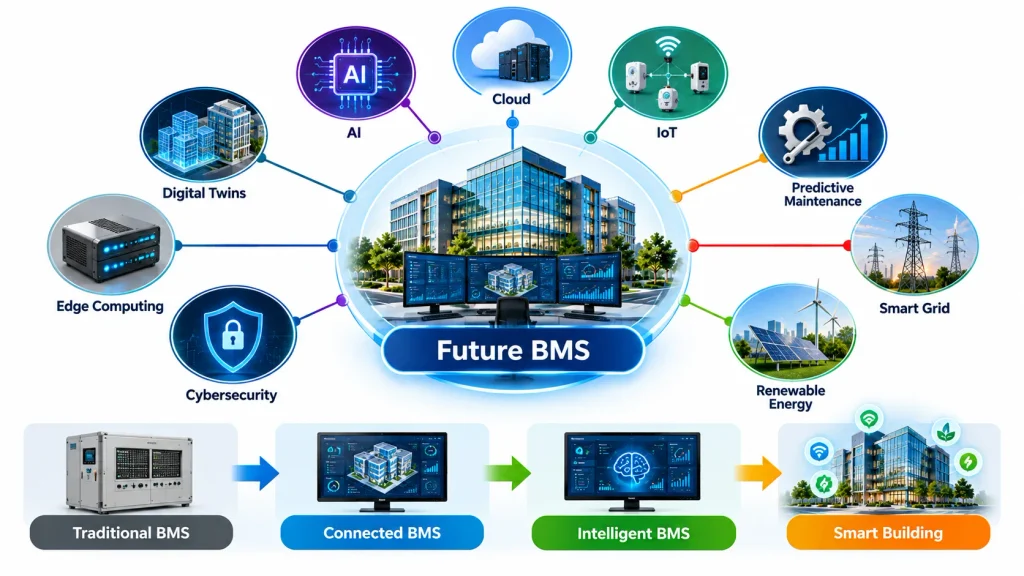
The Future of BMS: From Automation to Intelligence
The overall evolution can be understood as a progression:
Traditional Controls
→ Digital BMS
→ Integrated BMS
→ IoT-Connected BMS
→ Cloud BMS
→ AI-Enabled BMS
→ Autonomous and Data-Driven Buildings
The future BMS will therefore not simply be a system that turns equipment on and off. It is increasingly becoming a central intelligence and coordination layer for building operations.
Conclusion
A Building Management System (BMS) helps monitor and control important building services such as HVAC, lighting and energy systems. It can improve energy efficiency, comfort, safety and operational control.
With technologies such as IoT, artificial intelligence and predictive maintenance, modern BMS solutions are becoming more intelligent and efficient. A properly designed and maintained BMS can support better building performance and long-term cost savings.