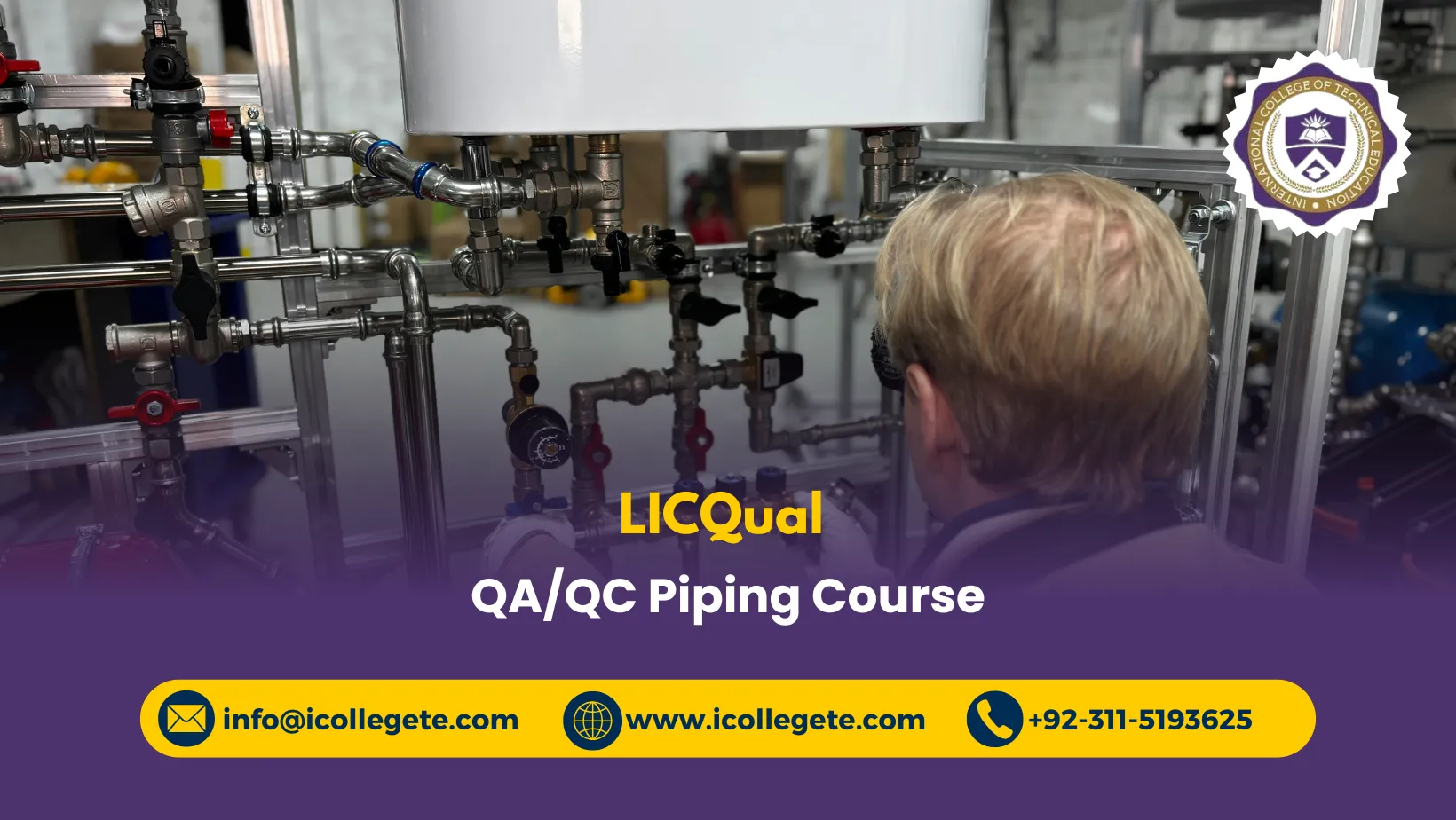
LICQual QA/QC Piping Training Course Pakistan
The LICQual QA/QC Piping Course in Pakistan is a professional training program designed to provide learners with advanced knowledge and practical expertise in quality assurance and quality control specific to piping systems. This course focuses on international standards, inspection techniques, and compliance procedures that are vital for ensuring the safety, reliability, and efficiency of piping networks used in industries such as oil and gas, petrochemical, power generation, and construction.
Through a structured curriculum, participants will gain a strong understanding of piping materials, welding inspection, non-destructive testing methods, and fabrication processes. The program blends theoretical learning with practical applications, enabling learners to confidently perform inspections, interpret results, and implement quality control measures in real-world piping projects.
Course Overview
The LICQual QA/QC Piping Course in Pakistan is a specialized training program designed to provide learners with advanced knowledge and practical skills in quality assurance and quality control within the piping industry. This course focuses on international standards, inspection techniques, and compliance procedures that are essential for ensuring the safety, durability, and efficiency of piping systems in industries such as oil and gas, petrochemical, power plants, and construction.
Participants will gain in-depth exposure to piping materials, welding inspection, non-destructive testing methods, and quality management systems. The program blends theoretical learning with practical applications, preparing learners to meet industry demands and excel in roles across piping inspection, fabrication, and project management. By the end of the course, learners will be equipped with the skills required to handle real-world QA/QC challenges in piping projects.
Entry Requirements
To ensure participants are prepared for the advanced level of study, candidates must meet the following eligibility criteria:
- Age Requirement: Applicants must be at least 18 years old.
- Qualification Requirement: A minimum of a diploma or equivalent qualification in mechanical, piping, or a related engineering field.
- Professional Experience: At least one year of relevant work experience in piping, fabrication, or industrial projects.
- Educational Background: Strong foundation in mathematics, physics, and engineering principles.
- English Language Proficiency: Basic understanding of English to comprehend technical materials.
- Technical Aptitude: Ability to work with piping drawings, inspection tools, and fabrication equipment.
Course Study Units
- Introduction to QA/QC in Piping Engineering
- Piping Materials and International Standards
- Welding Inspection and Testing for Piping
- Non-Destructive Testing (NDT) Methods in Piping
- Piping Fabrication and Installation Inspection
- Quality Management Systems (QMS) in Piping Projects
- Codes, Standards, and Specifications for Piping
- Documentation and Reporting in QA/QC
Course Learning Outcomes
By completing this course, learners will acquire practical skills and theoretical knowledge aligned with the study units.
Introduction to QA/QC in Piping Engineering
- Fundamentals of quality assurance and quality control in piping projects.
- Importance of QA/QC in fabrication, installation, and maintenance.
- Roles and responsibilities of QA/QC professionals in piping engineering.
Piping Materials and International Standards
- Properties and classifications of piping materials.
- International standards for material selection and usage.
- Material testing procedures to ensure compliance and durability.
Welding Inspection and Testing for Piping
- Welding processes and techniques used in piping systems.
- Inspection methods for weld quality and integrity.
- Identifying welding defects and applying corrective actions.
Non-Destructive Testing (NDT) Methods in Piping
- Introduction to NDT techniques in piping engineering.
- Applications of ultrasonic, radiographic, and magnetic particle testing.
- Practical use of NDT for assessing piping integrity and safety.
Piping Fabrication and Installation Inspection
- Inspection of piping fabrication processes.
- Evaluating installation procedures for compliance with standards.
- Ensuring reliability and safety in piping systems.
Quality Management Systems (QMS) in Piping Projects
- Overview of QMS frameworks in piping engineering.
- Implementation of quality systems in piping projects.
- Continuous improvement and compliance monitoring.
Codes, Standards, and Specifications for Piping
- International codes and standards in piping engineering.
- Application of specifications in QA/QC practices.
- Ensuring project compliance with regulatory requirements.
Documentation and Reporting in QA/QC
- Importance of accurate documentation in piping QA/QC.
- Preparing inspection reports and quality records.
- Maintaining transparency and accountability in project management.
Course Benefits
This course offers multiple benefits to learners, enhancing both their knowledge and career opportunities.
Career Advancement
- Gain globally recognized certification.
- Improve employability in piping industries.
- Access opportunities in oil, gas, and petrochemical sectors.
Practical Skills Development
- Learn hands-on inspection techniques.
- Apply QA/QC standards in real-world piping projects.
- Strengthen technical problem-solving abilities.
Industry Recognition
- Enhance credibility with employers.
- Meet international QA/QC standards.
- Build a strong professional profile.
Knowledge Expansion
- Understand advanced piping concepts.
- Gain exposure to international codes and standards.
- Improve technical communication and reporting skills.
Who Can Enroll
This course is suitable for a wide range of learners who wish to build or advance their careers in piping QA/QC.
Piping Engineers
- Professionals seeking specialized QA/QC knowledge.
- Engineers aiming to work in oil and gas industries.
- Individuals wanting to enhance inspection skills.
Diploma Holders
- Students with mechanical or piping diplomas.
- Fresh graduates looking for career opportunities.
- Learners aiming to strengthen technical expertise.
Industry Professionals
- Technicians working in piping projects.
- Supervisors responsible for quality control.
- Employees seeking career progression.
Future Progression
Completing this course opens doors to advanced qualifications and career opportunities.
Higher-Level Certifications
- Progress to Level 4 QA/QC certifications.
- Specialize in advanced piping inspection.
- Gain international recognition.
Career Opportunities
- Work as QA/QC inspector in oil and gas projects.
- Secure roles in petrochemical and construction industries.
- Advance to supervisory positions.
Professional Development
- Enhance technical expertise.
- Build leadership skills in QA/QC.
- Expand career networks globally.
Academic Pathways
- Pursue higher education in mechanical or piping engineering.
- Enroll in specialized piping courses.
- Strengthen academic credentials for research.
The LICQual QA/QC Piping Course in Pakistan is a well-structured program that equips learners with the technical knowledge, inspection skills, and quality management expertise required in today’s competitive piping industry. Covering essential study units such as welding inspection, non-destructive testing, and quality management systems, the course ensures that participants are prepared to meet international standards and industry expectations. The entry requirements guarantee that learners have the necessary background to succeed, while the detailed learning outcomes align with practical applications in real-world projects.
Take the Next Step Toward World LICQual QA/QC Piping Course-Enroll Now