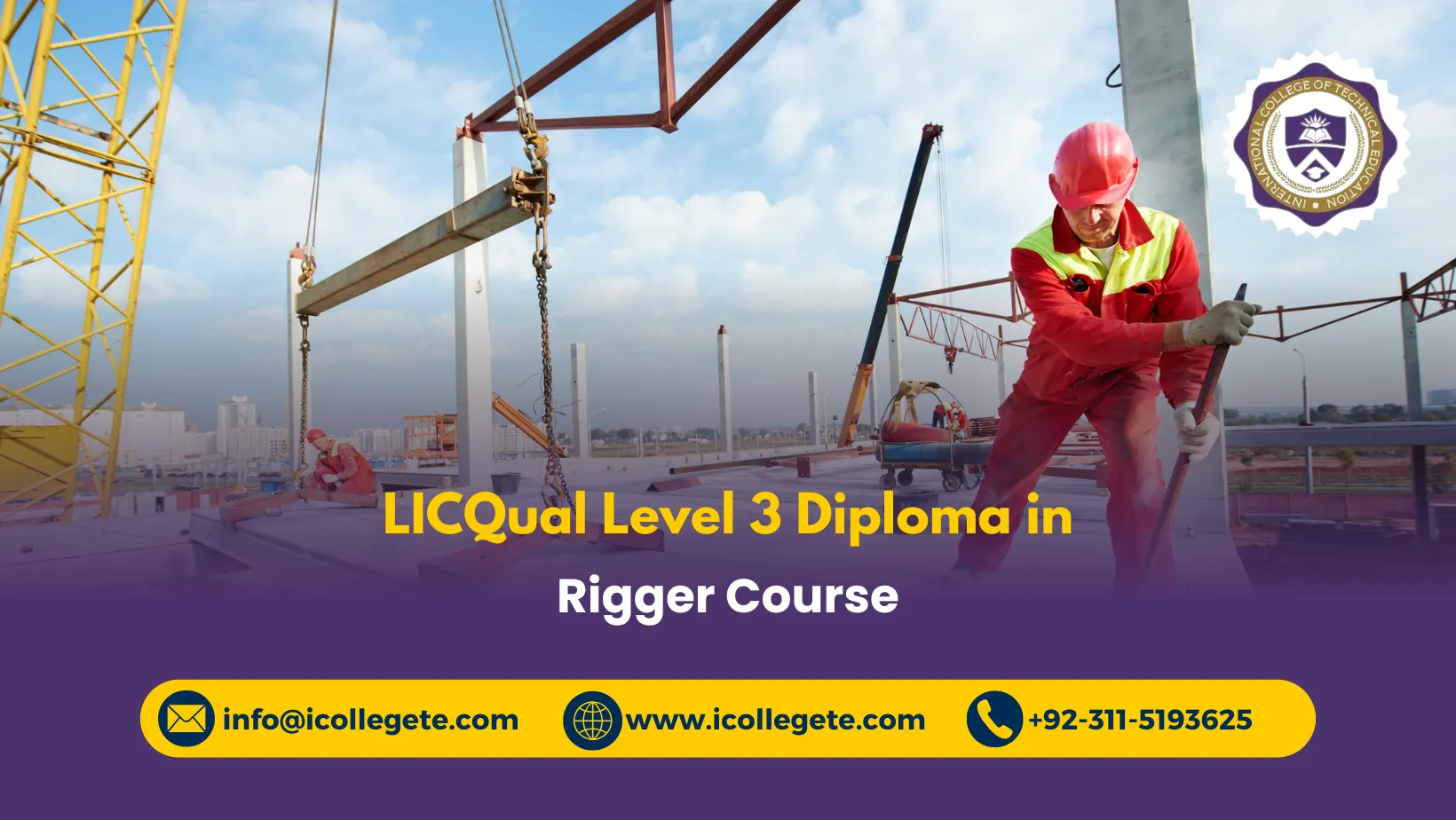
The LICQual Level 3 Diploma in Rigger Course in Peshawar is a vocational training programme designed to develop practical and technical competence in rigging, lifting, load handling and lifting equipment operations. The course is suitable for learners seeking to build professional skills for construction, oil and gas, manufacturing, engineering, infrastructure, logistics, marine and industrial lifting environments.
Rigging requires careful planning, accurate load assessment, appropriate equipment selection and safe execution. This qualification develops knowledge of lifting principles, load calculations, rigging tools, safety procedures, risk assessment, equipment inspection and practical lifting operations. Learners develop the ability to identify lifting hazards, select suitable rigging arrangements, understand working load limits and apply safe practices when preparing and controlling loads. Industry guidance emphasises correct sling selection, inspection, maintenance, load balance and avoidance of unsafe practices such as shock loading and working beneath suspended loads.
The course also develops practical decision-making through workplace scenarios and case studies. Learners gain an understanding of how rigging operations should be planned, communicated and monitored while considering load characteristics, equipment condition, environmental conditions and workplace risks. The qualification provides a strong foundation for learners aiming to progress into professional rigger, lifting operations and related construction or industrial roles.
Course Overview
The LICQual Level 3 Diploma in Rigger Course in Peshawar is a vocational qualification designed to develop essential knowledge and skills in rigging, lifting operations, load calculations, equipment handling, workplace safety, and risk assessment. Delivered through six study units, the course helps learners understand safe lifting practices, rigging equipment inspection, load stability, and practical lifting procedures. It is suitable for aspiring riggers and professionals working in construction, engineering, oil and gas, manufacturing, and industrial sectors. This course supports career development by strengthening technical competence and preparing learners for rigging and lifting-related employment opportunities in Pakistan and internationally.
Entry Requirements
To enroll in this course, candidates must meet specific requirements to ensure they are prepared for the training.
- Age Requirements: Minimum age of 18 years.
- Qualification Requirements: Basic secondary education or equivalent.
- Professional Experience: Prior exposure to construction or industrial work is preferred but not mandatory.
- Educational Background: Candidates should have a general understanding of technical or vocational subjects.
- Language Skills: Basic proficiency in English or Urdu for understanding course materials.
Course Study Units
Unit 1: Principles of Rigging and Lifting
This unit introduces the fundamental principles of rigging and lifting operations. Learners explore the role and responsibilities of a rigger, basic lifting terminology, types of lifting operations and the relationship between cranes, hoists, slings and lifting accessories.
Key areas include:
- Principles of safe lifting and rigging
- Roles and responsibilities of riggers
- Types of lifting operations
- Basic rigging terminology
- Load stability and centre of gravity
- Types of slings and lifting accessories
- Basic lifting plans and procedures
- Communication during lifting operations
- Load control and positioning
- Safe working practices around suspended loads
Learners develop an understanding of how different rigging arrangements affect load stability and lifting safety.
Unit 2: Load Calculations and Weight Estimation
This unit develops the knowledge required to estimate load weights and assess lifting requirements before an operation begins. Learners explore basic calculations involving dimensions, density, weight, centre of gravity, working load limits and sling configurations.
Key areas include:
- Load weight estimation
- Dimensions and material density
- Centre of gravity
- Working load limits
- Safe working loads
- Sling angles
- Load distribution
- Multi-leg sling arrangements
- Lifting points
- Crane and lifting equipment capacity
- Basic rigging calculations
- Allowance for dynamic and environmental factors
Correct sling selection and capacity assessment are critical because sling capacity can depend on factors such as material strength, hitch type, loading angle and configuration.
Learners develop the ability to interpret load information and determine whether proposed rigging arrangements are suitable for the intended lifting activity.
Unit 3: Rigging Tools and Equipment Handling
This unit focuses on the identification, selection and safe handling of common rigging equipment and accessories.
Learners study:
- Wire rope slings
- Chain slings
- Web slings
- Round slings
- Shackles
- Hooks
- Eye bolts
- Lifting points
- Turnbuckles
- Spreader beams
- Lifting beams
- Rigging blocks
- Hoists
- Tag lines
- Connecting hardware
- Load-indicating devices
The unit also covers equipment selection according to load type, lifting configuration, environmental conditions and manufacturer requirements. Learners develop safe handling techniques and understand why damaged, unsuitable or incorrectly configured equipment must not be used.
Unit 4: Safety Standards and Risk Assessment
This unit develops learners’ understanding of safety management within rigging and lifting operations. Learners explore hazards associated with suspended loads, lifting equipment, poor communication, unstable loads, environmental conditions and unsuitable rigging arrangements.
Key areas include:
- Rigging safety principles
- Hazard identification
- Risk assessment
- Control measures
- Safe systems of work
- Lifting plans
- Permit-to-work considerations
- Exclusion zones
- Suspended-load hazards
- Communication and signalling
- Emergency procedures
- Environmental hazards
- Human factors
- Personal protective equipment
- Stop-work procedures
Industry guidance identifies hazards including damaged slings, incorrect attachments, improper storage and unsafe practices around suspended loads.
Learners develop the ability to identify risks and select appropriate control measures before and during lifting activities.
Unit 5: Inspection and Maintenance of Rigging Equipment
This unit focuses on maintaining rigging equipment in safe working condition. Learners learn how to carry out pre-use inspections, identify defects and understand when equipment should be removed from service.
Key areas include:
- Pre-use inspection
- Routine inspection
- Periodic inspection
- Sling identification
- Working load limit markings
- Wire rope damage
- Broken wires
- Kinking and crushing
- Corrosion
- Cuts and abrasion
- Heat damage
- Damaged hooks and shackles
- Deformed components
- Inspection records
- Equipment storage
- Maintenance requirements
- Removal from service
Rigging guidance recommends inspection of slings and attachments before use and additional periodic inspections based on service conditions, frequency and the nature of lifting operations. Defective equipment should be removed from service.
Learners gain the knowledge needed to recognise conditions that may compromise lifting equipment and understand the importance of following manufacturer instructions and applicable workplace requirements.
Unit 6: Practical Rigging Operations and Case Studies
This unit applies the knowledge developed throughout the qualification to realistic workplace situations. Learners examine practical lifting operations and case studies involving different load types, equipment configurations and workplace environments.
Key areas include:
- Preparing for lifting operations
- Selecting suitable rigging equipment
- Checking load information
- Assessing centre of gravity
- Connecting slings and accessories
- Controlling loads
- Using tag lines
- Communication with lifting teams
- Trial lifts
- Load positioning
- Controlled lowering
- Post-lift procedures
- Identifying unsafe conditions
- Responding to changing conditions
- Learning from lifting incidents and case studies
The practical focus helps learners develop confidence in applying safe rigging principles rather than relying only on theoretical knowledge.
Learning Outcomes
On successful completion of the LICQual Level 3 Diploma in Rigger Course, learners should be able to:
- Explain fundamental principles of rigging and lifting operations.
- Identify different types of rigging equipment and lifting accessories.
- Explain the responsibilities of personnel involved in lifting activities.
- Estimate load weights using relevant information and basic calculations.
- Assess centre of gravity and load distribution.
- Determine appropriate rigging arrangements for different loads.
- Interpret working load limits and equipment capacity information.
- Select suitable slings, shackles, hooks and lifting accessories.
- Explain the effect of sling angles on lifting capacity.
- Identify hazards associated with rigging and lifting operations.
- Conduct basic risk assessments for lifting activities.
- Recommend appropriate control measures for identified hazards.
- Apply safe working practices around suspended loads.
- Conduct pre-use inspections of rigging equipment.
- Identify common defects and damage in lifting accessories.
- Explain appropriate storage and maintenance requirements.
- Recognise when rigging equipment should be removed from service.
- Apply safe rigging techniques in practical workplace situations.
- Analyse lifting scenarios and select appropriate control measures.
- Apply effective communication during rigging operations.
- Respond appropriately to changing conditions during lifting activities.
- Evaluate practical lifting arrangements using case studies.
Course Benefits
Develop Practical Rigging Competence
The course provides learners with practical knowledge of rigging equipment, lifting arrangements, load handling and safe lifting procedures.
Improve Load Assessment Skills
Learners develop the ability to estimate load weights, understand load distribution and consider centre of gravity when preparing lifting operations.
Strengthen Workplace Safety Awareness
The programme develops awareness of hazards associated with suspended loads, lifting accessories, cranes and rigging activities.
Understand Equipment Inspection
Learners develop knowledge of inspecting slings, hooks, shackles, wire ropes and other rigging equipment for visible damage and defects.
Support Construction and Industrial Careers
Rigging skills can support employment opportunities across construction, engineering, manufacturing, infrastructure, logistics, oil and gas and industrial operations.
Develop Risk Assessment Skills
Learners gain the ability to identify hazards, evaluate risks and recommend suitable control measures for lifting activities.
Build Job-Ready Knowledge
The combination of technical knowledge, practical application and case studies helps learners develop skills relevant to workplace lifting operations.
Who is This Course For?
The LICQual Level 3 Diploma in Rigger Course in Peshawar is suitable for:
- Aspiring riggers
- Junior riggers
- Construction workers
- Lifting and rigging assistants
- Crane and lifting personnel
- Mechanical workers
- Engineering workers
- Oil and gas personnel
- Industrial maintenance workers
- Warehouse and logistics personnel
- Manufacturing workers
- Infrastructure project workers
- Site workers involved in lifting operations
- Supervisors responsible for lifting activities
- Learners seeking a career in rigging and lifting
It is particularly suitable for learners who want to develop structured vocational knowledge before entering or progressing within lifting and rigging environments.
Why Choose This Course?
Industry-Relevant Rigging Knowledge
The course focuses on practical rigging and lifting knowledge applicable to real workplace environments.
Comprehensive Course Structure
Learners study the complete lifting process, from load assessment and equipment selection through to inspection, risk assessment and practical operations.
Safety-Focused Training
Safety is integrated throughout the course, including hazard identification, equipment inspection, load control and safe working practices.
Practical Learning Approach
Case studies and practical scenarios help learners understand how rigging principles are applied to real lifting operations.
Suitable for Multiple Industries
The knowledge can be relevant across construction, engineering, manufacturing, infrastructure, logistics, oil and gas and other industries where lifting operations are performed.
Professional Development
The qualification can support learners seeking to strengthen their technical profile and progress towards roles involving rigging, lifting operations and site-based responsibilities.
Internationally Relevant Principles
The course develops principles that can be applied across different industrial environments while encouraging learners to follow the applicable local legislation, employer procedures, equipment manufacturer instructions and recognised industry standards.
Future Progression
Successful completion of the LICQual Level 3 Diploma in Rigger Course can provide a foundation for progression into more advanced occupational roles and specialist lifting-related training.
Potential career progression may include:
- Rigger
- Senior Rigger
- Rigging Technician
- Lifting Operations Assistant
- Lifting Supervisor
- Rigging Supervisor
- Lifting Coordinator
- Crane and Rigging Team Leader
- Construction Site Lifting Personnel
- Industrial Lifting Technician
- Oil and Gas Rigging Personnel
Learners may also consider additional training in crane operations, lifting supervision, lifting planning, banksman and signalling, lifting equipment inspection, health and safety, construction site supervision and specialist industrial lifting operations.
Progression should be based on the requirements of the employer, relevant national regulations, site competency requirements and any prerequisites established by the organisation responsible for the next qualification or occupational role.
Take the Next Step Toward World LICQual Level 3 Diploma in Rigger Course – Enroll Now