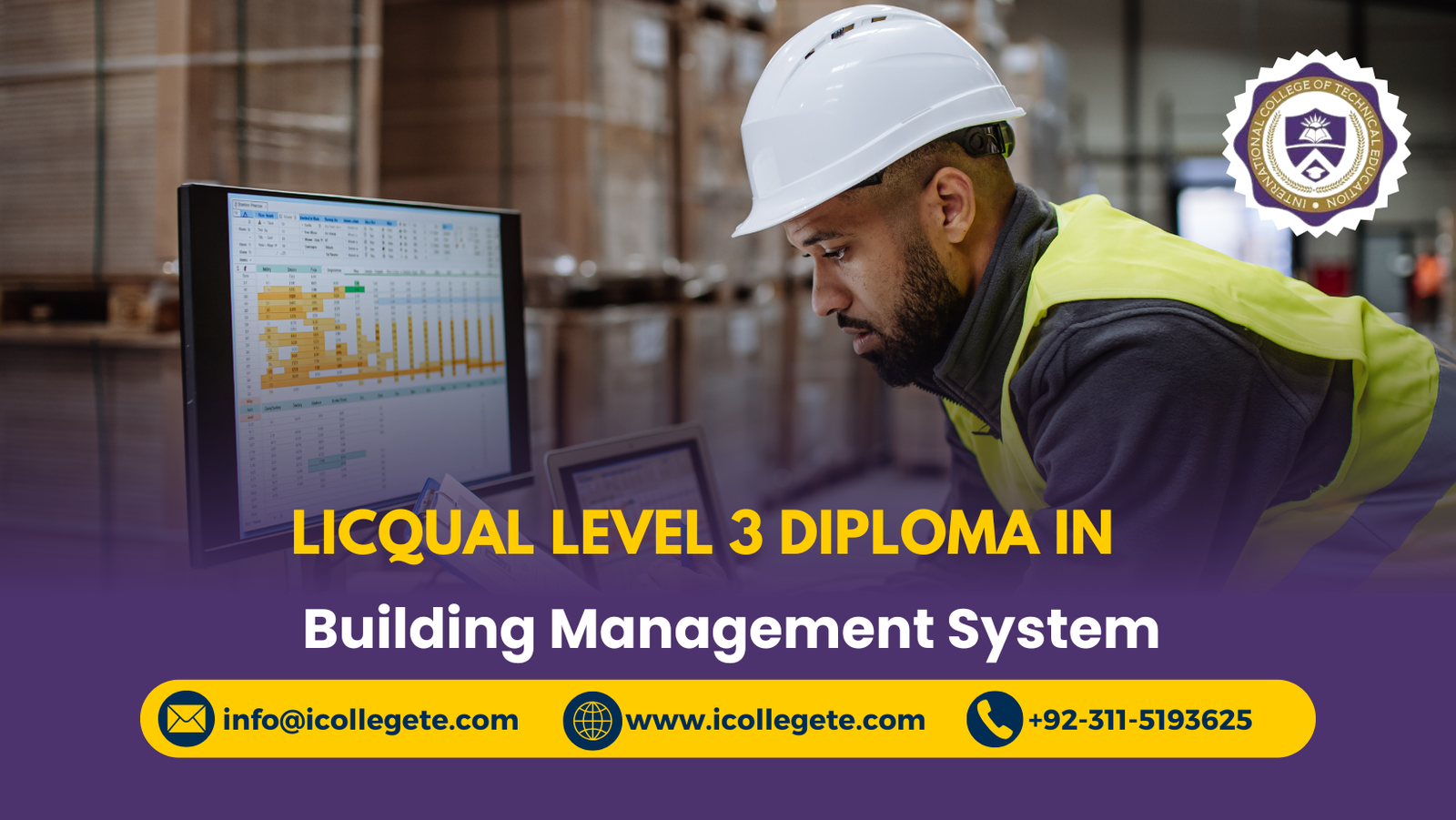
The LICQual Level 3 Diploma in Building Management System is a professionally focused qualification designed to develop the knowledge and practical understanding required to operate, monitor, maintain and optimise modern Building Management Systems (BMS). Building Management Systems integrate and control important building services such as heating, ventilation and air conditioning (HVAC), lighting, energy monitoring and other electrical and mechanical systems through centralised digital control.
The qualification provides learners with a structured understanding of BMS components, automation technologies, energy management, system design, maintenance and troubleshooting. Learners develop the ability to understand how sensors, controllers, actuators, communication networks, software interfaces and automated control strategies work together to support efficient building operation.
The LICQual Level 3 Diploma in Building Management System also develops awareness of energy efficiency and sustainable building operation. A well-configured BMS can support energy monitoring, equipment scheduling, fault detection, comfort management and performance optimisation.
This qualification is suitable for learners interested in building automation, facilities management, building services, electrical and mechanical systems, energy management and smart building technologies. It can provide a strong foundation for employment and further professional development in BMS operation, facilities management, building automation and energy-efficient building management.
Course Overview
The LICQual Level 3 Diploma in Building Management System develops technical knowledge and practical understanding of the technologies used to monitor and control modern buildings. Learners explore BMS architecture, field devices, controllers, software interfaces, communication systems, automation strategies and integrated building services.
The course also focuses on energy efficiency, sustainable operation, BMS design, system implementation, preventative maintenance and troubleshooting. These areas help learners understand how BMS technologies can contribute to reliable building operation, improved energy performance, occupant comfort and effective facilities management.
The qualification consists of six core study areas specified for this course content, providing a progressive learning pathway from fundamental BMS principles through to system optimisation and problem solving.
Course Study Units
Unit 1: Introduction to Building Management Systems (BMS)
This unit establishes the fundamental knowledge required to understand Building Management Systems and their role in modern buildings.
Learners explore:
- Fundamentals and purpose of Building Management Systems
- Role of BMS in modern commercial, industrial and residential buildings
- Basic BMS architecture and operating principles
- Centralised monitoring and control
- Relationship between BMS and building services
- HVAC monitoring and control
- Lighting control and automation
- Energy monitoring and management
- Building security and access-control integration
- Environmental monitoring
- Sensors, controllers and actuators
- BMS software and graphical user interfaces
- Benefits of automation and centralised control
- BMS applications in smart and connected buildings
- Basic principles of building performance monitoring
A BMS can provide centralised monitoring and control of mechanical and electrical services and may integrate systems such as HVAC, lighting, security and access control.
Unit 2: BMS Components and Technologies
This unit develops knowledge of the physical and digital technologies that form a Building Management System.
Learners explore:
- Sensors and sensing technologies
- Temperature, humidity and pressure sensors
- Occupancy and motion sensors
- Air-quality and carbon dioxide sensors
- Energy meters and monitoring devices
- Actuators and control devices
- Valves and dampers
- Direct digital controllers
- Programmable and automation controllers
- Input and output devices
- BMS panels and control cabinets
- Communication networks
- Wired and wireless BMS technologies
- Common communication concepts and protocols
- BMS software platforms
- Operator workstations and dashboards
- Alarms, notifications and event monitoring
- Data logging and trend analysis
- Integration between different building systems
The unit helps learners understand how individual field devices and control technologies communicate with higher-level BMS software to provide monitoring, control and automation.
Unit 3: Energy Management and Sustainability
This unit focuses on using BMS technologies to improve energy performance and support sustainable building operation.
Learners explore:
- Principles of building energy management
- Energy consumption monitoring
- Energy-use patterns and trends
- Energy baselines
- Building energy performance
- HVAC energy optimisation
- Lighting energy management
- Equipment scheduling
- Occupancy-based control
- Set-point management
- Demand management
- Automated operating schedules
- Energy waste identification
- Performance monitoring
- Energy-saving control strategies
- Environmental sustainability
- Resource efficiency
- Carbon reduction considerations
- Renewable-energy integration
- Energy reporting and performance analysis
- Continuous improvement of building energy performance
BMS technology can support energy efficiency through equipment scheduling, comfort control, occupancy-based strategies, trend monitoring and identification of excessive energy consumption. Accurate sensor positioning and calibration are also important for reliable control.
Unit 4: BMS Design and Implementation
This unit develops an understanding of how BMS solutions are planned, designed, configured and implemented according to building requirements.
Learners explore:
- BMS project requirements
- Building-system surveys
- Functional requirements
- System architecture
- Control strategies
- Points schedules
- Input and output requirements
- Sensor selection
- Controller selection
- Actuator selection
- Network and communication requirements
- HVAC control strategies
- Lighting-control integration
- Energy-monitoring integration
- System interoperability
- BMS graphics and user interfaces
- Alarm configuration
- Data logging and trend configuration
- System commissioning
- Testing and verification
- Handover documentation
- Operator training
- System performance evaluation
Learners develop an understanding of how a BMS should be matched to the building’s operational requirements rather than treating automation as a one-size-fits-all solution.
Unit 5: Maintenance and Optimisation of BMS
This unit focuses on maintaining BMS functionality and improving system performance throughout its operational life.
Learners explore:
- BMS maintenance principles
- Preventative maintenance
- Routine system inspections
- Sensor inspection and calibration
- Controller checks
- Actuator checks
- Network and communication checks
- Alarm review
- Trend-data analysis
- Control-loop performance
- Software and configuration checks
- Backup and recovery procedures
- Documentation management
- Performance benchmarking
- System tuning
- Energy-performance optimisation
- Identification of inefficient operating patterns
- Maintenance planning
- Fault prevention
- System upgrades
- Legacy BMS considerations
- Continuous performance improvement
BMS monitoring can help identify equipment degradation and emerging faults, allowing operators to undertake preventative maintenance before problems cause greater operational disruption.
Unit 6: Troubleshooting and Problem Solving in BMS
This unit develops systematic approaches to identifying, analysing and resolving common BMS faults.
Learners explore:
- BMS fault identification
- Systematic troubleshooting methods
- Alarm interpretation
- Fault-code analysis
- Sensor-related problems
- Communication failures
- Controller faults
- Actuator problems
- Incorrect set points
- Scheduling errors
- Network problems
- Data-quality issues
- HVAC control faults
- Lighting-control faults
- Intermittent system problems
- Software and configuration issues
- Trend-data investigation
- Root-cause analysis
- Corrective actions
- Fault verification
- Preventative measures
- Maintenance records and reporting
The unit encourages learners to distinguish between symptoms and root causes so that corrective actions address the underlying problem rather than simply resetting alarms or restarting equipment.
Course Learning Outcomes
By successfully completing the LICQual Level 3 Diploma in Building Management System, learners should be able to:
- Explain the purpose, functions and applications of Building Management Systems.
- Describe the architecture and operating principles of a BMS.
- Identify major BMS components, field devices and control technologies.
- Explain how sensors, controllers and actuators interact within a BMS.
- Understand the relationship between BMS and HVAC, lighting and energy systems.
- Interpret basic BMS monitoring information and operational data.
- Explain principles of building energy management and efficiency.
- Identify opportunities for reducing unnecessary energy consumption.
- Apply basic sustainability principles to building-system operation.
- Understand the stages involved in BMS design and implementation.
- Interpret basic BMS requirements and control strategies.
- Understand commissioning, testing and system handover processes.
- Apply principles of preventative BMS maintenance.
- Identify common BMS faults and operational problems.
- Use a structured approach to BMS troubleshooting.
- Analyse alarms, trends and system information when investigating faults.
- Recommend appropriate corrective actions for common BMS problems.
- Recognise the importance of accurate sensors, effective control and system tuning.
- Support continuous improvement of BMS performance.
- Contribute to efficient, reliable and sustainable building operation.
Course Benefits
The LICQual Level 3 Diploma in Building Management System provides learners with a combination of technical knowledge and practical understanding relevant to modern building automation.
Key benefits include:
- Develops a strong foundation in Building Management Systems.
- Builds knowledge of BMS architecture and components.
- Introduces HVAC, lighting and energy-control applications.
- Develops understanding of building automation technologies.
- Strengthens energy-management knowledge.
- Supports understanding of sustainable building operation.
- Develops BMS maintenance and troubleshooting skills.
- Improves understanding of system monitoring and performance analysis.
- Introduces BMS design and implementation principles.
- Develops problem-solving approaches for common BMS faults.
- Supports progression into building automation and facilities-management roles.
- Provides knowledge relevant to commercial, industrial and residential environments.
- Helps learners understand smart-building technologies.
- Supports professional development in building services and automation.
- Develops skills relevant to energy-efficient building operation.
Who is This Course For?
The LICQual Level 3 Diploma in Building Management System is suitable for learners and professionals who want to develop knowledge of building automation, BMS operation and modern building services.
The course is particularly suitable for:
- Aspiring BMS technicians
- Building management professionals
- Facilities management personnel
- Facilities supervisors
- Building services technicians
- Maintenance technicians
- Electrical technicians
- Mechanical technicians
- HVAC technicians
- Building automation technicians
- Control and instrumentation personnel
- Energy-management personnel
- Construction and building-services professionals
- Maintenance supervisors
- Property and facilities personnel
- Engineering learners seeking BMS knowledge
- Professionals moving towards smart-building technologies
- Individuals interested in sustainable building operation
- Learners seeking a foundation in building automation
- Professionals wishing to expand their technical knowledge
The qualification is also relevant to individuals working with electrical, mechanical, HVAC, facilities or building-services systems who want to understand how these systems can be monitored and controlled through an integrated BMS.
Why Choose the LICQual Level 3 Diploma in Building Management System?
Practical Building Automation Knowledge
The course focuses on the technologies and processes used in real building environments, including sensors, controllers, actuators, monitoring systems, automation and troubleshooting.
Focus on Modern BMS Technologies
Learners develop knowledge of the digital technologies used to monitor and control building services and understand the relationship between field-level equipment, control systems and management interfaces.
Energy Efficiency and Sustainability
Energy management is an important part of modern BMS operation. The course develops understanding of monitoring, scheduling, optimisation and energy-saving strategies.
Maintenance and Troubleshooting Skills
The qualification covers preventative maintenance and systematic troubleshooting, helping learners understand how faults can be identified, investigated and corrected.
Relevant to Smart Buildings
BMS technologies are an important part of increasingly connected and automated buildings. Modern systems can use network connectivity, data monitoring and integration between multiple building services.
Suitable for Multiple Building Environments
BMS technology can be applied across commercial, industrial and residential environments. Learners therefore gain knowledge that can be relevant across several building-services contexts.
Career Development
The qualification can support learners seeking to develop their knowledge for roles associated with BMS, facilities management, building services, automation, maintenance and energy management.
Future Progression
The LICQual Level 3 Diploma in Building Management System can provide a foundation for continued professional development in building automation, facilities management, building services, energy management and related technical disciplines.
Potential progression areas include:
- Advanced Building Management System qualifications
- Building automation and control qualifications
- Facilities management qualifications
- HVAC control and automation training
- Electrical and control engineering studies
- Energy management qualifications
- Sustainable building management programmes
- Smart-building technology training
- Building services engineering development
- Maintenance and asset-management programmes
- Industrial automation and control training
Professionally, learners may seek opportunities in areas such as BMS operation, facilities support, building services, maintenance, HVAC controls, energy monitoring and building automation, depending on experience, technical competence and employer requirements.
The qualification can therefore form part of a broader professional development pathway towards increasingly specialised responsibilities in smart buildings, automation, energy efficiency and facilities operations.
Career Opportunities
Completion of the LICQual Level 3 Diploma in Building Management System may support progression towards roles or responsibilities such as:
- BMS Technician
- Junior BMS Technician
- Building Automation Technician
- Facilities Technician
- Building Services Technician
- Maintenance Technician
- HVAC Controls Technician
- Energy Management Assistant
- Facilities Management Assistant
- Building Automation Support Technician
- Maintenance Supervisor
- Building Systems Operator