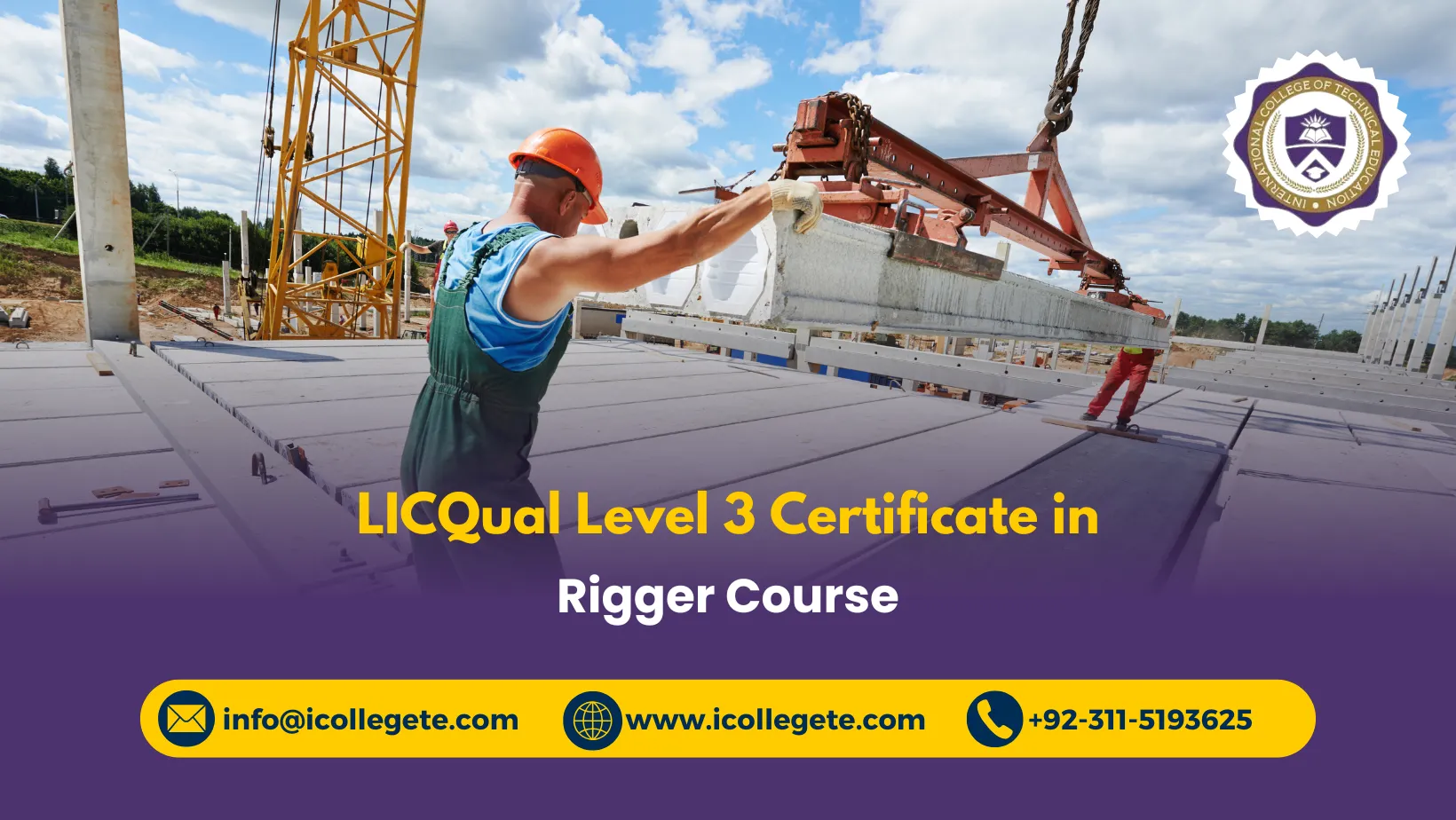
The LICQual Level 3 Certificate in Rigger Course in Swabi is a practical and career-focused qualification designed for individuals who want to develop advanced knowledge and professional skills in rigging and lifting operations. The course provides learners with a structured understanding of how to prepare, inspect, calculate, coordinate, and safely execute lifting activities in construction, engineering, manufacturing, oil and gas, logistics, and other industrial environments.
Learners develop competence in advanced rigging operations, rigging tools and equipment maintenance, load calculations, weight estimation, lifting techniques, safety standards, risk assessment, and hazard control. The programme also introduces supervisory responsibilities, enabling learners to understand how rigging teams can be coordinated effectively while maintaining safe working practices and operational control.
The LICQual Level 3 Certificate in Rigger Course in Swabi combines technical knowledge with practical workplace applications. Learners examine real-world rigging scenarios and industry practices to understand how lifting plans, equipment selection, communication, inspection, and risk controls contribute to successful lifting operations.
This course is suitable for aspiring and existing riggers who want to strengthen their technical competence and improve their understanding of professional lifting operations. It provides a relevant learning pathway for individuals seeking to develop their careers in rigging, lifting, construction, industrial maintenance, and related engineering environments.
Course Study Units
Unit 1: Introduction to Advanced Rigging Operations
This unit introduces learners to the principles and responsibilities associated with advanced rigging operations.
Key topics include:
- Principles of advanced rigging operations
- Roles and responsibilities of riggers
- Types of lifting and rigging activities
- Basic lifting plans and work procedures
- Rigging terminology and communication
- Load control and positioning
- Coordination between riggers, operators and supervisors
- Pre-lifting preparation and operational checks
- Importance of competent personnel
- Good practice in industrial lifting operations
Unit 2: Rigging Tools and Equipment Maintenance
This unit develops knowledge of common rigging tools and lifting equipment and explains how they should be inspected, maintained and stored.
Key topics include:
- Wire ropes and wire rope slings
- Chain slings and synthetic web slings
- Shackles, hooks and master links
- Eye bolts and lifting accessories
- Spreader beams and lifting beams
- Inspection requirements for rigging equipment
- Identification of damaged or defective equipment
- Safe storage and handling
- Equipment maintenance practices
- Inspection records and equipment traceability
- Withdrawal of unsafe equipment from service
Unit 3: Advanced Load Calculations and Weight Estimation
This unit focuses on the calculations required to plan safe lifting operations and select suitable rigging equipment.
Key topics include:
- Load weight estimation
- Centre of gravity
- Load distribution
- Working Load Limit (WLL)
- Safe Working Load (SWL)
- Sling angle considerations
- Load factors and lifting configurations
- Basic mechanical advantage
- Selection of suitable lifting accessories
- Understanding manufacturer specifications
- Consequences of incorrect load calculations
Unit 4: Safety Standards and International Compliance
This unit develops learners’ understanding of safety requirements and internationally recognised principles relevant to lifting and rigging activities.
Key topics include:
- Rigging and lifting safety principles
- Workplace lifting responsibilities
- Equipment inspection requirements
- Safe systems of work
- Manufacturer instructions
- Permit and authorisation requirements
- Personal protective equipment
- Communication and signalling
- International lifting safety practices
- Compliance monitoring
- Importance of competent and authorised personnel
Unit 5: Rigging Techniques and Lifting Procedures
This unit explores professional rigging methods and procedures used to prepare and control loads during lifting operations.
Key topics include:
- Slinging and securing loads
- Selection of rigging configurations
- Hooking and connecting loads
- Load balancing
- Controlling suspended loads
- Tag lines and load positioning
- Banksman and signalling principles
- Crane and lifting equipment coordination
- Pre-lift checks
- Controlled lifting procedures
- Landing and positioning loads safely
- Post-lifting procedures
Unit 6: Supervisory Skills in Rigging Operations
This unit introduces the leadership and coordination skills required when supervising rigging activities.
Key topics include:
- Responsibilities of rigging supervisors
- Team coordination
- Work allocation
- Toolbox talks and briefings
- Communication during lifting operations
- Monitoring work practices
- Competence and authorisation
- Coordination with crane operators
- Managing lifting teams
- Addressing unsafe practices
- Maintaining operational discipline
- Reporting and documentation
Unit 7: Risk Assessment and Hazard Control
This unit focuses on identifying hazards associated with lifting operations and implementing appropriate control measures.
Key topics include:
- Principles of risk assessment
- Identification of lifting hazards
- Falling and dropped loads
- Overloading risks
- Equipment failure
- Suspended-load hazards
- Crush and pinch points
- Environmental conditions
- Ground and site conditions
- Human factors
- Hierarchy of controls
- Emergency arrangements
- Monitoring and reviewing control measures
Unit 8: Practical Rigging Applications
This unit enables learners to apply their knowledge to realistic rigging and lifting situations.
Key topics include:
- Preparing lifting equipment
- Inspecting rigging accessories
- Assessing loads
- Selecting appropriate rigging equipment
- Applying rigging configurations
- Securing and balancing loads
- Conducting pre-lift checks
- Communicating with lifting teams
- Controlling load movement
- Safe positioning and landing
- Identifying unsafe conditions
- Applying corrective actions
Unit 9: Case Studies and Industry Practices
This unit uses practical examples and workplace scenarios to strengthen learners’ understanding of professional rigging operations.
Key topics include:
- Analysis of lifting operation case studies
- Common rigging failures and contributing factors
- Lessons learned from lifting incidents
- Effective lifting planning
- Equipment selection decisions
- Risk-control strategies
- Communication failures and corrective measures
- Supervisory decision-making
- Industry good practices
- Review of successful lifting operations
- Continuous improvement in rigging safety
Learning Outcomes
On successful completion of the LICQual Level 3 Certificate in Rigger Course in Swabi, learners should be able to:
- Explain advanced principles of rigging and lifting operations.
- Identify different types of rigging tools, equipment and lifting accessories.
- Inspect rigging equipment and recognise signs of damage or deterioration.
- Explain appropriate maintenance, storage and inspection practices.
- Calculate or estimate load weights using relevant information.
- Explain the importance of centre of gravity and load distribution.
- Select suitable rigging equipment according to load requirements.
- Apply appropriate sling configurations and rigging techniques.
- Explain safe lifting and load-control procedures.
- Demonstrate understanding of lifting communication and signalling.
- Identify hazards associated with rigging and lifting operations.
- Conduct structured risk assessments for lifting activities.
- Recommend suitable control measures for identified hazards.
- Explain relevant safety standards and compliance principles.
- Understand the responsibilities of riggers and rigging supervisors.
- Coordinate rigging teams and communicate effectively during lifting operations.
- Apply safe working practices to practical rigging scenarios.
- Analyse lifting case studies and identify opportunities for improvement.
- Support the implementation of safe systems of work.
- Demonstrate professional awareness of workplace lifting responsibilities.
Course Benefits
The LICQual Level 3 Certificate in Rigger Course in Swabi can provide learners with several professional and practical benefits:
- Develops advanced rigging and lifting knowledge.
- Builds practical understanding of lifting operations.
- Improves knowledge of rigging equipment and accessories.
- Strengthens load calculation and weight estimation skills.
- Develops hazard identification and risk-control capabilities.
- Improves understanding of safe lifting procedures.
- Introduces supervisory and team-coordination responsibilities.
- Supports safer workplace lifting practices.
- Provides knowledge relevant to construction and industrial environments.
- Helps learners understand internationally recognised safety principles.
- Strengthens professional competence for rigging-related roles.
- Provides a structured qualification for career development.
- Enhances confidence when working with lifting teams and equipment.
- Supports progression toward higher-level rigging, lifting and safety qualifications.
Who Is This Course For?
The LICQual Level 3 Certificate in Rigger Course in Swabi is suitable for:
- Riggers seeking to improve their professional competence.
- Assistant riggers progressing toward experienced roles.
- Lifting and rigging workers in construction.
- Crane and lifting operation support personnel.
- Banksmen and signalling personnel.
- Industrial maintenance workers involved in lifting activities.
- Mechanical and engineering workers.
- Oil and gas industry personnel.
- Warehouse and logistics lifting personnel.
- Supervisors involved in lifting operations.
- Individuals seeking a career in rigging and lifting.
- Workers who want to strengthen their understanding of lifting safety.
- Professionals preparing for greater responsibility within rigging teams.
Why Choose the LICQual Level 3 Certificate in Rigger Course in Swabi?
Choosing the LICQual Level 3 Certificate in Rigger Course in Swabi provides learners with a focused route to develop technical, practical and supervisory knowledge in rigging operations.
The course covers the complete rigging process, from equipment inspection and load assessment to rigging selection, lifting procedures, hazard control and post-lift activities. Rather than focusing only on basic terminology, learners develop an understanding of how rigging decisions affect safety, equipment performance, load stability and operational efficiency.
The programme also incorporates practical applications and industry case studies, helping learners connect theoretical concepts with realistic workplace situations. This makes the qualification particularly relevant for individuals working or planning to work in construction, engineering, industrial maintenance, logistics, manufacturing and other environments where lifting operations are performed.
Another important advantage is the inclusion of supervisory skills. Learners gain an understanding of communication, team coordination, work allocation, safety briefings and monitoring responsibilities, supporting their development toward positions involving greater responsibility.
For learners in Swabi, the course provides a locally accessible opportunity to develop specialised rigging knowledge while building skills relevant to wider industrial and engineering employment markets.
Future Progression
After completing the LICQual Level 3 Certificate in Rigger Course in Swabi, learners can consider further professional development in areas such as:
- Advanced rigging and lifting operations
- Crane and lifting operations
- Lifting supervision
- Construction site supervision
- Industrial maintenance
- Mechanical engineering support
- Occupational health and safety
- Lifting equipment inspection
- Heavy lifting operations
- Oil and gas lifting operations
- Construction management
- Higher-level vocational qualifications in engineering or safety
The qualification can also help experienced learners build a stronger foundation for roles such as:
- Rigger
- Senior Rigger
- Rigging Team Leader
- Lifting Supervisor
- Banksman/Signaller
- Rigging Coordinator
- Lifting Operations Assistant
- Industrial Lifting Technician
Career progression will depend on the learner’s practical experience, employer requirements, competence, additional training and any relevant statutory or industry certification requirements.
Take the Next Step Toward World LICQual Level 3 Certificate in Rigger Course-Enroll Now