
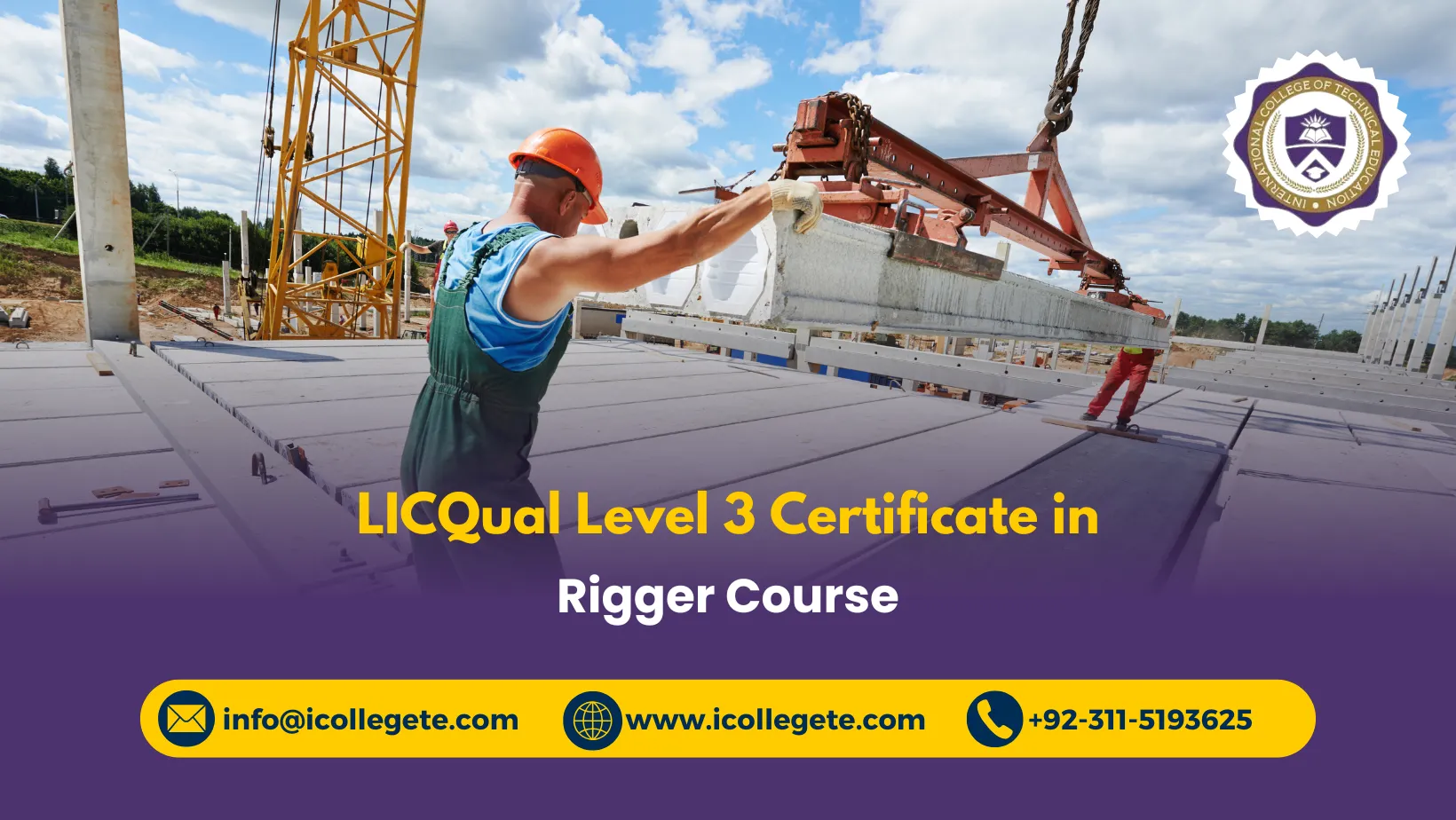
The LICQual Level 3 Certificate in Rigger Course in Pakistan is an advanced vocational qualification designed for individuals who want to strengthen their professional competence in rigging, lifting, load handling, equipment selection, and safe lifting operations. The course develops the technical knowledge and practical awareness required to work confidently with lifting accessories, rigging tools, cranes, hoists, and different types of loads in construction, manufacturing, logistics, oil and gas, engineering, and other industrial environments. LICQual describes its Level 3 Rigger qualification as focusing on advanced rigging techniques, equipment handling, load calculations, safety protocols, communication, and the coordination of lifting operations.
This Rigger Level 3 course in Pakistan emphasizes safe and systematic lifting practices rather than simply learning how to attach a load. Learners develop an understanding of load weight and distribution, lifting capacity, rigging configurations, equipment inspection, hazard identification, risk assessment, communication, and practical rigging procedures. Effective lift planning and competent rigging are particularly important because lifting operations can expose workers, equipment, and structures to significant risks when they are not properly planned and controlled.
Through theoretical learning and practical application, participants can build the competence needed to perform rigging activities responsibly, support lifting teams, and contribute to safer and more efficient lifting operations. The qualification is therefore suitable for experienced riggers and workers seeking to develop their technical skills and progress toward greater responsibilities within the lifting and rigging sector.
Course Study Units
The LICQual Level 3 Certificate in Rigger course covers the following seven study units:
Unit 1: Principles of Rigging and Lifting
This unit develops an advanced understanding of the principles behind safe rigging and lifting operations.
Key topics include:
- Fundamentals and terminology of rigging and lifting
- Roles and responsibilities of a professional rigger
- Types of lifting operations
- Load stability and balance
- Centre of gravity and centre of load
- Safe lifting principles
- Sling configurations and lifting arrangements
- Static and dynamic considerations
- Factors affecting lifting capacity
- Basic lift planning principles
- Safe positioning of loads
- Common rigging hazards
Learners will understand how fundamental rigging principles influence the safety, stability, and efficiency of lifting operations.
Unit 2: Rigging Equipment and Tools
This unit focuses on identifying, selecting, handling, and safely using rigging equipment and lifting accessories.
Key topics include:
- Wire-rope slings
- Chain slings
- Web and synthetic slings
- Shackles
- Hooks
- Eye bolts and lifting points
- Turnbuckles and connecting devices
- Spreader and lifting beams
- Hoists and winches
- Lifting accessories
- Equipment identification and markings
- Safe Working Load (SWL)
- Working Load Limit (WLL)
- Equipment selection based on lifting requirements
- Correct handling and storage of rigging equipment
Learners develop the ability to select appropriate rigging equipment according to the load, lifting arrangement, working environment, and operational requirements.
Unit 3: Load Calculations and Weight Estimation
Accurate load assessment is an essential part of safe rigging. This unit develops learners’ ability to assess loads before lifting operations.
Key topics include:
- Estimating load weight
- Understanding load dimensions
- Centre of gravity
- Load distribution
- Sling angles and their effect on loading
- Working Load Limit calculations
- Load capacity considerations
- Forces acting on lifting accessories
- Uneven and irregular loads
- Multi-leg sling arrangements
- Load stability
- Basic lifting calculations
- Preventing overload conditions
- Interpreting relevant equipment information and load data
Learners will understand why accurate weight estimation and load assessment are essential before selecting lifting equipment or commencing a lifting operation. Load calculation and centre-of-gravity knowledge are also commonly emphasized in professional rigger training.
Unit 4: Safety Standards and Risk Assessment
This unit focuses on controlling hazards associated with rigging and lifting activities.
Key topics include:
- Rigging and lifting hazards
- Hazard identification
- Risk assessment principles
- Control measures
- PPE requirements
- Exclusion zones
- Working near people and structures
- Environmental hazards
- Weather and visibility considerations
- Overhead hazards
- Suspended-load hazards
- Unsafe lifting practices
- Emergency procedures
- Incident prevention
- Safe systems of work
- Compliance with applicable workplace requirements and industry standards
Learners develop the ability to recognize foreseeable hazards, assess risks, and apply appropriate control measures before and during lifting activities.
Unit 5: Rigging Procedures and Techniques
This unit develops practical knowledge of rigging methods used to prepare, lift, move, position, and lower loads.
Key topics include:
- Pre-lift preparation
- Selecting suitable lifting accessories
- Slinging and securing loads
- Different sling arrangements
- Choke, vertical, and basket configurations
- Connecting loads to lifting equipment
- Load balancing
- Controlled lifting and lowering
- Tag lines and load control
- Positioning and landing loads
- Working with cranes and hoists
- Basic complex-lift considerations
- Safe removal of rigging equipment
- Post-lift procedures
The emphasis is on carrying out rigging procedures systematically while maintaining load control and protecting people, equipment, and surrounding structures.
Unit 6: Inspection and Maintenance of Rigging Gear
This unit teaches learners how to recognize equipment defects and support effective inspection and maintenance practices.
Key topics include:
- Pre-use inspection
- Routine inspection principles
- Identification of damaged slings
- Wire-rope defects
- Chain and hook damage
- Shackle inspection
- Deformation and excessive wear
- Corrosion
- Cuts, abrasion, and heat damage
- Damaged identification tags
- Equipment rejection criteria
- Cleaning and storage
- Maintenance records
- Quarantine of defective equipment
- Safe replacement of damaged lifting accessories
Learners will understand that lifting accessories must be inspected and maintained appropriately before being used for lifting operations.
Unit 7: Communication and Team Coordination
Effective communication is essential when multiple people are involved in a lifting operation. This unit develops the teamwork and communication skills required for coordinated rigging activities.
Key topics include:
- Roles within a lifting team
- Rigger and crane operator coordination
- Standard hand signals
- Radio communication
- Pre-lift briefings
- Clear lifting instructions
- Communication during blind lifts
- Confirmation of instructions
- Stop-work signals
- Team responsibilities
- Coordination during load movement
- Reporting unsafe conditions
- Emergency communication
- Maintaining situational awareness
Learners will develop the ability to communicate clearly and coordinate with operators, supervisors, banksmen, and other members of the lifting team.
Unit 8: Practical Rigging Applications
This unit brings together the knowledge and skills developed throughout the qualification through practical and scenario-based applications.
Practical areas may include:
- Equipment identification
- Rigging gear selection
- Pre-use inspection
- Load assessment
- Sling selection
- Load attachment
- Load balancing
- Basic lifting operations
- Controlled movement of loads
- Communication with lifting teams
- Hazard identification
- Risk-control implementation
- Safe positioning and landing
- Removal and storage of rigging equipment
- Practical problem-solving
Learners are encouraged to apply theoretical principles to realistic workplace situations and demonstrate safe working practices.
Learning Outcomes
On successful completion of the LICQual Level 3 Certificate in Rigger Course in Pakistan, learners should be able to:
- Explain advanced principles of rigging and lifting and their application in workplace operations.
- Identify different types of rigging equipment, lifting accessories, and associated tools.
- Select appropriate rigging equipment according to load characteristics and lifting requirements.
- Understand SWL, WLL, load distribution, sling angles, and centre of gravity.
- Perform appropriate load weight estimation and basic rigging calculations.
- Identify hazards associated with lifting and rigging operations.
- Conduct or contribute to suitable risk assessments and implement control measures.
- Apply safe rigging procedures for attaching, lifting, moving, positioning, and lowering loads.
- Demonstrate appropriate use of slings, shackles, hooks, lifting points, and related equipment.
- Inspect rigging gear for visible damage, defects, wear, corrosion, and other unsafe conditions.
- Understand appropriate maintenance, storage, quarantine, and replacement practices for lifting accessories.
- Use standard communication methods and signals during lifting operations.
- Coordinate effectively with crane operators, supervisors, banksmen, and other lifting personnel.
- Apply safe working practices during practical rigging activities.
- Recognize situations where a lifting operation should be stopped or reassessed.
- Contribute to safer, more organized, and efficient lifting operations in industrial environments.
These learning areas are consistent with the broader competencies associated with Level 3 professional rigger training, including equipment competence, load assessment, risk management, communication, and practical rigging skills.
Course Benefits
The LICQual Level 3 Certificate in Rigger can provide learners with several professional and practical benefits:
1. Develop Advanced Rigging Knowledge
Build stronger knowledge of rigging principles, lifting equipment, load management, and safe lifting practices.
2. Improve Workplace Safety
Develop the ability to identify lifting hazards, assess risks, and apply appropriate safety controls.
3. Strengthen Load-Handling Skills
Improve understanding of load weight, centre of gravity, load distribution, sling angles, and lifting capacity.
4. Improve Equipment Selection
Learn how different slings, shackles, hooks, beams, hoists, and other accessories are selected according to operational requirements.
5. Build Practical Competence
Connect classroom knowledge with realistic rigging applications and workplace scenarios.
6. Improve Communication Skills
Develop more effective communication and coordination with crane operators, lifting supervisors, banksmen, and rigging teams.
7. Support Career Development
A Level 3 qualification can strengthen a learner’s professional profile when applying for or developing within rigging and lifting roles.
8. Support Work Across Industrial Sectors
Rigging skills can be relevant to construction, manufacturing, engineering, logistics, warehouses, oil and gas, shipyards, infrastructure, and other industries involving lifting operations.
9. Develop Professional Confidence
Learners gain a more structured understanding of how to approach lifting activities safely and systematically.
Who Is This Course For?
The LICQual Level 3 Certificate in Rigger Course in Pakistan is suitable for:
- Experienced riggers seeking Level 3 certification
- Rigger Level 2 holders seeking to strengthen their skills
- Construction workers involved in lifting operations
- Lifting and rigging personnel
- Crane and lifting support personnel
- Banksmen and signalers seeking broader rigging knowledge
- Industrial workers involved in load handling
- Warehouse and logistics personnel involved in lifting activities
- Oil and gas industry workers
- Mechanical and engineering workers
- Maintenance personnel involved in lifting equipment
- Supervisors supporting rigging activities
- Individuals seeking career development in lifting and rigging
For a Level 3 programme, previous rigging experience or Level 2 knowledge can be beneficial because learners are expected to build on existing lifting and rigging competence. Requirements can vary by approved training provider, so candidates should confirm the applicable entry criteria before enrolment. Current Pakistan-based course information commonly recommends prior rigging experience or Level 2 training for Level 3 study.
Why Choose LICQual Level 3 Certificate in Rigger?
Industry-Relevant Rigging Skills
The course focuses on practical areas that matter in real lifting environments, including equipment selection, load assessment, risk control, rigging procedures, inspection, communication, and practical applications.
Safety-Focused Learning
Rigging is a safety-critical activity. The course helps learners understand why lifting operations need appropriate planning, competent personnel, suitable equipment, and effective risk controls.
Practical and Technical Development
Rather than focusing only on theory, the qualification supports the development of practical rigging knowledge alongside technical understanding.
Suitable for Pakistan’s Industrial Workforce
The qualification can be relevant to workers seeking opportunities in Pakistan’s construction, engineering, manufacturing, logistics, infrastructure, and industrial sectors, as well as professionals seeking experience applicable to international work environments.
Career-Focused Qualification
Level 3 study can help experienced riggers demonstrate a higher level of knowledge and competence and prepare for positions involving greater responsibility.
Comprehensive Coverage
The course covers the complete lifting process—from understanding the load and selecting equipment to conducting inspections, communicating with the team, applying rigging techniques, and safely completing the operation.
Future Progression of the Course
After completing the LICQual Level 3 Certificate in Rigger, learners can continue developing their professional careers by gaining additional workplace experience and undertaking specialized training relevant to their intended sector.
Potential future development areas include:
- Advanced rigging and lifting operations
- Crane and hoist operations
- Lifting supervision
- Lift planning
- Appointed Person training
- Banksman/Slinger or Signalman training
- Lifting equipment inspection
- Health and safety qualifications
- Construction safety management
- Oil and gas lifting operations
- Heavy-lift and specialized lifting activities
- Rigging team leadership and supervision
The next stage of professional development will depend on the learner’s experience, employer requirements, sector, and the specific competency or certification required for a particular role. Advanced rigger programmes commonly extend into complex lifting, project planning, supervision, communication systems, and specialized equipment
Take the Next Step Toward World LICQual Level 3 Certificate in Rigger Course-Enroll Now