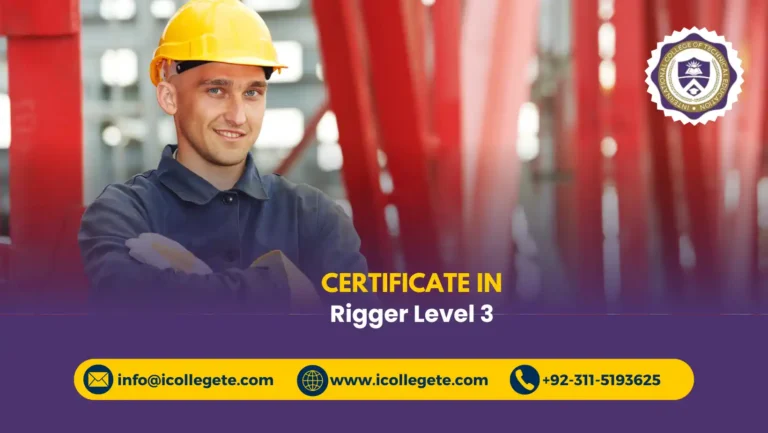
The LICQual Level 2 Diploma in Rigger Course in Pakistan is designed to develop the intermediate technical knowledge, practical competence, and safety awareness required to support and perform professional rigging and lifting operations across construction, manufacturing, oil and gas, logistics, engineering, marine, and other industrial environments. The course builds upon fundamental rigging knowledge and focuses on the controlled handling, positioning, securing, and movement of loads using appropriate lifting equipment and rigging techniques.
Learners develop a stronger understanding of rigging equipment selection, load calculations, load distribution, sling configurations, lifting procedures, inspection requirements, risk management, communication, and practical rigging applications. Particular emphasis is placed on identifying hazards before lifting, understanding load stability and centre of gravity, selecting suitable rigging gear, and coordinating safely with crane operators, banksmen, supervisors, and other members of the lifting team.
The qualification also supports the development of workplace competence by connecting theoretical principles with realistic industrial scenarios. Learners are encouraged to apply safe systems of work, follow lifting plans and organisational procedures, communicate clearly during lifting activities, and recognise when equipment or conditions are unsuitable for a lift. These competencies reflect the importance of competent rigging personnel in preventing dropped loads, equipment failure, struck-by incidents, and other lifting-related hazards.
Course Study Units
Unit 1: Intermediate Principles of Rigging and Lifting
This unit develops learners’ understanding of intermediate rigging principles and safe lifting practices. Learners explore the relationship between lifting equipment, load characteristics, rigging configurations, and lifting conditions.
Key topics include:
- Principles of intermediate rigging operations
- Roles and responsibilities of a professional rigger
- Types of lifting operations
- Load stability and balance
- Centre of gravity
- Working Load Limit (WLL) and Safe Working Load (SWL)
- Sling configurations and hitch types
- Basic mechanical advantage
- Tag lines and load-control techniques
- Factors affecting lifting capacity
- Preparation for lifting operations
- Safe positioning of personnel around suspended loads
Unit 2: Rigging Equipment and Tools – Advanced Usage
This unit focuses on the correct selection, handling, application, and limitations of rigging equipment used during industrial lifting operations.
Key topics include:
- Wire-rope slings
- Chain slings
- Web and round slings
- Shackles
- Hooks
- Eye bolts and lifting points
- Turnbuckles and connecting hardware
- Spreader beams and lifting beams
- Clamps and other lifting accessories
- Tag lines and load-control equipment
- Equipment identification and markings
- Correct equipment selection
- Understanding equipment capacity
- Safe handling and storage of rigging equipment
- Common equipment misuse and failure causes
Unit 3: Load Calculations and Distribution Techniques
This unit develops the mathematical and practical skills required to understand load weight, load distribution, lifting angles, and stability.
Key topics include:
- Estimating and determining load weight
- Centre-of-gravity calculations
- Load distribution
- Sling-angle considerations
- Tension in multi-leg slings
- Effect of lifting-point positions
- Uneven and off-centre loads
- Load stability
- Selection of suitable lifting points
- Capacity limitations
- Basic rigging calculations
- Preventing overload conditions
- Practical load-control techniques
Understanding load weight, centre of gravity, sling angles, and lifting-point arrangements is an important component of competent rigging practice.
Unit 4: Safety Standards and Risk Management
This unit develops learners’ ability to identify hazards, assess risks, and apply appropriate control measures before and during lifting operations.
Key topics include:
- Rigging and lifting hazards
- Risk assessment principles
- Job Safety Analysis (JSA)
- Method statements and lifting plans
- Hierarchy of controls
- Exclusion zones
- Suspended-load hazards
- Crush and pinch points
- Falling-object hazards
- Environmental conditions
- Ground and workspace conditions
- Personal Protective Equipment (PPE)
- Emergency procedures
- Unsafe lifting practices
- Stop-work responsibilities
- Safety communication and reporting
Safe lifting operations should be properly planned, supervised, and carried out by competent personnel, with appropriate attention to load limits, signalling, and exclusion from suspended loads.
Unit 5: Rigging Procedures for Complex Operations
This unit introduces learners to more demanding rigging scenarios where careful planning, equipment selection, communication, and load control are required.
Key topics include:
- Planning complex lifting activities
- Multi-point lifting
- Multiple-sling configurations
- Tandem or coordinated lifting concepts
- Long and awkward loads
- Irregularly shaped loads
- Restricted-area lifting
- Controlled positioning of loads
- Use of tag lines
- Spreader and lifting beams
- Pre-lift checks
- Lift-path assessment
- Coordination with crane operators
- Communication during critical lifting activities
- Emergency response during lifting operations
The emphasis is on understanding the planning and control requirements of complex operations rather than treating every lift as a routine task.
Unit 6: Inspection and Maintenance of Rigging Gear
This unit develops the competence required to identify defects and determine whether rigging equipment remains suitable for use.
Key topics include:
- Pre-use inspection
- Routine inspection procedures
- Wire-rope inspection
- Chain-sling inspection
- Synthetic-sling inspection
- Shackle and hook inspection
- Identification of deformation
- Corrosion and excessive wear
- Cuts, abrasion, kinks, broken wires, and other defects
- Damaged identification tags
- Equipment rejection criteria
- Quarantine procedures
- Cleaning and storage
- Maintenance records
- Inspection documentation
- Safe removal of defective equipment from service
Inspection and maintenance are essential because damaged or unsuitable lifting gear can compromise the entire lifting operation. LICQual’s existing Level 2 rigger qualification framework also identifies equipment inspection as a core area of competence.
Unit 7: Team Coordination and Communication Skills
Effective communication is critical because rigging operations commonly involve several people working together around cranes, lifting equipment, loads, and exclusion zones.
Key topics include:
- Rigger and crane-operator coordination
- Banksman/slinger communication
- Standard hand signals
- Radio communication
- Clear and concise instructions
- Communication protocols
- Confirmation of instructions
- Roles within a lifting team
- Coordination with supervisors
- Communication during blind lifts
- Emergency communication
- Reporting unsafe conditions
- Stop-work communication
- Teamwork and situational awareness
Learners develop the ability to communicate accurately and consistently so that lifting movements can be coordinated safely and efficiently.
Unit 8: Practical Rigging Applications in Industry
This unit provides an opportunity to apply theoretical knowledge to realistic rigging and lifting situations.
Practical areas may include:
- Pre-lift equipment checks
- Selection of appropriate rigging gear
- Slinging and securing loads
- Correct hitch selection
- Load balancing
- Application of tag lines
- Basic load-control operations
- Communication with crane operators
- Establishment of exclusion zones
- Load positioning
- Post-lift inspection
- Safe dismantling of rigging arrangements
- Equipment storage
- Documentation and reporting
- Practical lifting scenarios and workplace case studies
The practical emphasis helps learners connect technical knowledge with the realities of industrial lifting environments.
Learning Outcomes
Upon successful completion of the LICQual Level 2 Diploma in Rigger Course in Pakistan, learners should be able to:
- Explain intermediate principles of rigging and lifting and apply them to workplace activities.
- Identify appropriate rigging equipment for different load characteristics and lifting requirements.
- Use slings, shackles, hooks, lifting points, and associated rigging equipment correctly.
- Interpret WLL/SWL information and recognise equipment capacity limitations.
- Calculate or estimate load weight and understand centre-of-gravity considerations.
- Apply basic load-distribution and sling-angle principles to lifting arrangements.
- Identify hazards associated with rigging and lifting operations.
- Participate effectively in risk assessments, lift planning, and pre-lift safety checks.
- Apply appropriate control measures for suspended loads, exclusion zones, pinch points, and other hazards.
- Understand procedures for more complex or non-routine lifting operations.
- Conduct appropriate pre-use and routine inspections of rigging equipment.
- Recognise defects, damage, wear, deformation, and other conditions that may make equipment unsafe.
- Apply appropriate procedures for reporting, quarantining, and removing defective rigging gear.
- Communicate effectively with crane operators, banksmen, supervisors, and other lifting personnel.
- Use appropriate hand signals and radio communication principles.
- Coordinate rigging activities as part of a lifting team.
- Apply safe rigging techniques during practical workplace scenarios.
- Demonstrate an appropriate safety-first approach to industrial lifting operations.
Course Benefits
The LICQual Level 2 Diploma in Rigger Course in Pakistan can provide learners with several professional and workplace benefits:
1. Develops Intermediate Rigging Competence
The course builds beyond basic awareness and develops practical understanding of equipment, loads, lifting procedures, and workplace controls.
2. Strengthens Lifting Safety Knowledge
Learners develop greater awareness of hazards such as suspended loads, equipment failure, unstable loads, poor communication, and incorrect rigging configurations.
3. Improves Equipment Selection Skills
Learners understand how to select appropriate slings, shackles, hooks, lifting points, and other accessories according to the lifting task.
4. Builds Load-Calculation Awareness
Understanding load weight, centre of gravity, sling angles, and load distribution helps learners make safer decisions during lifting preparation.
5. Enhances Inspection Skills
The course develops the ability to recognise visible defects and understand the importance of removing unsuitable lifting equipment from service.
6. Improves Workplace Communication
Effective communication between riggers, crane operators, banksmen, supervisors, and other workers is reinforced throughout the course.
7. Supports Safer Industrial Operations
Competent rigging practices can contribute to improved control of lifting activities and reduction of preventable lifting-related incidents.
8. Supports Career Development
The qualification can strengthen a learner’s professional profile when applying for rigging and lifting-related roles in construction, engineering, manufacturing, logistics, energy, and other industrial sectors.
9. Develops Practical Confidence
By connecting theory with practical rigging applications, learners can become more confident in preparing, securing, controlling, and positioning loads safely.
Who Is This Course For?
The LICQual Level 2 Diploma in Rigger Course in Pakistan is suitable for individuals who want to develop intermediate knowledge and practical skills in rigging and lifting operations.
It may be particularly suitable for:
- Aspiring professional riggers
- Existing riggers seeking structured Level 2 training
- Construction workers
- Lifting and rigging assistants
- Banksmen and signalers
- Crane-support personnel
- Mechanical workers
- Industrial maintenance workers
- Warehouse and logistics personnel
- Oil and gas workers
- Manufacturing workers
- Marine and shipyard personnel
- Engineering-sector workers
- Site safety personnel involved in lifting operations
- Workers seeking to formalise existing rigging experience
Learners with previous exposure to rigging, lifting, construction, mechanical work, or a related technical environment may find the intermediate content particularly relevant. Some Pakistan-based course providers recommend previous rigging experience or Level 1 training for Level 2 study.
Why Choose LICQual Level 2 Diploma in Rigger Course in Pakistan?
Industry-Relevant Rigging Knowledge
The course focuses on practical areas that matter in real lifting environments, including equipment selection, load control, inspection, safety, communication, and practical rigging.
Strong Safety Focus
Rigging is a high-responsibility activity where incorrect equipment selection, poor communication, inadequate planning, or improper load control can create serious risks. This qualification places safety and risk management at the centre of learning.
Practical and Technical Development
Learners are not limited to terminology. They develop knowledge that can be applied to equipment inspection, load preparation, lifting arrangements, communication, and practical workplace scenarios.
Load Management Skills
A strong understanding of weight, centre of gravity, sling angles, and load distribution is essential for safer lifting. The course specifically develops these areas.
Equipment Inspection Awareness
Learners gain structured knowledge of inspecting lifting accessories and recognising defects before equipment is used.
Communication and Teamwork
Safe lifting depends on coordinated teamwork. Learners develop communication skills for working with crane operators, supervisors, banksmen, and other members of the lifting team.
Relevant to Multiple Industries
Rigging skills can be relevant across construction, oil and gas, manufacturing, logistics, engineering, marine operations, shipyards, warehouses, and industrial maintenance.
Professional Development
The qualification can help learners strengthen their technical profile and prepare for greater responsibility within lifting and rigging environments.
Future Progression of LICQual Level 2 Diploma in Rigger
After completing the LICQual Level 2 Diploma in Rigger, learners can continue developing their professional knowledge through additional specialist training and higher-level responsibilities within lifting and rigging environments.
Potential areas for future professional development include:
- Advanced rigging and lifting operations
- Crane and lifting equipment operations
- Banksman and slinger/signaler training
- Lifting supervision
- Lift planning
- Appointed Person-related training
- Lifting equipment inspection
- Advanced health and safety qualifications
- Construction safety management
- Industrial safety management
- Oil and gas lifting and rigging specialisation
- Offshore lifting operations
- Marine and shipyard lifting operations
Learners may also seek roles with increasing responsibility, depending on their practical competence, workplace experience, employer requirements, and any additional certifications required for specific equipment or lifting activities.
For example, LICQual’s broader professional rigger offerings include areas such as advanced rigging techniques, high-risk environments, inspection, maintenance, and regulatory compliance, demonstrating how rigging competence can develop into broader professional specialisation.
Take the Next Step Toward World LICQual Level 2 Diploma in Rigger Course-Enroll Now