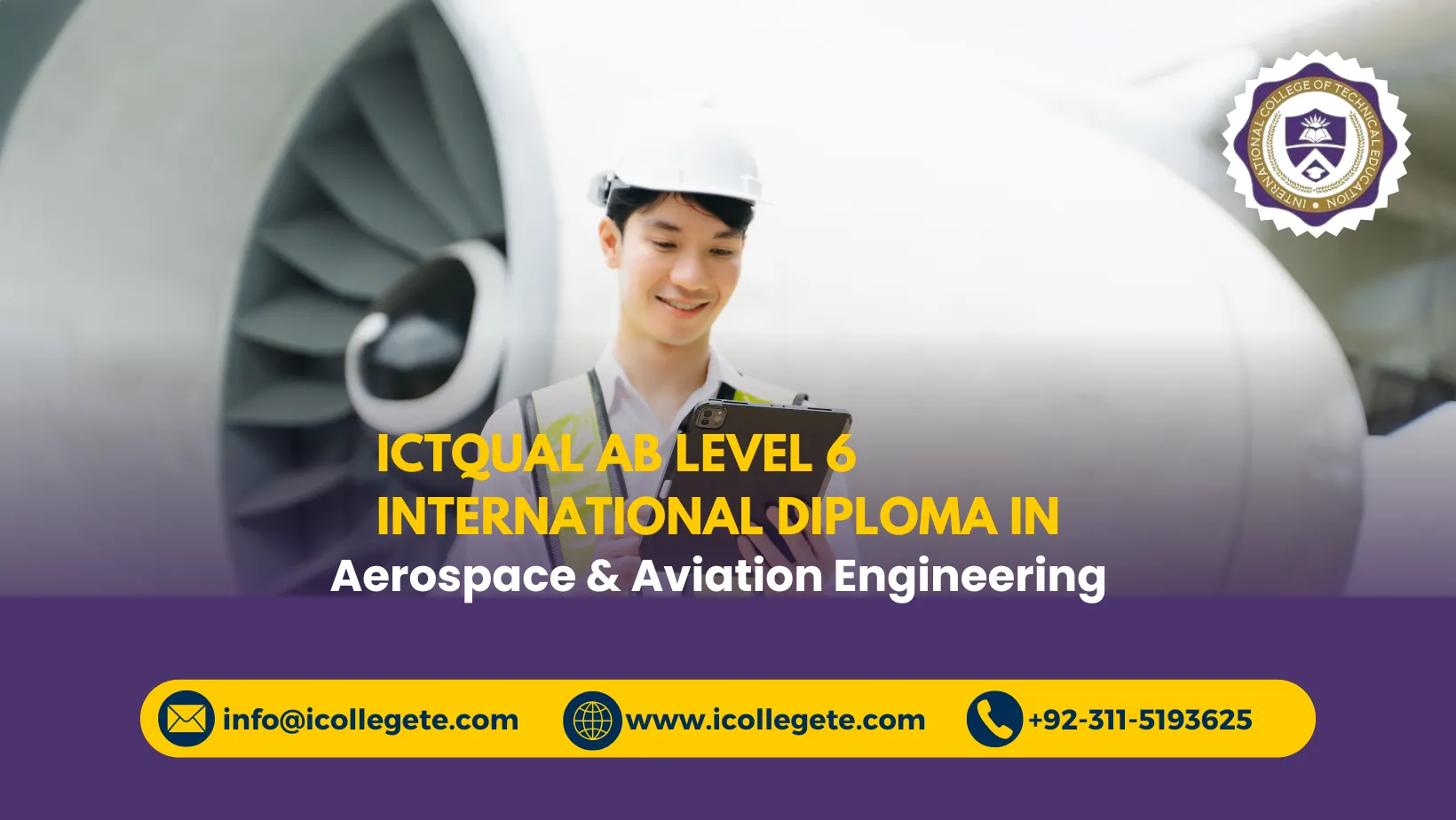
The ICTQual AB Level 6 International Diploma in Aerospace & Aviation Engineering is a prestigious and internationally recognized qualification designed for learners aspiring to build professional careers in the aviation and aerospace industry. This comprehensive program focuses on the principles, technologies, and practices that drive modern aviation, encompassing aircraft design, aerodynamics, propulsion systems, maintenance, and safety management. Graduates emerge with advanced technical expertise alongside strong problem-solving and analytical skills required to excel in one of the world’s most competitive and technologically advanced sectors.
The curriculum provides an in-depth understanding of aerospace engineering fundamentals including aircraft structures, materials science, aerodynamics, avionics, and propulsion systems. Learners also explore aviation operations, international regulations, and global safety standards that govern the industry. Additionally, the course highlights the critical importance of sustainability and innovation in aerospace, ensuring graduates are well-prepared to meet the evolving challenges and technological advancements shaping the future of aviation.
This diploma is ideal for learners aiming to join the global workforce in aircraft manufacturing, airlines, airport operations, aerospace research, or defense and space exploration. By combining academic theory with practical applications, the program ensures graduates can address real-world engineering problems and contribute meaningfully to aerospace advancements. Upon completion, learners develop strong technical and managerial skills while gaining access to global career opportunities and academic progression pathways, making this qualification a valuable stepping stone to higher-level studies and leadership roles in aerospace and aviation engineering.
Year 1 – Foundation in Aerospace & Aviation Engineering
- Principles of Aerospace and Aviation Engineering
- Engineering Mathematics
- Fundamentals of Mechanical and Electrical Engineering
- Materials Science and Engineering
- Engineering Drawing and Computer-Aided Design (CAD)
- Introduction to Aerodynamics and Flight Mechanics
- Basics of Propulsion Systems
- Aircraft Structures – Fundamentals
- Avionics and Electrical Systems – Basics
- Health, Safety, and Environmental Practices in Aviation
- Communication and Technical Report Writing
- Introduction to Project Management in Engineering
Year 2 – Intermediate Studies in Aerospace & Aviation Engineering
- Aerodynamics and Fluid Dynamics – Applications
- Propulsion Systems and Gas Turbine Engines
- Aircraft Structural Analysis and Design
- Avionics and Navigation Systems
- Flight Mechanics and Performance Analysis
- Aerospace Materials and Manufacturing Processes
- Aircraft Maintenance and Reliability Engineering
- Systems Engineering in Aerospace Projects
- Unmanned Aerial Vehicles (UAV) – Fundamentals
- Sustainable Aviation and Green Technologies
- Applied Research Methods in Aerospace Engineering
- Project Planning and Aviation Operations Management
Year 3 – Advanced Studies in Aerospace & Aviation Engineering
- Final Year Major Project (Capstone Project)
- Advanced Aerodynamics and Computational Fluid Dynamics (CFD)
- Advanced Propulsion and Rocket Systems
- Advanced Structural Analysis and Composite Materials
- Flight Control Systems and Automation
- Space Systems Engineering and Satellite Technology
- Robotics and Autonomous Systems in Aviation
- Smart Aviation Technologies and Industry 4.0
- Aviation Safety, Risk, and Quality Management
- Cyber-Physical Systems and IoT in Aerospace Engineering
- Professional Ethics and Sustainability in Aerospace Engineering
- Innovation, Entrepreneurship, and Aviation Business Development
- Apply advanced principles of aerospace and aviation engineering
- Analyze and design aircraft structures, propulsion systems, and avionics
- Understand and apply aerodynamics and flight mechanics
- Perform aircraft maintenance and safety checks according to international standards
- Demonstrate knowledge of aviation laws, regulations, and compliance requirements
- Use engineering software and modern tools in aerospace applications
- Assess and implement sustainable practices in aviation engineering
- Develop leadership and project management skills for aviation projects
- Contribute to innovation and research in aerospace and aviation industries
- Enhance global employability and professional competence
- Internationally recognized qualification in aerospace and aviation engineering
- Enhances career prospects in the global aviation and aerospace industries
- Provides advanced knowledge of aircraft design, systems, and maintenance
- Builds strong analytical, problem-solving, and technical skills
- Offers practical insights into aviation safety, laws, and regulations
- Opens opportunities in both civil and defense aviation sectors
- Prepares learners for leadership roles and advanced academic progression
- Aerospace and aviation graduates: Individuals with academic backgrounds in aerospace engineering, aviation technology, or related disciplines who want to advance their expertise and career prospects.
- Aspiring aerospace engineers and aviation specialists: Students and recent graduates seeking specialized training in aircraft design, propulsion systems, avionics, aerodynamics, and aerospace materials.
- Industry professionals: Employees working in airlines, aircraft manufacturing, maintenance, defense, or aerospace research organizations who wish to strengthen their technical and managerial skills.
- Career changers: Professionals from allied engineering, mechanical, or industrial fields aiming to transition into aerospace and aviation engineering.
- International learners: Those pursuing globally recognized qualifications to access career opportunities in aviation companies, aerospace industries, defense organizations, and research institutions worldwide.