
Hybrid Car Technology: How Hybrid Vehicles Work, Benefits, Skills and Career Opportunities
Hybrid car technology has become an important part of the modern automotive industry as vehicle manufacturers continue developing cleaner, more efficient, and technologically advanced transportation systems. Hybrid vehicles combine two different sources of propulsion, normally an internal combustion engine and an electric motor, to deliver efficient vehicle performance while reducing fuel consumption and emissions.
The growing use of hybrid vehicles has also created demand for automotive professionals who understand hybrid powertrains, high-voltage electrical systems, battery technology, electronic control units, diagnostic equipment, and safe maintenance procedures. This has increased interest in Hybrid Car Technology courses among automotive technicians, mechanics, electricians, engineering learners, and individuals seeking specialised automotive skills.
Unlike conventional vehicles, hybrid vehicles require an understanding of both mechanical and electrical systems. A technician working with hybrid vehicles may need to understand how electric motors interact with combustion engines, how regenerative braking recovers energy, how battery management systems operate, and how electronic control systems determine the appropriate power source.
This guide explains how hybrid vehicles work, their main components, benefits, required technical skills, maintenance considerations, training opportunities, and potential career paths. It provides a practical starting point for learners interested in developing knowledge and skills in hybrid vehicle technology.
What Is Hybrid Car Technology?
Hybrid car technology refers to the integration of an internal combustion engine with one or more electric propulsion systems within a vehicle. The objective is to use each power source effectively according to driving conditions.
In a conventional vehicle, the internal combustion engine generally provides the primary source of propulsion. In a hybrid vehicle, the electric motor can assist the engine, provide propulsion independently in certain operating conditions, or support specific functions such as acceleration.
The hybrid system is controlled electronically so that the vehicle can determine how and when power should be delivered. Depending on the vehicle design, the engine and electric motor can operate separately or together.
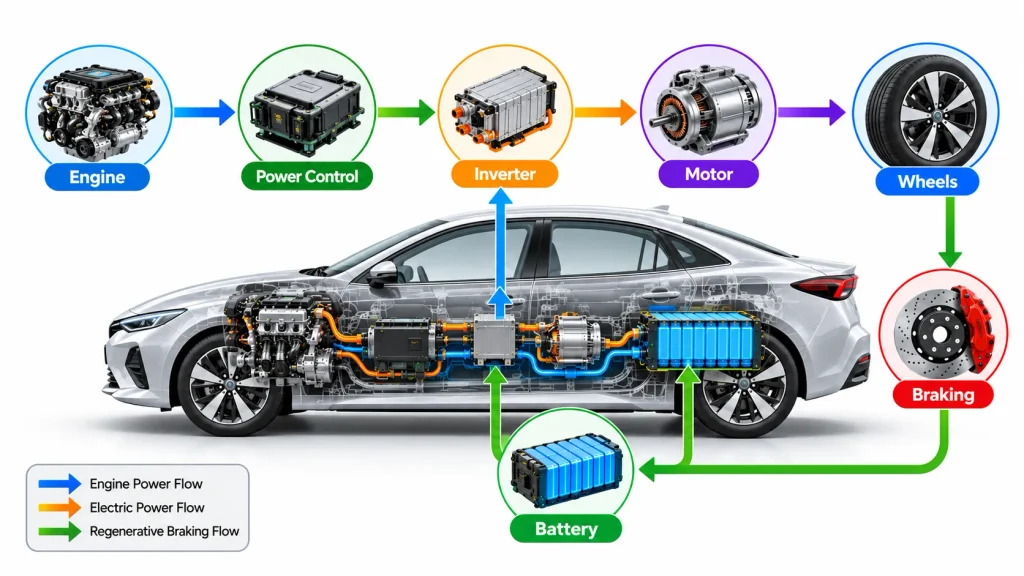
A typical hybrid system includes:
- Internal combustion engine
- Electric motor
- High-voltage battery
- Inverter
- DC-DC converter
- Battery management system
- Hybrid control unit
- Regenerative braking system
- Transmission or power-split mechanism
- High-voltage cabling
- Sensors and electronic control systems
Understanding the interaction between these components is fundamental to hybrid vehicle servicing and diagnostics.
How Do Hybrid Vehicles Work?
A hybrid vehicle continuously manages energy between the engine, electric motor, battery, and wheels. The exact operating strategy varies according to the hybrid architecture and manufacturer.
During different driving conditions, the vehicle may use electric propulsion, engine propulsion, or a combination of both.
Starting and Low-Speed Operation
Some full hybrid vehicles can begin moving using electric power under suitable conditions. The electric motor receives energy from the high-voltage battery and produces torque to move the vehicle.
This can reduce the need to operate the combustion engine during certain low-load conditions.
Acceleration
During acceleration, the electric motor can provide additional torque. The engine may also operate at the same time.
Electric motor assistance can reduce the amount of work required from the combustion engine during demanding driving conditions.
Cruising
During steady-speed driving, the control system determines the most appropriate operating strategy. Depending on vehicle design, the engine may provide most of the propulsion while the electric system provides assistance or manages battery charging.
Deceleration and Braking
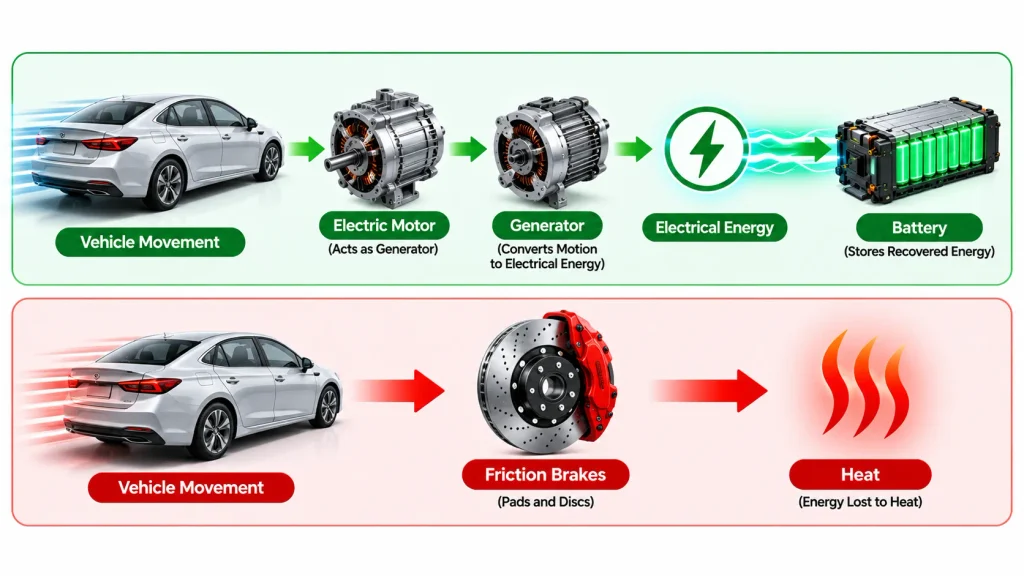
One of the important characteristics of hybrid vehicles is regenerative braking.
When the vehicle slows down, the electric motor can operate as a generator. Some of the vehicle’s kinetic energy is converted into electrical energy and transferred back to the high-voltage battery.
This process helps recover energy that would otherwise largely be dissipated as heat through conventional friction braking.
Stopping
When the vehicle stops, the combustion engine may shut down automatically where operating conditions permit.
This reduces unnecessary idling and can improve fuel efficiency.
Main Types of Hybrid Vehicles
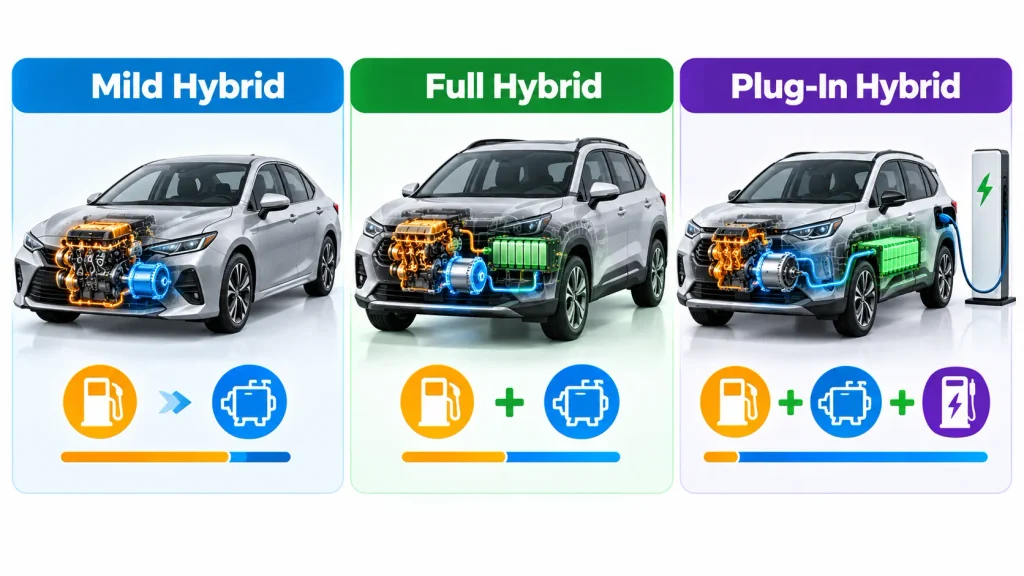
Hybrid vehicles are available in different configurations. Understanding these configurations is important for technicians because their systems, components, operating strategies, and servicing requirements can differ.
Mild Hybrid Vehicles
A mild hybrid system normally uses a smaller electric motor and battery system to assist the combustion engine.
The electric system can support functions such as engine starting, acceleration assistance, and energy recovery.
Unlike many full hybrid systems, a mild hybrid vehicle generally cannot propel the vehicle using electric power alone for normal driving.
Full Hybrid Vehicles
A full hybrid vehicle can typically operate using the combustion engine, electric motor, or both, depending on operating conditions.
The electric motor can provide propulsion at suitable speeds and loads, while the combustion engine can operate when greater power or sustained propulsion is required.
Full hybrid systems use sophisticated control strategies to manage energy flow and vehicle performance.
Plug-In Hybrid Vehicles
Plug-in hybrid vehicles, commonly called PHEVs, contain a larger battery that can be charged using an external electrical supply.
A plug-in hybrid can generally travel a greater distance using electric propulsion than a conventional full hybrid before the combustion engine becomes necessary.
PHEVs therefore combine characteristics of battery-electric operation with the extended driving capability provided by an internal combustion engine.
Key Components of Hybrid Vehicles
Hybrid vehicles combine mechanical, electrical, and electronic systems to deliver efficient propulsion. Understanding the main components helps learners understand how hybrid vehicles operate and how their systems are maintained.
Internal Combustion Engine
The internal combustion engine remains an important power source in many hybrid vehicles. However, unlike a conventional vehicle, the hybrid control system decides when the engine should start, stop, or work alongside the electric motor.
The engine may switch off during certain low-demand conditions and restart when additional power is required. This controlled operation can help improve fuel efficiency.
Electric Motor
The electric motor converts electrical energy from the battery into mechanical energy to help move the vehicle. Depending on the hybrid design, it can assist the engine or provide electric propulsion on its own.
During regenerative braking, the motor can also work as a generator to recover energy and send it back to the battery.
High-Voltage Battery
The high-voltage battery stores electrical energy used by the electric motor and other hybrid systems. It operates at much higher voltage levels than the conventional 12-volt vehicle battery.
Battery temperature, state of charge, condition, and electrical integrity are important for safe and reliable hybrid vehicle operation.
Inverter
The inverter manages electrical energy between the high-voltage battery and electric motor. It converts the battery’s DC electrical energy into the form required by the motor.
During regenerative braking, it also helps manage the electrical energy generated by the motor before it is stored in the battery.
DC-DC Converter
The DC-DC converter reduces high-voltage electrical energy to a lower voltage suitable for the vehicle’s conventional electrical systems.
It can support systems such as lighting, control modules, instruments, and the low-voltage battery.
Battery Management System
The Battery Management System monitors important battery conditions to support safe and efficient operation.
It can monitor:
- Battery voltage
- Temperature
- Current
- State of charge
- Battery condition
- Fault conditions
Hybrid Control Unit
The Hybrid Control Unit coordinates the major hybrid systems. It uses information from sensors and other control units to determine when the engine, electric motor, battery, and regenerative braking system should operate.
This helps manage power delivery and energy use according to driving conditions.
Regenerative Braking System
Regenerative braking recovers some of the vehicle’s kinetic energy during deceleration. The electric motor operates as a generator, converting movement into electrical energy that can be stored in the high-voltage battery.
This helps reduce energy losses during braking.
High-Voltage Cables
High-voltage cables connect major hybrid components such as the battery, inverter, and electric motor. They require suitable insulation, protection, identification, and safe handling because they can carry hazardous electrical energy.
Proper training and manufacturer-approved safety procedures are essential when working with high-voltage systems.
What Are the Benefits of Hybrid Vehicles?
Hybrid vehicles can provide several benefits depending on their design, operating environment, driving conditions, and maintenance condition.
Improved Fuel Efficiency
One major benefit is the potential for reduced fuel consumption.
Electric motor assistance, engine stop-start operation, regenerative braking, and efficient power management can reduce the amount of fuel required under suitable driving conditions.
Reduced Tailpipe Emissions
Using electric propulsion and improving engine operating efficiency can reduce tailpipe emissions compared with some conventional vehicles.
The actual environmental benefit varies according to vehicle type, driving pattern, energy source, and other factors.
Energy Recovery
Regenerative braking allows part of the vehicle’s kinetic energy to be recovered rather than losing all of it through friction braking.
This recovered energy can subsequently be used for electric propulsion.
Smooth Power Delivery
Electric motors can produce torque quickly, which can contribute to smooth acceleration and responsive vehicle operation.
Reduced Engine Idling
Hybrid control systems can automatically stop the combustion engine during selected operating conditions.
This can reduce unnecessary fuel consumption during stationary periods.
Technological Development
Hybrid vehicles incorporate advanced electrical, electronic, mechanical, and software-based systems.
This creates opportunities for automotive professionals to develop specialised technical skills.
What Skills Are Required for Hybrid Car Technology?
Hybrid vehicle technicians need a combination of traditional automotive knowledge and modern electrical and electronic skills.
Important skills include:
- Automotive mechanical fundamentals
- Electrical circuit understanding
- Electronic system diagnosis
- High-voltage safety awareness
- Battery system knowledge
- Electric motor fundamentals
- Hybrid powertrain operation
- Diagnostic equipment operation
- Fault-code interpretation
- Wiring diagram analysis
- Sensor testing
- Preventive maintenance
- Safe isolation procedures
- Technical documentation
- Problem-solving
- Risk assessment
A successful hybrid technician must understand not only individual components but also how those components interact as a complete vehicle system.
Why is High-Voltage Safety Important?
High-voltage systems are one of the most important areas of hybrid vehicle training.
Hybrid traction batteries and associated components can contain hazardous electrical energy even when the vehicle’s engine is switched off.
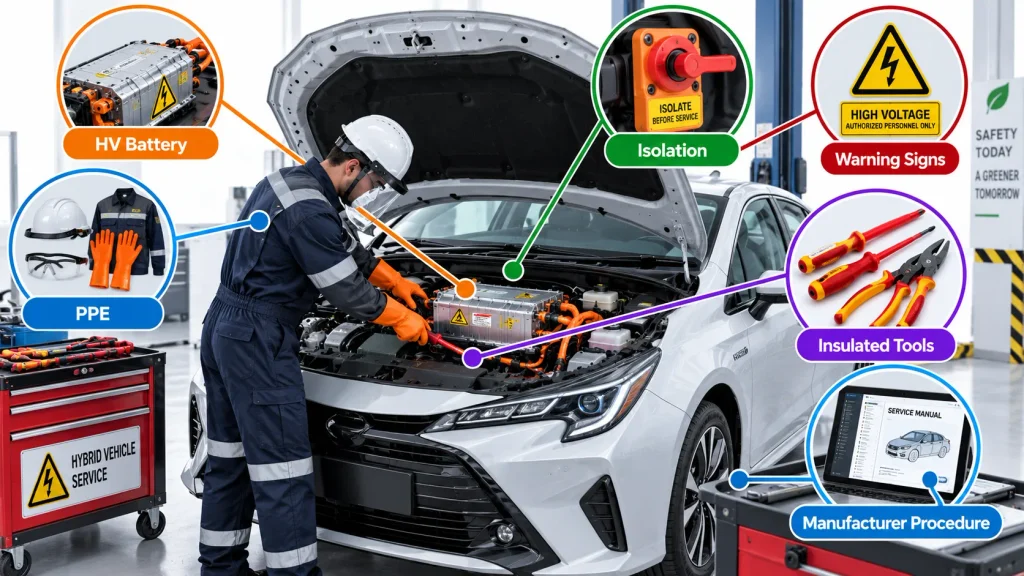
For this reason, servicing should only be performed using appropriate procedures, equipment, training, and manufacturer instructions.
Important safety practices can include:
- Identifying high-voltage components
- Following approved isolation procedures
- Using suitable personal protective equipment
- Preventing unauthorised access
- Checking the vehicle condition before work
- Using appropriate insulated tools where required
- Following manufacturer procedures
- Verifying electrical isolation using approved methods
- Maintaining clear warning and communication controls
Hybrid vehicle training should therefore place strong emphasis on electrical safety as well as mechanical servicing.
What is a Hybrid Car Technology Course?
A Hybrid Car Technology course is designed to develop knowledge of hybrid vehicle systems, components, operating principles, diagnostics, maintenance, and safety.
Course content can vary depending on the training provider and qualification structure. A comprehensive programme may introduce learners to both theoretical principles and practical automotive applications.
Typical study areas may include:
Hybrid Vehicle Fundamentals
Learners develop an understanding of hybrid vehicle concepts, architectures, terminology, and operating principles.
Hybrid Electrical Systems
This area focuses on electrical circuits, high-voltage systems, energy flow, wiring, electrical components, and electronic controls.
Hybrid Battery Technology
Learners explore battery construction, battery management, charging, state of charge, thermal considerations, and common battery-related issues.
Electric Motor Systems
This section introduces electric motor operation and its role in propulsion and regenerative braking.
Regenerative Braking
Learners examine how kinetic energy is recovered during braking and converted into electrical energy.
Hybrid Diagnostics
Diagnostic training can cover scan tools, diagnostic trouble codes, live data, sensors, system testing, and fault-finding procedures.
Preventive Maintenance
Learners can develop knowledge of inspection and maintenance requirements for hybrid vehicles.
High-Voltage Safety
Safety training focuses on hazards, isolation, safe working practices, appropriate equipment, and manufacturer procedures.
Benefits of Studying Hybrid Car Technology
Studying hybrid vehicle technology can provide several practical and professional benefits.
Develops Modern Automotive Skills
The automotive industry increasingly combines mechanical engineering with electrical, electronic, digital, and software technologies.
Hybrid vehicle training helps learners understand this changing technical environment.
Supports Diagnostic Capability
Hybrid systems require structured diagnostic approaches. Training can help learners understand how to interpret diagnostic information and identify system faults.
Improves Electrical Knowledge
Learners can develop knowledge of electrical circuits, batteries, motors, control units, sensors, and power electronics.
Supports Workshop Safety
Proper training helps learners recognise hazards associated with high-voltage vehicle systems and understand the importance of following approved safety procedures.
Builds Specialised Knowledge
Hybrid technology is more complex than traditional mechanical vehicle systems in several areas. Specialised training can therefore help learners build a focused technical skill set.
Supports Career Development
Hybrid vehicle knowledge can support career development in automotive workshops, dealerships, service centres, diagnostic operations, fleet maintenance, and related technical environments.
Who Can Study a Hybrid Car Technology Course?
A Hybrid Car Technology course can be relevant to a wide range of learners interested in modern automotive systems.
Potential learners include:
- Automotive mechanics
- Auto electricians
- Automotive technicians
- Vehicle diagnostic technicians
- Workshop technicians
- Automotive engineering learners
- Vehicle maintenance personnel
- Fleet maintenance staff
- Automotive workshop owners
- Technical professionals seeking hybrid vehicle knowledge
- Individuals beginning a career in automotive technology
Existing automotive experience can be helpful, although the appropriate entry requirements depend on the specific course and training provider.
Career Opportunities in Hybrid Vehicle Technology
The expansion of hybrid and electrified vehicles has created demand for professionals who understand advanced vehicle systems.
Potential career roles can include:
Hybrid Vehicle Technician
A hybrid vehicle technician may inspect, maintain, diagnose, and repair hybrid propulsion systems according to manufacturer procedures and workplace requirements.
Auto Electrician
An auto electrician with hybrid vehicle knowledge can work with vehicle electrical and electronic systems while developing specialist capabilities related to hybrid technology.
Automotive Diagnostic Technician
Diagnostic technicians can use electronic diagnostic tools to identify faults within vehicle control systems.
Hybrid Battery Technician
Specialised technicians may work with battery inspection, diagnostics, maintenance, and approved replacement procedures.
Automotive Service Technician
Service technicians with hybrid knowledge can support routine maintenance and system inspections for hybrid vehicles.
Fleet Maintenance Technician
Organisations operating hybrid vehicle fleets may require technicians who understand hybrid powertrain operation and maintenance requirements.
Automotive Workshop Specialist
Experienced technicians may develop specialist workshop capabilities focused on hybrid and electrified vehicle servicing.
Hybrid Car Technology and the Future of the Automotive Industry
The automotive industry is undergoing significant technological change.
Vehicle manufacturers are introducing increasingly sophisticated combinations of mechanical systems, electrical systems, electronic control units, software, sensors, batteries, and electric propulsion.
Hybrid vehicles represent an important stage in this technological development because they combine established combustion technology with electric propulsion.
For automotive professionals, this means that mechanical knowledge alone may not be sufficient for many modern vehicle systems. Electrical diagnostics, electronic control systems, high-voltage safety, battery technology, and digital diagnostic tools are becoming increasingly relevant.
The long-term development of the automotive sector also includes battery-electric vehicles, plug-in hybrids, advanced driver-assistance systems, connected vehicles, and other emerging technologies.
Developing hybrid vehicle knowledge can therefore help learners understand several important concepts used across modern automotive engineering.
Hybrid Vehicle Maintenance Considerations
Hybrid vehicle maintenance requires attention to both conventional vehicle components and hybrid-specific systems.
Routine maintenance can involve areas such as:
- Engine condition
- Cooling systems
- Brake systems
- Tyres
- Suspension
- Electrical systems
- High-voltage components
- Battery condition
- Diagnostic systems
- Warning indicators
- Software and control systems
Maintenance requirements vary according to vehicle manufacturer, model, mileage, operating conditions, and service schedule.
Technicians should always follow the applicable manufacturer’s technical information rather than relying solely on general hybrid vehicle procedures.
Hybrid Car Technology vs Conventional Car Technology
The main difference between hybrid and conventional vehicles is the integration of electric propulsion with the combustion powertrain.
| Feature | Conventional Vehicle | Hybrid Vehicle |
|---|---|---|
| Main propulsion | Combustion engine | Engine and electric motor |
| Traction battery | Usually 12V | Includes high-voltage battery |
| Electric motor | Generally absent | Integral to hybrid system |
| Regenerative braking | Limited or absent | Commonly used |
| Engine stop-start | Depends on vehicle | Common hybrid function |
| High-voltage safety | Usually limited | Major consideration |
| Diagnostic requirements | Mechanical and electronic | Mechanical, electrical and electronic |
| Technician skills | Mechanical and electrical | Mechanical, electrical, electronic and high-voltage |
This comparison demonstrates why specialised training can be valuable for technicians working with hybrid vehicles.
Conclusion
Hybrid Car Technology is an important part of modern automotive engineering. It combines engine power with electric systems to improve efficiency and reduce fuel use. Learning hybrid technology helps learners understand batteries, electric motors, diagnostics, maintenance, and safety. A Hybrid Car Technology course can therefore provide useful skills for building a career in the growing automotive industry.