
IOSH Managing Safely vs Working Safely: Key Differences Explained
Choosing between IOSH Working Safely and IOSH Managing Safely depends on a person’s workplace responsibilities, professional objectives and existing safety knowledge. Although both courses are designed to improve occupational health and safety, they serve different purposes and develop different capabilities.
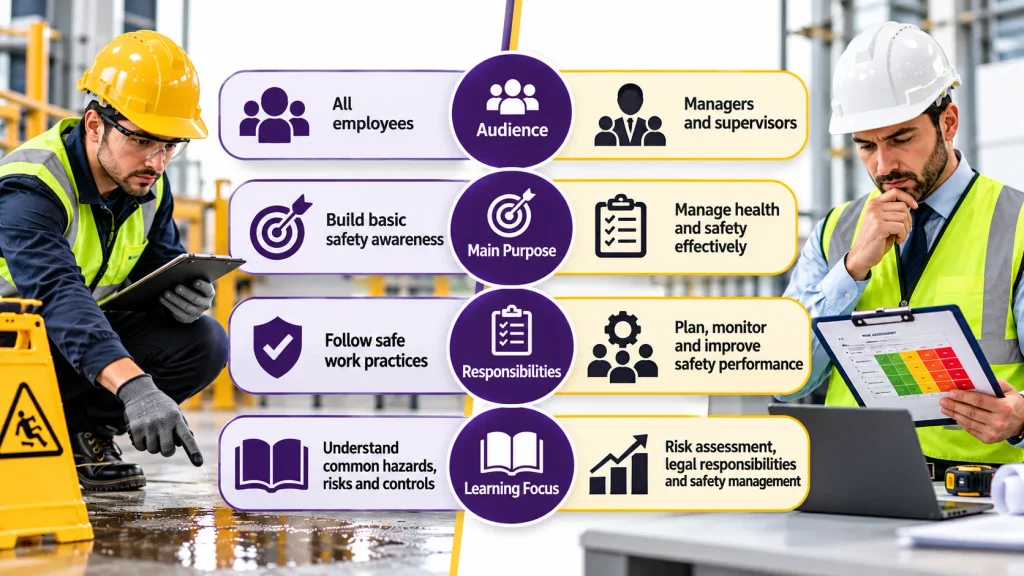
IOSH Working Safely is designed for employees who need to recognise workplace hazards, understand risks and contribute to safer working practices. IOSH Managing Safely is intended primarily for managers, supervisors and team leaders who need to assess risks, implement control measures, understand their responsibilities and improve safety performance.
The main difference between IOSH Working Safely and IOSH Managing Safely is the scope of responsibility. Working Safely focuses on how individuals can work safely, while Managing Safely focuses on how people responsible for work activities can manage health and safety within their teams.
This guide compares both IOSH courses in terms of duration, learning outcomes, course content, assessment, eligibility, benefits and workplace applications. It also explains which course is more suitable for different job roles, whether previous safety training is necessary, how the certificates differ and what learners should consider before enrolling.
By the end of this comparison, learners and employers will be better equipped to select the IOSH course that matches their actual training requirements.
What is the Difference Between IOSH Working Safely and Managing Safely?
IOSH Working Safely and IOSH Managing Safely are workplace health and safety training courses developed by the Institution of Occupational Safety and Health (IOSH). Both aim to improve safety awareness and workplace performance, but their intended audiences and learning objectives differ.
Working Safely provides employees with practical knowledge to recognise hazards, understand risks and adopt safer working behaviours. Managing Safely develops managers’ and supervisors’ understanding of risk assessment, risk controls, responsibilities, incident investigation and safety performance.
The appropriate course should be selected according to the responsibilities of the person receiving training, rather than simply choosing the shorter or more advanced-sounding option.
IOSH Working Safely vs Managing Safely: Comparison Table
| Comparison factor | IOSH Working Safely | IOSH Managing Safely |
|---|---|---|
| Main purpose | Develop workplace safety awareness | Develop practical safety management skills |
| Target audience | Employees and operational workers | Managers, supervisors and team leaders |
| Primary focus | Personal safety and hazard awareness | Managing risks and protecting teams |
| Course duration | One day | Three days for the full course |
| Previous safety experience | Not required | Not required |
| Main learning areas | Hazards, risks, safe behaviour and environmental awareness | Risk assessment, risk controls, responsibilities, incident investigation and performance measurement |
| Practical application | Recognising and reporting hazards | Assessing risks and managing safety controls |
| Workplace responsibility | Individual contribution to safety | Management of safety within a person’s area of responsibility |
| Delivery | In-person, online or hybrid, depending on provider | In-person, online or hybrid, depending on provider |
| Assessment | Confirm the current assessment format with the provider | Confirm the current assessment format with the provider |
| Certificate | IOSH Working Safely certificate | IOSH Managing Safely certificate |
| Best suited to | Employees seeking foundational safety knowledge | People responsible for supervising work or managing teams |
IOSH identifies Working Safely as a one-day course and the full Managing Safely course as a three-day programme. Actual arrangements and available delivery formats should be confirmed with an approved training provider. Both courses are available internationally through IOSH’s training provider network.
What is IOSH Working Safely?
IOSH Working Safely is an introductory occupational health and safety course designed for employees across different industries. It helps learners understand why workplace safety matters, how hazards can cause harm and how individual actions can contribute to a safer working environment.
The course uses practical examples and accessible learning activities to develop essential safety knowledge without requiring previous health and safety experience.
What Does IOSH Working Safely Cover?
The main learning areas include:
- Introduction to working safely and the importance of workplace health and safety.
- Understanding the difference between hazards and risks.
- Identifying common workplace hazards.
- Recognising unsafe conditions and behaviours.
- Improving individual safety performance.
- Understanding how workplace activities affect the environment.
These learning areas help employees understand how to identify potential dangers and contribute to effective workplace safety arrangements.
Who Should Take IOSH Working Safely?
IOSH Working Safely is suitable for:
- General employees: Workers who need a practical understanding of workplace hazards and safe working practices.
- Construction workers: Operatives who need to recognise common site hazards and understand the importance of following safety procedures.
- Manufacturing employees: Production workers who need to understand machinery-related hazards, workplace risks and safe operating practices.
- Warehouse and logistics staff: Employees involved in storage, loading, unloading, manual handling and movement of goods.
- Office employees: Staff who need awareness of ergonomic risks, slips and trips, electrical hazards and other everyday workplace dangers.
- New employees: People beginning a new role who need foundational occupational health and safety knowledge.
- Hospitality and retail workers: Employees who need to recognise hazards associated with customer areas, equipment, storage and routine operations.
- International learners: Individuals seeking practical safety awareness training that can support their understanding of workplace health and safety across industries.
Key Benefits of IOSH Working Safely
IOSH Working Safely can help learners:
- Recognise hazards before they cause harm.
- Understand the importance of safe working procedures.
- Develop greater awareness of individual safety responsibilities.
- Report unsafe conditions and potential risks appropriately.
- Contribute to a positive workplace safety culture.
- Build a foundation for further occupational safety training.
The course is particularly useful when an organisation wants employees to develop a consistent understanding of everyday safety expectations.
What is IOSH Managing Safely?
IOSH Managing Safely is a practical health and safety course designed primarily for line managers, supervisors and team leaders. It helps individuals understand how to manage workplace risks as part of their normal operational responsibilities.
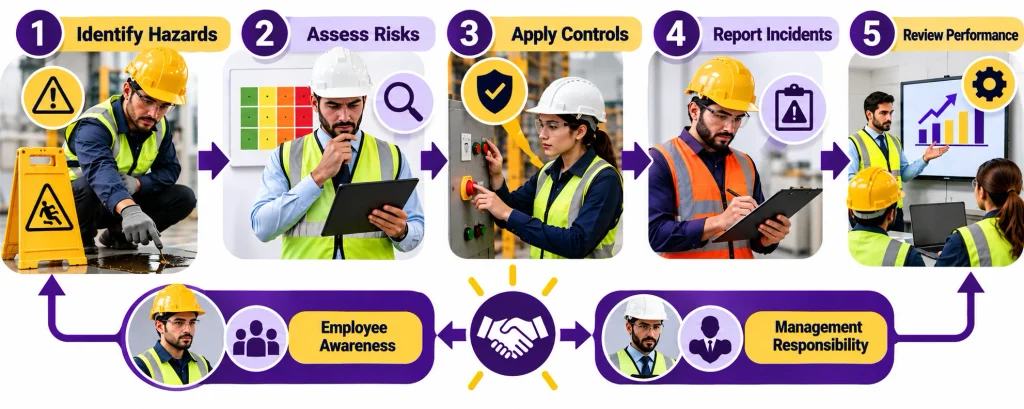
Unlike Working Safely, which focuses on personal awareness, Managing Safely examines how risks can be assessed, controlled, monitored and reviewed. It also introduces incident investigation and safety performance measurement.
Previous health and safety expertise is not required. The course is designed to help managers and supervisors develop practical knowledge they can apply to their existing responsibilities.
What Does IOSH Managing Safely Cover?
The main learning areas include:
- Assessing risks: Identifying workplace hazards and evaluating the likelihood and potential severity of harm.
- Controlling risks: Understanding practical measures that can eliminate hazards or reduce risks to an acceptable level.
- Understanding responsibilities: Recognising the responsibilities associated with managing workplace health and safety.
- Understanding hazards: Identifying different types of workplace hazards and understanding how they may affect employees and others.
- Investigating incidents: Examining incidents to understand contributing factors and identify measures that may prevent recurrence.
- Measuring performance: Using monitoring and performance information to review safety arrangements and support continuous improvement.
These learning areas help managers make informed decisions about workplace safety rather than relying exclusively on employees to follow instructions.
Who Should Take IOSH Managing Safely?
IOSH Managing Safely is suitable for:
- Managers and department heads: Professionals responsible for coordinating work, allocating resources and overseeing workplace performance.
- Supervisors and team leaders: Individuals who monitor employees, assign tasks and ensure that work is performed safely.
- Construction site supervisors: Professionals who oversee site activities and need to understand hazards, risk controls and safety responsibilities.
- Production and operations managers: Managers responsible for machinery, processes, production activities and operational risk.
- Warehouse managers: Professionals responsible for storage arrangements, vehicle movements, manual handling and employee safety.
- Facilities managers: Individuals overseeing building operations, maintenance activities, contractors and workplace safety arrangements.
- Business owners: Employers who need to understand practical approaches to managing workplace risks and supporting safer operations.
- Aspiring supervisors: Employees preparing to move into roles that involve supervising people or coordinating workplace activities.
Key Benefits of IOSH Managing Safely
IOSH Managing Safely can help learners:
- Develop a structured understanding of risk assessment.
- Identify suitable measures to control workplace risks.
- Understand how safety responsibilities relate to management duties.
- Investigate incidents and identify lessons for improvement.
- Monitor safety performance and review control measures.
- Strengthen communication about workplace safety.
- Integrate safety considerations into everyday management decisions.
The course is especially relevant to professionals who need to manage safety alongside production, service delivery, staffing or other operational responsibilities.
IOSH Working Safely vs Managing Safely: Which Is Better for Different Job Roles?
Neither course is universally better than the other. The appropriate choice depends on the work a person performs and the level of responsibility held within an organisation.
| Job role or situation | Recommended course | Reason |
|---|---|---|
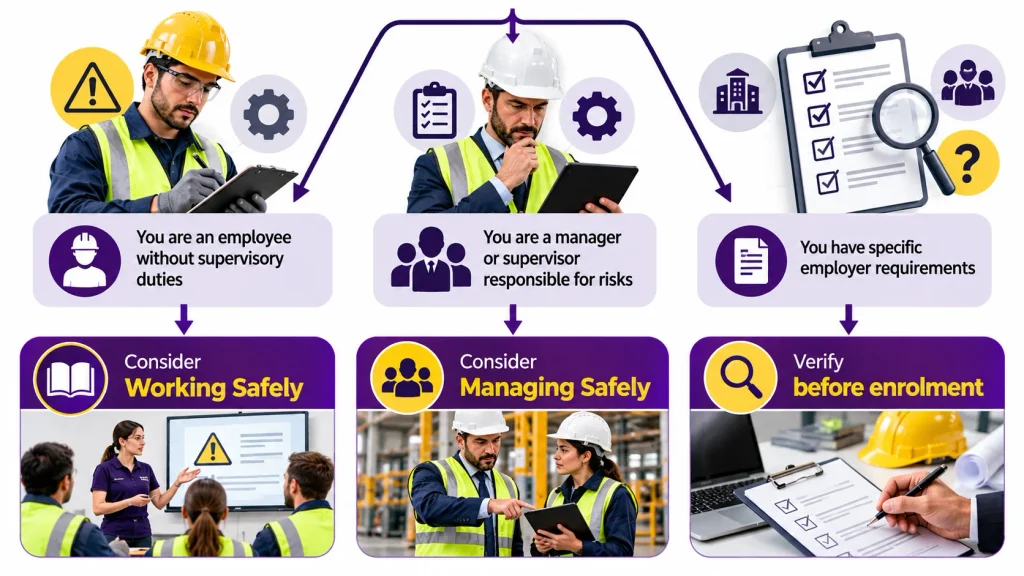
| Employee without supervisory duties | Working Safely | Focuses on personal safety awareness |
| New worker entering a workplace | Working Safely | Introduces essential safety principles |
| Construction operative | Working Safely | Develops awareness of everyday workplace hazards |
| Warehouse operative | Working Safely | Supports safer working practices and hazard reporting |
| Team leader allocating work | Managing Safely | Covers risk management and supervisory responsibilities |
| Production supervisor | Managing Safely | Helps manage risks associated with workplace operations |
| Facilities manager | Managing Safely | Supports the management of operational and maintenance risks |
| Department manager | Managing Safely | Develops practical safety management knowledge |
| Employee preparing for a supervisory role | Depends on current responsibilities | Select according to duties and the intended development pathway |
| Organisation training an entire workforce | Both, according to role | Allows training to match different responsibilities |
Employers should also consider client requirements, contractual obligations, sector-specific risks and applicable legislation before deciding which training to provide.
Practical Workplace Examples: How the Two Courses Differ
Realistic workplace situations make the distinction between the courses easier to understand.
Example 1: Construction Site Safety
A construction operative notices that materials have been left across a pedestrian walkway. The operative needs to recognise the obstruction, understand the potential for trips and falls, and report or address the hazard according to workplace procedures.
IOSH Working Safely supports this understanding by developing hazard awareness and individual responsibility.
A site supervisor, however, may need to assess the wider risk, arrange the removal of materials, review storage arrangements, communicate with the workforce and check whether the control measures remain effective.
IOSH Managing Safely is more directly relevant to these supervisory responsibilities.
Example 2: Warehouse Operations
A warehouse employee notices that a pallet is damaged and could cause goods to fall during handling. The employee needs to recognise the danger, follow the reporting procedure and avoid unsafe handling.
A warehouse manager may need to assess the risk, isolate the affected pallet, review inspection procedures and determine whether additional controls or training are required.
Working Safely supports the employee’s awareness, while Managing Safely supports the manager’s approach to risk control.
Example 3: Manufacturing Workplace
A production employee notices that a machine guard appears damaged. The employee should recognise the potential danger and follow the established procedure for reporting unsafe equipment.
The production supervisor may need to ensure that the equipment is not used until it has been assessed, arrange appropriate maintenance, review the incident and verify that suitable controls are in place.
These responsibilities illustrate why managers may need a more detailed understanding of risk assessment and safety performance.
Example 4: Office Environment
An employee notices trailing cables across a busy walkway. Working Safely helps the employee recognise the hazard and understand the importance of reporting or correcting it safely.
An office manager may need to arrange suitable cable management, review the workstation layout, communicate with facilities personnel and check whether similar hazards exist elsewhere.
The distinction is not that one person cares about safety more than another. Both roles contribute to prevention, but their responsibilities and decisions differ.
IOSH Working Safely vs Managing Safely: Assessments and Certificates
Assessment arrangements are an important consideration when comparing training courses. Learners should distinguish between the knowledge covered by a course and the specific assessment requirements established for that course.
IOSH Working Safely Assessment
Working Safely includes assessment arrangements intended to check understanding of the course content. Learners should confirm the current assessment format, requirements and completion arrangements with the chosen provider.
IOSH Managing Safely Assessment
Managing Safely includes assessment arrangements intended to evaluate understanding of safety management principles and their practical application. The exact format, submission requirements and assessment guidance should be confirmed with the training provider before enrolment.
Preparation should focus on understanding the learning material, recognising hazards, applying risk assessment principles and selecting appropriate control measures rather than memorising isolated facts.
Do Both Courses Provide an IOSH Certificate?
Successful learners receive the relevant IOSH course certificate after meeting the applicable completion and assessment requirements.
The certificates identify different training programmes and should not be treated as interchangeable evidence of the same learning outcomes.
Learners should check the certificate details and verification arrangements provided by IOSH or the approved training provider.
Is IOSH Working Safely Easier Than Managing Safely?
Working Safely is more introductory in scope, while Managing Safely addresses a broader range of management responsibilities. For that reason, Working Safely may feel more straightforward to someone who is new to safety training.
However, the perceived difficulty of either course depends on the learner’s experience, familiarity with workplace terminology, study habits and ability to apply the learning material.
Managing Safely is not restricted to experienced health and safety professionals. It is designed to introduce managers and supervisors to practical safety management concepts, even when they have no previous formal safety expertise.
Rather than choosing a course solely because it appears easier, learners should choose the programme that reflects the work they need to perform.
Can You Take IOSH Managing Safely Without Working Safely?
Yes. IOSH Managing Safely is intended for managers and supervisors and does not generally require prior completion of Working Safely.
An employee who has no supervisory responsibility may benefit from Working Safely first. However, someone who already manages staff, allocates work or oversees operational risks may find Managing Safely more directly relevant.
Completing both courses can also be useful when a person’s responsibilities change over time. For example, an employee may undertake Working Safely and later complete Managing Safely after moving into a supervisory position.
The choice should be based on current responsibilities, intended development and any specific employer requirements..
IOSH Working Safely vs Managing Safely: Recognition and Career Benefits
Both courses are designed by IOSH and are available through its training provider network in the UK and internationally. They can support workplace learning and professional development, but their certificates demonstrate different areas of knowledge.
Career Benefits of IOSH Working Safely
Working Safely can help employees strengthen their understanding of workplace safety and demonstrate commitment to safer working practices.
It may support employees working in construction, manufacturing, logistics, retail, healthcare, facilities and other sectors. However, completing the course does not guarantee employment, promotion or eligibility for a specific occupation.
Career Benefits of IOSH Managing Safely
Managing Safely can support professionals whose existing roles include supervising people, coordinating work activities or overseeing operational risks.
It may be relevant to supervisors, team leaders, operations managers, facilities managers and other professionals responsible for workplace safety arrangements.
However, Managing Safely is a practical training course, not a substitute for every technical qualification required for a dedicated occupational health and safety career. Job-specific requirements should be checked before selecting a training pathway.
Which Course Is Better for Career Progression?
Working Safely is a suitable option for developing foundational knowledge. Managing Safely is more directly aligned with supervisory and management responsibilities.
For individuals who want to progress into a dedicated health and safety profession, additional qualifications, relevant experience and professional development may be required, depending on the intended role.
The best pathway depends on the learner’s current position, career objective and the requirements of prospective employers.
How Employers Can Choose Between IOSH Working Safely and Managing Safely
Employers should begin by identifying the responsibilities associated with each job role and determining the training needed to support those responsibilities.
A practical approach includes the following considerations:
- Review job responsibilities: Identify who performs operational tasks and who allocates, supervises or monitors work.
- Assess existing knowledge: Determine whether employees need basic safety awareness or a more detailed understanding of risk management.
- Consider workplace hazards: Review the risks associated with the industry, equipment, work activities and operating environment.
- Check legal and contractual obligations: Identify applicable training requirements, client specifications and workplace procedures.
- Match training to responsibilities: Select Working Safely for appropriate foundational training and Managing Safely for relevant management and supervisory responsibilities.
- Review training effectiveness: Evaluate whether learners can apply their knowledge and whether additional training or workplace controls are necessary.
Conclusion
IOSH Working Safely and IOSH Managing Safely serve different workplace health and safety training needs. Working Safely is ideal for employees who need to recognise hazards and follow safe working practices, while Managing Safely is designed for managers and supervisors responsible for assessing risks, implementing controls and improving safety performance.
The right course depends on job responsibilities, professional goals and employer requirements. Before enrolling, learners should compare course content, duration, assessment arrangements and provider approval status to ensure the training meets their needs.