
What is IOSH? Complete Guide to IOSH Courses, Benefits and Careers
IOSH is a professional body dedicated to improving occupational safety and health. Its training courses and professional qualifications help employees, supervisors, managers and aspiring safety professionals develop the knowledge needed to identify workplace hazards, assess risks and promote safer working practices.
However, IOSH is not a single course or certificate. Different programmes serve different purposes, from introducing employees to essential workplace safety principles to developing the practical management skills and professional competence needed for occupational safety and health roles.
This complete guide explains what IOSH stands for, which courses are available, how they differ, who can enrol, what assessment involves and how the training may support professional development. It also explains the distinction between short training courses and professional qualifications, how to choose an appropriate provider, and what international learners should check before enrolling.
What is IOSH?
IOSH stands for the Institution of Occupational Safety and Health. It is a UK-based chartered professional body for occupational safety and health, supporting individuals and organisations in developing safer, healthier working environments.
IOSH contributes to the profession through training, professional development, guidance, research and membership services. Its courses help people understand workplace risks and responsibilities, while its professional qualifications provide more extensive learning for individuals developing their careers in occupational safety and health.
IOSH is relevant across industries such as construction, engineering, manufacturing, oil and gas, logistics, healthcare, facilities management, retail and office-based businesses.
For example, a construction supervisor may need to identify fall hazards and check that appropriate controls are in place. A warehouse manager may need to address vehicle movements, manual handling and unsafe storage. IOSH training can help learners understand the principles behind these responsibilities, although the precise skills developed depend on the course selected.
The most suitable option depends on the learner’s job role, current experience, workplace responsibilities and career objectives.
What Does IOSH Stand For?
IOSH stands for the Institution of Occupational Safety and Health.
The organisation supports the development of occupational safety and health practice through professional learning, guidance and membership. Its work is associated with improving workplace safety, strengthening professional competence and encouraging effective risk management.
It is important to distinguish between the organisation and its training programmes. IOSH is the professional body, while IOSH Working Safely and IOSH Managing Safely are specific courses. The IOSH Level 3 Certificate and Level 6 Diploma are professional qualifications with different learning objectives and requirements.
Understanding this distinction helps learners select appropriate training instead of assuming that every IOSH course provides the same depth of knowledge or career progression.
What is an IOSH Course?
An IOSH course is a training programme designed to develop knowledge and skills related to occupational safety and health. Depending on the programme, learners may study hazard identification, risk assessment, workplace responsibilities, incident investigation, risk controls and safety performance.
Common learning areas include:
- Identifying hazards in the workplace.
- Understanding the difference between hazards and risks.
- Evaluating risks and selecting appropriate controls.
- Understanding employee and management responsibilities.
- Reporting incidents and unsafe conditions.
- Following safe systems of work.
- Monitoring workplace safety arrangements.
- Improving communication about health and safety.
The depth of learning depends on the course. An introductory programme focuses on essential awareness, while a management course develops practical skills for people responsible for teams or work activities.
Professional qualifications involve more extensive study and are intended for learners seeking to develop broader occupational safety and health competence.
Which IOSH Courses Are Available?
IOSH offers short training courses as well as professional qualifications. These options should not be treated as interchangeable because they have different purposes and intended audiences.
Difference Between IOSH Working Safely and IOSH Managing Safely
IOSH Working Safely and IOSH Managing Safely serve different learning needs. Working Safely focuses on essential health and safety awareness for employees, whereas Managing Safely develops practical safety management knowledge for managers, supervisors and team leaders.
| Comparison factor | IOSH Working Safely | IOSH Managing Safely |
|---|---|---|
| Main purpose | Develop workplace safety awareness | Develop practical safety management skills |
| Target audience | Employees and general workers | Managers, supervisors and team leaders |
| Learning focus | Recognising hazards and understanding risks | Assessing risks and implementing controls |
| Safety responsibilities | Individual workplace responsibilities | Management and supervisory responsibilities |
| Risk assessment | Understand basic risk assessment principles | Apply risk assessment principles to work activities |
| Hazard identification | Recognise common workplace hazards | Identify hazards and determine appropriate controls |
| Incident management | Understand the importance of reporting incidents | Develop knowledge of incident investigation |
| Safety performance | Contribute to safer working practices | Monitor and measure safety performance |
| Practical application | Recognise unsafe conditions, such as blocked walkways | Address operational risks, unsafe equipment and control failures |
| Previous experience | Generally suitable without specialist safety experience | Generally suitable for managers without previous specialist safety experience |
| Career relevance | Supports general workplace safety awareness | Supports existing management and supervisory responsibilities |
| Best suited for | Employees seeking essential safety knowledge | Managers responsible for people and work activities |
IOSH Working Safely
IOSH Working Safely is designed for employees and other people who need an understanding of essential workplace health and safety principles.
It is suitable for learners across a wide range of industries, including those who do not have formal responsibility for managing safety.
The course focuses on understanding common workplace hazards, recognising risks and contributing to safer working practices.
Typical learning areas include:
- Recognising workplace hazards.
- Understanding the importance of risk assessment.
- Following safe working procedures.
- Understanding individual safety responsibilities.
- Contributing to a safer working environment.
For example, a warehouse employee may learn to recognise blocked walkways, unsafe stacking and risks created by moving vehicles.
Working Safely is a suitable option for general workplace safety awareness. It is not a substitute for specialist training required for high-risk activities or dedicated safety management responsibilities.
IOSH Managing Safely
IOSH Managing Safely is designed for managers, supervisors, team leaders and others who manage work activities and need to understand their health and safety responsibilities.
It focuses on practical safety management, helping participants understand how to identify hazards, assess risks, introduce controls and monitor safety performance.
The course commonly covers:
- Assessing workplace risks.
- Controlling hazards and risks.
- Understanding management responsibilities.
- Recognising common workplace hazards.
- Investigating incidents.
- Measuring health and safety performance.
Consider a manufacturing supervisor who discovers that a machine guard has been removed. The supervisor needs to recognise the danger, prevent unsafe operation, report the issue and ensure that suitable corrective action is taken.
Managing Safely develops knowledge relevant to these responsibilities and helps managers integrate safety considerations into everyday operational decisions.
Previous specialist health and safety experience is not generally required for the standard course. Learners should nevertheless check the current course specification and assessment requirements before enrolling.
IOSH Leading Safely
IOSH Leading Safely is intended for senior leaders and executives who need to understand the connection between health and safety leadership and organisational performance.
Its focus is on leadership responsibility, strategic decision-making and developing an organisational culture in which safety is treated as a core management priority.
The course can help leaders consider how workplace safety affects workforce wellbeing, operational continuity, reputation and organisational risk.
It is different from an introductory employee course because it concentrates on leadership and organisational responsibility rather than basic workplace hazard awareness.
IOSH Safety for Executives and Directors
IOSH Safety for Executives and Directors is another leadership-focused option for senior decision-makers.
It addresses the role of executives and directors in providing leadership, establishing accountability and ensuring that occupational safety and health receives appropriate attention at organisational level.
Learners considering this course should compare its current syllabus and intended audience with those of IOSH Leading Safely before making a decision.
IOSH Level 3 Certificate in Occupational Safety and Health Principles and Practice
The IOSH Level 3 Certificate in Occupational Safety and Health Principles and Practice is a professional qualification designed for individuals beginning their careers in occupational safety and health. It provides a structured learning pathway that goes beyond basic workplace safety awareness, helping learners develop the knowledge and practical skills needed to understand workplace hazards, assess risks and contribute to effective safety management.
This qualification may be suitable for learners who want to establish a professional foundation in health and safety or strengthen their understanding of workplace risk management. Key benefits include:
- Developing foundational occupational safety and health knowledge.
- Understanding workplace hazards, risk assessment and control measures.
- Building skills relevant to professional health and safety responsibilities.
- Supporting progression towards occupational safety and health roles.
- Preparing for further professional development in the safety sector.
Learners should consult the official IOSH qualification specification to confirm current entry requirements, assessment methods, delivery options and approved study-centre arrangements.
IOSH Level 6 Diploma in Occupational Safety and Health Leadership and Management
The IOSH Level 6 Diploma in Occupational Safety and Health Leadership and Management is a professional qualification designed for individuals seeking advanced development in occupational safety and health. It focuses on strengthening technical knowledge, strategic decision-making and leadership capabilities required to manage workplace risks and improve organisational safety performance. This qualification may be suitable for experienced practitioners and learners who meet the recommended preparation requirements and want to progress towards senior safety management responsibilities.
Key learning and professional development benefits include:
- Developing advanced occupational safety and health knowledge.
- Strengthening leadership and safety management capabilities.
- Improving strategic risk assessment and control decision-making.
- Supporting the development of effective safety policies and procedures.
- Building competence for more complex occupational safety and health responsibilities.
- Supporting professional development towards senior safety-related roles.
Learners should consult the official IOSH qualification specification to verify current entry requirements, assessment arrangements, course availability and progression opportunities before enrolling.
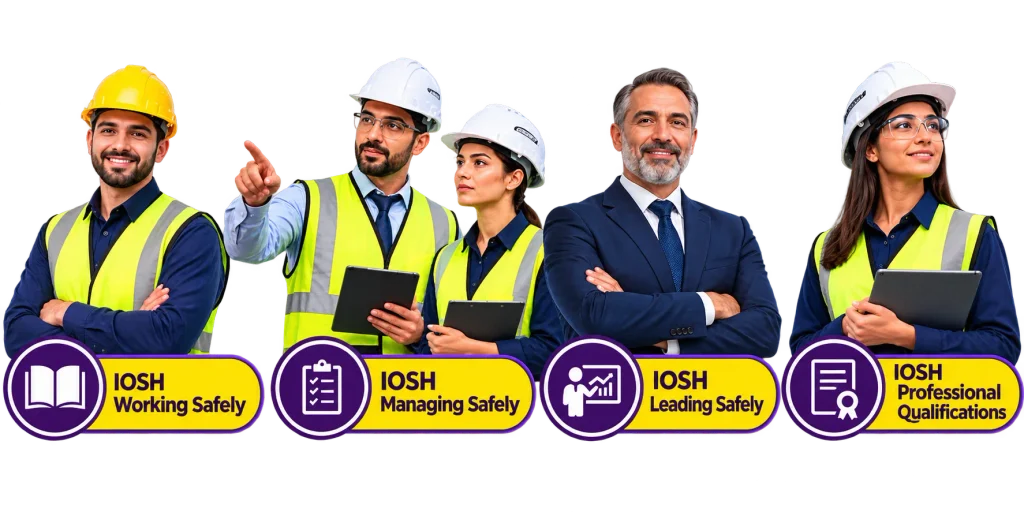
IOSH Courses Compared: Which One Should You Choose?
The best course depends on the learner’s responsibilities and intended outcome.
| Course or qualification | Intended audience | Main purpose |
|---|---|---|
| IOSH Working Safely | Employees and general workers | Develop essential safety awareness |
| IOSH Managing Safely | Managers and supervisors | Develop practical safety management knowledge |
| IOSH Leading Safely | Senior leaders and executives | Connect safety with leadership and business performance |
| IOSH Safety for Executives and Directors | Directors and senior decision-makers | Understand leadership accountability |
| IOSH Level 3 Certificate | New and aspiring safety professionals | Build a professional foundation |
| IOSH Level 6 Diploma | Advancing or experienced practitioners | Develop advanced safety and leadership competence |
An employee who needs to understand everyday hazards may benefit most from Working Safely. A supervisor responsible for work activities may find Managing Safely more relevant. Someone planning a dedicated safety career should investigate professional qualifications and the requirements of their intended role.
There is no single best IOSH course for every learner. The right choice is the programme that matches the learning objective, workplace responsibilities and expected career pathway.
What Does IOSH Training Cover?
Although course content varies, several important principles are central to occupational safety and health.
Hazard Identification
A hazard is something with the potential to cause injury, illness or damage. Examples include unguarded machinery, exposed electrical conductors, hazardous chemicals, excessive noise, poor housekeeping and unsafe work at height.
Learners develop an understanding of how to recognise hazards before they cause harm.
Risk Assessment
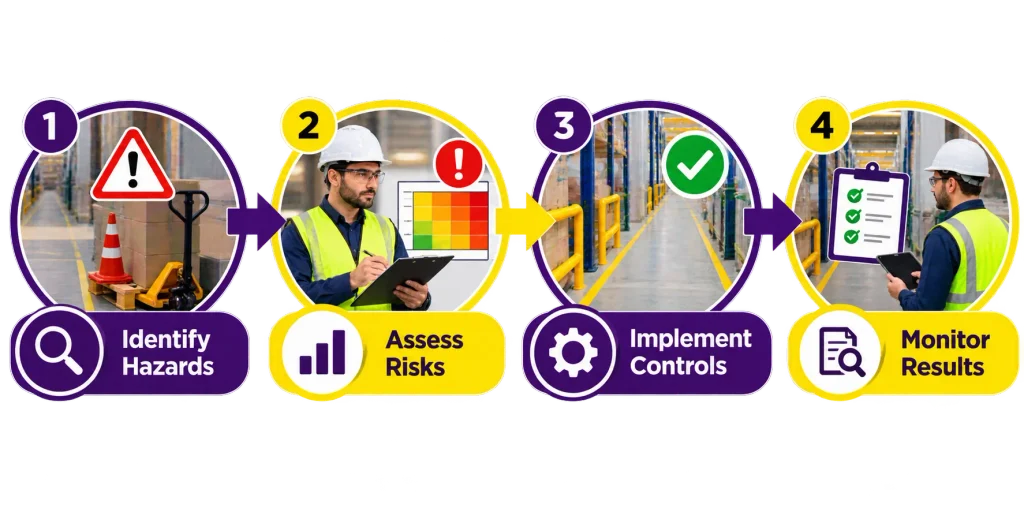
Risk assessment involves identifying hazards, considering who might be harmed, evaluating the likelihood and severity of potential consequences, and determining whether existing controls are adequate.
For example, a maintenance team preparing to work at height must consider access equipment, fall prevention, weather conditions, the work environment and emergency arrangements.
A useful risk assessment should support decisions about practical controls rather than simply produce paperwork.
Risk Control
Risk control involves selecting and implementing measures to eliminate hazards or reduce risks to an acceptable level.
Controls may include eliminating a hazardous activity, substituting a dangerous substance, installing engineering safeguards, improving work procedures or providing appropriate personal protective equipment.
Effective control selection should consider the hierarchy of controls and prioritise measures that address the source of the risk.
Incident Reporting and Investigation
Incident reporting helps organisations record events, identify hazards and take corrective action. Investigation goes further by examining why an incident occurred and what can prevent recurrence.
For example, repeated slips in a production area may indicate a problem with housekeeping, drainage, equipment maintenance or work procedures.
An effective investigation considers immediate causes and underlying factors rather than focusing only on individual behaviour.
Monitoring Safety Performance
Monitoring helps determine whether safety arrangements are effective in practice.
Activities may include workplace inspections, reviewing incident reports, monitoring corrective actions, checking equipment maintenance records and evaluating audit findings.
Managers can use these results to identify recurring problems and improve risk controls.
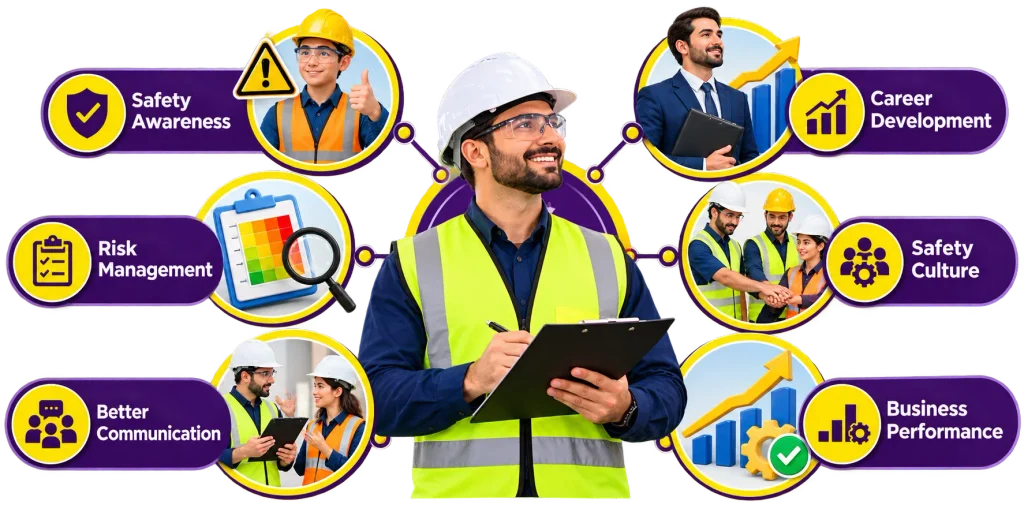
What Are the Benefits of IOSH Training?
IOSH training helps learners develop occupational safety and health knowledge that can be applied in different workplace environments. Depending on the selected course, it can improve hazard awareness, strengthen risk management skills and support safer working practices. Organisations may also benefit when employees and managers apply their learning to workplace procedures, incident prevention and safety performance.
Improved Workplace Safety Awareness
IOSH training helps learners recognise common workplace hazards, understand potential risks and identify appropriate preventive measures. This knowledge can support safer decisions and encourage employees to take greater responsibility for workplace safety.
Key benefits include:
- Recognising workplace hazards and unsafe conditions.
- Understanding basic risk assessment principles.
- Following safe working procedures.
- Contributing to accident and injury prevention.
Better Risk Management
Managers and supervisors can develop a clearer understanding of how to identify hazards, assess risks and implement suitable control measures. This supports more systematic decision-making and helps organisations address workplace risks before incidents occur.
Practical benefits include:
- Identifying hazards associated with work activities.
- Evaluating risks and selecting appropriate controls.
- Monitoring the effectiveness of safety measures.
- Supporting continuous workplace safety improvement.
Stronger Safety Communication
Effective communication is essential for maintaining safe working environments. IOSH training can help learners understand safety responsibilities, report hazards and communicate workplace risks more clearly.
Learners can develop the ability to:
- Report unsafe conditions and incidents.
- Explain relevant safety procedures.
- Communicate risks to colleagues and supervisors.
- Encourage cooperation in workplace safety activities.
Support for Professional Development
Completing relevant IOSH training demonstrates a commitment to occupational safety and health. It may strengthen a learner’s professional profile when applying for supervisory, operational management or safety-related positions. However, career progression depends on experience, practical competence, additional qualifications and employer requirements.
Professional development benefits may include:
- Strengthening occupational safety and health knowledge.
- Supporting existing management responsibilities.
- Improving the professional profile for relevant job opportunities.
- Identifying suitable pathways for further safety training.
Improved Workplace Safety Culture
A positive safety culture develops when employees, supervisors and managers understand their responsibilities and consistently apply appropriate safety practices. IOSH training can contribute to this process by improving awareness and encouraging responsible workplace behaviour.
Organisations can reinforce these benefits by:
- Promoting employee involvement in safety activities.
- Providing clear procedures and instructions.
- Maintaining suitable safety equipment.
- Supporting competent supervision and regular inspections.
Support for Business Performance
Effective occupational safety and health practices can help organisations reduce avoidable incidents, protect equipment and minimise operational disruption. Training can contribute to these outcomes when learners apply their knowledge and management provides the necessary resources and support.
Potential organisational benefits include:
- Reducing risks associated with workplace activities.
- Supporting workforce wellbeing and operational continuity.
- Improving awareness of safety responsibilities.
- Identifying opportunities to strengthen existing safety arrangements.
IOSH training alone does not guarantee legal compliance, eliminate workplace incidents or ensure business improvements. Organisations must implement suitable risk controls, maintain effective safety management arrangements and comply with applicable legal requirements.
Who Should Take an IOSH Course?
IOSH courses are suitable for different audiences depending on the programme.
Potential learners include:
- Employees who want to improve workplace safety awareness.
- Team leaders and supervisors responsible for daily operations.
- Managers overseeing people, equipment or work processes.
- Construction and engineering professionals with safety responsibilities.
- Manufacturing and warehouse supervisors.
- Facilities and maintenance managers.
- Business owners and operational decision-makers.
- Individuals considering a career in occupational safety and health.
- Experienced practitioners seeking professional development.
The main consideration is whether the course fits the learner’s responsibilities and goals.
A general employee may need introductory safety awareness, while a manager responsible for controlling operational risks may need practical management training. An aspiring safety professional may need a broader qualification pathway.
How is an IOSH Course Assessed?
IOSH course assessment methods vary according to the selected programme, its learning objectives and its assessment requirements. Short training courses may use multiple-choice questions, knowledge tests, hazard-identification activities or practical exercises to evaluate learners’ understanding of workplace health and safety principles. IOSH Managing Safely includes a knowledge assessment and a practical workplace risk assessment, while professional qualifications follow their own assessment specifications.
To prepare effectively for an IOSH assessment, learners should focus on the following areas:
- Reviewing the official course materials and key learning concepts.
- Understanding workplace hazards, risk assessment and control measures.
- Practising hazard identification using realistic workplace scenarios.
- Applying health and safety principles to practical situations.
- Following the assessment instructions and completion requirements provided by the training provider.
Successful completion demonstrates that a learner has met the relevant assessment requirements for the selected programme. However, an IOSH certificate does not automatically establish competence for every safety-critical activity or specialist occupational role. Additional training, practical experience and job-specific qualifications may be necessary, depending on the responsibilities involved.
How Long Does an IOSH Course Take?
Course duration varies according to the programme and delivery method.
IOSH Working Safely is commonly delivered as a short course, often around one day. IOSH Managing Safely is typically delivered over three days in a full-course format. Online and virtual delivery may follow different study schedules.
Professional qualifications require a longer commitment and should be planned according to the relevant specification.
| Course | General duration guidance |
|---|---|
| IOSH Working Safely | Often around one day |
| IOSH Managing Safely | Typically three days in a full-course format |
| IOSH Leading Safely | Short leadership-focused course; confirm current schedule |
| IOSH professional qualifications | Longer programmes; check the official study requirements |
These are general planning guides rather than guaranteed completion times. Confirm the current duration with the approved provider before booking.
Is an IOSH Certificate Valid for Life?
IOSH Working Safely and IOSH Managing Safely certificates are generally understood to have no formal expiry date. However, learners should confirm the current certificate conditions with the training provider or IOSH, as requirements may vary by programme and employer expectations.
Although a certificate may remain valid, workplace hazards, safety procedures, equipment and legal requirements can change over time. Refresher training can help learners maintain up-to-date knowledge and apply appropriate safety practices.
Refresher training may be particularly beneficial for managers, supervisors and employees working in environments where risks or responsibilities change frequently. Key considerations include:
- Reviewing updated workplace health and safety procedures.
- Refreshing knowledge of hazard identification and risk control.
- Understanding changes in relevant legal or industry requirements.
- Following employer policies on periodic safety training.
- Maintaining competence for current workplace responsibilities.
An IOSH certificate without a formal expiry date does not mean that refresher training is never necessary. Employers may require additional training to maintain workplace competence and meet applicable safety obligations.
IOSH Training vs Professional Qualifications
One common source of confusion is the difference between a short training course and a professional qualification.
Short courses are designed to address specific workplace learning needs. They can help employees understand safety responsibilities or help managers develop practical risk management knowledge.
Professional qualifications generally involve broader study, more extensive assessment and deeper technical learning. They may be more suitable for people aiming to work in dedicated occupational safety and health roles.
| Consideration | Short IOSH training course | IOSH professional qualification |
|---|---|---|
| Main purpose | Awareness or practical management skills | Broader professional competence |
| Typical audience | Employees, supervisors and managers | Aspiring or advancing safety professionals |
| Study commitment | Usually shorter | More extensive |
| Assessment | Depends on the course | Defined by the qualification specification |
| Career relevance | Supports existing workplace responsibilities | May support progression towards professional safety roles |
Neither option is automatically best for everyone. The appropriate choice depends on the learner’s current responsibilities and future objectives.
What Careers Can IOSH Training Support?
The career value of IOSH training depends on the course completed, the learner’s experience and the requirements of the intended job.
Short courses may support people working in roles such as team leader, site supervisor, operations supervisor, facilities coordinator, production supervisor, warehouse manager or project manager.
Professional qualifications may be more relevant to people developing towards roles such as health and safety officer, occupational safety and health adviser, safety coordinator or safety manager, subject to employer requirements and the learner’s broader competence.
IOSH training should be viewed as one part of professional development rather than a guarantee of employment or promotion. Relevant experience, technical knowledge and practical competence may also be essential.
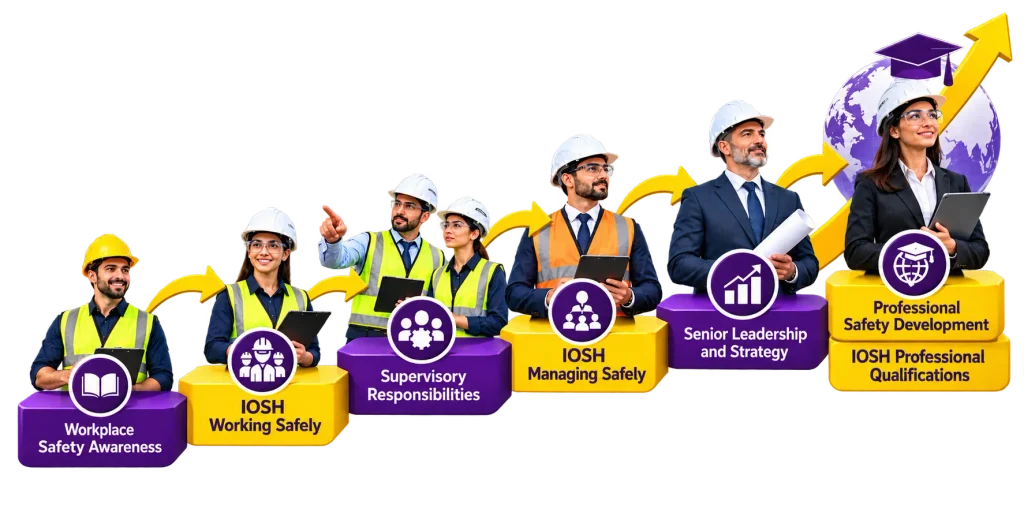
How to Choose the Right IOSH Course
Choosing the right programme becomes easier when the decision is based on the learner’s role and career objectives.
Step 1: Identify the Learning Goal
Determine whether the main objective is general safety awareness, practical safety management, leadership development or a professional safety career.
Step 2: Match the Course to the Role
Employees may benefit from Working Safely, while managers and supervisors may find Managing Safely more relevant. Senior leaders should consider leadership-focused training, while aspiring safety professionals should investigate professional qualifications.
Step 3: Check the Official Specification
Review the course title, syllabus, entry guidance, duration, assessment and certificate arrangements.
Step 4: Verify the Training Provider
Use the official IOSH website to confirm approval for the particular programme. Approval to deliver one course should not automatically be assumed to cover every other programme.
Step 5: Compare Delivery and Support
Consider whether online, virtual classroom or face-to-face study best suits the learner’s schedule. Check the availability of learning materials, tutor support and assessment guidance.
Step 6: Consider the Next Career Step
Review job advertisements in the intended industry or country to understand which courses, qualifications and experience employers request.
This approach helps learners select training based on a realistic objective rather than relying only on general claims about career benefits.
Why Choose the Right IOSH Course?
Choosing the right IOSH course helps learners develop health and safety knowledge that matches their workplace responsibilities and professional goals. Relevant training can improve hazard awareness, strengthen risk management skills and support safer working practices across industries such as construction, engineering, manufacturing, logistics and facilities management.
Depending on the selected programme, learners may benefit from:
- Developing a better understanding of workplace hazards and risks.
- Improving knowledge of safety procedures and preventive measures.
- Strengthening management and supervisory safety responsibilities.
- Building a foundation for professional development in occupational safety and health.
- Applying practical safety principles to everyday workplace activities.
Before enrolling, learners should review the course syllabus, entry requirements, assessment methods, delivery options and training provider approval status. Comparing these factors helps ensure that the selected programme matches the learner’s experience, learning needs and intended career direction.
Conclusion
IOSH supports occupational safety and health through training, professional development and qualifications designed for different audiences. Its short courses can help employees and managers improve workplace safety knowledge, while its professional qualifications provide a more extensive pathway for people developing their careers in occupational safety and health.
The best starting point is to identify the learner’s responsibilities and long-term objectives. Employees may need basic safety awareness, managers may require practical risk management training, and aspiring professionals may benefit from a broader qualification.
By checking official course specifications, verifying provider approval and understanding what each certificate represents, learners can make informed decisions about their training. This helps ensure that the selected programme supports practical workplace safety, professional development and realistic career goals.