
What is a Rigger? Roles, Responsibilities, Skills, Qualifications and Career Guide
A rigger is a trained lifting and load-handling professional who prepares, secures, moves, guides and positions heavy materials, machinery and structural components using cranes, hoists, slings, shackles, wire ropes, chains and other lifting equipment. Riggers play a critical role in construction, manufacturing, oil and gas, mining, marine operations, renewable energy, infrastructure, industrial maintenance and major installation projects.
The rigger works as part of a coordinated lifting team and may communicate directly with crane operators, lifting supervisors, engineers, site managers and other workers. The quality of a rigging operation can affect not only productivity but also the safety of people, equipment and the surrounding work area.
Although rigging is sometimes described simply as “attaching a load to a crane,” professional rigging involves much more. A competent rigger must understand load weight, centre of gravity, lifting capacity, sling angles, equipment limitations, communication procedures, hazards and safe lifting practices.
This comprehensive guide explains what a rigger is, what a rigger does, the main responsibilities and skills required, common rigging equipment, qualifications and training pathways, working environments, career progression, advantages and challenges, and how to build a successful career in rigging.
What is a Rigger?
A rigger is a skilled worker responsible for preparing and securing loads so that they can be safely lifted, moved and positioned using lifting equipment.
Before a lift takes place, the rigger considers factors such as:
- Load weight
- Load dimensions
- Centre of gravity
- Lifting points
- Rigging configuration
- Sling type and capacity
- Sling angles
- Crane or hoist capacity
- Load path
- Surrounding hazards
- Weather and environmental conditions
- Communication arrangements
- Required exclusion zones
The rigger then selects suitable lifting accessories, attaches them correctly, checks the setup and helps coordinate the movement of the load.
Modern riggers can work on relatively routine lifts as well as highly complex operations involving oversized machinery, structural steel, industrial components, wind-turbine parts and other heavy or awkward loads.
Industry career guides consistently identify load preparation, equipment selection, inspection, communication and safe movement as core aspects of the occupation.
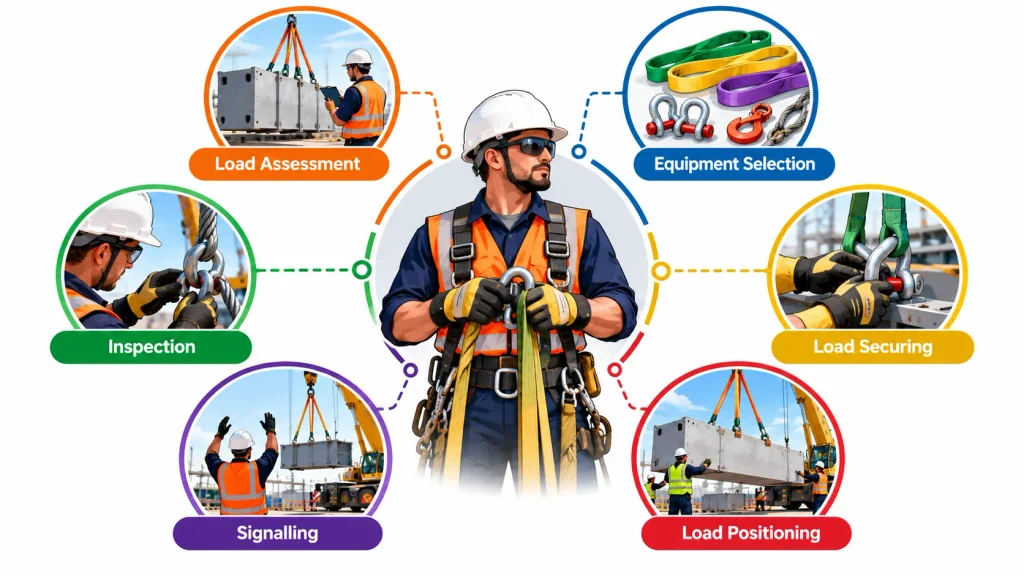
What Does a Rigger Do?
The exact duties of a rigger depend on the industry, project and level of responsibility. However, most riggers perform several core activities.
Assess and Prepare the Load
A rigger begins by understanding what needs to be moved.
This can involve identifying the load’s:
- Approximate weight
- Shape and dimensions
- Centre of gravity
- Lifting points
- Stability
- Surface condition
- Fragile or vulnerable components
- Potential movement during lifting
A poorly understood load can create significant risks during a lifting operation. Therefore, load assessment is an essential part of competent rigging.
Select Rigging Equipment
Different loads require different lifting accessories.
Depending on the operation, a rigger may use:
- Wire-rope slings
- Chain slings
- Synthetic web slings
- Shackles
- Hooks
- Eye bolts
- Spreader beams
- Lifting beams
- Hoists
- Winches
- Pulleys and blocks
- Clamps
- Lifting points
- Tag lines
The equipment must be appropriate for the load, configuration and operating conditions.
Inspect Rigging Gear
Inspection is one of the most important rigger responsibilities.
Before use, lifting accessories should be checked for signs of damage, wear, deformation, corrosion, broken wires, cuts, excessive abrasion or other defects.
Riggers should also check identification markings, working load limits and other required information according to applicable procedures and regulations.
Industry guidance and career resources repeatedly identify equipment inspection as a fundamental rigger responsibility.
Attach and Secure Loads
The rigger attaches the selected lifting accessories to the load and ensures the connection is secure.
This may involve configuring slings, connecting shackles, attaching hooks, protecting slings from sharp edges and establishing suitable lifting points.
The objective is not merely to connect the load but to create a stable lifting arrangement that is suitable for the planned movement.
Guide Suspended Loads
Once the load is lifted, the rigger may guide it through the planned route.
This can require:
- Hand signals
- Radio communication
- Tag lines
- Visual observation
- Coordination with the crane operator
- Awareness of surrounding structures and workers
The rigger needs to understand how the load may react when lifted, lowered, rotated or moved.
Communicate with the Crane Operator
Clear communication is essential.
Depending on the site procedure, a rigger or designated signal person may communicate with the crane operator using standard hand signals, radio communication or other approved methods.
Communication must be clear, consistent and understood by everyone involved in the lifting operation.
Position and Align Loads
Rigging does not always end when the load reaches the destination.
The rigger may help guide, align, position or lower the load accurately into its final location.
This is particularly important when installing:
- Structural steel
- Industrial machinery
- Pipes
- Mechanical equipment
- Large electrical components
- Wind-turbine components
- Precast elements
- Heavy plant
Dismantle and Store Equipment
After a lifting operation, rigging equipment may need to be removed, inspected and stored correctly.
Proper storage can help protect lifting accessories from unnecessary damage and maintain their condition for future use.
Main Responsibilities of a Rigger
A professional rigger may have responsibility for the following activities:
- Reviewing the lifting requirements
- Assessing load characteristics
- Selecting appropriate lifting accessories
- Inspecting rigging equipment before use
- Checking working load limits
- Establishing suitable rigging configurations
- Attaching loads securely
- Protecting lifting equipment from damage
- Communicating with crane operators
- Guiding suspended loads
- Maintaining safe distances from loads
- Monitoring changing site conditions
- Supporting lifting-plan implementation
- Maintaining exclusion zones where required
- Reporting defective equipment
- Stopping or escalating unsafe operations
- Dismantling rigging equipment after use
- Maintaining good housekeeping around lifting areas
The responsibilities become more complex as a rigger gains experience and moves into specialist or supervisory work.
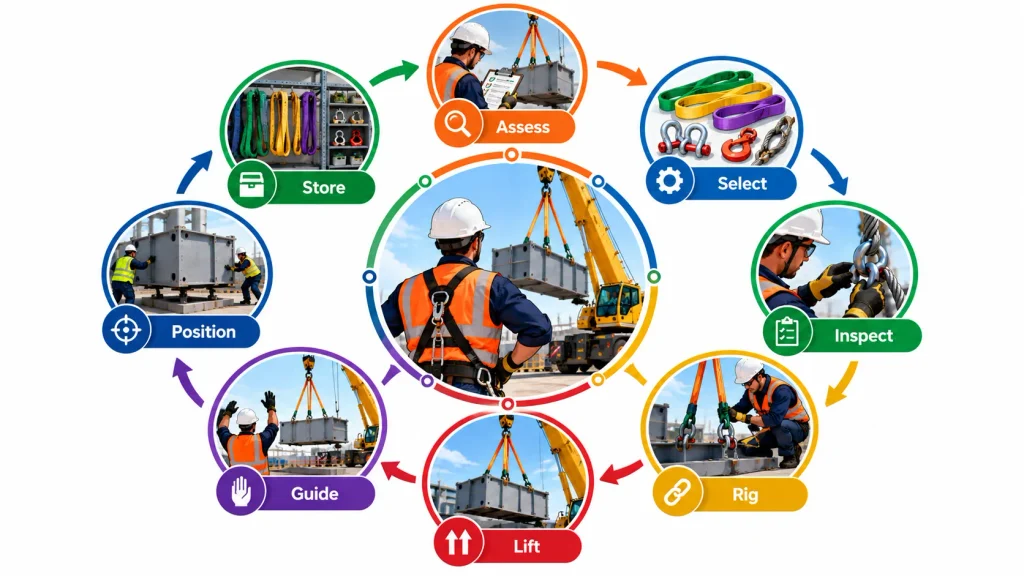
Rigger vs Crane Operator: What is the Difference?
A rigger and a crane operator work together during lifting operations, but their responsibilities are different. The following table explains the key differences:
| Aspect | Rigger | Crane Operator |
|---|---|---|
| Primary Role | Prepares, secures, guides and positions the load for lifting. | Operates the crane and controls its movement. |
| Load Assessment | Assesses the load, weight, centre of gravity and lifting requirements. | Uses the crane within its rated capacity and operating limits. |
| Equipment Selection | Selects suitable slings, shackles, hooks and other lifting accessories. | Selects or operates the appropriate crane according to the lifting plan and site requirements. |
| Rigging Equipment | Attaches, checks and secures rigging equipment to the load. | Connects with the lifting team to ensure the crane and load are ready for lifting. |
| Crane Operation | Does not normally operate the crane unless separately trained and authorised. | Operates crane controls to raise, lower, swing, travel or position the load. |
| Communication | Communicates with the crane operator using approved signals or radio communication. | Receives and responds to authorised lifting signals and instructions. |
| Load Guidance | Guides and controls the load using approved methods such as tag lines and signals. | Controls crane movements to move the suspended load. |
| Load Positioning | Helps guide and accurately position the load at its final location. | Controls crane movements to place the load safely and accurately. |
| Equipment Inspection | Inspects slings, shackles, hooks and other rigging accessories before use. | Checks the crane and relevant operating systems according to required procedures. |
| Safety Responsibility | Identifies rigging hazards and ensures the load is suitably prepared and secured. | Operates the crane safely and monitors crane-related operating conditions. |
| Main Expertise | Rigging, load handling, lifting accessories, load stability and signalling. | Crane operation, controls, capacity, movement and crane safety. |
| Typical Training | Rigging, lifting equipment, load assessment, signalling and safe lifting practices. | Crane operation, equipment-specific competency and applicable licensing or certification. |
| Career Progression | Senior Rigger → Advanced Rigger → Lift Supervisor → Rigging Supervisor. | Crane Operator → Senior Crane Operator → Crane Supervisor or related lifting roles. |
Rigger vs Signalman or Banksman: What is the Difference?
Terminology and role responsibilities can vary between countries, industries and employers. A rigger may sometimes perform signalling duties, while some lifting operations appoint a separate signalman or banksman.
| Aspect | Rigger | Signalman / Banksman |
|---|---|---|
| Primary Role | Prepares, secures, guides and positions loads for lifting. | Directs or communicates crane and lifting movements using approved signals or communication methods. |
| Load Preparation | Assesses the load and prepares the appropriate rigging arrangement. | May support the lifting team but is primarily focused on communication and movement direction. |
| Rigging Equipment | Selects, attaches and checks slings, shackles, hooks and other lifting accessories. | May not be responsible for selecting or attaching rigging equipment unless separately trained and authorised. |
| Signalling | May provide lifting signals to the crane operator where authorised. | Provides clear and recognised signals or radio instructions to the crane operator. |
| Load Guidance | Guides and controls the suspended load using suitable methods such as tag lines. | Directs crane movements and helps maintain communication during the lifting operation. |
| Communication | Communicates load and rigging requirements to the crane operator and lifting team. | Maintains continuous and unambiguous communication with the crane operator during movements. |
| Safety Focus | Focuses on safe load preparation, rigging configuration, equipment condition and load stability. | Focuses on safe movement, visibility, communication and coordination of crane operations. |
| Equipment Inspection | Commonly inspects rigging accessories before use. | May check the lifting area and communication arrangements but equipment inspection responsibilities depend on the role. |
| Common Work Areas | Construction, heavy lifting, oil and gas, mining, manufacturing, marine and industrial projects. | Construction sites, logistics areas, lifting zones, warehouses and other environments involving vehicle or lifting movements. |
| Role Overlap | May also act as a signalman when appropriately trained and authorised. | May also perform rigging duties where appropriately trained and competent. |
| Terminology | Commonly referred to as a rigger, advanced rigger or specialist rigger depending on the jurisdiction. | May be called a signalman, banksman, dogman or dogger depending on the country and industry. |
| Training Requirements | Usually requires rigging and lifting-equipment competency appropriate to the work. | Usually requires signalling, communication and relevant lifting or site-safety competency. |
| Main Responsibility | Ensuring the load is properly prepared, secured and suitable for safe lifting. | Ensuring crane movements are clearly communicated and coordinated. |
Rigger Skills: What Skills Does a Rigger Need?
A successful rigger needs a combination of technical, practical, physical, communication and safety skills.
Technical Rigging Skills
A rigger should understand:
- Lifting equipment
- Rigging accessories
- Sling configurations
- Working load limits
- Load distribution
- Centre of gravity
- Basic mechanical principles
- Load movement
- Lifting plans
- Equipment inspection
- Safe lifting procedures
Load Calculation and Basic Mathematics
Rigging involves practical mathematics.
Depending on the job, riggers may need to understand:
- Load weight
- Sling angles
- Load distribution
- Working load limits
- Equipment capacity
- Clearance distances
- Dimensions
- Basic force relationships
The ability to interpret technical information accurately can make a significant difference to lifting safety.
Spatial Awareness
Riggers need excellent awareness of their surroundings.
A suspended load may need to pass:
- Between structures
- Through narrow spaces
- Around machinery
- Above other equipment
- Near temporary works
- Into restricted areas
The rigger must anticipate how the load will move and identify potential obstructions before they become problems.
Communication
Communication is a critical rigger skill.
A rigger may need to communicate with:
- Crane operators
- Lift supervisors
- Site managers
- Engineers
- Construction workers
- Safety personnel
- Other riggers
Instructions must be clear and unambiguous, especially when visibility is restricted.
Attention to Detail
Small mistakes can have serious consequences during lifting operations.
A competent rigger pays close attention to:
- Equipment condition
- Identification markings
- Connections
- Sling positions
- Load stability
- Environmental conditions
- Communication
- Exclusion zones
- Changes to the lifting environment
Problem-Solving
Not every lift proceeds exactly as planned.
Unexpected obstacles, equipment problems, changing weather or load behaviour may require the lifting team to reassess the operation.
A good rigger knows when to stop, communicate the concern and seek appropriate direction rather than improvising an unsafe solution.
Physical Fitness and Work Readiness
Rigging can be physically demanding.
Depending on the work environment, riggers may:
- Carry equipment
- Position lifting accessories
- Work outdoors
- Climb structures
- Work at height
- Stand for extended periods
- Work in difficult weather
- Work around noisy machinery
Physical capability requirements vary by job and jurisdiction.
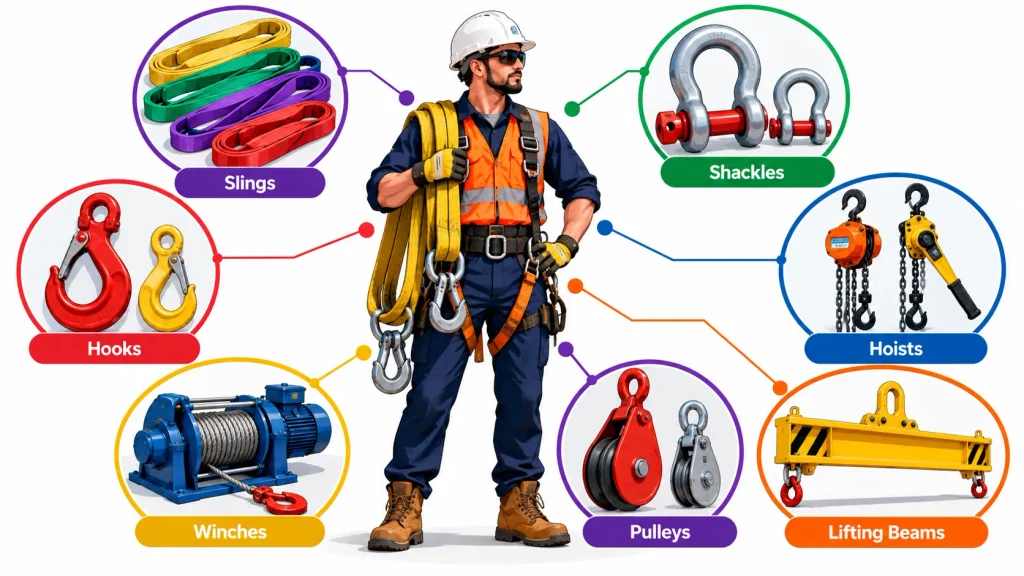
What Equipment Does a Rigger Use?
Riggers use a variety of lifting and rigging equipment to prepare, secure, lift, guide and position loads safely. Equipment selection depends on factors such as load weight, shape, centre of gravity, lifting configuration, working environment and manufacturer instructions. Each item must be suitable for the intended application and inspected before use where required.
Slings
Slings are among the most commonly used rigging accessories. They connect the load to the crane hook or other lifting equipment and must be selected according to the load and lifting arrangement.
Common types include:
- Wire-rope slings
- Chain slings
- Synthetic web slings
- Round slings
The rigger should consider rated capacity, sling angle, load characteristics, edge protection and environmental conditions before selecting a sling.
Shackles
Shackles provide secure connection points between lifting accessories, loads and other rigging components. They are commonly used with slings, lifting points and hooks.
A rigger should check:
- Rated capacity
- Correct shackle type
- Pin condition
- Identification markings
- Deformation or damage
- Compatibility with the lifting arrangement
Hooks
Hooks connect lifting equipment with slings, shackles and other accessories. They are available in different designs and capacities for specific lifting applications.
Before use, hooks should be checked for visible damage, excessive wear, deformation and other defects. The hook must also be suitable for the intended load and lifting configuration.
Hoists and Winches
Hoists and winches are used to lift, lower, pull or position loads. They may be manually operated, electrically powered, hydraulically operated or powered by other systems.
Selection depends on:
- Load capacity
- Required lifting distance
- Operating environment
- Lifting speed
- Intended application
Pulleys and Blocks
Pulleys and blocks can change the direction of a rope and, in suitable arrangements, provide mechanical advantage. They are particularly useful in controlled lifting, pulling and positioning operations.
The rigger must ensure that the equipment has an appropriate capacity and is configured according to manufacturer requirements and the lifting plan.
Spreader and Lifting Beams
Spreader beams and lifting beams can help distribute loads and maintain a suitable lifting arrangement. They are particularly useful when loads are long, wide, flexible or require controlled lifting points.
Their use requires careful consideration of:
- Beam capacity
- Load distribution
- Lifting-point locations
- Rigging configuration
- Manufacturer requirements
- Applicable lifting procedures
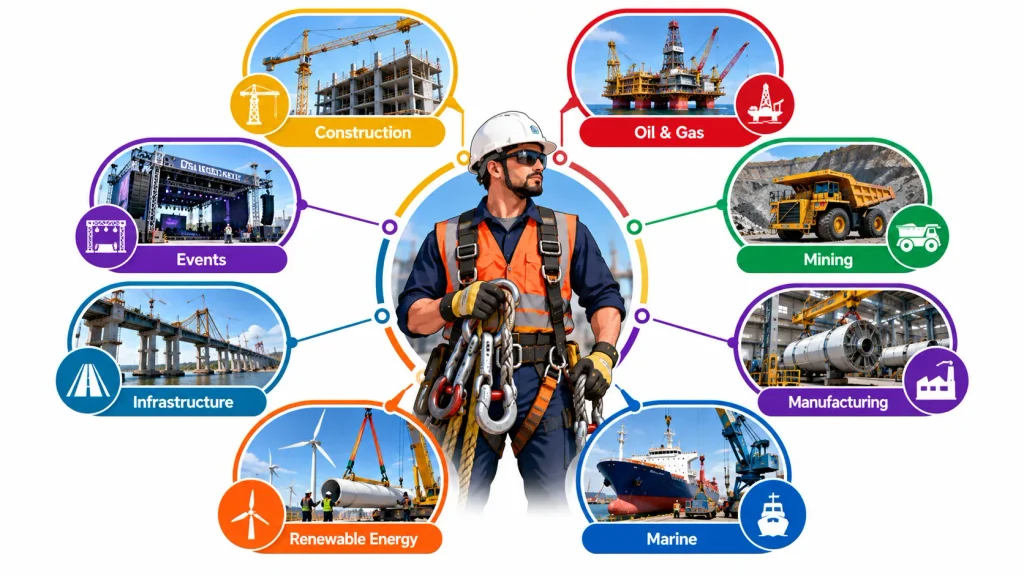
Where Do Riggers Work?
Riggers are employed across industries where heavy, oversized, complex or valuable loads need to be lifted, moved, positioned or installed safely. Their work is particularly important in construction, energy, manufacturing, mining, marine operations and large infrastructure projects. The exact duties and competency requirements can vary depending on the industry, equipment and country.
Construction
Construction is one of the most common employment areas for riggers. They support lifting operations involving structural components, machinery and building materials, often working alongside crane operators and lifting supervisors.
Typical activities include:
- Structural steel installation
- Construction machinery movement
- Precast component lifting
- Building material handling
- Tower crane operations
- Heavy plant installation
- Mechanical equipment positioning
Oil and Gas
The oil and gas industry requires riggers for complex lifting and equipment-handling operations. Riggers may work both onshore and offshore, where careful planning and strict safety procedures are essential.
Common work may involve:
- Offshore platforms
- Refineries
- Petrochemical facilities
- Shutdown and turnaround projects
- Heavy equipment installation
- Maintenance and replacement activities
Mining
Mining sites frequently use large and heavy machinery that must be installed, relocated, maintained or replaced. Riggers support these activities by preparing loads and coordinating their safe movement.
Mining riggers may handle:
- Mining machinery
- Processing equipment
- Structural components
- Motors and generators
- Heavy maintenance components
Manufacturing
Industrial and manufacturing facilities often require riggers when production machinery or large components need to be moved or installed. This can involve working within restricted spaces where accurate positioning is particularly important.
Typical equipment includes:
- Production machinery
- Motors
- Generators
- Industrial equipment
- Mechanical systems
Marine and Shipyards
Marine and shipyard environments involve large structural and mechanical components that require specialised lifting and positioning. Riggers may support construction, repair, maintenance and installation activities.
They may work with:
- Ship components
- Marine machinery
- Steel structures
- Cables and winches
- Heavy equipment
- Vessel maintenance components
Renewable Energy
Renewable-energy projects increasingly require specialised lifting and installation activities because wind turbines and other energy infrastructure can involve very large and heavy components. Riggers may support the transportation, lifting and positioning of these components during construction and maintenance.
Typical work can involve:
- Wind-turbine components
- Generators
- Structural sections
- Heavy mechanical equipment
- Renewable-energy infrastructure
This sector can provide opportunities for experienced riggers with appropriate specialist training and practical competence.
Entertainment and Events
Specialist riggers can also work in entertainment and event environments, where temporary structures and technical equipment need to be suspended or positioned safely. These operations can have different risks and competency requirements from construction and industrial rigging.
Typical applications include:
- Lighting systems
- Stage structures
- Audio equipment
- Trusses
- Temporary event installations
Because entertainment rigging can involve specialised equipment and temporary structures, learners should ensure that their training matches the specific type of rigging work they intend to perform.
What Qualifications Does a Rigger Need?
There is no single worldwide qualification that applies to every rigger.
Requirements depend on:
- Country
- State or province
- Industry
- Type of lifting operation
- Employer
- Risk level
- Equipment used
- Legal requirements
Some employers may require a recognised rigging qualification, practical competency assessment, site-specific training or a high-risk work licence.
For example, Australian career guidance highlights nationally recognised training and the relevant High Risk Work Licence pathway for regulated rigging work.
In Singapore, recognised rigger and signalman training includes both written and practical assessment, demonstrating that competency can involve both knowledge and hands-on performance.
Common Areas of Rigger Training
Depending on the jurisdiction, rigger training may cover:
- Basic rigging principles
- Lifting equipment
- Sling selection
- Load calculations
- Centre of gravity
- Load stability
- Signalling
- Crane operations awareness
- Inspection of lifting accessories
- Hazard identification
- Risk assessment
- Safe lifting procedures
- Emergency response
- Working at height
- Manual handling
A learner should verify that the qualification or training programme is recognised for the intended country and job role.
How to Become a Rigger
A typical career pathway can involve the following steps.
Step 1: Understand the Role
Before entering the occupation, a learner should understand the physical, technical and safety demands of rigging.
Step 2: Complete Appropriate Training
Select a recognised rigging or lifting qualification that matches the intended industry and jurisdiction.
Step 3: Develop Practical Competence
Rigging is a practical occupation. Classroom knowledge should be supported by supervised hands-on experience.
Step 4: Gain Site Experience
Entry-level positions, apprenticeships, trainee roles and supervised site work can help develop practical competence.
Step 5: Add Complementary Training
Depending on the career direction, useful additional training may include:
- Working at height
- Banksman or signalman training
- Manual handling
- Confined-space awareness
- Crane-related training
- Lifting supervision
- Occupational safety
- First aid
Step 6: Progress Through Specialisation
With experience, a rigger may move into advanced rigging, heavy lifting, offshore operations, renewable energy, industrial installation or supervisory positions.
QCS Staffing similarly identifies a combination of recognised training, practical experience and additional safety training as an important pathway into rigging careers.
What Are the Advantages of Becoming a Rigger?
Rigging can provide a strong career pathway for people who enjoy technical, practical and physically active work.
Strong Industry Relevance
Riggers are required wherever heavy materials, machinery or structural components need to be moved safely.
Multiple Industry Options
Skills can potentially transfer between:
- Construction
- Energy
- Manufacturing
- Mining
- Marine
- Infrastructure
- Industrial maintenance
- Renewable energy
- Events
Practical Career
Rigging provides hands-on work rather than being primarily office-based.
Career Progression
Experienced riggers can move toward:
- Senior rigger
- Advanced rigger
- Heavy-lift specialist
- Crane-related roles
- Lift supervisor
- Rigging supervisor
- Site supervision
- Lifting coordination
- Safety-related positions
Career resources identify progression toward supervisory and crane-related roles as possible pathways for experienced riggers.
International Opportunities
Heavy construction, infrastructure, energy and industrial projects exist across many countries. However, a qualification recognised in one jurisdiction may not automatically satisfy another country’s licensing requirements.
What Are the Challenges of Being a Rigger?
Rigging is a demanding occupation and is not suitable for everyone.
Physically Demanding Work
The job can involve carrying equipment, climbing, standing for long periods and working in challenging environments.
Working at Height
Some rigging activities involve elevated work and require appropriate fall-prevention and protection measures.
Weather Exposure
Outdoor riggers may work in heat, cold, rain, wind or other difficult conditions.
High Safety Responsibility
A rigger works around suspended loads and heavy equipment. Poor decisions can expose workers, property and projects to serious risk.
Irregular Working Hours
Major construction, shutdown, offshore and infrastructure projects may involve long shifts, night work, overtime or rotational schedules.
Continuous Competence Requirements
Rigging practices, equipment, legislation and employer requirements can change. Competent riggers need ongoing learning and refresher training where required.
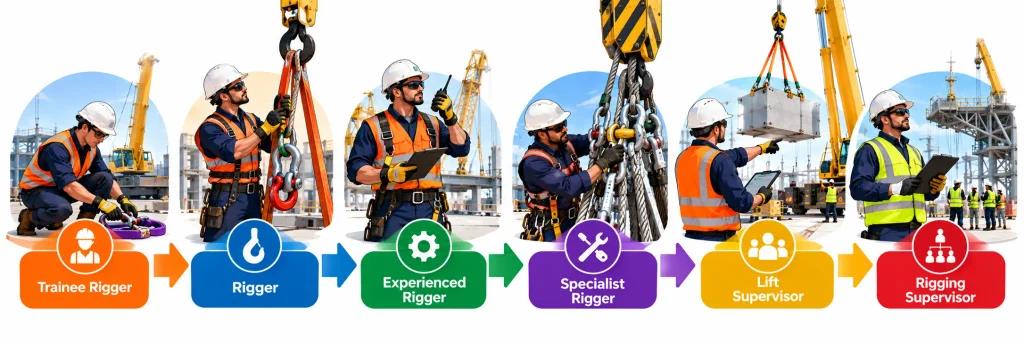
Rigger Career Progression
A possible career progression pathway is:
Trainee Rigger → Rigger → Experienced Rigger → Specialist/Advanced Rigger → Lift Supervisor → Rigging Supervisor → Lifting or Site Management
The pathway is not identical for every workplace.
Additional experience can also open opportunities in crane operations, heavy transport, lifting supervision, construction management, industrial maintenance and safety.
How a Rigger Supports Safe Lifting Operations
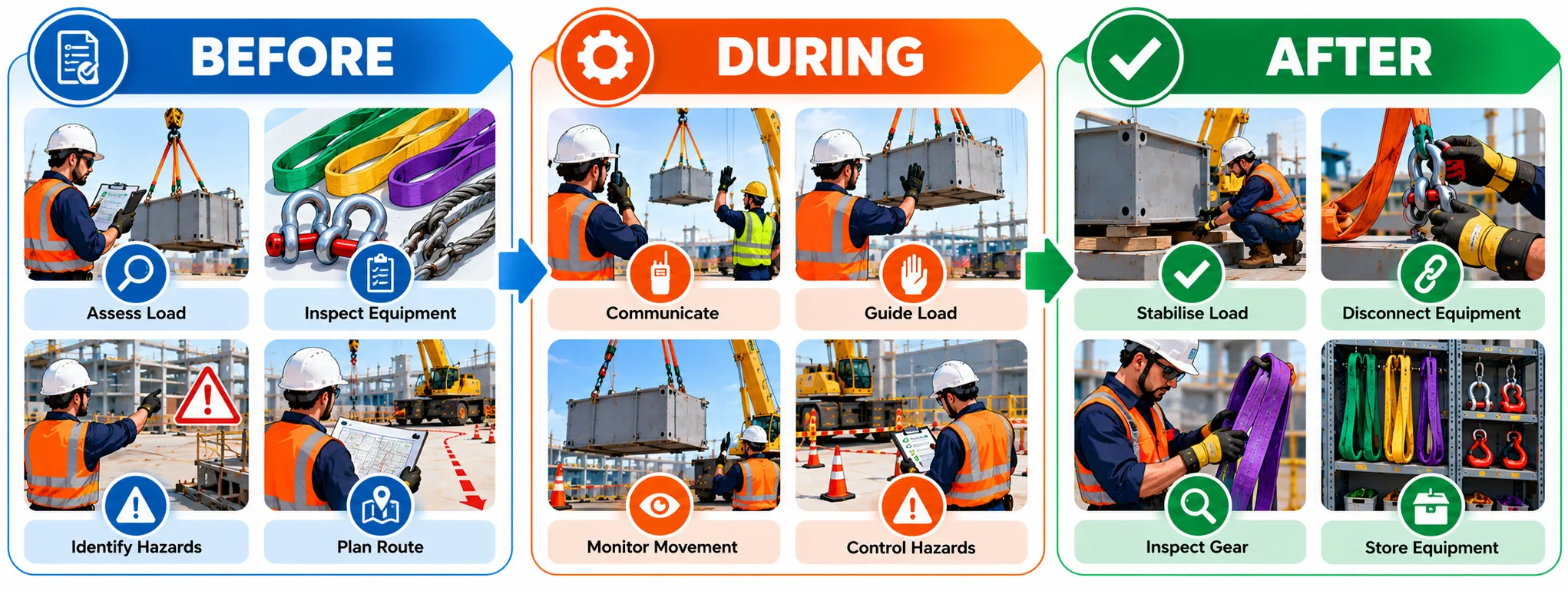
A rigger plays an important safety role throughout the entire lifting process, not only when a load is suspended. Safe rigging begins with careful preparation, continues through controlled lifting and ends with proper equipment removal and storage. By assessing hazards, selecting suitable equipment and maintaining effective communication, the rigger helps reduce avoidable lifting risks.
Before the Lift
Before lifting begins, the rigger helps ensure that the load and rigging arrangement are suitable for the planned operation. This preparation can include:
- Reviewing the load weight, dimensions and characteristics
- Checking designated lifting points
- Selecting suitable slings, shackles and other accessories
- Inspecting lifting equipment for damage or defects
- Assessing load stability and centre of gravity
- Reviewing the planned load path
- Identifying nearby structures, equipment and other hazards
- Participating in pre-lift briefings and communication checks
During the Lift
During the lifting operation, the rigger helps monitor the load and maintain coordination with the crane operator and lifting team. Key responsibilities may include:
- Maintaining clear communication with the lifting team
- Guiding the load using approved methods
- Monitoring load movement and stability
- Watching for obstructions and changing site conditions
- Maintaining a safe position away from suspended loads
- Communicating unexpected changes or hazards
- Stopping or escalating the operation when unsafe conditions arise
After the Lift
Once the load has been safely positioned, the rigger helps complete the operation in a controlled manner. Post-lift activities may include:
- Maintaining a clean and organised lifting area
- Confirming that the load is stable and properly positioned
- Safely disconnecting slings and other lifting accessories
- Inspecting equipment after use where required
- Removing damaged or defective equipment from service
- Storing lifting accessories correctly
- Reporting equipment defects or safety concerns
Why is a Rigger Important?
A crane provides the mechanical power required to lift a load, but safe lifting involves more than the crane’s lifting capacity. The rigger plays a vital role in preparing, securing, guiding and positioning loads so that lifting operations can be carried out in a controlled and safe manner.
The rigger connects the load, lifting accessories, lifting equipment, lifting plan and work team. Before a lift begins, the rigger helps assess the load, select suitable rigging equipment, inspect lifting accessories and identify potential hazards that could affect the operation.
A competent rigger can help to:
- Reduce avoidable lifting hazards
- Select and use suitable lifting accessories
- Improve load stability during lifting
- Support accurate load positioning
- Maintain effective communication with the lifting team
- Prevent misuse of slings, shackles, hooks and other equipment
- Identify damaged or unsuitable lifting accessories
- Reduce unnecessary damage to loads and lifting equipment
- Identify unsafe conditions before lifting begins
- Support efficient and controlled lifting operations
The importance of a rigger is particularly significant when handling heavy, irregular, suspended or difficult-to-position loads. Incorrect rigging can affect load stability, equipment performance and the safety of people working around the lifting area.
Is Rigging a Good Career?
Rigging can be a good career for learners who enjoy practical work, technical problem-solving, teamwork and physically active environments.
It may be particularly suitable for someone who:
- Enjoys working with equipment
- Has good spatial awareness
- Pays close attention to detail
- Can communicate clearly
- Is comfortable working outdoors
- Can follow safety procedures
- Wants a practical technical career
- Is interested in construction or heavy industry
However, anyone considering the occupation should understand the physical demands, safety responsibilities, working-at-height requirements and potentially demanding work schedules.
Conclusion
A rigger is a skilled professional who plays an essential role in safe lifting, load handling and equipment positioning across construction, energy, manufacturing, mining, marine and other industries. The role requires technical knowledge, practical competence, careful equipment inspection, effective communication and a strong commitment to workplace safety.
For learners considering rigging as a career, recognised training, supervised practical experience and continuous skills development can provide a strong foundation for progression. With experience and appropriate competencies, a rigger can advance into specialist rigging, heavy lifting, lifting supervision and other related construction or industrial roles.