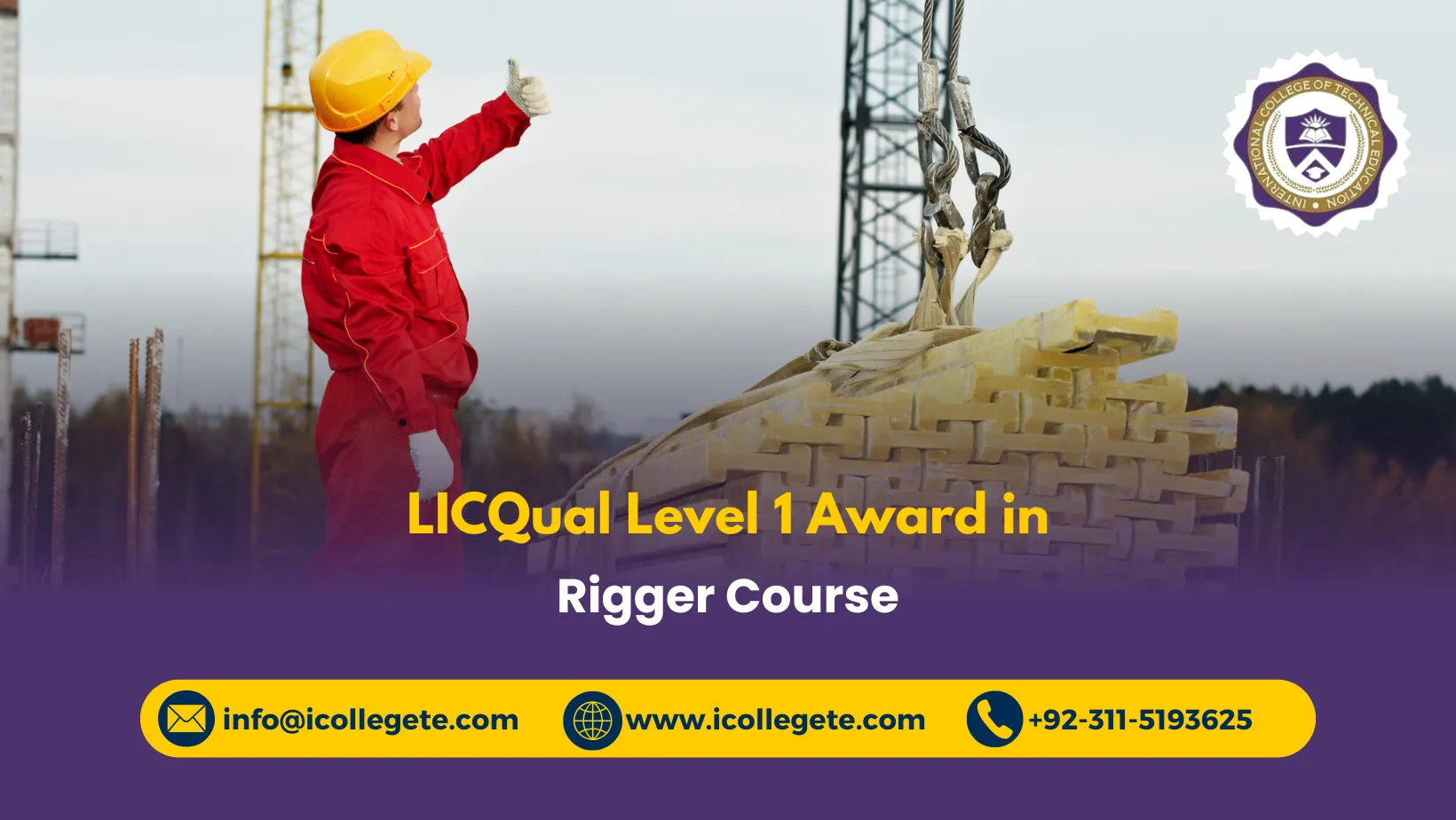
The LICQual Level 1 Award in Rigger Course in Pakistan is an entry-level qualification designed to provide learners with essential knowledge and practical understanding of rigging and lifting operations. The course introduces the fundamental responsibilities of a rigger, basic lifting principles, rigging equipment, load handling, hazard identification and safe working practices. It is suitable for learners who are beginning a career in construction, industrial operations, logistics, manufacturing and other workplaces where lifting and rigging activities are performed. The official LICQual Level 1 rigger qualification framework is designed around foundational rigging competence, equipment awareness, safe lifting procedures and workplace responsibilities.
The course develops awareness of commonly used rigging equipment and tools, including slings, shackles, hooks, ropes and related lifting accessories. Learners also develop an understanding of pre-use checks, load stability, safe lifting techniques, communication and the importance of following established lifting procedures. Risk assessment and hazard identification are integrated throughout the programme so that learners can recognise unsafe conditions before participating in lifting activities. These areas reflect the practical focus commonly associated with entry-level rigger training in Pakistan.
Through theoretical learning, practical exercises and workplace-based case studies, the qualification establishes a foundation for safe participation in rigging operations under appropriate supervision. The course can support learners seeking entry-level opportunities or additional competence in construction sites, industrial facilities, warehouses, manufacturing environments and other lifting-related workplaces. Successful completion can also provide a foundation for progression toward more advanced rigging and lifting qualifications and responsibilities.
Course Study Units
The LICQual Level 1 Award in Rigger Course in Pakistan consists of the following six study units:
Study Unit 1: Introduction to Rigging and Lifting Operations
This unit introduces the fundamental concepts of rigging and lifting operations. Learners explore the role of a rigger, common terminology, lifting activities and the relationship between riggers, crane operators, supervisors and other members of a lifting team.
Key Topics
- Fundamentals of rigging
- Purpose and importance of rigging
- Role and responsibilities of a rigger
- Basic lifting terminology
- Types of lifting operations
- Basic crane and lifting equipment awareness
- Load movement and positioning
- Communication within lifting teams
- Importance of safe systems of work
Study Unit 2: Rigging Equipment and Tools
This unit develops foundational knowledge of equipment and tools commonly used in rigging operations. Learners examine the purpose, selection, identification and basic inspection of lifting accessories.
Key Topics
- Wire rope slings
- Web slings
- Chain slings
- Shackles
- Hooks
- Eye bolts and lifting points
- Hoists and basic lifting accessories
- Tag lines
- Rigging tools
- Identification markings
- Working Load Limit and Safe Working Load concepts
- Pre-use inspection
- Equipment defects and rejection criteria
Study Unit 3: Principles of Load Handling and Safety
This unit focuses on the fundamental principles involved in handling loads safely. Learners develop awareness of load weight, balance, centre of gravity, stability and appropriate equipment selection.
Key Topics
- Load weight and dimensions
- Centre of gravity
- Load stability
- Load distribution
- Lifting points
- Sling configuration
- Load protection
- Safe Working Load and Working Load Limit
- Basic load-handling principles
- Avoiding shock loading
- Preventing uncontrolled load movement
Study Unit 4: Risk Assessment and Hazard Identification
This unit introduces learners to the identification and control of hazards associated with rigging and lifting activities. Risk awareness is essential because lifting operations can expose workers to suspended loads, moving equipment, pinch points and unstable loads.
Key Topics
- Hazard identification
- Basic risk assessment
- Lifting operation hazards
- Suspended loads
- Dropped-object hazards
- Crush and pinch points
- Uneven ground
- Overhead obstructions
- Poor weather conditions
- Damaged lifting equipment
- Unauthorised access
- Exclusion zones
- Control measures
- Personal protective equipment
Study Unit 5: Safe Use of Lifting Techniques
This unit introduces practical techniques for safely preparing and handling loads during basic lifting activities. Learners develop awareness of correct positioning, sling arrangement, load control and communication.
Key Topics
- Preparing for a lifting operation
- Selecting suitable lifting accessories
- Slinging basic loads
- Connecting and securing loads
- Maintaining load balance
- Use of tag lines
- Safe positioning of personnel
- Controlling load movement
- Standard communication principles
- Hand signals
- Coordination with crane operators
- Safe landing and positioning of loads
Study Unit 6: Workplace Safety and Compliance Standards
This unit develops an understanding of workplace safety responsibilities and the importance of complying with applicable procedures, standards and site requirements. The emphasis is on safe behaviour, PPE, communication, equipment inspection and following established lifting plans and instructions.
Key Topics
- Workplace safety responsibilities
- Site safety rules
- Personal protective equipment
- Safe systems of work
- Lifting plans
- Permit and authorisation requirements
- Equipment inspection requirements
- Communication procedures
- Emergency procedures
- Incident reporting
- Toolbox talks
- Environmental considerations
- Compliance with applicable workplace requirements
Study Unit 7: Practical Rigging Exercises and Case Studies
This unit provides opportunities to apply foundational knowledge to practical situations and workplace scenarios. Learners consider realistic lifting problems and practise basic rigging activities under appropriate supervision.
Key Topics
- Basic rigging preparation
- Equipment identification
- Pre-use equipment checks
- Sling selection
- Basic load securing
- Communication and signalling
- Load control
- Safe positioning
- Hazard recognition
- Practical lifting scenarios
- Case-study analysis
- Emergency response awareness
- Post-operation checks
Course Learning Outcomes
Upon successful completion of the LICQual Level 1 Award in Rigger Course in Pakistan, learners will be able to:
- Explain fundamental rigging and lifting concepts.
- Identify the responsibilities of a basic-level rigger.
- Identify commonly used lifting equipment and accessories.
- Explain basic principles of load handling and stability.
- Recognise common rigging and lifting hazards.
- Apply basic risk-control principles.
- Conduct basic pre-use visual checks of lifting equipment.
- Understand the importance of Working Load Limit and Safe Working Load information.
- Apply fundamental safe lifting techniques.
- Maintain safe positioning around lifting operations.
- Understand basic communication and signalling requirements.
- Follow workplace safety procedures and instructions.
- Recognise unsafe conditions and report them appropriately.
- Participate safely in supervised rigging activities.
- Apply foundational knowledge to practical rigging scenarios and case studies.
Course Benefits
Develops Foundational Rigging Knowledge
The course provides a structured introduction to rigging, lifting equipment, load handling and workplace safety, making it suitable for individuals entering the field.
Builds Equipment Awareness
Learners develop knowledge of commonly used slings, shackles, hooks, ropes and other lifting accessories and understand the importance of inspection before use.
Strengthens Safety Awareness
The qualification focuses strongly on hazard recognition, risk control, safe positioning, PPE and safe working procedures.
Supports Practical Skill Development
Practical exercises and case studies allow learners to connect theoretical knowledge with realistic lifting and rigging situations.
Supports Workplace Readiness
The qualification provides foundational knowledge relevant to construction, manufacturing, industrial maintenance, logistics and other environments involving lifting operations.
Develops Communication Skills
Learners understand the importance of clear communication, signalling and teamwork when working with crane operators, supervisors and lifting teams.
Provides a Foundation for Progression
The Level 1 qualification establishes foundational knowledge that can support progression into more advanced rigging, lifting and related vocational qualifications.
Who Is This Course For?
The LICQual Level 1 Award in Rigger Course in Pakistan can be suitable for:
- Individuals beginning a career in rigging and lifting.
- Entry-level construction workers.
- Junior rigging personnel.
- Warehouse and logistics workers involved in load handling.
- Industrial and manufacturing workers.
- Mechanical maintenance workers.
- Individuals interested in crane and lifting operations.
- Workers seeking structured training in basic rigging safety.
- Construction personnel who need foundational lifting knowledge.
- Individuals preparing for entry-level rigging responsibilities.
- Learners seeking an internationally oriented vocational qualification.
Prior rigging experience is not necessarily required for the entry-level LICQual rigger qualification; the official LICQual Level 1 framework indicates that applicants can enter without previous rigging experience, subject to the applicable centre requirements.
Entry Requirements
Typical entry requirements for the LICQual Level 1 rigger qualification include:
- Minimum age requirements specified by the approved training centre.
- Basic literacy and numeracy skills.
- Ability to understand safety instructions and technical information.
- Physical capability appropriate to the practical activities.
- No previous professional rigging experience is necessarily required.
Specific admission requirements may vary according to the approved training centre and delivery arrangements, so the centre’s current enrolment requirements should be checked before registration. The LICQual qualification information identifies Level 1 as an entry-level pathway without a requirement for previous rigging experience.
Why Choose the LICQual Level 1 Award in Rigger Course?
Entry-Level Professional Development
The qualification provides a structured starting point for learners who want to understand the fundamentals of rigging and lifting operations.
Practical Industry Focus
The course combines foundational theory with practical exercises, equipment awareness and case-study activities relevant to real workplace situations.
Safety-Centred Learning
Risk assessment, hazard identification, equipment inspection and safe lifting practices are incorporated throughout the learning programme.
Relevant to Multiple Industries
Rigging knowledge can be relevant to construction, manufacturing, industrial maintenance, logistics, engineering and other sectors where lifting operations take place.
Internationally Oriented Qualification
The course provides a structured vocational learning pathway focused on competencies that are relevant to lifting and rigging environments.
Clear Progression Route
Learners can use the Level 1 qualification as a foundation for developing more advanced knowledge and responsibilities in rigging and lifting operations. LICQual’s broader rigger qualification pathways include more advanced equipment, lifting, inspection and high-risk-environment competencies.
Future Progression
After completing the LICQual Level 1 Award in Rigger Course in Pakistan, learners may consider progressing through relevant rigging and lifting qualifications and workplace responsibilities.
A typical progression pathway can include:
LICQual Level 1 Award in Rigger
↓
Intermediate Rigger / Slinger and Signaller Training
↓
Advanced Rigging and Lifting Qualifications
↓
Specialist Rigging Competence
↓
Senior Rigger / Rigging Team Responsibilities
Progression may involve developing competence in areas such as:
- Advanced rigging systems
- Complex load handling
- Load calculations
- Lift planning
- Crane signalling
- Rigging equipment inspection
- High-risk lifting environments
- Supervisory rigging responsibilities
- Lifting operations coordination
LICQual’s wider professional rigger pathway includes advanced rigging techniques, high-risk environments, inspection, maintenance and regulatory compliance, providing examples of the competencies that can be developed beyond entry-level learning.
Take the Next Step Toward World LICQual Level 1 Award in Rigger Course-Enroll Now