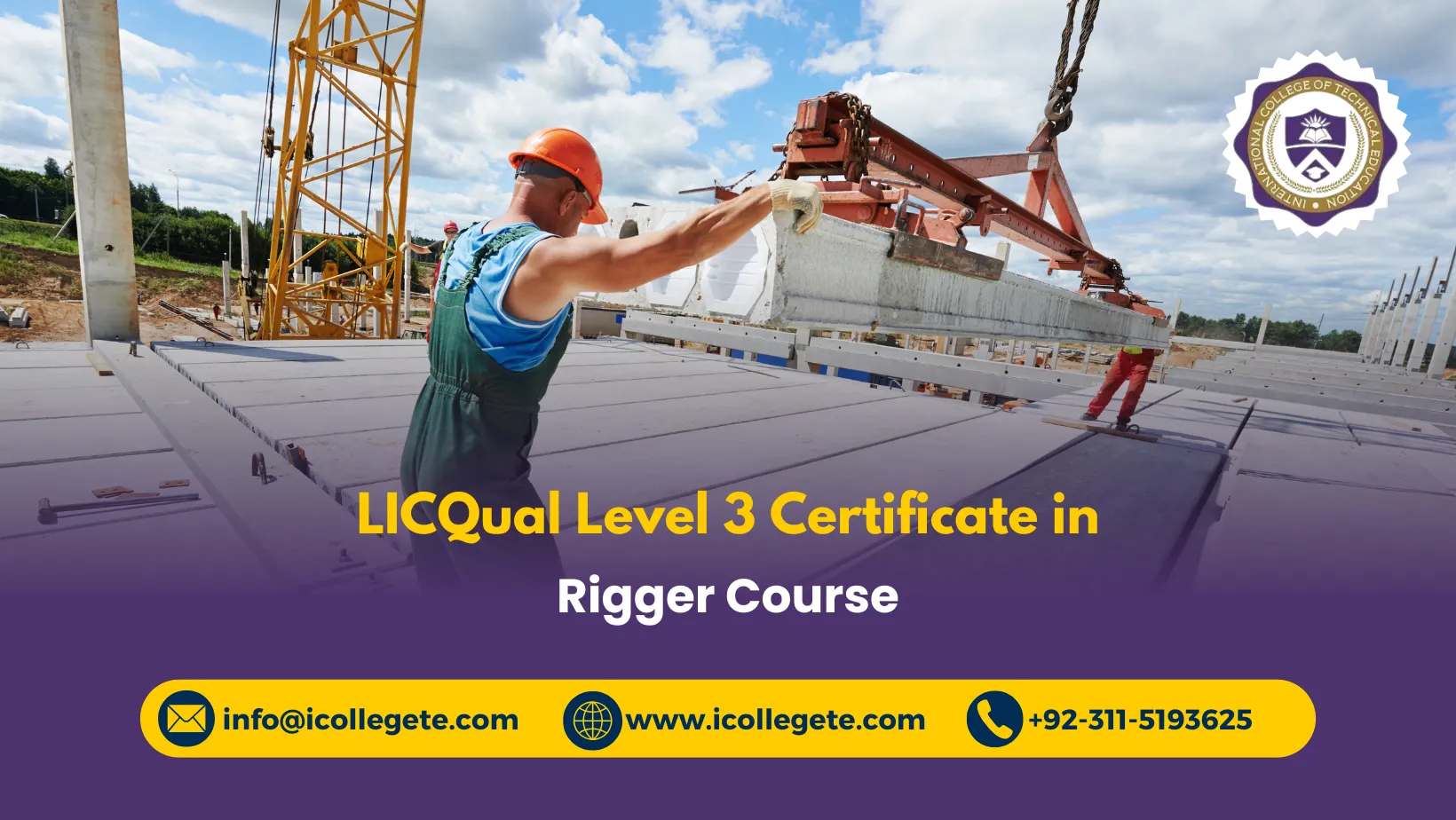
The LICQual Level 3 Certificate in Rigger Course in Peshawar is designed for learners seeking advanced knowledge and practical skills in rigging, lifting operations, load handling, and workplace lifting safety. The course develops the technical competence required to plan, prepare, inspect and carry out rigging activities involving heavy, complex and non-standard loads across construction, engineering, manufacturing, oil and gas, logistics, industrial maintenance and other lifting environments.
This rigger course builds on fundamental rigging knowledge by introducing advanced load calculations, weight estimation, rigging equipment selection, lifting methods, risk assessment and complex lifting procedures. Learners develop an understanding of how to identify hazards, select appropriate lifting accessories, control risks and apply safe working practices during lifting operations.
The qualification also focuses on inspection and maintenance of rigging equipment, helping learners recognise defects, wear, damage and conditions that could compromise lifting safety. Practical exercises and simulations provide opportunities to apply rigging principles in realistic workplace situations.
Based in Peshawar, this course can support learners who want to strengthen their professional rigging capabilities and improve their readiness for industrial lifting environments. It is particularly suitable for individuals progressing from basic rigging responsibilities toward more advanced operational and supervisory roles.
Course Overview
The LICQual Level 3 Certificate in Rigger Course in Peshawar is designed to develop advanced rigging, lifting, load calculation, and workplace safety skills. This vocational qualification comprises 8 study units covering international safety standards, rigging equipment handling, complex load estimation, heavy-load lifting, advanced rigging techniques, equipment inspection, risk assessment, and practical rigging exercises. Learners gain essential knowledge to support safe and efficient lifting operations across construction, engineering, manufacturing, and industrial environments. The course is suitable for aspiring and experienced riggers seeking to enhance technical competence, improve workplace safety awareness, and explore career progression opportunities in professional rigging and lifting operations.
Entry Requirements
To enroll in the LICQual Level 3 Certificate in Rigger Course in Peshawar, applicants must meet the following criteria:
- Age Requirements: Applicants must be at least 18 years old.
- Qualification Requirements: A minimum of matriculation or equivalent qualification is required.
- Professional Experience: Prior rigging or industrial work experience is strongly preferred.
- Educational Background: Candidates with technical or vocational education will be given preference.
- Language Proficiency: Basic understanding of English or Urdu is required to follow course materials.
Course Study Units
Unit 1: Advanced Rigging and International Safety Standards
This unit develops advanced knowledge of rigging principles and internationally recognised approaches to lifting safety. Learners explore safe systems of work, lifting responsibilities, industry terminology, applicable safety requirements and the importance of following approved procedures.
Learners will develop knowledge of:
- Advanced rigging principles
- International lifting safety practices
- Roles and responsibilities within lifting teams
- Safe systems of work
- Lifting plans and method statements
- Communication during lifting operations
- Exclusion zones and controlled lifting areas
- Relevant workplace safety requirements
- Good practice for preventing lifting incidents
- Professional responsibilities of riggers
Unit 2: Rigging Tools and Equipment Handling
This unit focuses on selecting, handling and using rigging tools and lifting accessories safely. Learners examine the characteristics and applications of equipment used for different lifting operations.
Key areas include:
- Slings and lifting accessories
- Shackles and connecting devices
- Hooks and lifting points
- Wire rope equipment
- Chain slings
- Webbing slings
- Spreader beams and lifting beams
- Clamps and specialised lifting accessories
- Equipment identification and safe handling
- Safe storage and protection of rigging equipment
Learners also develop the ability to select equipment according to load characteristics, lifting requirements and safe working limits.
Unit 3: Complex Load Calculations and Weight Estimation
This unit introduces the calculations and estimation techniques required for more complex lifting operations. Learners develop the ability to evaluate load characteristics and understand how load distribution affects lifting safety.
Topics include:
- Load weight estimation
- Centre of gravity
- Load distribution
- Sling angles
- Sling tension
- Working Load Limit (WLL)
- Safe Working Load (SWL)
- Load-bearing capacity
- Lifting point selection
- Basic lifting calculations
- Uneven and asymmetrical loads
- Factors affecting lifting capacity
Learners will understand why accurate load information is essential when selecting lifting equipment and planning a safe lifting operation.
Unit 4: Safe Lifting Practices for Heavy Loads
This unit develops advanced knowledge of safe lifting practices for heavy and challenging loads. Learners examine how lifting operations should be prepared, controlled and monitored.
The unit covers:
- Heavy-load lifting principles
- Pre-lift preparation
- Ground and site conditions
- Load stability
- Crane and lifting equipment coordination
- Safe positioning of riggers
- Communication and signalling
- Exclusion zones
- Weather considerations
- Suspended-load hazards
- Emergency procedures
- Controlled lifting and lowering
- Safe placement of loads
Learners develop an understanding of how effective preparation and communication can reduce the risk of dropped loads, equipment failure and personnel injury.
Unit 5: Rigging Procedures and Advanced Techniques
This unit focuses on advanced rigging procedures used for complex lifting activities. Learners explore different rigging configurations and techniques and develop the ability to determine appropriate methods for particular loads.
Areas of study include:
- Advanced sling configurations
- Multi-leg lifting arrangements
- Load balancing
- Controlled lifting techniques
- Tagline use
- Tandem lifting principles
- Lifting awkward and irregular loads
- Rigging for restricted areas
- Load positioning techniques
- Communication during complex lifts
- Coordinating rigging teams
- Following approved lifting procedures
The unit emphasises the importance of following an approved lifting plan and using appropriate equipment for each specific operation.
Unit 6: Inspection and Maintenance of Rigging Equipment
This unit develops competence in checking rigging equipment before and after use and recognising conditions that may make equipment unsafe.
Learners study:
- Pre-use equipment inspections
- Periodic inspection principles
- Identification of damage and defects
- Wire rope deterioration
- Sling damage
- Shackle and hook defects
- Corrosion and deformation
- Wear and abrasion
- Equipment identification and traceability
- Inspection records
- Quarantine and removal of defective equipment
- Safe storage and maintenance practices
Learners understand that damaged or unsuitable equipment should not be used for lifting operations.
Unit 7: Risk Assessment and Hazard Control
This unit develops advanced skills in identifying hazards associated with rigging and lifting operations and implementing suitable control measures.
Learners explore:
- Hazard identification
- Risk assessment
- Dropped-object hazards
- Overloading risks
- Equipment failure
- Poor ground conditions
- Environmental hazards
- Personnel positioning
- Crush and trapping hazards
- Communication failures
- Control measures
- Emergency planning
- Dynamic risk assessment
- Monitoring and reviewing controls
The unit encourages learners to consider changing workplace conditions and apply appropriate controls throughout lifting operations.
Unit 8: Practical Rigging Exercises and Simulations
This practical unit allows learners to apply knowledge and skills in controlled rigging activities and realistic lifting scenarios.
Practical activities may include:
- Identifying rigging equipment
- Selecting suitable lifting accessories
- Inspecting equipment
- Estimating load weights
- Identifying centres of gravity
- Preparing lifting arrangements
- Applying correct rigging techniques
- Connecting lifting accessories
- Performing controlled lifting activities
- Using communication and signalling methods
- Establishing exclusion zones
- Identifying unsafe conditions
- Responding to simulated lifting hazards
- Completing post-operation checks
The practical element helps learners develop confidence, accuracy and safe working behaviour when performing rigging tasks.
Learning Outcomes
On successful completion of the LICQual Level 3 Certificate in Rigger Course in Peshawar, learners should be able to:
- Explain advanced rigging principles and international safety practices.
- Identify and select appropriate rigging tools and lifting accessories.
- Estimate load weights and assess load characteristics.
- Apply basic and advanced load calculation principles.
- Determine suitable lifting arrangements for different loads.
- Apply safe practices when handling heavy and complex loads.
- Understand sling angles, load distribution and lifting capacity.
- Perform advanced rigging procedures safely.
- Inspect rigging equipment for defects, wear and damage.
- Understand equipment maintenance and storage requirements.
- Identify hazards associated with lifting operations.
- Conduct suitable risk assessments for rigging activities.
- Apply appropriate control measures to reduce lifting risks.
- Communicate effectively with lifting teams.
- Apply practical rigging techniques in controlled exercises.
- Respond appropriately to changing conditions and simulated emergencies.
- Support safe, organised and controlled lifting operations.
Course Benefits
The LICQual Level 3 Certificate in Rigger Course in Peshawar can provide learners with several professional and practical benefits:
- Develop advanced rigging and lifting knowledge.
- Improve understanding of heavy-load lifting operations.
- Build confidence in selecting rigging equipment.
- Develop load calculation and weight estimation skills.
- Strengthen workplace lifting safety awareness.
- Improve hazard identification and risk-control abilities.
- Develop equipment inspection and defect-recognition skills.
- Gain practical experience through rigging exercises and simulations.
- Improve communication and coordination within lifting teams.
- Support progression toward more responsible rigging roles.
- Develop transferable skills for construction and industrial environments.
- Strengthen professional understanding of safe lifting procedures.
Who is This Course For?
The LICQual Level 3 Certificate in Rigger Course in Peshawar is suitable for:
- Riggers seeking advanced professional training.
- Experienced lifting and rigging workers.
- Construction site personnel involved in lifting operations.
- Crane and lifting support personnel.
- Banksmen and lifting team members seeking progression.
- Mechanical and industrial workers involved in load handling.
- Oil and gas industry personnel.
- Manufacturing and engineering workers.
- Warehouse and logistics personnel involved in heavy-load handling.
- Maintenance personnel working with lifting equipment.
- Supervisors responsible for rigging and lifting activities.
- Learners seeking to develop a professional career in rigging.
Why Choose This Course?
The LICQual Level 3 Certificate in Rigger Course in Peshawar provides a structured pathway for learners who want to develop advanced rigging competence. Rather than focusing only on basic equipment identification, the course covers load calculations, complex lifting arrangements, equipment inspection, risk assessment and practical rigging activities.
Key reasons to choose this course include:
- Advanced focus on rigging and lifting operations.
- Practical and workplace-oriented learning.
- Coverage of heavy and complex load handling.
- Focus on risk assessment and hazard control.
- Development of equipment inspection skills.
- Practical exercises and simulated lifting scenarios.
- Alignment with professional workplace expectations.
- Suitable for construction and industrial environments.
- Supports progression toward experienced rigging responsibilities.
- Develops transferable technical and safety skills.
Future Progression
Successful completion of the LICQual Level 3 Certificate in Rigger Course can support learners in progressing toward more advanced responsibilities within lifting, rigging, construction and industrial operations.
Potential progression routes may include:
- Senior Rigger
- Advanced Rigger
- Rigging Team Leader
- Lifting Operations Supervisor
- Rigging Supervisor
- Lifting Coordinator
- Crane Operations Support
- Heavy-Lift Operations
- Construction Site Lifting Roles
- Industrial Maintenance and Lifting Roles
- Oil and Gas Rigging Operations
- Specialist Rigging and Load Handling
With additional experience and relevant training, learners may also progress toward supervisory and lifting-planning responsibilities. Further specialist development in areas such as crane operations, lifting supervision, lifting planning, inspection, health and safety or construction management can strengthen long-term career opportunities.
Take the Next Step Toward World LICQual Level 3 Certificate in Rigger Course – Enroll Now