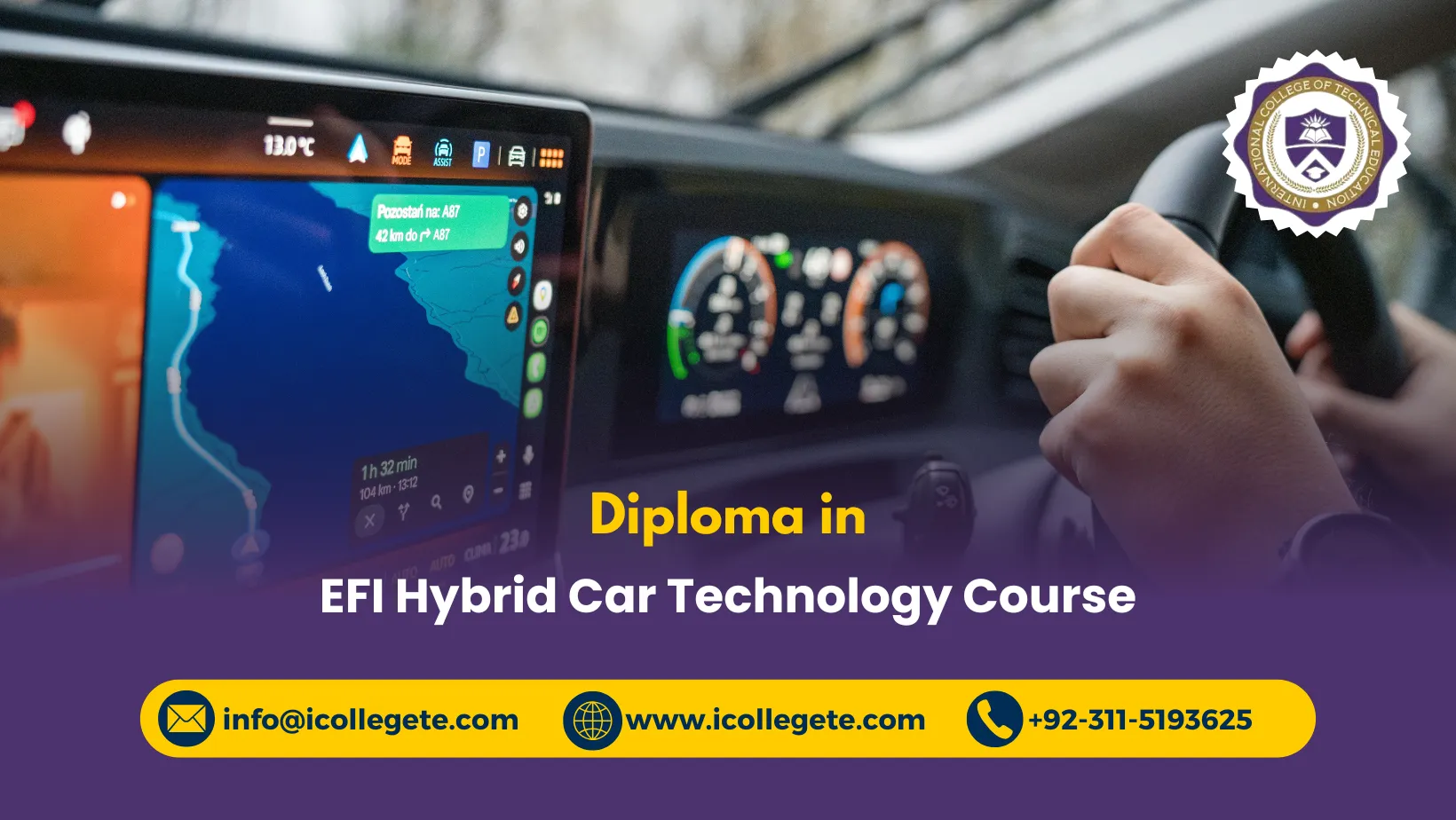
The Diploma in EFI Hybrid Car Technology Course in Rawalpindi is designed to develop practical and technical competence in modern vehicle systems, combining Electronic Fuel Injection (EFI), automotive electrical systems, electronic control units, sensors, diagnostics, and hybrid vehicle technology. As modern vehicles increasingly depend on electronic control, computerised diagnostics, and hybrid powertrain systems, automotive technicians require skills that extend beyond conventional mechanical repair. Current automotive training programmes in Rawalpindi similarly emphasise EFI diagnostics, hybrid systems, sensors, ECUs, wiring, diagnostic scanners, and workshop safety.
The course provides a structured pathway for learners to understand how EFI and hybrid systems operate, how electrical circuits communicate with vehicle control systems, and how faults can be identified using appropriate diagnostic methods. Learners develop knowledge of wiring diagrams, sensors, ECUs, diagnostic equipment, fault codes, electrical measurements, and systematic troubleshooting.
Practical application is an important component of the programme, enabling learners to connect theoretical knowledge with automotive workshop situations. The curriculum also introduces appropriate safety practices for working around automotive electrical and hybrid systems, where controlled procedures and suitable protective equipment are essential.
By completing the Diploma in EFI Hybrid Car Technology Course in Rawalpindi, learners can develop job-relevant skills for automotive workshops, diagnostic centres, vehicle service facilities, dealerships, and independent automotive businesses.
Course Overview
The Diploma in EFI Hybrid Car Technology Course in Rawalpindi focuses on the integration of EFI technology, vehicle electronics, electrical circuits, sensors, ECUs, diagnostic systems, troubleshooting, and hybrid vehicle technology.
The course is suitable for both aspiring automotive technicians and existing mechanics seeking to upgrade from conventional vehicle repair to modern electronically controlled and hybrid vehicles. The selected study units provide a progression from fundamental EFI and hybrid concepts to electrical diagnosis, electronic control, fault identification, and safe workshop practices.
Entry Requirements
To enroll in the Diploma in EFI Hybrid Car Technology Course in Rawalpindi , applicants must meet basic eligibility criteria to ensure readiness for both theoretical and practical training.
- Age Requirement: Minimum age of 18 years
- Qualification Requirement: Secondary school certificate or equivalent
- Professional Experience: Prior exposure to automotive or technical environments preferred but not mandatory
- Educational Background: Basic knowledge of science or vocational subjects is beneficial
- Language Proficiency: Ability to communicate in Urdu or English for documentation and workplace coordination
Course Study Units
Unit 1: Fundamentals of EFI Hybrid Systems
This unit introduces the operating principles and components of Electronic Fuel Injection and hybrid vehicle systems. Learners explore how fuel delivery, air management, electronic control and hybrid powertrain components work together.
Key topics include:
- Introduction to Electronic Fuel Injection
- EFI system components and operation
- Fuel injection control principles
- Fuel pumps and fuel injectors
- Throttle body and air management
- Introduction to hybrid vehicle technology
- Hybrid powertrain configurations
- Electric motors and generators
- Hybrid batteries and energy flow
- Inverters and converters
- Regenerative braking principles
- Electronic control of engine and hybrid systems
- Comparison of conventional and hybrid vehicle systems
Unit 2: Vehicle Wiring and Electrical Circuits
This unit develops understanding of automotive electrical principles and vehicle wiring systems. Learners study how electrical power and signals are distributed throughout modern vehicles and how wiring faults can affect system performance.
Key topics include:
- Automotive electrical fundamentals
- Voltage, current and resistance
- Ohm’s Law
- Series and parallel circuits
- Automotive batteries and power supplies
- Fuses, relays and circuit protection
- Wiring harnesses and connectors
- Grounding and earth circuits
- Automotive wiring diagrams
- Circuit continuity and voltage testing
- Electrical fault isolation
- CAN communication fundamentals
- Safe electrical testing procedures
Unit 3: Sensors and Electronic Control Units (ECUs)
This unit focuses on the electronic components that monitor and control vehicle operation. Learners examine how sensors collect information and how ECUs process inputs to control fuel injection, ignition, emissions and hybrid vehicle functions.
Key topics include:
- Purpose and operation of automotive sensors
- Throttle Position Sensor (TPS)
- Mass Air Flow (MAF) sensor
- Manifold Absolute Pressure (MAP) sensor
- Oxygen and air-fuel ratio sensors
- Crankshaft and camshaft position sensors
- Coolant temperature sensors
- Wheel speed and vehicle speed sensors
- Hybrid battery monitoring sensors
- Engine Control Units
- Hybrid control units
- Electronic signals and sensor outputs
- ECU communication and control strategies
- Basic ECU diagnostic procedures
Unit 4: Diagnostic Tools and Techniques
This unit develops practical diagnostic competence using modern automotive testing and scanning equipment. Learners develop a systematic approach to identifying faults rather than relying solely on component replacement.
Key topics include:
- Introduction to automotive diagnostics
- OBD and OBD-II systems
- Diagnostic scanners
- Diagnostic Trouble Codes (DTCs)
- Live data analysis
- Digital multimeter applications
- Voltage and resistance testing
- Continuity testing
- Basic oscilloscope applications
- Sensor waveform interpretation
- ECU communication diagnosis
- Hybrid system diagnostic functions
- Diagnostic reports and documentation
- Systematic diagnostic procedures
Modern EFI and hybrid training commonly incorporates diagnostic scanners, multimeters, oscilloscopes and live-data interpretation to support vehicle fault diagnosis.
Unit 5: Fault Detection and Troubleshooting
This unit develops structured troubleshooting skills for EFI, electrical and hybrid vehicle systems. Learners examine symptoms, interpret diagnostic information, identify possible causes and select appropriate corrective actions.
Key topics include:
- Principles of automotive fault diagnosis
- Fault symptoms and system behaviour
- Intermittent and permanent faults
- EFI system faults
- Fuel injection faults
- Sensor-related faults
- Wiring and connection faults
- ECU-related faults
- Battery and charging system faults
- Hybrid system warning conditions
- Diagnostic trouble code analysis
- Root-cause identification
- Fault isolation techniques
- Repair verification and testing
- Preventive troubleshooting practices
Unit 6: Safety Standards and Workshop Practices
This unit establishes safe working practices for automotive workshops, particularly when dealing with electrical and hybrid vehicle systems.
Key topics include:
- Automotive workshop safety
- Personal protective equipment
- Electrical safety procedures
- Hybrid vehicle safety precautions
- High-voltage system awareness
- Isolation and de-energisation procedures
- Safe use of insulated tools
- Battery handling precautions
- Fire and emergency procedures
- Safe use of diagnostic equipment
- Automotive fluid and chemical handling
- Workshop housekeeping
- Risk identification and control
- Safe vehicle lifting and support
- Accident and incident prevention
Hybrid vehicle training programmes commonly include high-voltage awareness, insulated tools, system shutdown/isolation procedures and emergency response as important workshop competencies.
Course Learning Outcomes
By completing the Diploma in EFI Hybrid Car Technology Course in Rawalpindi, learners will be able to:
EFI and Hybrid Systems
- Explain the fundamental principles of EFI technology.
- Describe the major components of hybrid vehicle systems.
- Explain the relationship between engine, electrical and hybrid powertrain systems.
- Identify major EFI and hybrid system components.
- Explain basic energy flow within hybrid vehicles.
Vehicle Electrical Systems
- Explain basic automotive electrical principles.
- Interpret vehicle wiring diagrams.
- Identify electrical circuits and their components.
- Perform basic voltage, resistance and continuity testing.
- Identify common wiring and connection faults.
Sensors and ECUs
- Identify common automotive sensors and their functions.
- Explain how sensors provide information to ECUs.
- Interpret basic sensor outputs.
- Explain the role of ECUs in engine and hybrid control.
- Conduct basic ECU-related diagnostic checks.
Diagnostics
- Operate appropriate automotive diagnostic equipment.
- Retrieve and interpret Diagnostic Trouble Codes.
- Analyse basic vehicle live data.
- Use a digital multimeter for automotive testing.
- Apply systematic diagnostic procedures.
Fault Detection and Troubleshooting
- Identify symptoms associated with common EFI and hybrid faults.
- Analyse possible causes of vehicle system problems.
- Apply structured troubleshooting techniques.
- Verify corrective actions through testing.
- Document diagnostic findings accurately.
Safety and Workshop Practice
- Apply appropriate automotive workshop safety procedures.
- Recognise hazards associated with hybrid electrical systems.
- Use suitable PPE and insulated equipment where required.
- Apply safe isolation and de-energisation principles.
- Maintain a safe and organised workshop environment.
Course Benefits
Practical Automotive Technology Skills
The course develops practical knowledge relevant to modern vehicles, including EFI systems, sensors, ECUs, electrical circuits and hybrid technology.
Diagnostic Competence
Learners develop the ability to use diagnostic scanners, electrical testing equipment and systematic fault-finding methods rather than depending solely on traditional mechanical inspection.
Hybrid Vehicle Knowledge
The programme introduces the architecture and operation of hybrid vehicles, including batteries, electric motors, inverters, control systems and regenerative braking.
Improved Technical Versatility
Combining EFI, electrical and hybrid technologies enables learners to develop a broader automotive skill set suitable for modern workshops and diagnostic environments.
Workshop Safety Awareness
Learners develop awareness of electrical and hybrid vehicle hazards and appropriate workshop controls, supporting safer working practices.
Career Development
The qualification can support progression toward technician-level roles in automotive workshops, service centres, diagnostic facilities and vehicle maintenance businesses.
Who is This Course For?
The Diploma in EFI Hybrid Car Technology Course in Rawalpindi is suitable for:
- Aspiring automotive technicians
- Auto mechanics
- EFI technicians
- Automotive electricians
- Vehicle diagnostic technicians
- Workshop technicians
- Automotive engineering students
- Mechanical engineering learners
- Vehicle service professionals
- Workshop owners and supervisors
- Technicians upgrading from conventional vehicles
- Individuals interested in hybrid vehicle technology
- Entrepreneurs planning an automotive diagnostic or repair business
Existing mechanics can particularly benefit from the programme because modern vehicle repair increasingly requires knowledge of electronic control, diagnostic scanners, sensors and hybrid systems.
Why Choose the Diploma in EFI Hybrid Car Technology Course in Rawalpindi?
Focused on Modern Vehicle Technology
The course addresses technologies increasingly found in modern vehicles, including EFI, electronic control, sensors, computerised diagnostics and hybrid systems.
Combines Electrical and Mechanical Knowledge
Learners develop an integrated understanding of vehicle operation rather than studying mechanical systems in isolation.
Strong Diagnostic Focus
The programme emphasises fault codes, electrical testing, sensor analysis and systematic troubleshooting, which are central to modern automotive servicing.
Suitable for Beginners and Existing Technicians
The learning structure can support learners entering automotive technology as well as experienced mechanics seeking to upgrade existing technical skills.
Practical Workshop Application
The subject areas are structured around real automotive systems and diagnostic situations, helping learners connect theoretical principles with practical vehicle servicing.
Relevant to Rawalpindi’s Automotive Sector
Rawalpindi and the wider Islamabad–Rawalpindi region have training providers offering EFI, hybrid, automotive electrical and diagnostic programmes, reflecting local interest in modern vehicle technologies.
Future Progression
Successful completion of the Diploma in EFI Hybrid Car Technology Course in Rawalpindi can provide a foundation for continued development in several automotive technology areas.
Automotive Diagnostic Technician
Learners can progress toward specialist diagnostic roles involving vehicle scanners, electronic control systems, sensor testing, wiring diagnosis and fault-code analysis.
EFI Specialist
Further technical development can lead toward advanced EFI diagnostics, fuel-system analysis, engine management and electronic fuel-control systems.
Hybrid Vehicle Technician
Additional specialist training can build competence in hybrid battery systems, high-voltage safety, inverter systems, electric motors, battery management and hybrid control systems.
Automotive Electrical Specialist
Learners can develop further expertise in automotive wiring, electronic circuits, CAN communication, electrical fault finding and vehicle control modules.
Workshop Management
Experienced technicians may progress toward workshop supervisory and management responsibilities, combining technical knowledge with job-card preparation, customer communication, workflow planning and quality control.
Automotive Business Development
The knowledge gained can also provide a foundation for establishing or developing an automotive repair, EFI diagnostic or hybrid vehicle service business, subject to relevant local business, technical and safety requirements.
Further Technical Specialisation
Future learning may include:
- Advanced automotive diagnostics
- Hybrid and electric vehicle technology
- Automotive ECU programming
- CAN Bus diagnostics
- Automotive electrical systems
- Battery management systems
- Electric vehicle technology
- Advanced engine management
- Automotive oscilloscope diagnostics
- Vehicle electronics and control systems
Career Opportunities
Depending on additional experience, practical competence and employer requirements, graduates may pursue roles such as:
- EFI Technician
- Hybrid Vehicle Technician
- Automotive Diagnostic Technician
- Automotive Electrician
- Vehicle Service Technician
- Automotive Electronics Technician
- Workshop Technician
- Hybrid System Diagnostic Assistant
- Vehicle Maintenance Technician
- Automotive Workshop Supervisor
The wider automotive training market in Rawalpindi currently highlights roles and skills associated with EFI diagnostics, hybrid systems, ECU programming, vehicle electronics and diagnostic equipment.
Take the Next Step Toward Diploma in EFI Hybrid Car Technology Course – Enroll Now