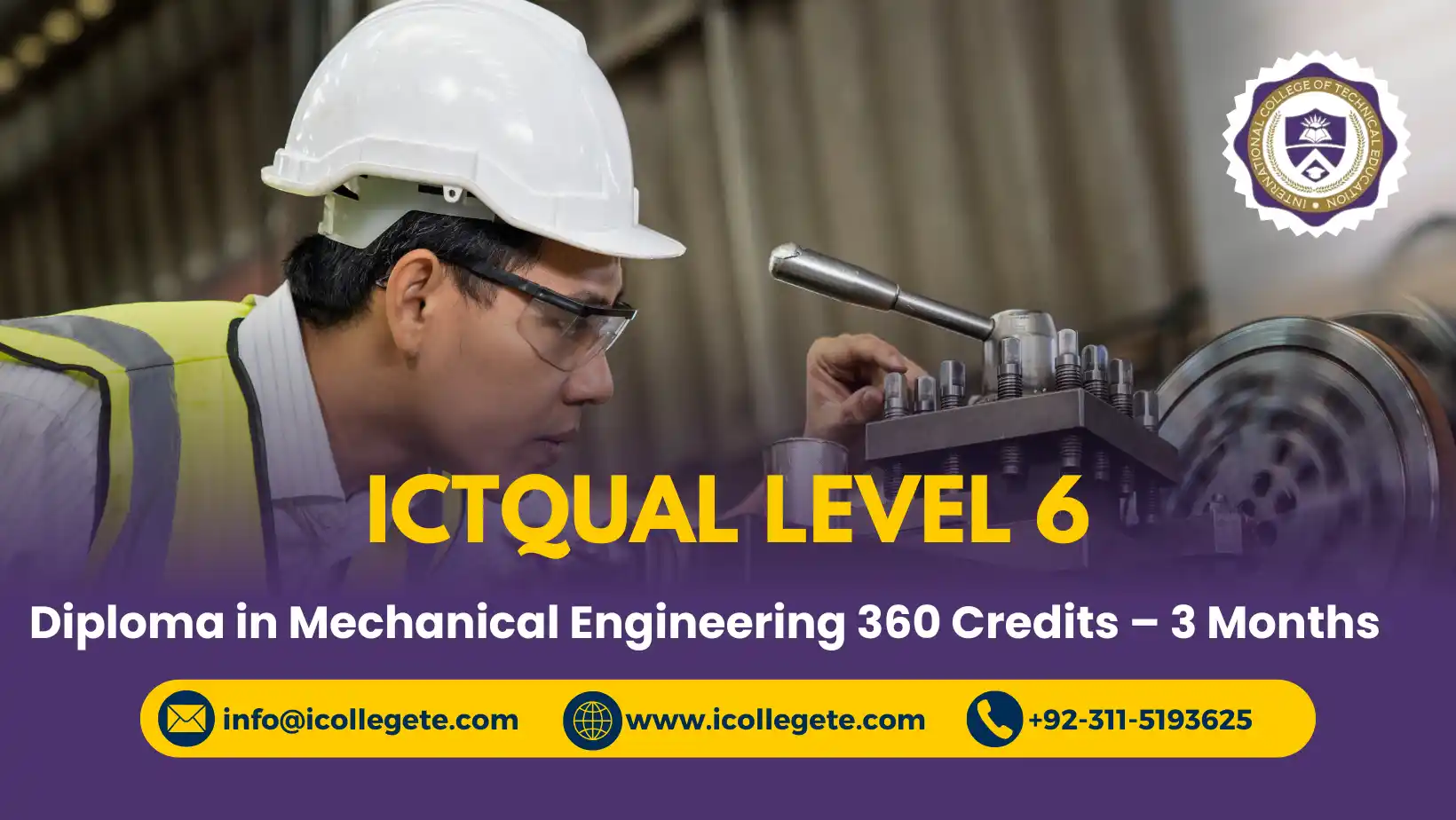
The ICTQual Level 6 Diploma in Mechanical Engineering (360 Credits – Three Years) is a comprehensive and industry-focused qualification designed to develop advanced technical knowledge and professional engineering skills. This program provides learners with a strong foundation in mechanical engineering principles, including design, manufacturing, maintenance, and modern engineering technologies. It prepares students to meet the growing demands of the engineering sector by combining theoretical knowledge with practical applications.
Throughout the three-year program, learners gain in-depth understanding of key mechanical engineering areas such as thermodynamics, fluid mechanics, materials engineering, mechanical design, and production systems. The course emphasizes problem-solving, innovation, and technical analysis, enabling students to confidently handle real-world engineering challenges. With a curriculum aligned to international standards, students develop the competencies required to work effectively in industrial and engineering environments.
The ICTQual Level 6 Diploma in Mechanical Engineering is ideal for individuals who want to build a successful career in the mechanical engineering field or progress to higher-level engineering studies. Graduates of this program can pursue opportunities in manufacturing industries, construction projects, maintenance engineering, and technical consultancy. By completing this qualification, learners gain the knowledge, practical skills, and professional confidence needed to succeed in today’s competitive engineering industry.
Year 1: Foundation and Core Engineering Principles
- Mathematics for Engineering
- Engineering Principles
- Materials Science and Engineering
- Engineering Drawing and CAD
- Statics and Dynamics
- Introduction to Thermodynamics
- Manufacturing Processes
- Fluid Mechanics
- Electrical and Electronic Systems for Engineers
- Engineering Mathematics for Design
- Mechanical Design Fundamentals
- Engineering Project Management
Year 2: Advanced Engineering Concepts and Applications
- Advanced Thermodynamics
- Strength of Materials
- Heat Transfer and Fluid Dynamics
- Advanced Manufacturing Techniques
- Mechanical Vibrations and Acoustics
- Engineering Dynamics and Control
- Design and Analysis of Machine Elements
- Control Systems for Mechanical Engineering
- Engineering Materials and Failure Analysis
- Computer-Aided Engineering (CAE)
- Mechanical System Design
- Project Planning and Cost Estimation
Year 3: Specialization and Practical Application
- Advanced Mechanical System Design
- Energy Systems and Sustainability
- Advanced CAD and 3D Modeling
- Finite Element Analysis (FEA) for Mechanical Engineers
- Advanced Manufacturing and Robotics
- Mechatronics and Automation
- Engineering Research Methodology
- Industrial Engineering and Process Optimization
- Design for Manufacturability
- Professional Practice in Mechanical Engineering
- Engineering Innovation and Entrepreneurship
- Capstone Project/Thesis
Upon successful completion of this qualification, learners will demonstrate advanced knowledge and practical competence in mechanical engineering principles and applications.
Year 1: Foundation and Core Engineering Principles
Mathematics for Engineering
Develop proficiency in fundamental mathematical techniques used to solve engineering problems. Apply calculus, algebra, and trigonometry in engineering contexts.
Engineering Principles
Understand and apply core engineering concepts including forces, motion, and energy. Build a strong foundation in engineering mechanics and systems.
Materials Science and Engineering
Gain knowledge of the properties and behavior of materials used in mechanical engineering. Analyze material selection and performance in engineering applications.
Engineering Drawing and CAD
Learn to create and interpret professional engineering drawings. Develop practical skills in Computer-Aided Design (CAD) for modeling mechanical systems.
Statics and Dynamics
Apply the principles of static and dynamic analysis to engineering problems. Analyze forces and motion in mechanical systems.
Introduction to Thermodynamics
Understand the fundamental laws of thermodynamics and their engineering applications. Study energy transfer and transformation in mechanical systems.
Manufacturing Processes
Learn key manufacturing methods used in producing mechanical components. Understand processes such as casting, machining, and welding.
Fluid Mechanics
Understand the properties and behavior of fluids and fluid flow. Apply fluid mechanics principles to practical engineering problems.
Electrical and Electronic Systems for Engineers
Develop an understanding of basic electrical circuits and components. Learn how electrical systems integrate with mechanical engineering applications.
Engineering Mathematics for Design
Apply mathematical methods to solve mechanical engineering design problems. Use advanced calculations to model and analyze mechanical systems.
Mechanical Design Fundamentals
Understand the core principles of mechanical design, including material selection and stress analysis. Develop skills in designing mechanical components and systems.
Engineering Project Management
Learn essential project management skills including planning, risk management, and resource allocation. Understand how to manage engineering projects effectively.
Year 2: Advanced Engineering Concepts and Applications
Advanced Thermodynamics
Develop deeper knowledge of thermodynamic cycles, efficiency, and energy systems. Apply thermodynamic principles to engineering analysis and design.
Strength of Materials
Analyze the strength and deformation of materials under various loading conditions. Study stress, strain, and failure in engineering materials.
Heat Transfer and Fluid Dynamics
Understand mechanisms of heat transfer and fluid flow in mechanical systems. Apply these concepts to solve complex engineering problems.
Advanced Manufacturing Techniques
Study advanced manufacturing technologies such as CNC machining, additive manufacturing, and robotics. Understand their industrial applications and limitations.
Mechanical Vibrations and Acoustics
Analyze vibration and resonance in mechanical systems. Apply acoustic principles to control noise and vibration.
Engineering Dynamics and Control
Understand the behavior of dynamic systems and control theory. Model and control mechanical systems for improved performance.
Design and Analysis of Machine Elements
Design and analyze machine elements including gears, shafts, and bearings. Understand their performance and operational principles.
Control Systems for Mechanical Engineering
Apply control theory to mechanical systems including feedback and system stability. Design efficient control systems for engineering applications.
Engineering Materials and Failure Analysis
Study material failure mechanisms such as fatigue, fracture, and corrosion. Apply failure analysis to improve reliability of mechanical systems.
Computer-Aided Engineering (CAE)
Develop skills in engineering simulation and analysis tools. Apply Finite Element Analysis (FEA) and Computational Fluid Dynamics (CFD).
Mechanical System Design
Design and optimize mechanical systems based on performance, safety, and cost considerations. Solve real engineering design challenges.
Project Planning and Cost Estimation
Learn cost estimation techniques and project planning methods. Manage engineering projects with effective budgeting and scheduling.
Year 3: Specialization and Practical Application
Advanced Mechanical System Design
Apply advanced design techniques to develop complex mechanical systems. Optimize designs for performance and efficiency.
Energy Systems and Sustainability
Study renewable energy technologies and sustainable engineering practices. Design energy-efficient and environmentally responsible systems.
Advanced CAD and 3D Modeling
Master advanced CAD software for 3D modeling and simulation. Create detailed prototypes and engineering designs.
Finite Element Analysis (FEA) for Mechanical Engineers
Use FEA techniques to analyze and optimize mechanical structures. Solve complex problems involving stress and deformation.
Advanced Manufacturing and Robotics
Explore advanced manufacturing technologies and robotics integration. Apply automation in modern production systems.
Mechatronics and Automation
Study the integration of mechanical systems, electronics, and control technologies. Design automated mechatronic systems for industrial use.
Engineering Research Methodology
Develop research skills for investigating engineering problems. Conduct experiments, analyze data, and present technical findings.
Industrial Engineering and Process Optimization
Apply industrial engineering principles to improve production efficiency. Optimize workflows and manufacturing processes.
Design for Manufacturability
Learn to design products that are easy and cost-effective to manufacture. Improve production efficiency through optimized design.
Professional Practice in Mechanical Engineering
Understand ethical, professional, and regulatory responsibilities of engineers. Develop effective communication and workplace skills.
Engineering Innovation and Entrepreneurship
Explore innovation opportunities within the engineering sector. Develop skills to commercialize engineering ideas and products.
Capstone Project / Thesis
Complete a comprehensive engineering project or research thesis. Demonstrate the ability to solve real-world engineering problems and present results professionally.
This course provides learners with advanced technical knowledge and practical skills required in modern mechanical engineering industries.
1. Advanced Technical Expertise
- Master complex mechanical systems and engineering design principles.
- Gain advanced knowledge in thermodynamics, hydraulics, pneumatics, and automation.
- Develop skills in advanced fabrication, maintenance, and quality control.
- Apply problem-solving techniques to high-level engineering challenges.
2. Practical Industry Experience
- Hands-on training with industry-standard tools, machinery, and software.
- Conduct real-world projects and practical assessments.
- Implement engineering solutions efficiently and safely.
- Build competence in troubleshooting complex mechanical systems.
3. Leadership & Management Skills
- Develop supervisory and team management capabilities.
- Learn project planning, execution, and resource management.
- Enhance strategic decision-making and problem-solving abilities.
4. Career Advancement Opportunities
- Prepare for senior engineering, supervisory, and managerial roles.
- Enhance employability in industrial, manufacturing, and engineering sectors.
- Strengthen your profile with an internationally recognized Level 6 diploma.
5. Industry Readiness
- Gain skills applicable to advanced mechanical, industrial, and technical roles.
- Build confidence to manage complex projects and teams.
- Ensure compliance with industry standards and workplace safety regulations.
This course is designed for professionals seeking to advance their mechanical engineering expertise, take on senior roles, and develop leadership skills in industrial and technical projects.
- Level 5 Diploma Graduates: Learners progressing from Level 5 Mechanical Engineering or equivalent qualifications.
- Senior Technicians & Engineers: Professionals seeking to advance into leadership or managerial roles.
- Apprentices & Trainees: Individuals wishing to formalize practical experience into an internationally recognized diploma.
- Career Changers: Professionals from related technical or industrial fields seeking advanced specialization.
- Workshop & Industrial Supervisors: Staff aiming to strengthen technical knowledge and team management capabilities.