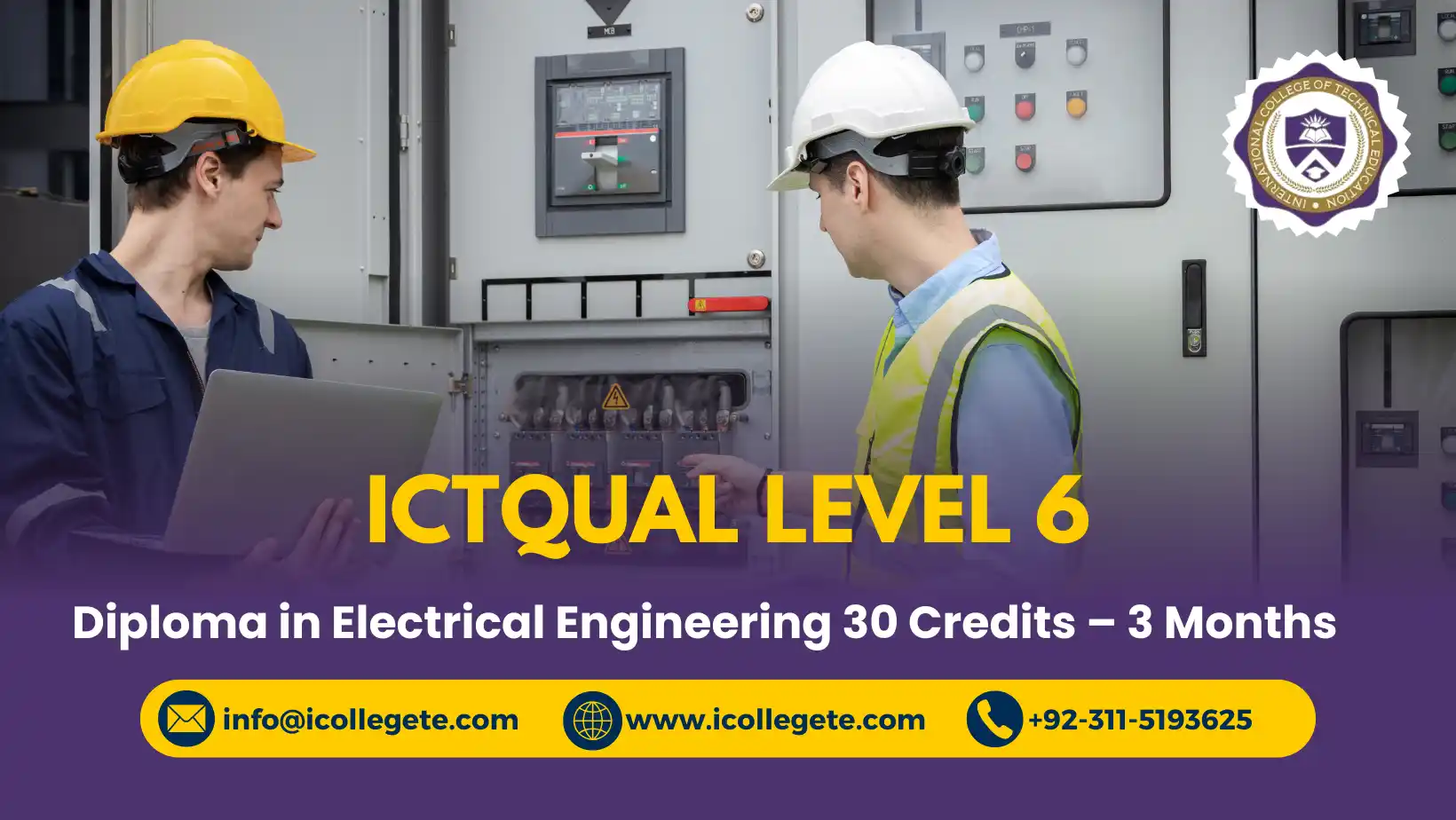
The ICTQual Level 6 Diploma in Electrical Engineering (360 Credits – Three Years) is a comprehensive program designed to provide learners with advanced knowledge and practical expertise in electrical engineering. This diploma is structured to cover essential concepts, technical skills, and industry applications, preparing students to meet the growing demands of modern engineering sectors. With a strong focus on both theoretical foundations and hands‑on practice, learners will gain the confidence to work on complex electrical systems and contribute effectively to industrial projects.
Throughout the three‑year program, students will explore a wide range of topics including electrical circuits, power systems, electronics, control systems, and renewable energy technologies. The curriculum is carefully designed to balance academic learning with practical training, ensuring graduates are equipped with the skills required to solve real‑world engineering challenges. By engaging with industry‑relevant projects and case studies, learners will develop problem‑solving abilities and technical competence that align with global standards.
This diploma is ideal for individuals seeking to build a career in electrical engineering or progress into higher academic qualifications. By completing the ICTQual Level 6 Diploma, learners will not only enhance their employability but also gain recognition as skilled professionals capable of contributing to innovation, sustainability, and technological advancement in the electrical engineering field.
Year 1: Foundational Knowledge
- Engineering Mathematics I
- Fundamentals of Electrical Circuits
- Principles of Electronics
- Digital Logic Design
- Electrical Machines and Transformers
- Introduction to Control Systems
- Engineering Drawing and CAD
- Introduction to Microprocessors and Microcontrollers
- Electrical Measurement and Instrumentation
- Physics for Engineers
- Health and Safety in Engineering
- Sustainability in Electrical Engineering
Year 2: Intermediate Proficiency
- Engineering Mathematics II
- Power Systems Analysis
- Analog Electronics
- Embedded Systems and Applications
- Electrical Energy Systems
- Signals and Systems
- Principles of Automation and Robotics
- Industrial Electronics
- Communication Systems Engineering
- Renewable Energy Technologies
- Electrical Project Management
- Technical Report Writing and Research Methods
Year 3: Advanced Specialization and Application
- Advanced Power Electronics
- Smart Grid Technology
- Electrical Machine Design
- Advanced Control Systems
- High Voltage Engineering
- Instrumentation and Process Control
- Advanced Embedded Systems
- Energy Storage and Conversion Systems
- Wireless and Optical Communication
- Electromagnetic Compatibility
- Capstone Project
- Professional Development and Ethical Practices
The ICTQual Level 6 Diploma in Electrical Engineering (360 Credits – Three Years) is designed to develop advanced technical knowledge and practical engineering skills required in modern electrical industries.
Year 1: Foundational Knowledge
Engineering Mathematics I
- Apply fundamental mathematical concepts such as calculus, algebra, and trigonometry to solve engineering problems.
- Utilize mathematical tools to model and analyze simple electrical and electronic systems.
Fundamentals of Electrical Circuits
- Analyze electrical circuits using basic laws and theorems, such as Ohm’s Law and Kirchhoff’s Laws.
- Design and simulate basic electrical circuits for practical applications.
Principles of Electronics
- Understand the operation of basic electronic components such as diodes and transistors.
- Apply principles of electronics to design simple amplifiers and rectifiers.
Digital Logic Design
- Develop logic circuits using combinational and sequential design techniques.
- Use truth tables and Karnaugh maps to simplify and optimize digital circuits.
Electrical Machines and Transformers
- Explain the working principles of electrical machines and transformers.
- Perform calculations to determine the performance parameters of these devices.
Introduction to Control Systems
- Understand the fundamental concepts of control systems, including feedback and stability.
- Design simple control systems using proportional, integral, and derivative (PID) controllers.
Engineering Drawing and CAD
- Create accurate engineering drawings using traditional and computer-aided design (CAD) tools.
- Interpret and produce technical drawings for electrical and electronic components.
Introduction to Microprocessors and Microcontrollers
- Understand the architecture and operation of microprocessors and microcontrollers.
- Develop basic programs to control hardware systems using microcontrollers.
Electrical Measurement and Instrumentation
- Use measurement tools and instruments to quantify electrical parameters like voltage, current, and resistance.
- Evaluate the accuracy and reliability of electrical measurement systems.
Physics for Engineers
- Apply fundamental physics concepts, such as electromagnetism and mechanics, to engineering scenarios.
- Solve problems involving energy, force, and motion in electrical systems.
Health and Safety in Engineering
- Identify potential hazards in engineering environments and implement appropriate safety measures.
- Understand and comply with health and safety regulations in engineering practice.
Sustainability in Electrical Engineering
- Evaluate the environmental impact of electrical engineering solutions and processes.
- Incorporate sustainable practices and energy-efficient designs into engineering projects.
Year 2: Intermediate Proficiency
Engineering Mathematics II
- Apply advanced mathematical methods, such as differential equations and complex numbers, to solve engineering problems.
- Use numerical techniques to analyze electrical and electronic systems.
Power Systems Analysis
- Analyze power generation, transmission, and distribution systems.
- Use computational tools to evaluate the performance and stability of power systems.
Analog Electronics
- Design and analyze analog circuits, including oscillators and amplifiers.
- Understand the operation of integrated circuits in practical applications.
Embedded Systems and Applications
- Design and program embedded systems for specific applications.
- Integrate hardware and software components for efficient system operation.
Electrical Energy Systems
- Understand the principles of electrical energy generation, conversion, and distribution.
- Evaluate the performance and efficiency of different energy systems.
Signals and Systems
- Analyze signals and their transformations in time and frequency domains.
- Design and implement basic signal processing techniques.
Principles of Automation and Robotics
- Understand the fundamentals of automation and robotic systems.
- Design and simulate simple robotic systems using basic control techniques.
Industrial Electronics
- Design and analyze circuits used in industrial applications, such as power electronics and drives.
- Understand the role of electronic systems in industrial automation.
Communication Systems Engineering
- Understand the principles of analog and digital communication systems.
- Analyze the performance of communication systems under different conditions.
Renewable Energy Technologies
- Evaluate the working principles and applications of renewable energy systems.
- Design basic renewable energy solutions, such as solar and wind power systems.
Electrical Project Management
- Plan and manage electrical engineering projects, including resource allocation and scheduling.
- Apply project management tools to ensure successful project completion.
Technical Report Writing and Research Methods
- Develop technical writing skills for documenting research and project findings.
- Use research methods to solve engineering problems and present results effectively.
Year 3: Advanced Specialization and Application
Advanced Power Electronics
- Design and analyze advanced power electronic converters and systems.
- Understand the applications of power electronics in renewable energy and industrial automation.
Smart Grid Technology
- Analyze the components and functionality of smart grid systems.
- Develop solutions for integrating renewable energy sources into the smart grid.
Electrical Machine Design
- Apply design principles to develop efficient and reliable electrical machines.
- Evaluate the performance of machine designs under different operating conditions.
Advanced Control Systems
- Design and implement advanced control strategies for dynamic systems.
- Use computational tools to simulate and optimize control system performance.
High Voltage Engineering
- Understand the principles of high voltage generation and insulation.
- Analyze the behavior of high voltage systems under various conditions.
Instrumentation and Process Control
- Design and implement advanced instrumentation systems for industrial applications.
- Apply process control techniques to maintain system stability and efficiency.
Advanced Embedded Systems
- Develop complex embedded systems using advanced programming and hardware techniques.
- Integrate sensors and actuators for real-time control applications.
Energy Storage and Conversion Systems
- Evaluate the performance of energy storage technologies, such as batteries and supercapacitors.
- Design systems for efficient energy storage and conversion.
Wireless and Optical Communication
- Understand the principles and technologies behind wireless and optical communication systems.
- Analyze the performance of communication systems in different environments.
Electromagnetic Compatibility
- Identify and mitigate electromagnetic interference in electrical and electronic systems.
- Design systems to meet electromagnetic compatibility standards.
Capstone Project
- Apply theoretical and practical knowledge to design and implement a comprehensive engineering project.
- Demonstrate project management, teamwork, and problem-solving skills.
Professional Development and Ethical Practices
- Understand the ethical responsibilities of an electrical engineer and the importance of professionalism.
- Develop strategies for continuous learning and career growth in the engineering field.
The ICTQual Level 6 Diploma in Electrical Engineering (360 Credits – Three Years) offers learners the opportunity to gain advanced technical knowledge and practical engineering skills required in the modern electrical industry.
Strong Technical Foundation
- Develop a deep understanding of electrical engineering principles and technologies.
- Learn about power systems, electronics, and electrical installations.
- Strengthen analytical and technical problem-solving abilities.
Practical Industry Skills
- Gain hands-on experience with modern electrical tools and systems.
- Apply engineering knowledge to real-world technical projects.
- Improve troubleshooting and system design skills.
Career Advancement Opportunities
- Enhance employability in electrical and engineering industries.
- Prepare for roles such as electrical technician, engineer, or supervisor.
- Build a pathway toward higher education and professional development.
Industry-Relevant Knowledge
- Learn according to current industry standards and best practices.
- Understand safety regulations and electrical compliance requirements.
- Develop skills aligned with modern engineering demands.
The ICTQual Level 6 Diploma in Electrical Engineering (360 Credits – Three Years) is suitable for individuals who want to build a strong career in electrical engineering and develop advanced technical skills.
- Level 5 Diploma Graduates: Learners progressing from Level 5 Mechanical Engineering or equivalent qualifications.
- Experienced Mechanical Technicians & Engineers: Professionals aiming for senior technical or supervisory roles.
- Career Changers: Individuals from related technical fields seeking in-depth knowledge in mechanical systems.
- Industrial & Workshop Supervisors: Staff looking to enhance their skills, manage projects, and lead engineering teams.