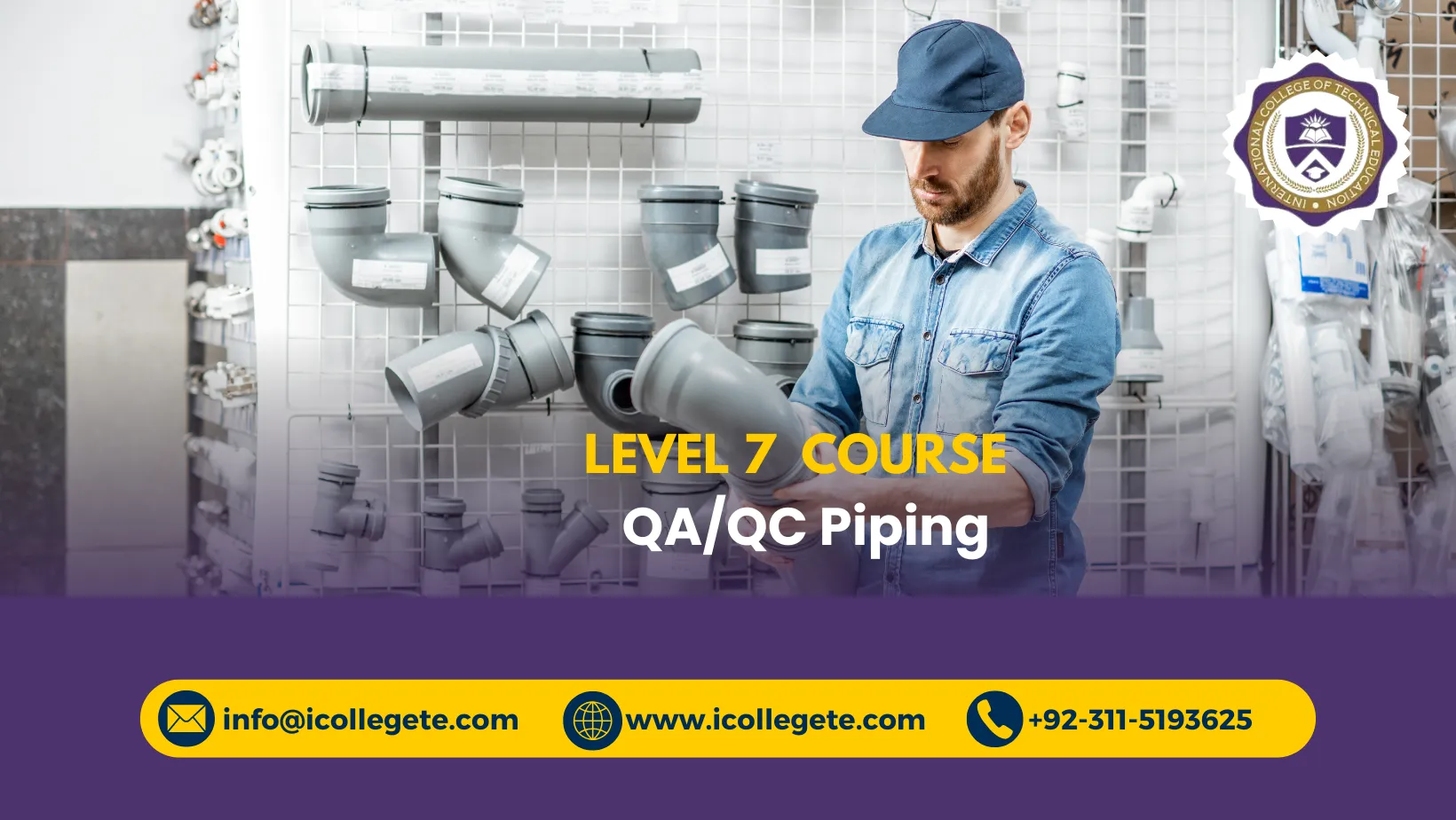
Step into the world of industrial precision and quality assurance with the QA/QC Piping Level 7 Course in Rawalpindi—a specialized training program designed for individuals aiming to master piping inspection, welding standards, and quality control procedures in oil, gas, and construction sectors. QA/QC Piping level 7 Course in Rawalpindi equips learners with the technical expertise required to ensure compliance, safety, and performance in piping systems across major industrial projects.
Structured to meet international QA/QC standards, the QA/QC Piping level 7 Course in Rawalpindi covers essential topics such as piping codes, welding inspection, NDT techniques, material verification, and documentation protocols. Learners gain hands-on exposure to real-world scenarios, enabling them to interpret isometric drawings, conduct visual inspections, and manage quality records with confidence and accuracy.
Ideal for engineers, technicians, and professionals seeking career advancement, the QA/QC Piping Level 7 Course in Rawalpindi offers a pathway to high-demand roles in quality assurance, site inspection, and project supervision. The QA/QC Piping level 7 Course in Rawalpindi is tailored to meet the evolving needs of Pakistan’s industrial landscape, with a focus on both local and international job markets.
Delivered through expert-led sessions and practical workshops, this course ensures that participants are not only certified but also industry-ready. Upon completion of QA/QC Piping level 7 Course in Rawalpindi, learners receive a recognized qualification that enhances their employability and prepares them for leadership roles in quality control and piping inspection. QA/QC Piping level 7 Course in Rawalpindi is your opportunity to build a career rooted in precision, safety, and global standards.
Course Overview
The QA/QC Piping Level 7 Course in Rawalpindi is a professional-level training program designed to build advanced competencies in piping inspection and quality control. As a Level 7 course, QA/QC Piping level 7 Course in Rawalpindi caters to learners who are ready to engage with complex industrial standards, inspection protocols, and compliance frameworks used across oil, gas, and infrastructure projects. The curriculum is structured to meet global expectations, making QA/QC Piping level 7 Course in Rawalpindi suitable for individuals seeking technical mastery and career mobility in high-demand sectors.
QA/QC Piping level 7 Course in Rawalpindi is divided into six focused study units, each addressing a critical area of piping QA/QC. Learners explore topics such as welding procedure specifications (WPS), piping material identification, non-destructive testing (NDT) methods, inspection documentation, code interpretation, and site quality audits. These units are designed to provide both theoretical grounding and practical application, ensuring that participants can confidently perform inspections, verify compliance, and manage quality records in real-world environments. The modular format allows learners to build expertise progressively, with each unit reinforcing the next.
Unlike general engineering programs, QA/QC Piping level 7 Course in Rawalpindi emphasizes precision, accountability, and field-readiness. It prepares learners to work in multidisciplinary teams, interpret technical drawings, and uphold safety standards in industrial settings. Whether you’re aiming to work on refinery pipelines, construction sites, or fabrication yards, the QA/QC Piping Level 7 Course offers a direct path to specialized roles in quality assurance and inspection. With its targeted structure and industry-aligned content, it stands out as a practical and career-focused qualification for professionals in Rawalpindi and beyond.
Course Study Units
- Piping Codes, Standards, and Specifications
- Welding Inspection and Procedure Qualification (WPS/PQR/WQT)
- Non-Destructive Testing (NDT) Methods and Applications
- Material Identification and Traceability in Piping Systems
- Inspection Documentation and Quality Control Records
- Site Quality Audits and Compliance Verification
Learning Outcomes for this course
Understanding Piping Standards and Specifications
- Interpret international piping codes such as ASME, ASTM, and API
- Understand the classification and application of piping materials
- Identify the role of specifications in quality assurance and compliance
- Apply standards to real-world inspection scenarios
- Recognize deviations and non-conformities in piping systems
- Ensure documentation aligns with project and regulatory requirements
- Support engineering teams with accurate specification reviews
Mastery of Welding Inspection Procedures
- Understand welding symbols, joints, and techniques used in piping systems
- Evaluate welding procedure specifications (WPS), PQR, and welder qualifications
- Conduct visual inspections of welds for defects and compliance
- Monitor welding activities for adherence to quality standards
- Document welding inspections and maintain traceability records
- Collaborate with welding teams to resolve quality issues
- Apply acceptance criteria based on project codes and standards
Application of Non-Destructive Testing (NDT)
- Identify appropriate NDT methods for piping inspection (RT, UT, PT, MT)
- Understand the principles and limitations of each NDT technique
- Coordinate with certified NDT technicians during inspection phases
- Interpret NDT reports and integrate findings into QA documentation
- Ensure NDT procedures comply with safety and regulatory standards
- Support decision-making based on test results and defect analysis
- Maintain records of NDT activities for audit and review
Material Verification and Traceability
- Verify piping materials against purchase orders and specifications
- Understand heat numbers, batch codes, and mill test certificates
- Maintain traceability from material receipt to installation
- Identify and segregate non-compliant materials
- Document material inspections and approvals
- Support warehouse and site teams in material handling
- Ensure compliance with project-specific material requirements
Inspection Documentation and Reporting
- Prepare inspection test plans (ITPs) and checklists for piping activities
- Record inspection results with accuracy and clarity
- Maintain logs of site inspections, NCRs, and corrective actions
- Compile quality dossiers for project handover
- Communicate findings to QA managers and site supervisors
- Support audits with complete and organized documentation
- Ensure timely submission of reports to stakeholders
Site Quality Audits and Compliance Monitoring
- Conduct internal audits of piping activities and QA processes
- Identify gaps in compliance and recommend corrective actions
- Monitor contractor performance against quality benchmarks
- Participate in third-party and client audits
- Ensure site practices align with approved procedures
- Promote continuous improvement in quality systems
- Support project close-out with final audit documentation
Entry Requirements for this course
- Age Requirement Applicants must be at least 18 years old to enroll. This ensures they possess the maturity and legal eligibility required for industrial training and certification.
- Educational Qualification Minimum education required is intermediate (12th grade). Candidates with diplomas or degrees in mechanical, civil, or industrial engineering will benefit most from the technical content.
- Work Experience No prior experience is mandatory, but individuals with 1–2 years in construction, fabrication, or inspection roles will find the course easier to relate to and apply in field settings.
- Language Proficiency Basic understanding of English is required, as course materials and industry documentation often use international terminology. Urdu support may be available during sessions.
- Technical Familiarity Applicants should have basic knowledge of engineering drawings and site operations. Familiarity with tools, measurements, and safety protocols will enhance learning outcomes.
- Identification Documents A valid CNIC or passport copy is required for registration and certification. This ensures proper record-keeping and eligibility verification.
- Attendance Commitment Learners must commit to attending all sessions and completing assessments. Full participation is essential for certification and practical skill development.
Course Benefits of this course
Industry-Recognized Certification
- Earn a professional certificate aligned with international QA/QC standards
- Strengthen your resume with a qualification valued by employers in oil, gas, and construction
- Increase credibility when applying for inspection and quality control roles
- Meet global expectations for piping QA/QC professionals
- Improve your chances of selection in competitive industrial job markets
- Align your profile with ISO and ASME compliance benchmarks
- Build trust with clients, contractors, and project managers
- Open doors to domestic and overseas employment opportunities
- Support long-term career growth in technical inspection fields
Career Advancement Opportunities
- Qualify for roles such as piping inspector, QA/QC technician, or site auditor
- Become eligible for supervisory positions in quality control departments
- Improve salary potential in industrial and engineering sectors
- Transition into project quality management roles
- Build a foundation for advanced certifications in welding and NDT
- Stand out in interviews with specialized QA/QC knowledge
- Explore freelance inspection and consultancy opportunities
- Strengthen leadership and documentation skills
- Demonstrate initiative in quality assurance environments
Practical Field Inspection Skills
- Learn to conduct visual inspections of piping systems and welds
- Understand how to verify materials and traceability records
- Apply inspection procedures to real-world industrial settings
- Use checklists and test plans to ensure compliance
- Identify and report non-conformities with accuracy
- Collaborate with site teams during audits and inspections
- Improve documentation and reporting practices
- Support safety and performance standards on-site
- Reduce errors and improve inspection efficiency
Welding and NDT Proficiency
- Understand welding procedures and qualification standards
- Evaluate WPS, PQR, and welder performance records
- Apply NDT methods such as RT, UT, PT, and MT
- Coordinate with certified NDT technicians during inspections
- Interpret test results and integrate findings into QA reports
- Ensure compliance with welding and testing codes
- Document inspection outcomes for audit and review
- Support defect analysis and corrective action planning
- Enhance safety and reliability of welded joints
Documentation and Compliance Management
- Prepare inspection test plans and quality checklists
- Maintain logs of inspections, NCRs, and corrective actions
- Compile quality dossiers for project handover
- Ensure documentation meets client and regulatory standards
- Support internal and external audits with complete records
- Communicate findings to QA managers and stakeholders
- Improve traceability and accountability in quality systems
- Reduce delays through organized documentation
- Promote transparency in inspection processes
Local and International Job Readiness
- Prepare for roles in construction, fabrication, and oil & gas sectors
- Qualify for positions in multinational engineering firms
- Support infrastructure and industrial projects across Pakistan
- Apply for overseas jobs in Gulf countries and beyond
- Build a career in quality assurance across diverse industries
- Meet employer expectations for field-ready QA/QC professionals
- Gain exposure to international codes and standards
- Improve adaptability in global work environments
- Align with job requirements in high-risk industrial zones
Technical and Analytical Development
- Strengthen your ability to interpret engineering drawings and specifications
- Develop critical thinking for defect identification and resolution
- Improve analytical skills in material verification and compliance
- Learn to assess risks and recommend corrective actions
- Build confidence in decision-making during inspections
- Enhance your understanding of industrial workflows
- Support technical teams with accurate quality insights
- Contribute to continuous improvement initiatives
- Foster a mindset of precision and accountability
Accessible and Structured Learning
- Convenient training location in Rawalpindi for local learners
- Structured curriculum with six focused study units
- Interactive sessions led by experienced QA/QC professionals
- Practical workshops and field-based exercises included
- Urdu language support available for better comprehension
- Easy-to-follow course materials designed for technical learners
- Supportive learning environment for all educational backgrounds
- Affordable fee structure with high career value
- Certification awarded upon successful completion
Personal Growth and Professional Confidence
- Build confidence in handling inspection responsibilities and reporting
- Improve leadership and teamwork capabilities
- Develop professional ethics and accountability in technical roles
- Learn to manage time and quality expectations effectively
- Gain respect from peers, supervisors, and clients
- Become a role model for quality assurance practices
- Strengthen your ability to work under pressure
- Foster continuous learning and career development
- Enhance your influence in industrial quality environments
Contribution to Industrial Safety and Quality
- Promote safe and compliant piping installations
- Support quality-driven project execution and delivery
- Educate teams on inspection protocols and standards
- Encourage responsible material handling and verification
- Influence positive change in site safety culture
- Reduce risks through proactive quality control
- Build networks with QA/QC professionals and engineers
- Contribute to sustainable and efficient industrial practices
- Help shape the future of quality assurance in Pakistan
Who Should Enroll in this course
- Aspiring QA/QC Inspectors Individuals aiming to start a career in quality control and inspection within piping systems will gain foundational and advanced skills essential for field roles.
- Mechanical and Civil Engineering Graduates Fresh graduates from engineering disciplines can enhance their employability by acquiring specialized QA/QC knowledge aligned with industrial standards.
- Site Supervisors and Foremen Professionals already working on construction or fabrication sites can formalize their experience and qualify for inspection and documentation responsibilities.
- Technicians in Oil and Gas Projects Technicians involved in pipeline installation or maintenance will benefit from structured training in inspection protocols and compliance procedures.
- Welding Professionals Seeking Certification Welders and welding supervisors can expand their career options by learning how to evaluate welding procedures and participate in quality audits.
- NDT Assistants and Trainees Individuals working in non-destructive testing roles can deepen their understanding of how NDT integrates with piping QA/QC systems.
- Quality Control Assistants Entry-level QA staff can upgrade their skills to take on more technical responsibilities, including documentation, audits, and material verification.
- Project Engineers and Coordinators Engineers managing industrial projects can benefit from QA/QC training to ensure compliance, reduce rework, and improve project delivery.
- Fabrication Yard Personnel Staff involved in pipe cutting, welding, and assembly can learn how to meet inspection standards and maintain traceability.
- Safety Officers in Industrial Settings Safety professionals can complement their knowledge with QA/QC procedures that directly impact operational safety and compliance.
- Contractors and Subcontractors Individuals managing subcontracted work in piping installations can improve quality outcomes and meet client expectations through formal training.
- Technical Trainers and Educators Vocational instructors and trainers can update their curriculum and teaching methods with current QA/QC practices and standards.
- Professionals Seeking Gulf or Overseas Jobs Candidates preparing for jobs in the Middle East or other international markets will benefit from certification aligned with global QA/QC expectations.
- Government and Utility Sector Employees Staff working in public infrastructure projects can apply QA/QC principles to ensure long-term reliability and safety of piping systems.
- Maintenance and Repair Technicians Professionals responsible for maintaining industrial piping can learn how to inspect and document repairs according to quality standards.
- Industrial Auditors and Compliance Officers Auditors involved in quality and safety reviews can gain deeper insight into piping inspection protocols and documentation requirements.
- Diploma Holders in Technical Fields Individuals with diplomas in mechanical, civil, or industrial technology can specialize further through this advanced-level QA/QC course.
- Construction Managers and Site Leads Managers overseeing large-scale projects can use QA/QC training to improve workflow, reduce errors, and enhance client satisfaction.
- Unemployed Technical Workers Seeking Upskilling Job seekers with technical backgrounds can re-enter the workforce with a recognized qualification that opens doors in inspection and quality control.
- Anyone Passionate About Industrial Quality Systems Individuals with a keen interest in engineering, safety, and compliance will find this course a rewarding entry point into the QA/QC profession.
Future Progression of this course
Progression to Advanced QA/QC Certifications
- Enroll in QA/QC Welding Inspector Certification (CSWIP or AWS-CWI)
- Pursue certification in API 570 (Piping Inspection Code)
- Advance to API 653 (Aboveground Storage Tank Inspector)
- Take API 510 (Pressure Vessel Inspector) certification
- Obtain ISO 9001:2015 Lead Auditor certification
- Specialize in ASNT Level II or III in NDT methods
- Join advanced training in welding metallurgy and failure analysis
- Attend short courses in quality management systems (QMS)
- Build credentials for senior QA/QC roles in industrial projects
Career Growth in Oil and Gas Sector
- Apply for QA/QC Inspector roles in upstream and downstream operations
- Progress to QA/QC Engineer or Senior Inspector positions
- Work on pipeline construction and maintenance projects
- Join shutdown and turnaround inspection teams
- Handle quality documentation for offshore platforms
- Coordinate with EPC contractors on QA/QC compliance
- Support HSE and quality integration on oilfield sites
- Manage inspection teams in refinery or petrochemical plants
- Contribute to quality audits and vendor assessments
Opportunities in Construction and Infrastructure Projects
- Work as a QA/QC Inspector on high-rise and industrial buildings
- Inspect piping systems in HVAC, fire protection, and plumbing installations
- Ensure compliance with construction codes and material standards
- Support quality documentation for government infrastructure projects
- Coordinate with civil and MEP teams on quality issues
- Monitor subcontractor performance and material traceability
- Participate in third-party inspections and client audits
- Train site teams on QA/QC procedures and checklists
- Advance to QA/QC Coordinator or Site Quality Lead roles
Roles in Fabrication and Manufacturing Facilities
- Inspect piping spools and welded assemblies in fabrication shops
- Verify material certificates and heat numbers before production
- Monitor welding activities and dimensional checks
- Ensure compliance with fabrication drawings and tolerances
- Maintain inspection records and quality logs
- Coordinate with production and design teams for quality improvements
- Support ISO and ASME compliance in manufacturing processes
- Conduct internal audits and root cause analysis
- Lead quality teams in workshop environments
Advancement in Non-Destructive Testing (NDT)
- Specialize in advanced NDT techniques like TOFD and Phased Array
- Obtain ASNT Level II or III certification in UT, RT, MT, PT
- Work as an NDT technician or supervisor on industrial projects
- Interpret NDT results and prepare technical reports
- Coordinate with QA/QC teams for defect evaluation
- Support welding and fabrication teams with NDT feedback
- Train junior NDT personnel in field applications
- Ensure safety and compliance in testing environments
- Build a career in third-party inspection and testing services
Freelance and Consultancy Opportunities
- Offer freelance QA/QC inspection services to contractors and EPC firms
- Start a consultancy focused on quality audits and compliance
- Provide training workshops for QA/QC and NDT personnel
- Develop inspection plans and quality manuals for small firms
- Support documentation and certification for ISO and API audits
- Partner with fabrication shops for quality improvement initiatives
- Offer third-party inspection services for local projects
- Build a client base in oil, gas, and construction sectors
- Expand into regional or international consultancy assignments
Roles in Quality Management Systems (QMS)
- Assist in implementing ISO 9001:2015 QMS in industrial organizations
- Monitor internal quality processes and continuous improvement plans
- Conduct internal audits and prepare compliance reports
- Support management reviews and corrective action tracking
- Train staff on quality procedures and documentation standards
- Develop SOPs and inspection checklists for QA departments
- Coordinate with procurement and engineering for quality control
- Ensure alignment with client and regulatory requirements
- Advance to QMS Coordinator or Quality Assurance Officer roles
International Job Market Opportunities
- Apply for QA/QC roles in Gulf countries and Southeast Asia
- Work on international EPC and oilfield projects
- Join multinational construction and engineering firms
- Qualify for shutdown and maintenance contracts abroad
- Meet global standards through recognized certifications
- Gain exposure to diverse codes and inspection practices
- Build a competitive profile for overseas employment
- Network with international QA/QC professionals
- Access long-term contracts with global project developers
Training and Instructional Roles
- Become a QA/QC trainer in technical institutes or training centers
- Conduct workshops on piping inspection and welding standards
- Develop course materials for vocational QA/QC programs
- Mentor junior inspectors and technicians in field practices
- Support curriculum development for industry-aligned training
- Collaborate with educational boards on technical certification programs
- Lead seminars on NDT, welding, and quality documentation
- Train site teams on inspection protocols and safety compliance
- Build a career in industrial education and workforce development
Integration into Project Quality Teams
- Join multidisciplinary project teams as a QA/QC representative
- Coordinate with engineering, procurement, and construction departments
- Monitor quality milestones and inspection schedules
- Support project handover with complete quality documentation
- Participate in client and third-party audits
- Ensure alignment with project specifications and contract requirements
- Lead quality meetings and progress reviews
- Resolve quality issues through root cause analysis
- Contribute to project success through proactive quality control
Conclusion
The QA/QC Piping Level 7 Course in Rawalpindi offers more than a technical credential—QA/QC Piping level 7 Course in Rawalpindi cultivates a mindset of precision, accountability, and systems thinking essential for today’s industrial landscape. In a world where infrastructure integrity and operational safety are non-negotiable, professionals who understand the deeper dynamics of quality control are indispensable.
QA/QC Piping level 7 Course in Rawalpindi empowers learners to move beyond routine inspection tasks and engage with the strategic aspects of quality assurance. QA/QC Piping level 7 Course in Rawalpindi encourages a proactive approach to problem-solving, fosters collaboration across engineering and compliance teams, and instills the discipline required to uphold global standards in high-pressure environments.
What makes QA/QC Piping level 7 Course in Rawalpindi distinct is its ability to bridge the gap between field execution and quality leadership. Participants are not just trained to follow procedures—they’re equipped to evaluate, improve, and lead quality initiatives that directly impact project outcomes. The QA/QC Piping level 7 Course in Rawalpindi nurtures adaptability, technical fluency, and a commitment to continuous improvement—traits that define successful QA/QC professionals.
Whether learners aim to work in fabrication yards, oilfields, or infrastructure projects, QA/QC Piping level 7 Course in Rawalpindi lays the groundwork for meaningful contributions and long-term career resilience. It’s a launchpad for those who see quality not as a checklist, but as a culture—one that protects lives, assets, and reputations across industries. QA/QC Piping level 7 Course in Rawalpindi is where technical skill meets professional purpose.